Many counselors learn about ethics in graduate school by applying formal, step-by-step ethical decision-making models that require counselors to be aware of their values and refrain from imposing personal values that might harm clients. However, in the real world, counselors often make split-second ethical decisions based upon personal values. Values and Ethics in Counseling illustrates the ways in which ethical decisions are values—but more than that, it guides counselors through the process of examining their own values and analyzing how these values impact ethical decision making. Each chapter presents ethical decision making as what it is: a very personal, values-laden process, one that is most effectively illustrated through the real-life stories of counselors at various stages of professional development—from interns to seasoned clinicians—who made value-based decisions. Each story is followed by commentary from the author as well as analysis from the editors to contextualize the material and encourage reflection.
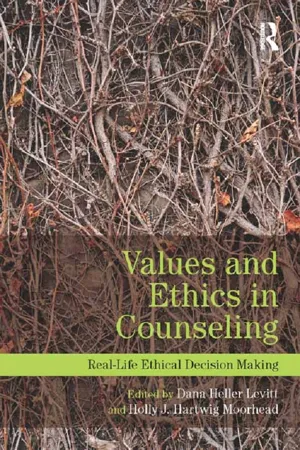
eBook - ePub
Values and Ethics in Counseling
Real-Life Ethical Decision Making
- 248 pages
- English
- ePUB (mobile friendly)
- Available on iOS & Android
eBook - ePub
Values and Ethics in Counseling
Real-Life Ethical Decision Making
About this book
Information
I
Foundations
1
Introduction
Ethics are foundational to our work as helping professionals and guide our decisions regarding best practices and working in the best interests of our clients. Regardless of specific work setting, counselors face ethical dilemmas in their daily work. Counselors must be able to reason ethically through challenging situations and determine the most appropriate course of action that ultimately is in the best interests of clients. This requires counselors to be aware of professional and personal issues influencing their decisions, especially when considering the potentially profound, harmful ramifications to clients, the public at large, counselors, and the counseling profession as a whole when sound ethical judgment is not employed.
The American Counseling Association's (ACA) Code of Ethics (2005) directs counselors regarding professional and ethical practice. However, violations of ethical codes, and more pointedly clients' basic rights, still exist. Nationally, between 2003 and 2011, the ACA Insurance Trust reported that 20% of all complaints pertained to sexual intimacy between counselors and clients (Wheeler & Bertram, 2012). Additionally, a 2001 study by Neukrug, Milliken, and Walden revealed over 2,000 cases of ethical dilemmas in a national sample of credentialed counselors. At the state level, between 2006 and 2007, Ohio's licensing board reported 241 cases of ethics violations among licensed counselors, social workers, and marriage and family therapists, primarily in areas of competence (27%) and boundary violations (14%). These data illustrate a range of ethical misconduct from inappropriate boundaries and multiple relationships between counselors and clients to breaches of confidentiality. When violations occur, professional associations, licensing boards, and credentialing bodies often mandate counselors participate in remediation that can include further ethics training as an alternative to suspending professional licenses and/or memberships. Remedial processes generally focus on helping counselors better understand ethical standards and employ sound ethical decision making. Just as ethics are foundational to the counseling profession, personal values are foundational to individual, and by association, professional decision making. We believe a critical component of ethical practice is examining the role of personal values and beliefs in ethical and unethical behavior, but this analysis is sorely missing from current literature. This is especially problematic as many ethical violations may correspond to counselors making ethics-related decisions based upon personal values rather than, and possibly in conflict with, adherence to professional ethical codes.
Several ethical decision making models (e.g., Corey, Corey, & Callanan, 2007; Forester-Miller & Davis, 1996; Kitchener, 1984; Remley & Herlihy, 2013; Stadler, 1986; Welfel, 2013) have been proposed. While few have been validated, many counselor educators use these models to help emerging counselors understand how professionals arrive at decisions in ethical dilemmas. In fact, many counseling students often gain experience applying such models to hypothetical clinical cases as part of their professional education and preparation. Ethical decision making, relying upon awareness of professional standards and personal moral reasoning, is foundational to understanding general ethical issues and making critical, split-second, sound decisions in the professional arena.
To what degree do counselors follow these stepwise decision making models in practice? The models are important to understanding the process of rendering ethical decisions when time can be suspended. However, from our experience teaching ethics courses within graduate counselor education, supervising counselors, and serving within professional counseling organizations where we have been part of evaluating ethical decisions made by counselors, we have observed that it may be more likely and realistic that counselors rely more on gut instincts, visceral reactions, clinical judgment, and an awareness of ethical and legal guidelines than these stepwise processes. The split-second nature of ethical decisions must be considered in how counselors render decisions, actions counselors take, as well as the outcomes of ethical dilemmas. Counselors often do not have time to fully consider each step of decision making models. As a result, we have seen counselors time and again apply their personal values and belief systems alongside their relative knowledge regarding professional ethical guidelines and expectations. As such, our passion for a values-based look at ethical decision making has evolved.
Part II, the most substantive portion of this book, is devoted to presenting cases counselors have encountered in practice. We asked the authors, counselors from novice to expert levels of experience, to share the processes that were utilized to determine how the ethical dilemmas were handled in the cases they contributed, and to analyze these processes and the outcome of the decisions that were made. The cases illustrate the personal nature of ethical decision making. Some of the resolutions are admittedly flawed, yet we hope you will see the intimate thought processes involved in rendering the decisions. We also provide our own analyses of the cases and discuss the ethical challenges in the counselors’ decision making and how some challenges might be handled from a different standpoint to adhere to ethical guidelines of professional counseling.
We believe that a solid foundation in understanding ethical decision making and the personal values and beliefs that are involved in such decisions better prepare counselors to handle difficult situations and take appropriate, professional, and responsible action. We hope this book will help prevent ethical violations by proactively preparing counselors to understand the intricacies of ethical decision making as a basis for providing competent, ethical, and professional counseling services, specifically by recognizing the impact of personal values upon making ethical decisions. Data clearly demonstrate that despite current, available resources, ethical violations remain prevalent. We systematically examine real-life case examples by critically analyzing how personal values and beliefs affect ethical decision making. Specifically, we analyze the cases from a values perspective rather than an academic and potentially at times prescriptive application of ethical decision making models.
Organization of the Book
The book is organized into three primary parts. In Part I, we lay out the foundations and contextual considerations of ethical decision making. We review morals and moral orientation that underlie decisions that counselors make when faced with ethical challenges. We also explore how personal values intersect with professional counseling. Finally, we discuss the importance of professional counselor identity to ethical counseling practice.
Part II is the heart of the casebook where we present ethical dilemmas that pertain to the eight sections of the ACA Code of Ethics (2005) (i.e., The Counseling Relationship; Confidentiality, Privileged Communication, and Privacy; Professional Responsibility; Relationships With Other Professionals; Evaluations, Assessment, and Interpretation; Supervision, Training, and Teaching; Research and Publication; and, Resolving Ethics Issues). The cases reflect current practice issues encountered by counselors in the field at varying levels of experience. Some counselors work in schools, others in clinical mental health settings, and others as counselor educators and supervisors. The cases have been written by contributors who represent a broad diversity, presenting many cultural perspectives that clearly influence the values-driven approach we advocate in this casebook and illustrating the nature of personal values in ethical decision making throughout one's career. In each case study, the contributors share the counselor's reflections and rationale relative to the ethical decisions that were made and identify relevant sections of the ACA Code of Ethics that apply to the clinical scenarios. Additionally, we provide editors' analyses of the cases, to offer additional perspectives and analyses of the ethical dilemmas, counselor responsibilities in the scenarios according to professional guidelines, and suggested alternative resolutions. We also deconstruct the decision making process to elucidate and appreciate the personal variables that are involved in each case study.
Part III includes application and professional development activities and a values self-assessment. This section includes a review of existing counselor ethical decision making models, intentionally placing this discussion later in the casebook to emphasize the importance of personal self-reflection and decision making over adherence to a specific model or theory. We believe that counselors first should have a better sense of self and what truly matters to them when making clinical decisions and then compare these beliefs and values to established ethical guidelines. Finally, our colleagues, Victoria Kress and Paul Hard, provide perspective into licensure board processes of investigating and adjudicating ethics violations.This section includes a review of existing counselor ethical decision making models, intentionally placing this discussion later in the casebook to emphasize the importance of personal self-reflection and decision making over adherence to a specific model or theory. We believe that counselors first should have a better sense of self and what truly matters to them when making clinical decisions and then compare these beliefs and values to established ethical guidelines. Finally, our colleagues, Victoria Kress and Paul Hard, provide perspective into licensure board processes of investigating and adjudicating ethics violations.
Throughout this casebook, we highlight the very subjective and personal nature of ethical decision making. While codes of ethics and ethical decision making models are valuable in the process, the personal position of the counselor often more realistically dictates the decision making that really occurs in day-to-day counseling practice. We trust that the cases presented will provide readers with thoughtful perspectives on practical and real-life issues in counseling. More importantly, we hope that the insights provided by the contributors' analyses of the cases included in this book will illustrate how counselors at varying levels of experience represent the humility that is critical to counselor self-growth and ethical practice over a career lifetime.
References
American Counseling Association. (2005). Code of ethics. Alexandria, VA: Author.
Corey, G., Corey, M. S., & Callanan, P. (2007). Issues and ethics in the helping professions (7th ed.). Pacific Grove, CA: Brooks/Cole.
Forester-Miller, H., & Davis, T. E. (1996). A practitioner's guide to ethical decision making. Alexandria, VA: American Counseling Association.
Kitchener, K. S. (1984). Intuition, critical-evaluation and ethical principles: The foundations for ethical decision making in counseling psychology. Counseling Psychologist, 12 (3), 43–55.
Neukrug, E., Milliken, T., & Walden, S. (2001). Ethical complaints made against credentialed counselors: An updated survey of state licensing boards. Counselor Education & Supervision, 41(1), 57–70.
Remley, T. P., & Herlihy, B. (2013). Ethical, legal, and professional issues in counseling (4th ed.). Upper Saddle River, NJ: Merrill.
Stadler, H. A. (1986). Making hard choices: Clarifying controversial ethical issues. Counseling and Human Development, 19, 1–10.
Welfel, E. R. (2013). Ethics in counseling and psychotherapy: Standards, research, and emerging issues (5th ed.). Belmont, CA: Brooks/Cole.
Wheeler, A. M., & Bertram, B. (2012). The counselor and the law: A guide to legal and ethical practice (6th ed.). Alexandria, VA: American Counseling Association.
2
Moral Development
Imagine that you are working with your very first client after completing your internship and accepting your first position as a professional counselor. When you meet your client, you notice a personal connection beyond the typical counseling relationship: you appear similar in temperament, many of the client's stories and sense of humor are similar to your own, and you even seem to come from similar family backgrounds. You have been taught throughout your graduate preparation to be objective and not let your personal story get in the way of counseling. You feel you can be objective, but you also sense that had you met this person outside of counseling you might be friends instead of counselor-client. What is a new counselor to do?
The way you respond to this dilemma has a great deal to do with your own sense of what is valuable and right. This may be what you see as most fair and judicious for the client, or perhaps what you think is in the client's best interests for continued care and development. When counselors operate from this highly personal and subjective position, we call upon our sense of morality. Morality serves as a foundation to ethical practice and decision making. Beginning and seasoned counselors alike must identify and explore their values, beliefs, and moral principles much in the same way that we facilitate this process for our clients. Counselors self-reflect to become aware of what is important to them and how that carries over into professional decisions and relationships with clients. In this chapter we will briefly explore moral development as a foundation for ethical decision making. We address Lawrence Kohlberg (1971) and Carol Gilligan's (1982) concepts of moral orientation within this context and explore its relationship to counselor development. We encourage readers to explore the relationship of counselor moral orientation to ethical counseling practice and decision making. Remember that there are no right or wrong answers when it comes to your personal morals and views. Your sense of right or wrong is internally driven from your unique moral foundation.
Moral Development Theories
Questions of moral turpitude arise and are addressed accordingly with one's level of identity development throughout the lifespan. In this way moral development is related to Erikson's theory of ego identity development as well as other cognitive, spiritual, physical, and socio-emotional growth. Erikson believed that individuals face “crises” of development at points along the lifespan. These crises represent primary tasks at each stage and healthy development is described as resolution of each. Although there are limitations to this model (see Hamachek, 1988), the theory provides a lifespan perspective that encompasses decision making and cuts to the very core of personal perspectives from which Kohlberg established his theory. The scope of this chapter l...
Table of contents
- Cover Page
- Half-Title Page
- Title Page
- Copyright Page
- Dedication
- Contents
- Acknowledgements
- Contributors
- Part I: Foundations
- Part II: Professional Issues and Case Analyses
- Part III: Ethics in Context
- Part IV: Conclusion
- Index
Trusted by 375,005 students
Access to over 1.5 million titles for a fair monthly price.
Study more efficiently using our study tools.
Frequently asked questions
Yes, you can cancel anytime from the Subscription tab in your account settings on the Perlego website. Your subscription will stay active until the end of your current billing period. Learn how to cancel your subscription
No, books cannot be downloaded as external files, such as PDFs, for use outside of Perlego. However, you can download books within the Perlego app for offline reading on mobile or tablet. Learn how to download books offline
Perlego offers two plans: Essential and Complete
- Essential is ideal for learners and professionals who enjoy exploring a wide range of subjects. Access the Essential Library with 800,000+ trusted titles and best-sellers across business, personal growth, and the humanities. Includes unlimited reading time and Standard Read Aloud voice.
- Complete: Perfect for advanced learners and researchers needing full, unrestricted access. Unlock 1.5M+ books across hundreds of subjects, including academic and specialized titles. The Complete Plan also includes advanced features like Premium Read Aloud and Research Assistant.
We are an online textbook subscription service, where you can get access to an entire online library for less than the price of a single book per month. With over 1.5 million books across 990+ topics, we’ve got you covered! Learn about our mission
Look out for the read-aloud symbol on your next book to see if you can listen to it. The read-aloud tool reads text aloud for you, highlighting the text as it is being read. You can pause it, speed it up and slow it down. Learn more about Read Aloud
Yes! You can use the Perlego app on both iOS and Android devices to read anytime, anywhere — even offline. Perfect for commutes or when you’re on the go.
Please note we cannot support devices running on iOS 13 and Android 7 or earlier. Learn more about using the app
Please note we cannot support devices running on iOS 13 and Android 7 or earlier. Learn more about using the app
Yes, you can access Values and Ethics in Counseling by Dana Heller Levitt, Holly J. Hartwig Moorhead, Dana Heller Levitt,Holly J. Hartwig Moorhead in PDF and/or ePUB format, as well as other popular books in Psychology & Mental Health in Psychology. We have over 1.5 million books available in our catalogue for you to explore.