Shakespeare in the Present is a stunning collection of essays by Terence Hawkes, which engage with, explain, and explore 'presentism'. Presentism is a critical manoeuvre which uses relevant aspects of the contemporary as a crucial trigger for its investigations. It deliberately begins with the material present and lets that set the interrogative agenda. This book suggests ways in which its principles may be applied to aspects of Shakespeare's plays.
Hawkes concentrates on two main areas in which Presentism impacts on the study of Shakespeare. The first is the concept of 'devolution' in British politics. The second is presentism's commitment to a reversal of conceptual hierarchies such as primary/secondary and past/present, and the interaction between performance and reference. The result is to sophisticate and expand our notion of performing and to refocus interest on what the early modern theatre meant by the activity it termed 'playing'.
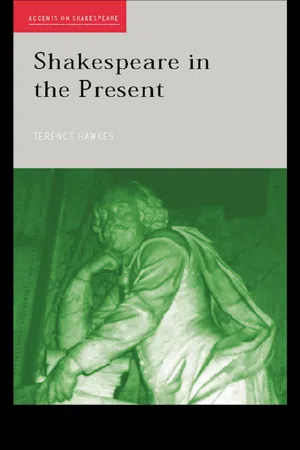
- 176 pages
- English
- ePUB (mobile friendly)
- Available on iOS & Android
eBook - ePub
Shakespeare in the Present
About this book
Information
1
Introduction
Pulling Ranke
This collection of essays doesn’t offer the methodical exposition of a thesis. It’s more a series of short-winded responses to aspects of the changing climate in Shakespeare studies. Currently prominent amongst them is one that urges us to read the plays ‘historically’: to reinsert them into the context in which they first came to be, and on which, it’s said, their intelligibility depends. Our aim for Shakespeare should be to ‘restore Shakespeare’s artistry to the earliest conditions of its realisation . . .’ and to ‘restore his works to the specific imaginative and material circumstances in which they were written and engaged’. Only when we do this, can we hope to confront the Bard’s ‘historical specificity’.1
Of course, if the alternative is to deal with plays in blissful ignorance of their historical context, to impose on them, as many teachers unthinkingly seem to do, some kind of absurd contemporaneity with ourselves, usually justified by windy rhetoric about the Bard’s ‘universality’, then perhaps historical specificity of some sort is an acceptable antidote. However, that kind of artlessness doesn’t seem to be the main target. One of the biggest obstacles to reading Shakespeare historically, says David Kastan, is ‘theory’. Theory’s stress on the critic’s ‘situatedness’ in the present results in a self-regarding focus that irrevocably contaminates any contact with the past. Only if we confront the plays’ texts in terms, not of the critic’s present situation, but of the ‘actual conditions of their production and reception’, stressing both their ‘particularity and contingency’, can we defeat the Bard’s most sinister enemy. Its name is ‘presentism’.2
The principal talisman capable of warding off this spectre is called ‘facts’: facts about specific historical conditions that have determined the reading and writing of literature, facts about the material circumstances of literary production, facts about how books and playscripts were actually produced, sold and received. Retrieved and analysed by the scholar, these facts will lay bare, not the author’s unique meaning, concealed within the text, but the extent to which the text itself speaks of ‘the corporate activities that have brought it into being’.3
All well and good, but – a matter of tone – what does that reiterated ‘restore’ imply? Does it hint at the recovery of a lost purity, of a final arrival at truth-revealing origins, of the Restoration at last of the genuine monarchy of genius, even of a more fundamental confrontation, no longer in a glass, darkly, but now face to face? It’s true that a looming, obtrusive present would certainly blur the outlines of any Grail worth grasping.
And if the aim of historical scholarship were simply to establish ‘how it really was’ – in the words of Leopold von Ranke, wie es eigentlich gewesen – then the present can only be an intervening, distracting fog that needs to be pierced or blown away. But the present’s relation to the past is surely a subtler matter than that. All restorations face one major problem. Reaching backwards, they can’t afford to examine the position in the present from which that manoeuvre is undertaken. As a result, they discount the nature of the choosing and the omission, the selections and suppressions that determine it. Yet to avoid the pitfall by taking one’s present situation fully into account seems inevitably to compromise the project. Genuinely to capture, or repeat, the past is of course fundamentally impossible for a variety of other reasons. In fact, the attempt to do so, an issue discussed in Chapter 8, usually risks an engagement, not with sameness, but with the very motive forces that produce dif- ference. Restoration may aim to be the thief of time, but it’s a notoriously unsuccessful one.
And if the aim of historical scholarship were simply to establish ‘how it really was’ – in the words of Leopold von Ranke, wie es eigentlich gewesen – then the present can only be an intervening, distracting fog that needs to be pierced or blown away. But the present’s relation to the past is surely a subtler matter than that. All restorations face one major problem. Reaching backwards, they can’t afford to examine the position in the present from which that manoeuvre is undertaken. As a result, they discount the nature of the choosing and the omission, the selections and suppressions that determine it. Yet to avoid the pitfall by taking one’s present situation fully into account seems inevitably to compromise the project. Genuinely to capture, or repeat, the past is of course fundamentally impossible for a variety of other reasons. In fact, the attempt to do so, an issue discussed in Chapter 8, usually risks an engagement, not with sameness, but with the very motive forces that produce dif- ference. Restoration may aim to be the thief of time, but it’s a notoriously unsuccessful one.
For none of us can step beyond time. It can’t be drained out of our experience. As a result, the critic’s own ‘situatedness’ does not – cannot – contaminate the past. In effect, it constitutes the only means by which it’s possible to see the past and perhaps comprehend it. And since we can only see the past through the eyes of the present, few serious historians would deny that the one has a major influence on their account of the other. Of course we should read Shakespeare historically. But given that history results from a never-ending dialogue between past and present, how can we decide whose historical circumstances will have priority in that process, Shakespeare’s, or our own?
To reduce history to a series of isolateable, untheorised ‘facts’, or neutrally analysable ‘texts’, is in any case unproductive. Facts do not speak for themselves. Nor do texts. This doesn’t mean that facts or texts don’t exist. It does mean that all of them are capable of genuinely contradictory meanings, none of which has any independent, ‘given’, undeniable, or self-evident status. Indeed, they don’t speak at all unless and until they are inserted into and perceived as part of specific discourses which impose their own shaping requirements and agendas. We choose the facts. We choose the texts. We do the inserting. We do the perceiving. Facts and texts, that is to say, don’t simply speak, don’t merely mean. We speak, we mean, by them.
Living in the present
It’s time to look at presentism again. History is far too important to be left to scholars who believe themselves able to make contact with a past unshaped by their own concerns. All history, said Benedetto Croce, is contemporary history. The present ranks, not as an obstacle to be avoided, nor as a prison to be escaped from. Quite the reverse: it’s a factor actively to be sought out, grasped and perhaps, as a result, understood. If an intrusive, shaping awareness of ourselves, alive and active in our own world, defines us, then it deserves our closest attention. Paying the present that degree of respect might more profitably be judged, not as a ‘mistake’, egregious and insouciant, blandly imposing a tritely modern perspective on whatever texts confront it, but rather as the basis of a critical stance whose engagement with the text is of a particular character. A Shakespeare criticism that takes that on board will not yearn to speak with the dead. It will aim, in the end, to talk to the living.
There are two areas in which presentism seems particularly suited to make a significant contribution to the study of Shakespeare and the following essays attempt to engage with both of them. The first concerns the recent development of ‘devolution’ in British politics. The commitment to parliaments or assemblies in Wales, Scotland and Northern Ireland made in 1997, and realised in 1999, ranks as one of the major constitutional changes of our present, even though its implications have yet fully to be absorbed in the United Kingdom, or indeed grasped by observers from abroad.4 The whole process requires that the ‘Great Britain’ project, chronicled and championed repeatedly in the Shakespearean canon, must henceforth be seen, not just as the opening of a new and apparently permanent world order, but as the beginning of an enterprise that, after four hundred years, has now reached its conclusion.
This cannot help but generate intricate realignments of our responses to a number of Shakespeare’s plays, and I have tried to make that point in my analysis of two of them in Chapters 3 and 4. That texts can never be read after 1999 in quite the same way that they could be read before that date, that their ‘meaning’, now thoroughly suffused with different levels and intensities of irony, seems to change before our eyes, offers a fine example of how the present helps to mould the past. It’s something that the zealous pursuit of wie es eigentlich gewesen not only cannot supply but must, to some extent, obscure.
The second area of potential interest arises from presentism’s crucial investment in the reversal of apparently immutable conceptual hierarchies such as primary/secondary, past/present, discussed in Chapter 2. After all, a fully paid-up presentist will always feel entitled to ask how the influence of Shakespeare on Marx or Freud matches up to the influence of Marx or Freud on Shakespeare. Even Hitler, as Chapter 5 suggests, made an impression on the Bard. Presentism thus finds itself inevitably predisposed to engage sympathetically with those ‘inverting’ tendencies that have lately begun to undermine some of the inherited priorities governing our perception of Shakespeare’s plays. Placing emphasis on the present can’t help but connect fruitfully with the current realignment of critical responses that stresses the performance of a play as much as its ‘reference’: that looks at what the play does, here and now in the theatre, as well as – or even against – what it says in terms of the world to which its written text refers. Presentism thus highlights what has been termed drama’s ‘performative’ function: a feature that always operates concurrently with, and perhaps as a modification of, its referential function. The effect of that realignment is to sophisticate and expand our notion of performing, and to refocus interest on what the early modern theatre meant by the activity it termed ‘playing’.
Playing, as distinct from acting, evidently embraced a far broader spectrum of activity, both on the stage and in the audience, than appears to modern eyes. Our systematic academic privileging of a play’s text over its performance comes to seem, as a result, oddly prejudiced. Chapters 6 and 7 explore that extended and complex sense of the term ‘play’, which, in its fifteenth- and sixteenth-century context, included the vast, unsystematised, and often non-verbal range of communicative traffic always evident in the here-and-now immediacy that binds performer to audience.
Earlier versions of a number of these essays have been published separately, as ideas and the occasions that called them forth developed. Their point of view remains, I hope, nevertheless cohesive, and the ‘essay’ mode, I trust, not entirely inappropriate to the project. If Chapter 2 does to some extent outline a case for a different kind of criticism, the pieces that follow aim, however unsystematically, to justify it. Perhaps, in their diversity, they might even be allowed to mimic as well as probe the disconcerting experience that these days seems an inevitable part of living in the present.
2
The Heimlich Manoeuvre
In custody
We can begin with two eruptions. The first occurs in the middle of Matthew Arnold’s famous essay of 1864, ‘The Function of Criticism At The Present Time’. Arnold has been addressing the linked questions of the true nature of literary criticism on the one hand and the true nature of British national culture on the other. If the first is ever to engage fruitfully with the second, he argues, literary criticism must become a de-politicised ‘absolutely and entirely independent’ activity.
Only then will it be able to confront and finally defeat what he calls the ‘retarding and vulgarizing’ accounts of the current national way of life recently put forward by two home-grown journalist/politicians, Sir Charles Adderley and Mr John Arthur Roebuck.
Then, casting round for an example of something concrete to set against the fatuous self-satisfaction of these apologists, with their cant about ‘our unrivalled happiness’ as members of ‘the old Anglo-Saxon race . . . the best breed in the whole world’, he suddenly quotes – out of the blue – from a newspaper account of a specific criminal case:
A shocking child murder has just been committed at Nottingham. A girl named Wragg left the workhouse there on Saturday morning with her young illegitimate child. The child was soon afterwards found dead on Mapperley Hills, having been strangled. Wragg is in custody.1
The impact of that, even today, is considerable. A nugget of genuine domestic Britishness, the case of Wragg is curiously disturbing at a number of levels. Nomen est omen. The ‘hideous’ name Wragg, Arnold comments, itself challenges the pretensions of ‘our old Anglo-Saxon breed . . . the best in the whole world’ by showing ‘how much that is harsh and ill-favoured’ there is in that best. A literary criticism that ‘serves the cause of perfection’ by insisting on the contrast between pretension and reality in society must begin precisely here, at home. And although Mr Roebuck may not think much of an adversary who ‘replies to his defiant songs of triumph only by murmuring under his breath Wragg is in custody’, in no other way (says Arnold) will these songs of triumph be induced gradually to moderate themselves.2 He doesn’t consider whether Mr Roebuck (nomen est omen indeed) might have been more effectively challenged by the murmuring of what a local newspaper reports to have been Wragg’s own piteous, yet oddly piercing, cry at her trial, setting her present state of custody tellingly against its opposite: ‘I should never have done it if I had had a home for him’.3
Homeboy
Wragg’s is a voice – and a name – that could easily have issued, a generation later, from the depths of T.S. Eliot’s The Waste Land. Like the snatches of conversation about pregnancy and marriage, and the drunken demotic pub-talk of that poem, her words somehow seem to speak from the domestic centre of a culture – indeed they focus on house and ‘home’ – whilst at the same time signalling a fundamental estrangement from it.
In fact the second eruption occurs in a critical essay of T.S. Eliot’s. It is one with a similar purpose to Arnold’s, indicated by its employment of the same title: ‘The Function of Criticism’ (1923). In response partly to the vapourisings of the critic John Middleton Murry, Eliot here also takes up the question of literary criticism and the nature of genuine Englishness. Murry has argued that the latter is to be found vested in something that he terms the ‘inner voice’ of the nation: ‘The English writer, the English divine, the English statesman, inherit no rules from their forebears; they inherit only this: a sense that in the last resort they must depend on the inner voice’.4 Eliot’s sensitivity to the imperatives of tradition, and his carefully honed New England sensibility (perhaps additionally burnished, as befits a recent immigrant, with newly Englished zeal), of course included a positive commitment to an inheritance from forebears. As a result, he immediately recoils from this ‘inner voice’ of Old England. Admitting, coldly, that the statement appears ‘to cover certain cases’, he begins a withering attack:
The inner voice, in fact, sounds remarkably like an old principle which has been formulated by an elder critic in the now familiar phrase of ‘doing as one likes’.
– and then the ice cracks and a most startling and memorable image suddenly erupts:
The possessors of the inner voice ride ten in a compartment to a football match at Swansea, listening to the inner voice, which breathes the eternal message of vanity, fear, and lust.5
Moral revelations vouchsafed in the corridor of a train of the Great Western Railway (as it then was), whilst pulling out of Paddington Station from London en route to Swansea, are no doubt few and far between. But even if they lack the force of holy writ, their impact can apparently be considerable. Faced with what might be called an excluding plenitude of rowdy Englishness, Eliot’s criticism here starts to draw on rhythmic and metaphorical skills developed in the cause of the modernist aesthetic. What suddenly surfaces is nothing less than the nucleus of a kind of imagist poem, something that Ezra Pound characterised as ‘an intellectual and emotional complex in an instant of time’. Characteristically – like Pound’s own famous ‘In a station of the Metro’
The apparition of these faces in the crowd;
Petals on a wet, black bough.
Petals on a wet, black bough.
– it i...
Table of contents
- Cover Page
- Title Page
- Copyright Page
- General Editor’s Preface
- Acknowledgements
- 1. Introduction
- 2. The Heimlich Manoeuvre
- 3. Bryn Glas
- 4. Aberdaugleddyf
- 5. The Old Bill
- 6. Harry Hunks, Superstar
- 7. Hank Cinq
- 8. Conclusion: Speaking to You In English
- Notes
- References
Trusted by 375,005 students
Access to over 1.5 million titles for a fair monthly price.
Study more efficiently using our study tools.
Frequently asked questions
Yes, you can cancel anytime from the Subscription tab in your account settings on the Perlego website. Your subscription will stay active until the end of your current billing period. Learn how to cancel your subscription
No, books cannot be downloaded as external files, such as PDFs, for use outside of Perlego. However, you can download books within the Perlego app for offline reading on mobile or tablet. Learn how to download books offline
Perlego offers two plans: Essential and Complete
- Essential is ideal for learners and professionals who enjoy exploring a wide range of subjects. Access the Essential Library with 800,000+ trusted titles and best-sellers across business, personal growth, and the humanities. Includes unlimited reading time and Standard Read Aloud voice.
- Complete: Perfect for advanced learners and researchers needing full, unrestricted access. Unlock 1.5M+ books across hundreds of subjects, including academic and specialized titles. The Complete Plan also includes advanced features like Premium Read Aloud and Research Assistant.
We are an online textbook subscription service, where you can get access to an entire online library for less than the price of a single book per month. With over 1.5 million books across 990+ topics, we’ve got you covered! Learn about our mission
Look out for the read-aloud symbol on your next book to see if you can listen to it. The read-aloud tool reads text aloud for you, highlighting the text as it is being read. You can pause it, speed it up and slow it down. Learn more about Read Aloud
Yes! You can use the Perlego app on both iOS and Android devices to read anytime, anywhere — even offline. Perfect for commutes or when you’re on the go.
Please note we cannot support devices running on iOS 13 and Android 7 or earlier. Learn more about using the app
Please note we cannot support devices running on iOS 13 and Android 7 or earlier. Learn more about using the app
Yes, you can access Shakespeare in the Present by Terence Hawkes in PDF and/or ePUB format, as well as other popular books in Literature & Literary Criticism. We have over 1.5 million books available in our catalogue for you to explore.