Why and how do music and abstract art pack such universal appeal? Why do they often have 'therapeutic' efficacy?
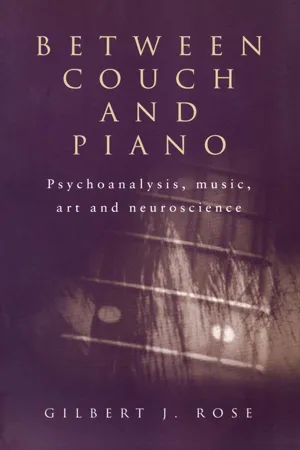
Between Couch and Piano links well-established psychoanalytic ideas with historical and neurological theory to help us begin to understand some of the reasons behind music's ubiquity and power.
Drawing on new psychoanalytic understanding as well as advances in neuroscience, this book sheds light on the role of the arts as stimulus, and as a key to creative awareness. Subjects covered include:
* music in relation to the trauma of loss
* music in connection with wholeness and the sense of identity
* the ability of music to jump-start normal feelings, motion and identity where these have been seemingly destroyed by neurological disease
* the theory of therapeutic efficacy of music and art.
Between Couch and Piano is a comprehensive overview that will be of interest to all those intrigued by the interrelation of psychoanalysis and the creative arts.
www.psychoanalysisarena.com
- 224 pages
- English
- ePUB (mobile friendly)
- Available on iOS & Android
eBook - ePub
About this book
Information
Chapter 1
Between words and music
Where does aesthetic responsiveness arise? A prototype may well lie in the nonverbal emotional rapport and empathy of the earliest infant-parent interplay. Within this matrix are found, too, the rhythmic sing-song and syllables that universally comprise the rudiments of music and words. Reaching further back, there is the interactional synchrony that neonates manifest within twenty minutes of birth: they react to voices with synchronized movements (cited by Benzon, 2001). And still further, since auditory systems become active three to four months before birth, perhaps the fetus becomes entrained to speech patterns in utero. Little is known about any of this.
We know perhaps even less about the continuum between knowing and feeling. Or words and music. We do know that words and music are both rooted in the body. As Freud (1891) made clear in a number of his writings beginning with On Aphasia, every word has been bathed in sensory sources coming from parental speech and intonation. There is no such thing as a disembodied word.
Emboldened by recent neuroscience, it would seem more apparent than ever that cognition and feeling are basically inseparable and not only in infancy. In the course of development and the attrition of daily life they become more differentiated from each other.
It is a common problem of clinical practice to attempt to rejoin them and thereby help restore a sense of inner and outer wholeness without the danger of flooding. The early discovery of transference, then counter-transference, and now an increased sensitivity to intersubjectivity are among the tools in this direction.
As for words and music, words tend to cluster towards the knowing end of the intellect-feeling spectrum; music towards the opposite pole.
Let us begin with clinical technique and then turn to other matters which arguably can be located somewhere in the mid-range between words and music: the difference in how verbal and nonverbal information is registered; the contribution of musical sensitivity to therapeutic communication including predicting suicidality; some bodily correlates of poetry and music; and recent thinking about the neurobiological basis of the sensory qualities of our subjective world. We will return specifically to words and music via one musician’s brave attempt to translate eight bars of music into words – only to demonstrate once again its ineffability within what has been termed the “mysterious leap” between body and mind.
* * *
It is a truism of psychoanalysis that insight without emotional involvement is of little therapeutic value. How can treatment unite thinking and feeling?
The long-established principle is that of “working through.” For however long it takes, one hopes that a new cognitive insight will eventually percolate down toward the depths of one’s affective core; at the same time, the defenses that keep deeper feelings sequestered from mature thought may gradually yield to the emotional constancy of the treatment alliance and tactful, timely interpretations of its transferential distortions.
Alas, life is short and psychoanalysis – perhaps necessarily – long.
In actual practice, experienced therapists find their own guiding principles the better to bridge between abstract theory and the pressing needs of reality.
Here are some of mine.
The arts sensitized me, and clinical experience confirmed, that psychic boundaries are permeable rather than being firm structures. Accomplishing what language does not readily do, the arts subjectify the outer world and objectify the inner; they show that the boundaries of subjectivity and objectivity are more permeable than traditional psychoanalytic theory used to teach. (Think of Munch’s painting of the experience of a kiss as a graphic representation of a meltdown of boundaries. Or the conflation of inner and outer surfaces in a Möbius strip.) They pioneered the insight that there is no immaculate perception without subjective interpretation, no reality without imagination, no thought without feeling. Contemporary neuroscience is adding heft to these principles.
It is useful to think that the constant interplay of imagination and knowledge helps each evolve to higher levels of development and complexity. One does not simply outgrow and abandon earlier forms of imagination and graduate to mature secondary process knowledge of reality. A less simplistic (and less dour) view: the past is an ever-present accompaniment and an only partially accessible resource, supplying the potential for both harmony and dissonance.
A child may outgrow an actual comfort blanket or other transitional object; but much of adult feelingful thinking continues to take place in Winnicott’s (1953) intermediate area. Here a transitional process of continuous interplay of inner and outer (Rose, 1978) in an open system (von Bertalanffy, 1968) reflects the dynamic between a breathing self and a changing reality – each shaping the other to create a unique synchronous totality. It is a minor, everyday version of the creative process bringing novelty to the tired, old familiar and building a bridge to the new and heretofore strange.
Ego boundaries expand and constrict as a person’s need for privacy alternates with the wish to share, be silent as well as communicate, savor distance as well as closeness, regress perhaps to consolidate further before venturing again to progress and explore.
All these dynamic shifts arise out of a field of dynamic forces which may be understood in time. Or not. In the meantime, professional name-calling such as “Resistance!” connotes an adversarial static state and recalls an outdated early era in the history of psychoanalysis.
The therapeutic process may usefully be thought of in terms of music. Music is not about playing notes; music consists of silences that breathe and shape the sound, engendering depths of feeling to be experienced without the necessity for immediate understanding.
As in music, a holding environment based on attunement and stability provides a reliable structure conducive to affect. Unrelieved structure, however, like a blank screen, may degenerate into a shared torpor rather than encouraging the freedom to discover and learn to express affect.
In addition to interpretation, other active measures consistent with objective neutrality and abstinence may well be required to promote affective interaction and keep the process from languishing. Flexible spontaneity and a readiness to improvise are called for, such as introducing discrete doses of controlled dissonance like changes of tempo and rhythm.
All this depends, of course, on the therapist’s own subjectivity: constraints and possibilities inherent in one’s character and humanity, assurance arising from the thoroughness of one’s personal training analysis, an ingrained habit of self-appraisal, and the confidence that accrues from successful clinical experience and learning from one’s mistakes. For the practitioner, the immense good fortune of a full personal life may be nothing less than a mental hygiene necessity.
Flexibility and spontaneity, however much hedged with cautions about respecting traditional parameters of neutrality and abstinence, the constancy of a reliable holding environment, and the necessity for self-appraisal should not be dismissed as mere boilerplate. On the other hand, since nothing short of a handbook of clinical illustrations would be sufficient, I will limit myself to sketching some of the ways I try to connect with a patient’s unverbalized affect – without scrupling too much about whether this is “real analysis” or “just therapy.”
Simply put, I try to discern and speak in the person’s natural language. This includes noting, accommodating and perhaps matching – not aping – phonological features of speech such as tempo, rhythm and volume. Also pertinent are the frequency and quality of silences, accompanying body language, congruity or discrepancy between style and content. I pay particular attention to trying to discover the latently operating metaphors that so often connect content with underlying feeling. All this may happen quickly or take many sessions.
The phonology and metaphors seem closely related to and embodied in much that is nonverbal. As I become comfortable with the style, like attending to a new language and adopting some of it, I frequently notice a mutual unbending taking place. Even the breathing seems easier. These considerations must be closely related to empathy, for it has been noted that adult partners who match their patterns of vocalization and pauses tend to feel more empathically related (Jaffe and Feldstein, 1970: 95–96).
A personal example far removed from professional life comes to mind and may convey what is difficult to express. As a preadolescent I spent some summers on a farm and hung out with the adult son of the owner, who seemed to enjoyed teaching me how to do some of the chores like milking. As a young adult years later I traveled to that part of the country and looked for the farm. It was boarded up and seemingly abandoned. Walking over the fields I saw a man. As we approached each other I called out, “Fred?” He, squinting, replied: “You look kinda natural!”
I often wondered later what went into the homey acknowledgement. Had I unconsciously reverted to an earlier gait, and/or perhaps mirrored his? Was it this whole gestalt, as well as my voice and “tonality” – certainly not my features for I was now grown in total appearance – that had allowed him to recognize me through himself as “kinda natural”?
As in relating this anecdote, as time has gone on I am not shy about using personal examples to illustrate something or make a point if it is apposite. It sets an example of my feeling comfortable and inviting the other to join me. I may also free associate aloud to something the person has said, or has not said, or expressed posturally or in some other nonverbal way. It sets an example of daring to be free even if it risks looking foolish or making a mistake, which I am also ready to admit. An instructor long ago defined doing therapy as: “two people sitting in a room, one is probably anxious, and it better not be you!”
In the ambience that I am describing, humor comes naturally to me. At its best, its use does not detract from always remaining serious if seldom solemn. In the course of time I have refined its use in therapy and have previously discussed it (Rose, 1969). It is an important aspect of my style along with striving to find the right metaphors, being guided largely by nonverbal cues, and using myself as a human instrument to invite a freer affective interchange.
As an example of using myself as an instrument, there are times when ironic self-directed humor emerges spontaneously. This can serve as an inoculation against unhealthy self-importance. It also sets a further example that there be no immunity – myself included – from detached objectivity. When directed towards the other person, it licenses me to be direct without being cruel, as it also counteracts any tendency to infantilize by being overly compassionate and over-identified. When it occasionally misfires, it offers an opportunity for clarification and a yet closer working alliance in which it is clear that I am not above – indeed, I invite – mutual criticism and candor.
* * *
Progress in cognitive psychology has brought a clarifying restatement of the problem of connecting underlying feeling with conscious thinking, if not how to solve it. Instead of feeling versus thinking, it offers a different duality: verbal versus nonverbal information processing. They are encoded and organized in different formats and are stored in separate systems specialized for each type. We turn now to summarizing some of the work of Wilma Bucci (1985, 1997).
Mental representations appear to be stored in dual codes: verbal and nonverbal. Verbal information is encoded and stored in linguistic form and may involve abstract phonological or semantic codes. The verbal system is activated by words, whether in the form of inner speech or verbal thought.
Nonverbal input is encoded and stored in perceptual forms which includes kinesthetic and visceral as well as other sensory representations. The nonverbal system is directly activated by pictures, sounds, tastes, smells and feelings.
Experimental studies show how important imagery is in forming mental representations; and that both imagery and emotion are associated with the nonverbal system. Since thought depends on mental representations, which require imagery, which is stored in the nonverbal system, it follows that the nonverbal system is closely implicated in thought. More cogently, language can no longer be considered the major vehicle of thought; the nonverbal, imagistic component of thought – closely related to affect – may be an equal if silent partner in cognition.
Repression is more likely to involve the nonverbal system. This is where much painful material may be stored, de-linked from words and never represented in verbal form.
The problem for psychoanalytic treatment is that the verbal and nonverbal systems are linked but often insufficiently. A person’s affective core is linked to nonverbal perceptual schemata. Treatment must go beyond dealing with verbalizable mental contents and reach down to the nonverbal levels where so much of the emotion is encoded. Free association and dreams aid in this. So, too, do the various devices beyond verbal interpretation that we have been discussing, like humor, and the analyst using his/her own personal style as an instrument for attunement and change.
Verbal interpretations often leave untouched emotional material that either has never been linked to words, as in alexithymia or somatization, or has been wrongly named. Language is necessary to disentangle faulty verbal connections that reflect emotional confusions.
Common examples in my own experience: disagreeing and being disagreeable; liking and being alike; objective aloneness and subjective loneliness; having wishes or needs and being wishful or needy; being objectively broke as against feeling poor, deprived, or helpless; authoritative and authoritarian; making judgments and being judgmental; moral and moralistic.
In addition to such linguistic disentanglement, Bucci appears to support the traditional view that conveying insight through language is the goal of psychoanalysis. Is linkage to language necessary to influence emotions encoded in the nonverbal system and thus effect structural change? One may question this partly on the basis of her own work, which shows that there is more to thought than language.
By now, many therapists agree that there is more to treatment than words. Much change in analytic therapy comes by way of an internalization of the emotional ambience of the therapeutic relationship, which in turn effects a more benevolently critical relation with oneself. Though this may never become fully conscious or verbalizable, it may yet prove enduring.
* * *
A recent book (Knoblauch, 2000) is a treasury of clinical illustrations of the phonological as contrasted to the semantic significance of verbalization. As a former jazz musician as well as therapist, the author is able to spell out how music can serve as a descriptive analog for tuning in to affect. This has the merit of hel...
Table of contents
- Cover
- Half Title
- Title Page
- Copyright Page
- Dedication
- Table of Contents
- Foreword by Jonathan D. Kramer: a musician listens to a psychoanalyst listening to music
- Preface
- Acknowledgements
- 1 Between words and music
- 2 On the shores of self: Samuel Beckett’s Molloy — irredentism and the creative impulse
- 3 Whence the feelings from art: communication or concordance?
- 4 The music of time in Faulkner’s Light in August
- 5 Music as temporal prosthesis: reflections from the Sundown Syndrome
- 6 In pursuit of slow time: modern music and a clinical vignette
- 7 The birth of music in the context of loss: music and affect regulation
- 8 The power of implicit motion: “it goes straight through”
- 9 A psychoanalyst listens to a musician listening to himself composing
- Bibliography
- Index
Trusted by 375,005 students
Access to over 1.5 million titles for a fair monthly price.
Study more efficiently using our study tools.
Frequently asked questions
Yes, you can cancel anytime from the Subscription tab in your account settings on the Perlego website. Your subscription will stay active until the end of your current billing period. Learn how to cancel your subscription
No, books cannot be downloaded as external files, such as PDFs, for use outside of Perlego. However, you can download books within the Perlego app for offline reading on mobile or tablet. Learn how to download books offline
Perlego offers two plans: Essential and Complete
- Essential is ideal for learners and professionals who enjoy exploring a wide range of subjects. Access the Essential Library with 800,000+ trusted titles and best-sellers across business, personal growth, and the humanities. Includes unlimited reading time and Standard Read Aloud voice.
- Complete: Perfect for advanced learners and researchers needing full, unrestricted access. Unlock 1.5M+ books across hundreds of subjects, including academic and specialized titles. The Complete Plan also includes advanced features like Premium Read Aloud and Research Assistant.
We are an online textbook subscription service, where you can get access to an entire online library for less than the price of a single book per month. With over 1.5 million books across 990+ topics, we’ve got you covered! Learn about our mission
Look out for the read-aloud symbol on your next book to see if you can listen to it. The read-aloud tool reads text aloud for you, highlighting the text as it is being read. You can pause it, speed it up and slow it down. Learn more about Read Aloud
Yes! You can use the Perlego app on both iOS and Android devices to read anytime, anywhere — even offline. Perfect for commutes or when you’re on the go.
Please note we cannot support devices running on iOS 13 and Android 7 or earlier. Learn more about using the app
Please note we cannot support devices running on iOS 13 and Android 7 or earlier. Learn more about using the app
Yes, you can access Between Couch and Piano by Gilbert J. Rose in PDF and/or ePUB format, as well as other popular books in Psychology & Cognitive Neuroscience & Neuropsychology. We have over 1.5 million books available in our catalogue for you to explore.