First published in 1997. This is Volume 8 in a series of a planned eleven on Contemporary Music Studies. Edison Denisov belongs to the generation of composers who came to the fore in the post-Stalinist era and were destined to change the course of Russian music. It would be hard to find a more impressive case of "running against the stream" in the history of Russian music. This post-war generation of composers grew up in the deadening atmosphere of totalitarianism behind the Iron Curtain, under the sway of the "personality cult" and the enforced precepts of so-called Socialist Realism. Their maturity in the late 1940s coincided with persecutions of the best writers, poets and theatrical figures, Party resolutions on music, and the struggle against "formalism" and "cosmopolitanism". This generation took up the challenge and embarked on its way, proceeding from unconscious but mounting intellectual ferment to an open breach with official ideological doctrines, towards more and more daring and independent artistic concepts. The creative personality of Edison Denisov, one of the leading Russian avant-gardists, was shaped under these conditions. Starting in a Shostakovian style, Denisov took a sharp tum toward the New Music of Boulez and Nono. Denisov's creative individuality, rooted in the past of Russian music and developed under the beneficial impact of 20th century composers like Stravinsky, Bartok and Webern, revealed itself to its best advantage in his avantgarde compositions beginning with the cantata The Sun of the Incas. In this monograph, detailed analyses are given of Denisov's compositional techniques and his musical and literary works in an attempt to reveal the inner world of one of the foremost representatives of the Russian avant-garde.
- 258 pages
- English
- ePUB (mobile friendly)
- Available on iOS & Android
eBook - ePub
Edison Denisov
About this book
Information
CHAPTER 1
A BIOGRAPHICAL OUTLINE
1. CHILDHOOD AND SCHOOL YEARS
The Family
Edison Vasilyevich Denisov was born on April 6,1929 in Tomsk, the first university city in the Asiatic part of Russia. 1 His father, Vasily Grigoryevich (1906–41) was a remarkable person. A radio physicist passionately in love with his voca-tion, 2 he was one of the pioneers of the large-scale movement of wireless enthusiasts, which emerged in the twenties in this country. Vasily Denisov invented a short-wave transmitter, the first of its kind in Siberia, conducted the first experiments in aviation radio communication, set up the first broadcasting station in Western Siberia, and devised a ‘Magniton’ device for musical accompaniment to silent films. The call-sign of his home radio station was known to radio-amateurs in many countries. 3 The composer’s mother, Antonina Ivanovna Titova (b. 1905) was a doctor by profession. Upon graduation from the Medical Department at Tomsk University, she held various medical positions.
Neither of his parents had a musical education, nonetheless, the family was often engaged in music-making. Endowed with a good ear and a beautiful voice, Mother was fond of singing, while Father was a fairly good pianist. The parents wanted their son to go to a music school, but he flatly refused calling music a ‘girlish pursuit’. At that time he was keen on some other things. From his earliest years Edik Denisov (as he was commonly known) was fascinated by mathematics, like his father. When he was just two years old, he showed interest in numbers and figures. Then, at the age of five, he got interested in chemistry. He learned to read very early and was always questioning his parents about what he read. Sometimes his mother got tired of his questions and had even to hide some books from him. When he was seven, he went to school.
School Years
At school Edik made a good progress, especially in physics, mathematics and German.
His interest in music arose unexpectedly for himself and his parents. Once, in the hostel for postgraduates of the Physics & Mathematics Department of Tomsk University where the Denisov family used to live, he heard the man living next door playing a mandolin. That neighbour became the boy’s first music teacher; then Edik took up the clarinet and later the seven-stringed guitar, using a teach-yourself book. With his drive for music growing, he was now determined to make a serious study of it. Since he was already sixteen years old, the only way out was to enter the general music courses (GMC). It was hard to study, for he had to attend the evening courses and the family had no piano at home, so he had to study the piano late at night in a kindergarten.
While still at school, Edik Denisov set up a small ensemble, with himself playing the mandolin. During the last year of the war and the first post-war years this group used to appear in concerts in hospitals.
After he had attended the GMC for a short time, Edison Denisov passed the exams and entered the piano department at the Tomsk Music College.
University Years
Upon finishing a general-education school in 1946, Edison Denisov entered the Physics & Mathematics Department of Tomsk University.
Edison Denisov:
“I felt no particular attraction to either physics or mathematics. But since my father had a big library and I always liked his occupation, I decided that I should follow suit. And after I attended the university for some time, I came to realize that I was more interested in mathematics than in physics. I felt increasingly drawn to the most abstract domains of mathematics such as mathematical logic and topology.”
A course of lectures read by Zakhar Ivanovich Klementyev, then an associate professor, who had evacuated to Tomsk from Leningrad, gave impetus to the young man’s thorough study of mathematics. Denisov was impressed by the relationships delineated in Klementyev’s lectures between mathematics and other fields of human knowledge, such as literature (the professor used to recite poetry during his lectures) and the arts. As a result, Denisov switched to the Mathematics Department of Tomsk University to attend Klementyev’s classes.
Zakhar Klementyev:
“At the senior courses I used to read lectures on the more advanced and complex problems of mathematical analysis, such as the theory of functions and functional analysis. Edison Denisov was one of my most attentive students. I admired the clarity of his thinking, the easiness and natural spontaneity with which he mastered the most abstract ideas and intricate mathematical theories. During my seventy-year-long teaching career I met many talented persons endowed with special mathematical gifts, but Edison’s abilities looked most extraordinary to me.”
The Music College. First Works
Along with the university Edison Denisov attended the special piano classes at the music college. He had at his disposal a fairly big music library containing a number of compositions little known at the time, among them Shostakovich’s opera The Nose and Katerina Izmailova.
Edison Denisov:
“I felt particular attraction to Russian music. I believe it was Glinka who captivated me most at that time and whose works I played more often than anyone else’s. Especially his operas were invariably on my music-stand and every day I played something from these operas and tried even to sing”.
His drive for composition first arose during his studies at the music college. There was no one in Tomsk to teach composition and therefore his early opuses proved to be imitative and far from the composer’s future style. His earliest works, preludes for piano written during the period from 1947 to 1949, bore out the young composer’s infatuation with lyrical poetry. Some preludes have epigraphs from Alexander Blok, Alexander Pushkin and Zinaida Gippius. These preludes also reflect a vigorous study of musical literature: three of them were written a la Scriabin, Chopin and Prokofiev.
His Classical Suite for two pianos (1948–49) falls into five parts—Prelude, Gavotte, Minuet, Intermezzo and Gigue, with the Gavotte orchestrated for chamber ensemble and representing the composer’s first independent experiment in scoring.
The same period yielded several lyrical songs written on poems by Heine, Mickiewicz, Blok, Lermontov and Yesenin, in their style akin to the Russian art songs of the first half of the 19th century.
Of his early works, special mention should be made of his comic scene Failure (1949), based on Anton Chekhov, which is in fact a mini-opera for four vocalists. The humour and character delineation in this composition telling about an unsuccessful marriage are reminiscent of Dargomyzhsky and Mussorgsky.
A Mathematician or a Musician?
By 1950 when he graduated from the music college with honours and got a diploma of a teacher of the elementary music school, Edison Denisov found himself irresistibly drawn to music. The young man faced the most serious dilemma in his life: he had to make a choice between two careers—a mathematician’s or a musician’s, for it was hardly possible to serve ‘two gods’ at the same time.
He was considered a highly promising student at the university and his superiors hoped to see him on the teaching staff there. At the music college Edison also made a good progress and was reputed as a student endowed with the great musical gifts. Besides, the young man had a bent for composition. But there was no chance in Tomsk to get a qualified piece of advice as to his gifts as a composer. Before making his choice the young specialist had to obtain an authoritative opinion about his music. And Edison Denisov took a decisive and bold step: he sent his compositions for appraisal to a major master of the day—Dmitry Shostakovich.
“Dear Edik, I’ve received your letter. I’m glad that you are so bent on music and aspire to become a musician. But before you take such a serious decision (entering the Conservatoire) I would ask you to send me your compositions” (from the letter of February 28, 1950). 4
Upon getting a permission from the venerable composer Edison Denisov sent him his pieces written independently during his studies at the music college—the Classical Suite, romances and his comic scene Failure.
Dmitry Shostakovich:
Dmitry Shostakovich:
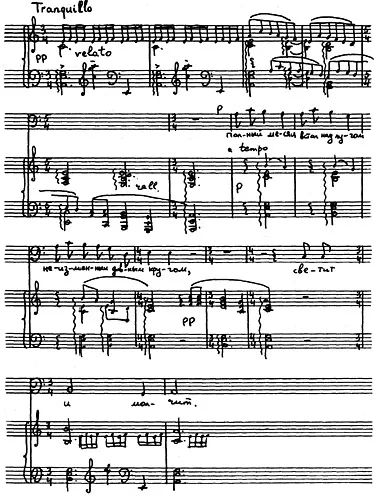
Ex. 1 ‘Full Moon O’er the Meadow’
“Dear Edik, your compositions have astonished me…I believe that you are endowed with a great gift for composition. And it would be a great sin to bury your talent” (from the letter of March 22, 1950).
Shostakovich found not only time to answer to a complete young stranger from Tomsk, but sent him a detailed letter with an analysis of his works and displayed a keen interest in the career of the budding composer. Dmitry Shostakovich gave his opinion on each separate item. Most of all he liked Denisov’s song on poems by Alexander Blok ‘Full Moon O’er the Meadow’ in which he distinguished its piano part (see Musical Example 1).
So it settled Denisov’s future career. A regular correspondence sprang up between the young and the world-famous composers. Dmitry Shostakovich repeatedly expressed his desire ‘to meet and have a talk’ with the aspiring composer from Siberia. He also volunteered to show Denisov’s compositions to some Moscow-based musicians, namely Vissarion Shebalin, Semyon Bogatyrev and Anatoly Alexandrov. In his view, it could be a tentative exam for the young composer. However, their judgement proved to be ‘quite unexpected’ for Dmitry Shostakovich. In his letter of May 20, 1950 he informed Denisov that the Moscow professors acknowledged his general musical capacity, a fairly high level of professionalism, but failed to see in him the hallmarks of ‘genuine gift for composition’.
On Shostakovich’s advice in the spring of 1950 Denisov came to Moscow and tried to enter the Conservatoire. But he failed to pass the exams. In addition to the negative opinion of the professors of the Moscow Conservatoire—Bogatyrev and Shebalin—about his endowments as a composer, he showed a poor knowledge of musical theory.
Nonetheless the first unsuccessful attempt failed to crush the aspirations of the young man from Siberia. He went back to Tomsk, graduated with honours from the university in 1951 as a specialist in ‘functional analysis’, passed his exams to attend the post-graduate courses and…left for Moscow once again. On an agreement with the director of the music college at the Moscow Conservatoire he was allowed to take some lessons there to prepare himself for another attempt to enter the conservatoire.
This time thoroughly prepared by his studies at the college, in the summer of 1951, Edison Denisov became a student of the composition department at the Moscow Conservatoire.
2. THE CONSERVATOIRE
The Post-1948 Period
The beginning of his composer’s career coincided with the most difficult period in the national musical life. The Resolution adopted by the Central Committee of the Communist Party in 1948 unleashed a campaign of severe criticism levelled at the ‘formalists’—Prokofiev, Shostakovich, Myaskovsky, Aram Khachaturyan, and a galaxy of Western composers. Even some of Pyotr Tchaikovsky’s later works came to be regarded as ideologically alien (his songs, and separate items in his Queen of Spades). “The whole of the Soviet people” (the ideological cliche of the time) without exception condemned the ‘errors’ of composers and musicologists. The late forties and the early fifties witnessed devastating ideological indoctrination of the people and the ‘brainwashing’ of the intelligentsia. The menace of reprisals for the ‘wrong’ tastes or views was impending. The label of a ‘formalist and cosmopolitan bowing down before the corrupt bourgeois West’ was offhandedly pinned on the creators of ‘formalist’ works. A crowd of cynical and unscrupulous characters emerged from the bottom of the intellectual life, taking a sadistic pleasure in repeating such formulas and clichés and spitefully defaming the best achievements in modern music. It was out of the question to defend the ‘formalists’ out loud, for it was tantamount to opposing the party and the people. Igor Stravinsky became one of the most dangerous persons, since he was an ‘emigré' which meant a ‘betrayer’ and ‘traitor to the Motherland’ who used to be executed by shooting some years earlier.
During the years following the adoption of that notorious Resolution the conservatoire students had to lock up themselves in a classroom to play a Shostakovich symphony or a Prokofiev sonata. Composer Roman Ledenyov whose interest in Hindemith was brought to somebody’s notice (he once played a piece by Hindemith) was summoned to the Komsomol Committee of the conservatoire for an ideological slating. Composer Arno Babajanyan used to tell his friends how, already in the seventies, he still quivered whenever he heard the name of Hindemith. 5 Jazz music was banned. To play it, jazz musicians gathered together behind the closed doors in some flat in the suburbs, which was jokingly called a ‘jazz shelter’. 6
After Stalin’s death (in 1953) Edison Denisov asked Dmitry Shostakovich whether the changes for the better could be expected. Shostakovich’s reply was rather pessimistic: “Edik, the times are new, but the informers are still the same.” The black shadow of 1948, despite the purifying effect of the 1958 Resolution on ‘correction of the errors’ committed by the 1948 Resolution, was hovering over Soviet music for many years to come. 7 Edison Denisov remained honest in his views. As early as in the mid-fifties he came to assert that the Resolution of 1948 on music had been ‘wrong’ and was persecuted for his attitude to it.
Under Vissarion Shebalin’s Tutorship
Dmitry Shostakovich:
“You must study in Shebalin’s class, for nowadays he is the only one who can teach the ‘musical metier’, or to be more precise the ‘composition metier’. And this is the most important for you now” (from the letter of August 4, 1951).
On his mentor’s advice Ediso...
Table of contents
- Cover Page
- Title Page
- Copyright Page
- INTRODUCTION TO THE SERIES
- LIST OF PLATES
- FOREWORD
- CHAPTER 1: A BIOGRAPHICAL OUTLINE
- CHAPTER 2: THE COMPOSER’S INNER WORLD
- CHAPTER 3: THE COMPOSER’S STYLE AND TECHNIQUES
- CHAPTER 4: MUSICAL COMPOSITIONS
- CHAPTER 5: DENISOV ON MUSIC: LITERARY WRITINGS & PUBLIC STATEMENTS
- AFTERWORD
- APPENDIX 1: LETTERS FROM DMITRY SHOSTAKOVICH TO EDISON DENISOV
- APPENDIX 2: PIERRE BOULEZ ABOUT EDISON DENISOV
- APPENDIX 3: ABOUT SOME MUSICAL WORKS
- APPENDIX 4: CHRONOLOGY
- APPENDIX 5: COMPLETE CATALOGUE OF WORKS
- APPENDIX 6: DISCOGRAPHY
- APPENDIX 7: MUSICOLOGICAL WORKS BY EDISON DENISOV
- APPENDIX 8: REFERENCES
Trusted by 375,005 students
Access to over 1.5 million titles for a fair monthly price.
Study more efficiently using our study tools.
Frequently asked questions
Yes, you can cancel anytime from the Subscription tab in your account settings on the Perlego website. Your subscription will stay active until the end of your current billing period. Learn how to cancel your subscription
No, books cannot be downloaded as external files, such as PDFs, for use outside of Perlego. However, you can download books within the Perlego app for offline reading on mobile or tablet. Learn how to download books offline
Perlego offers two plans: Essential and Complete
- Essential is ideal for learners and professionals who enjoy exploring a wide range of subjects. Access the Essential Library with 800,000+ trusted titles and best-sellers across business, personal growth, and the humanities. Includes unlimited reading time and Standard Read Aloud voice.
- Complete: Perfect for advanced learners and researchers needing full, unrestricted access. Unlock 1.5M+ books across hundreds of subjects, including academic and specialized titles. The Complete Plan also includes advanced features like Premium Read Aloud and Research Assistant.
We are an online textbook subscription service, where you can get access to an entire online library for less than the price of a single book per month. With over 1.5 million books across 990+ topics, we’ve got you covered! Learn about our mission
Look out for the read-aloud symbol on your next book to see if you can listen to it. The read-aloud tool reads text aloud for you, highlighting the text as it is being read. You can pause it, speed it up and slow it down. Learn more about Read Aloud
Yes! You can use the Perlego app on both iOS and Android devices to read anytime, anywhere — even offline. Perfect for commutes or when you’re on the go.
Please note we cannot support devices running on iOS 13 and Android 7 or earlier. Learn more about using the app
Please note we cannot support devices running on iOS 13 and Android 7 or earlier. Learn more about using the app
Yes, you can access Edison Denisov by Yuri Kholopov,Valeria Tsenova,Kholopov in PDF and/or ePUB format, as well as other popular books in Media & Performing Arts & Music. We have over 1.5 million books available in our catalogue for you to explore.