eBook - ePub
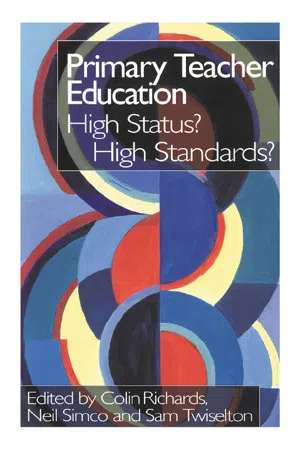
Primary Teacher Education
High Status? High Standards?
- 240 pages
- English
- ePUB (mobile friendly)
- Available on iOS & Android
eBook - ePub
About this book
Informed professional debate about primary teacher education is long overdue. This book provides a sense of direction and impetus in this debate by focusing on pressing topical issues of policy and provision. There is focus on the current national scrutiny of initial and inservice teacher training, which is resulting in the development of a National Curriculum for ITE, the proposal of a General Teaching Council, and Continuing Professional Development initiatives from the TTA. In addition, the book will be of direct use in the design and implementation of new courses in teacher education. All the contributions have been specially commissioned for this book.
Information
Part 1
The Changing Context of Primary Teacher Education
1
Changing Teacher Education—Genuine Partnership or Arranged Marriage?
Rob Hyland and Glynis Wood
In all the discussions and proposals for making the initial preparation of wouldbe teachers more effective, few concepts have been appealed to more often than that of the ‘partnership’ between schools and higher education. Often preceded by ‘new’, ‘real’ or ‘genuine’, it is difficult to resist the subtle or not so subtle discursive pressures exerted by such appeals; it is rather easier to dispute the attractions of motherhood and apple pie than it is to gainsay the merits of partnership. But tracing the developing use of the word illustrates the dynamic way in which partnership has taken on extended and particular meanings in the processes of policy generation and implementation. To be convinced of the necessity for a closer relationship between higher education and schools in the preparation of future teachers is not to be blind to ways in which ‘partnership’ may have served as a rhetorical device, masking the imposition of political control from the centre. A commitment to the desirability of a genuine partnership cannot obscure some of the real difficulties inherent in relationships forged under considerable pressure. The question is not whether partnership is desirable, but rather what sort of partnership can be achieved. Partnerships in teacher education are a matter of balancing interests as well as sharing commitments: for those working within schools and HEIs the balance achieved in the late 1990s seems at best precarious.
Long-standing Liaisons
For as long as some formal preparation beyond a rudimentary apprenticeship has been recognized as desirable, there have been links between schools and institutions geared to the specific preparation of teachers; and for just as long there has been debate about the desirable balance of influence (see, for example, Jones, 1924). In the early part of the long history of training teachers the schoolbased element was paramount, then the pendulum swung in favour of more education and training in institutions separate from schools. Though the McNair Report (1944) tried to give due weight to both elements, in the post-war era the details of their courses and the nature of their arrangements with schools for giving students practical experience were largely a matter for colleges and universities involved in ITT. The James Report (DES, 1972) tried to redress the balance of training and emphasize the particular contribution of schools and teachers, but most of its recommendations were quickly lost sight of as successive governments struggled to reduce ITT numbers in line with falling school rolls. Whilst there were many structural changes, and though students’ ‘teaching practice’ was commonly redefined as ‘school experience’, the essential relationship between HEIs and schools was undisturbed. Within very broad guidelines, ITT institutions and schools were free to enter into such liaisons as they saw fit.
There had always been some calls for more practical training and the greater direct involvement of serving teachers in ITT. In the late 1970s and early 1980s a number of projects, some funded by the DES, developed models of ITT involving closer links with schools (Ashton et al., 1983; Tickle, 1987; Furlong et al., 1988). Much of the impetus for such initiatives came from the professional communities of teachers and teacher educators. An HMI discussion document reflected these debates and recommended:
Partnerships between schools and initial training institutions should be strengthened at all levels, and in all aspects of the students’ training. (HMI, 1983, p. 17)
Thus far the debate was essentially a professional one in which the sorts of recommendations made by HMI, including those about ‘partnership’, enjoyed considerable support from HEIs and the Universities Council for the Education of Teachers (UCET).
Accredited Relationships
Indication of a general change in political climate came with the White Paper Teaching Quality; this did not just advocate increasing ‘the active participation of experienced practising school teachers’ in ITT, but also proposed a new body to accredit teacher training (DES, 1983). The Council for the Accreditation of Teacher Education (CATE), established in 1984, had to approve all ITT courses. DES Circular 3/84 set out the arrangements; its annex set the tone and language of much of what was to come. Under ‘Links between training institutions and schools’ it was clear that ‘courses should be developed and run in close working partnership with…schools’ (para 3). Not only were ‘experienced teachers from schools’ to be involved in the ‘planning, supervision and support of students’ school experience’, but they should also ‘be given an influential role in the assessment of students’ practical performance’. At this stage there was no suggestion that teachers should be directly responsible for the training of students in school, but they should be involved ‘in the training of the students within the institutions’ (i.e. HEIs). Such involvement is likely to have been identified as good practice in many ITT institutions at that time; somewhat more controversially, ITT staff were to be given ‘opportunities to demonstrate their teaching effectiveness in schools’ (para 4).
When CATE was reconstituted, DES Circular 24/89 replaced Circular 3/84. The requirements (the ‘CATE criteria’) were adjusted and amplified, but there was also a subtle change of tone in sections detailing the relationships between HEIs and schools which further extended the language of partnership:
Close cooperation between schools, local education authorities and initial teacher training institutions leads to better training of student teachers for their future careers and provides valuable staff development for institutions and schools. Where possible, institutions should build long-term partnerships with individual schools which will foster collaboration and training opportunities. (Circular 24/89, Annex B, para 1)
Whereas Circular 3/84 talked of ‘sharing responsibility’, Circular 24/89 was more directive:
The assessment of students should be a shared judgment, in which the views of both serving teachers and teacher trainers are given full weight, (ibid, para 3)
Serving teachers were also to be directly involved in interviewing candidates (ibid, para 4) and not restricted to drawing up selection guidelines. Circular 24/ 89 also extended the requirements of ‘school experience for ITT tutors’ (paras 7– 9).
Leading Partners
Secretary of State Kenneth Clarke’s speech to the North of England Education Conference, January 1992, signalled the firm direction of policy:
Student teachers need more time in classrooms guided by serving teachers and less time in the teacher training college. (Clarke, 1992, para 19)
The essence of school-based training is that the partnership is one in which the school and its teachers are in the lead in the whole of the training process, from the initial design of a course through to the assessment of the performance of the individual student, (ibid, para 22, emphasis added)
Perhaps the most crucial signal of intent however, was that ITT institutions ‘will have to reimburse the schools for the additional costs’ involving ‘a considerable shift of funds from colleges to schools’ (ibid, para 29). Nevertheless, Clarke maintained his proposals were:
designed not to take teacher training away from higher education, but to reaffirm that the objective of the training is to prepare the student for a career as a teacher in a school, (ibid, para 44)
There was another clear message: training institutions should select the ‘best schools’ as partner, those ‘which command the greatest confidence in academic and other aspects of measured performance’ (ibid, paras 31–2).
A Consultation Document, prepared by CATE, followed immediately (DES, 1992). Premised on the view that the ‘quality of the teaching force’ would be raised by measures ‘to give the best teachers real responsibility for training new members of their own profession’ (see page), the far-reaching proposals were designed to reform all of ITT and make it more ‘school-based’. The document was clear:
In future, the whole process of teacher training will be based on a more equal partnership between school teachers and tutors in higher education institutions, with the schools themselves playing a much bigger part, (ibid, p. 7)
The partnership would involve a contract between HEI and school and ‘a considerable shift of funds…to schools’ (ibid, p. 3). HEIs, however, would be ‘expected to associate as partners with the best schools’ and use ‘performance indicators’ to determine these (ibid, p. 7). The structure of the partnership would be part of CATE’s accreditation brief, as would the further specification of professional competences. New draft criteria for secondary courses were appended whilst another consultation document on primary ITT was promised in the accompanying ‘Dear colleagues’ letter from the DES. In characteristic fashion, that letter gave two months for reply, ‘if you have any comments on the Secretary of State’s proposals’ (Whitaker, 1992).
Within HEIs the ‘dear colleagues’ had plenty to comment upon: Gilroy’s rather intemperate language, ‘the political rape of initial teacher education’, reflected the depth of feeling in ITT (Gilroy, 1992). The disjunction between gentle words of ‘more equal partnership’ and the repetition of Clarke’s unequivocal statement that the schools would now be ‘in the lead in the whole of the training process’ was noted. There were dire predictions about universities withdrawing from initial training, but the reforms were pushed through. Secondary courses were restructured in line with the criteria of Circular 9/92; primary courses awaited the outcome of further consultation.
‘Mutual Trust and Willing Cooperation’
In June 1993, ‘new criteria for course approval’ for primary ITE were set out in a draft circular. Drawing attention to the reports of the ‘three wise men’ (Alexander et al., 1992) and the follow-up by OFSTED (1993), with their emphasis upon curricular subject knowledge and practical teaching competences, the draft circular stressed the National Curriculum as the ‘framework for teaching and learning’ and therefore ‘the basis for ITT requirements’ (DFE, 1993a, p. 6). Though recognizing that the ‘nature and extent’ of partnerships between HEIs and primary schools would ‘vary with local circumstances’, there was a clear transfer of responsibilities to schools (ibid, p. 14). Just in case any HEIs thought they could dupe their primary school partners over ‘an adequate transfer of funds’, the Secretary of State proposed to ‘monitor and make public’ the details of such arrangements; though naturally partnerships would be ‘on the basis of mutual trust and willing cooperation’ (ibid, p. 15). Should this not be enough:
the Secretary of State reserves the right to withhold approval from an institution’s courses of ITT if there is evidence that individual schools have been treated arbitrarily or unreasonably, (ibid)
The criteria (annex A) set out the details of the aims, course hours and conditions for ITE courses; it also included 33 ‘competences expected of newly qualified teachers’.
The Teacher Training Agency and Circular 10/97
Circular 14/93 formalized the draft criteria and established school-based training on the partnership model as the basis of primary ITE. An increased role in the delivery of the training of students was given to teachers in school and some of the funding was devolved accordingly. But even as it was being implemented, further reforms were set in motion with The Government’s Proposals for the Reform of Initial Teacher Training (DFE, 1993b). This document summarized progress to date, but most significantly proposed ‘a new statutory body, the Teacher Training Agency’. Its remit was to be more all-embracing than that of GATE; most noticeably it would ‘administer all central funds for initial teacher training in England (ibid, p. 6).
The Teacher Training Agency was established in September 1994. The TTA would now regulate the framework of partnership between HEIs and schools and draw up new standards for the training of teachers. Following consultations, Circular 10/97 was eventually issued. That the policy of school-based training based on partnerships was now established is clear:
In the case of all courses of ITT, higher education institutions and other non-school trainers must work in partnership with schools…(DfEE, 1997b, p. 45, para 3.1)
Though schools are to be ‘fully and actively involved’ where they ‘fall short’ it is ‘providers’ who must ‘demonstrate that extra support’ is given to ensure the quality of training. If this quality ‘cannot be guaranteed’, then the HEI (or ‘other non-school trainers’) must implement their ‘procedures…for the deselection of schools’. It is a ‘quality assurance requirement’ that:
only those schools and teachers who can offer appropriate training and support for trainees are used to provide ITT. (ibid, p. 46)
The new Circular continues the transfer of training to schools, but leaves quality assurance firmly in the hands of the higher education institutions. Far from solving the problems of teacher training, this precarious balance of responsibilities in school-based partnerships has given rise to many contentious issues for schools, individual teachers, HEIs and tutors.
Theory and Practice
As Glenny and Hickling (1995) observe:
The notion of partnership generated by recent educational policy indicates a determination to challenge the traditional role of higher education in the initial training of teachers. This has resulted in a rather truncated debate about partnership, focused primarily on the allocation of power and resources between schools and higher education, and has obscured the more fundamental shared core purpose of improving the quality of teaching and learning for children, (see page)
The ‘rather truncated debate’ concerning the location of initial teacher training sometimes descends to an argument over the relative merits of theory and practice, with schools providing the latter and higher education institutions the former. Such a practice/theory divide is simplistic. As Beardon et al. (1995) observe:
The difference between the training institution and the school is that in the former the theories are more likely to be very explicit and to be underpinned by some academic or research-based rationale, whereas in the latter the theories tend to be more explicit or taken for granted as good practice derived from the long experience of the supervising teacher. All practice is grounded in some kind of theory: it is impossible to get rid of theory simply by emphasizing practice or a particular location for that practice, (see page and page)
Evidence gathered from our work with mentors suggests some reticence on the part of mentors to teach the students anything linked to formal ‘theory’. This was generally due to a lack of security in up-to-date academic literature and a lack of time to read current research. Many mentors were very able to explain their practice, and inevitably discussed some of their underpinning theory, but they contrasted this with:
the sort of heavy theory you do in college, like all the stuff I did when I was a student, you know the latest info about the curriculum, orders from the DfEE or OFSTED, or about people like Piaget, Skinner, (unpublished fieldwork)
Whilst it is true that practice and theory are inextricably linked, it would be rather naive to assume that mentors are in a strong position to draw out all the aspects of educational theory which are related to students’ practice. In practical terms there needs to be an agreement about which aspects are best taught where and by whom; in the longer term there needs to be a more fundamental partnership between teachers in higher education and schools. If the old theory/ practice dichotomies are simply recreated, albeit in different settings, then the learning experience of the student must suffer.
Roles and Responsibilities
A major assumption underlying the new model is that schools actually desire to be ‘in the lead’. The TTA appears to have taken little heed of recent research demonstrating that many teachers and headteachers may not want significantly greater responsibility for ITE. John Furlong, commenting on a five-year research project which focused on partnerships, concluded:
Despite the misgivings of Government agencies over the style and quality of teacher education provided by universities and colleges, most heads think higher education is a better initial teacher training ground than the classroom. (THES, 19 July 1996, p. 4)
Even where schools are committed to being closely involved in the professional preparation of new teachers, in the final analysis training must be a secondary function. For most schools, receiving students in training remains an undertaking to be negotiated year-by-year; this in itself makes it difficult for them to take a longer term, proactive view, particularly against a background of continual educational change.
It remains the task of higher education institutions to recruit the overwhelming majority of would-be trainees and to be responsibl...
Table of contents
- Cover Page
- Title Page
- Copyright Page
- Carolyn Horne: A Very Enabling Woman
- Introduction: Primary Teacher Education: New Directions, New Issues, New Problems, New Opportunities
- Part 1 The Changing Context of Primary Teacher Education
- Part 2 A New National Curriculum for Primary Initial Teacher Education
- Part 3 Pedagogy in Initial Teacher Education
- Part 4 Emerging Issues in Mentoring
- Part 5 Beyond Initial Teacher Education
- Part 6 Primary Education and Primary Teacher Education
- Notes on Contributors
Trusted by 375,005 students
Access to over 1.5 million titles for a fair monthly price.
Study more efficiently using our study tools.
Frequently asked questions
Yes, you can cancel anytime from the Subscription tab in your account settings on the Perlego website. Your subscription will stay active until the end of your current billing period. Learn how to cancel your subscription
No, books cannot be downloaded as external files, such as PDFs, for use outside of Perlego. However, you can download books within the Perlego app for offline reading on mobile or tablet. Learn how to download books offline
Perlego offers two plans: Essential and Complete
- Essential is ideal for learners and professionals who enjoy exploring a wide range of subjects. Access the Essential Library with 800,000+ trusted titles and best-sellers across business, personal growth, and the humanities. Includes unlimited reading time and Standard Read Aloud voice.
- Complete: Perfect for advanced learners and researchers needing full, unrestricted access. Unlock 1.5M+ books across hundreds of subjects, including academic and specialized titles. The Complete Plan also includes advanced features like Premium Read Aloud and Research Assistant.
We are an online textbook subscription service, where you can get access to an entire online library for less than the price of a single book per month. With over 1.5 million books across 990+ topics, we’ve got you covered! Learn about our mission
Look out for the read-aloud symbol on your next book to see if you can listen to it. The read-aloud tool reads text aloud for you, highlighting the text as it is being read. You can pause it, speed it up and slow it down. Learn more about Read Aloud
Yes! You can use the Perlego app on both iOS and Android devices to read anytime, anywhere — even offline. Perfect for commutes or when you’re on the go.
Please note we cannot support devices running on iOS 13 and Android 7 or earlier. Learn more about using the app
Please note we cannot support devices running on iOS 13 and Android 7 or earlier. Learn more about using the app
Yes, you can access Primary Teacher Education by Colin Richards,Neil Simco,Sam Twiselton in PDF and/or ePUB format, as well as other popular books in Education & Education General. We have over 1.5 million books available in our catalogue for you to explore.