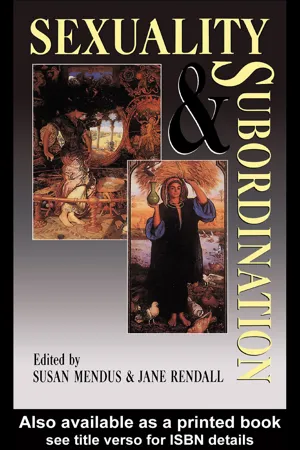
Sexuality and Subordination uses the insights of a range of disciplines to examine the construction of gender in nineteenth-century Britain and France. With contributions from history, literature, sociology and philosophy, its interdisciplinary approach demonstrates the extent to which a common focus can illuminate problems inaccessible to any single discipline.
'Victorianism' is generally understood to mean sexual double standards, hypocrisy and prudery among the middle classes. But, as this collection shows, the representation of sexuality in the nineteenth century was more diverse and complex than is sometimes realized. Both art and literature point to the deployment of sexual metaphors and imagery, and the language of educated public opinion was shaped by the dichotomy between mind and matter, between rationality and sexuality. The contributors to this volume explore how women, in questioning their subordination, had to challenge a construction of femininity which imposed sexual ignorance.
eBook - ePub
Sexuality and Subordination
Interdisciplinary Studies of Gender in the Nineteenth Century
- 260 pages
- English
- ePUB (mobile friendly)
- Available on iOS & Android
eBook - ePub
Sexuality and Subordination
Interdisciplinary Studies of Gender in the Nineteenth Century
About this book
Information
1
The Emerging Role of Women in Mexican Political Life
Victoria E. Rodríguez
I cannot understand democracy without the participation of women. The struggle that began many years ago has not finished. The year 2005 is the goal for parity.
—Senator María Elena Chapa (PRI), August 1997
The July 1997 midterm election in Mexico has been widely hailed as historic. For the first time in over seventy years of one-party rule, the governing elite has become genuinely plural. The Congress is now led by the combined opposition forces of the Partido Acción Nacional (National Action Party, PAN), to the right of the political spectrum, and the Partido de la Revolución Democrática (Party of the Democratic Revolution, PRD), to the left. Although the Partido Revolucionario Institucional (Party of the Institutionalized Revolution, PRI) remains the dominant party and governs nationally, there have been important opposition gains at the city and regional levels. Specifically, over 50 percent of the country's population is now governed by the opposition at the state and local levels, and more significantly, the three largest and most important metropolitan areas are in the hands of parties other than the PRI: Guadalajara and Monterrey have gone to the PAN, and the Federal District (Mexico City proper) went to the PRD on July 6, 1997. In the context of what was relatively recently called "a perfect dictatorship," a dramatic political opening is underway in Mexico.
If the 1997 election was historic, then how did the women fare? On the face of it, and compared with the situation that reigned before, the numbers look promising: Seventeen percent of the 1997-2000 Congress now consists of women (i.e., they occupy 85 seats out of 500). By way of contrast, in the United States women occupy 51 of the 435 seats in the House of Representatives, or 11.5 percent. And according to the Inter-Parliamentary Union, women now hold 10 percent of legislative seats in Latin America and the Caribbean, trailing behind the world average of 11.5 percent. The six countries in the world with the highest representation of women in their legislatures are Denmark, Finland, the Netherlands, New Zealand, Norway, and Sweden (the percentages in these countries range from 22 to 39 percent). The seventh is another Latin American nation— Argentina—which boosted its female representation with the passage of a quota law in 1993, from 5 percent in 1991 to 28 percent in 1995. Thus Mexico's 17 percent, although a step forward, still lags far behind that of many other countries. But if in Mexico the numbers themselves are significant, more significant yet is the trajectory Mexican women have followed to arrive at this level of formal representation and to position themselves as key actors in the country's transition to democracy.
This book explores the emergent role of women in Mexican politics and their increasingly important presence in the country's political life. To date, the mainstream literature on politics in Mexico—abundant as it is— has said little about women, even though their participation as formal political actors has increased dramatically in the last fifteen years. The political participation of women, although well documented in other Latin American countries, has been seriously neglected in the Mexican case, and only until recently has it began to grow as a field of study (see, for example, Fernández Poncela 1995; Hierro, Parada, and Careaga 1995; Martínez 1993; Massolo 1994d; Tarrés 1992). If this lack of scholarly attention can be explained, to a certain extent, by the fact that men continue to dramatically outnumber women in the Mexican political elite, it remains puzzling that their gains have been relatively ignored. The number of women in formal political office has increased steadily since the early 1980s, and as indicated above, the percentage of women in the legislature is comparatively and relatively high.
Roderic Camp points out in Chapter 11 that only one out of every fourteen members of the so-called political elite in Mexico is a woman. But again one must look beyond the numbers. Despite the dramatic underrepresentation of women in high-level appointed and elected positions, the quickening political participation and increased visibility of women in other arenas is now beginning to place them in a position to play a critical role as political actors. Women have become increasingly influential in the policymaking process through their activism in nongovernmental organizations (NGOs) and urban popular movements at both the local and the national levels. They have also become key actors in the electoral process, and not only because they make up more than 50 percent of the electorate. Women monitor elections, orchestrate campaign events, run campaigns, join marches and demonstrations in record numbers, and of course increasingly run for office and contend for the top positions within the political parties' internal structures. As elsewhere in the world, Mexican women have come of political age. As Jane Jaquette writes, "The growing participation and representation of women in politics is one of the most remarkable developments of the late twentieth century. For the first time, women in all countries and social classes are becoming politically active, achieving dramatic gains in the number and kind of offices they hold" (1997a:23).
This book analyzes the different forms of women's political participation and activism in Mexico in a systematic way and anticipates what the future holds for women in Mexican political life, thereby seeking to open a new path of scholarly inquiry in both the United States and Mexico. Because an important part of the analysis presented here documents the rise of women as political actors, the chapters in this book also seek to contribute to the growing literature on Mexico's democratization process. As elsewhere in Latin America, Mexican women are in a key position to steer their country's incipient political transformation.
Struggling for Political Rights and Equality
The dramatic opening that has occurred in the political and electoral processes of the last years in the Mexican system has brought to the fore a number of actors who previously had little or no say in the political and policy decisionmaking processes, which were overwhelmingly dominated at all levels by the PRI. In addition to the major gains of the opposition parties, led by the PAN and the PRD, the birth and growth of a new civic culture in Mexico have triggered new forms of activism and political participation. Previously repressed or ignored actors, such as women, independent agrarian organizations, and indigenous groups, have begun to organize and mobilize in order to press their demands. In so doing, they have attracted national and international attention. The Chiapas uprising of 1994, which counted among its ranks numerous women, was perhaps the most vivid illustration of this emergent political presence. Mexican women are organizationally and politically astute and well set to take advantage of this opening. In pursuit of their political rights and in their struggle for equality, they have devised a variety of strategies, as will be discussed below.
As elsewhere in Latin America, Mexican women are becoming a political force to be reckoned with. As Lourdes Arizpe puts it, "everywhere, women are mobilizing themselves. This phenomenon, which though not new, is only just becoming visible" (1990:xvi). Indeed, the political mobilization of women in Mexico is not new at all, dating as it does to the early part of this century. In the early 1900s women began to campaign vigorously for recognition as citizens, focusing their struggles on suffrage and equality. As Carmen Ramos Escandón describes in her chapter in this book, women built coalitions wherever they could, continued those fights through the mid 1900s, and were finally successful in winning the right to vote in 1953 (see also Miller 1991). Nevertheless, by the late 1950s, only a handful of women occupied prominent political positions. The first woman elected to Congress was Aurora Jiménez Palacios, from Baja California, in 1954, and the first woman elected as governor was Griselda Alvarez, from Colima, in 1979. Altogether, between 1954 and 1989, a derisory 229 women held high-level positions in the three branches of government (Silva 1989), and to date only three women have been state governors. Into the 1990s, in spite of women's constitutionally recognized equality and being the electoral majority, the playing field has remained unequal. Today, however, their presence is increasingly noticeable.
According to the last national census (INEGI 1990), women constitute 51 percent of Mexico's population. The majority live in urban areas and are under thirty years old. Of the female population, 37 percent are under the age of fifteen. Birth rates have fallen dramatically, with the average number of children being 3.8, or half that of the early 1970s. Education levels have increased steadily, though women still tend to have higher illiteracy rates than men (25.5 percent compared to 16.7 percent male) (Inter-American Development Bank 1995:201). Although higher education rates have also increased, with women representing 40 percent of university graduates, access to university remains a privilege of the elites. And as is the case in other parts of the world, women tend to concentrate in what are traditionally considered to be "female" career areas, such as education, nursing, and social work.
In the economic sphere, women have also become increasingly noticeable and active, mostly as a result of the economic crises of the 1980s and 1990s, which placed unprecedented burdens on women to become providers as well as caretakers for the family and the home. Women now constitute almost one-fourth of the economically active population in Mexico; in urban areas, where most women reside, this percentage is significantly higher (see INEGI 1993; García and de Oliveira 1997). These figures apply only to the formal labor sector and ignore the thousands of women who work as domestic servants or in other areas of the informal economy that are often not included in national statistics. Even though the stereotypical image of Mexican women is that they take on paid work while they are young and single, the composition of the female workforce has changed drastically and now includes large numbers of middle-aged wives and mothers, a growing percentage of whom are also heads of households (see Chant 1991; González de la Rocha and Escobar Latapí 1991; Roberts 1993; Staudt 1998).
This increased presence of women in the economic sector has also helped to trigger their political activism. At the formal level, women have gradually gained access to elected office, appointed positions within the bureaucracy, and top party structures at the federal, state, and municipal levels (see Fernández Poncela 1995; Hierro et al. 1995; Martínez 1993; and the chapters by Roderic Camp, Alejandra Massolo, Lilia Venegas, and Alicia Martínez and Teresa Incháustegui in this book). At the informal level (i.e., outside of government and political parties), women have invariably been the backbone of urban social movements and other organized forms of protest that demand basic services for their neighborhoods, pay equity and better working conditions through labor unions, and in many cases simple equality and fairness from the state in the delivery of goods and services (Bennett 1995a; Carrillo 1990; Foweraker 1995a; Jelin 1990a; Massolo 1994d; Stephen 1997). This political activism, both formal and informal, has transformed the role of women in the political process.
Becoming Politically Active
Just as the range of political activities in which women are engaged varies widely, so do the reasons for their becoming politically active. A series of in-depth interviews conducted in 1995-1997 with over eighty women who are politically active in Mexico (Rodríguez forthcoming) as well as other data (Camp this volume; Martínez 1993; Silva 1989) make it apparent that in the formal sphere of politics women overwhelmingly tend to come from the middle and upper classes, are highly educated, and in many cases belong to prominent political families. For example, Griselda Alvarez, Mexico's first female governor, comes from a long line of politicians: Her great grandfather was the first governor of Colima, and her father, also governor of the state between 1919 and 1923, was active in the Revolution and a friend of Venustiano Carranza. For politically active Mexican women, more often than not, political activism began at an early age, either by being exposed to politics through family life or by their joining some politically organized group while at university. Indeed, many of them were student leaders, who very early in their careers joined a political party and gained a position in government. Such is the case, for example, of Beatriz Paredes, who became a state diputada (congresswoman) at the age of nineteen—and later, among other things, federal congresswoman, governor, undersecretary, ambassador, party secretary, leader of the peasant sector, and senator (she is now in her late forties). Although some of these women are avowed feminists and have used their political office to advance women's causes, a large number of them are there, quite simply, for the thrill of politics and the exercise of power. One wonders how surprising it may be to some people that, as Camp describes in Chapter 11, these women are virtually indistinguishable from their male counterparts in their background, performance, and career tracks. Their policy agendas are also very similar.
Women who engage in other aspects of political life through social movements, NGOs, and other grassroots organizations become politically active often for very different reasons than those of their female counterparts in government. During the interviews alluded to earlier it became apparent that in numerous cases their involvement was originally triggered by a traumatic event: the 1968 student massacre in which friends were killed or arrested, the 1985 earthquakes in Mexico City, or the disappearance of a loved one. The interviews conducted also showed that although the women who lead the organized groups in these areas of activity tend to come from the middle and upper classes and are relatively highly educated, an overwhelming number of the groups' members are working-class women (Rodríguez forthcoming; see also Tarrés 1996). And although the leaders and organizers may join a group in pursuit of a cause for ideological reasons or in pursuit of the common good (e.g., human rights, environmental issues), a decided majority of activists in popular movements—both leaders and followers—have concrete demands for goods and services around which they organize. As is demonstrated in the respective chapters by Vivienne Bennett, Joe Foweraker, Maria Luisa Tarrés, and Lynn Stephen in this book, the mobilization of women at the informal level and their ability to impact policy decisions have turned women into a formidable political force. Measured in terms of political efficacy, therefore, Mexican women appear to have gone considerably farther in the informal than in the formal sphere of politics—at least to date
Strategizing Women's Issues
The wide variation in the reasons why women become politically active and involved is reflected in the goals and objectives they pursue as well as in the strategies they adopt. As is true for women elsewhere, the assumption is that in Mexico women in politics, especially those in government, will automatically support and promote women's causes. Although this may be accurate in some cases, the majority of women in Mexican politics tend to concentrate their struggles on other matters. With the exception of feminist groups and those NGOs that are devoted exclusively to promoting women's issues (e.g., reproductive rights, violence against women), the bulk of women's political activism tends to concentrate on fighting for public goods and services (at the informal level) and on supporting specific pieces of legislation and government programs in social policy (at the formal level). There are some notable exceptions, however, especially for those women who are able to bridge the informal and the formal spheres of politics and sustain their struggle for women's rights. In the new Congress, feminists are preparing strategies to convince legislators that the budget needs to be revised in order to provide better for women's health care, job training, and access to credit for businesses. And Patria Jiménez, who became the first openly gay woman to be elected to Congress in July 1997, also has a firm gender agenda. As leader of a lesbian group, El Closet de Sor Juana, she has devoted her political activities to fighting for women's rights and gay liberation in Mexico. Her policy agenda as she entered Congress firmly centered on better health care for women, reproductive rights, and tighter laws to ban discrimination against women seeking credit and protection of their property rights.
Gender concerns come in second within the majority of women's policy agendas, trailing behind whatever their principal policy priority area may be (fiscal policy, human rights, transportation, education, social welfare, health, and so on). Yet, in any way possible, most of the women who are politically active seek to support and promote women's issues. Women in government have been a critical force in passing legislation targeted at women, ranging from rape laws to education programs to child care facilities. Outside of government, organized groups have benefited women in a variety of ways, from providing training programs and health care facilities to unionizing domestic servants. Not one of the politically active women I have interviewed formally or conversed with informally in the course of my research has indicated that she does not care for women's concerns. Indeed, some of them categorically stated that while such concerns are critically important to them, their agendas are so full that gender issues sometimes have to come in a poor second—if at all. This situation was clearly confronted by María de los Angeles Moreno when she was head of her party, the PRI. Having received the party in its worst shape (up until then) after the 1988 election, she was faced with the impossible task of putting the party together and regaining some legitimacy for it. But being the highest-ranking woman in the political system overall, all women's eyes turned to her. Her hands tied with party affairs, she had little time for women's causes and was criticized rather harshly for this. Ironically, she is an avowed feminist, and since leaving the party presidency has become increasingly involved with women's groups in and outside government.
Only a handful of women interviewed appeared to be rather dismissive of explicit gender-related issues, but even they felt that if to support a particular program benefited women, so much the better. Altogether, only a very small proportion of women in politics concentrate single-mindedly on women. As most others pointed out to me, the social and economic needs in Mexico are so many and so pressing that gender inevitably still takes a back seat.
Because there are still relatively few women who are politically visible and even fewer yet who carry real political weight, women appear to be developing a sense of solidarity that cuts across party lines, political ideologies, and areas of activity. For example, this gender solidarity emerged when women of all parties and ideological positions united in support of the passage of the rape law in the early 1990s under the leadership of Amalia García, then a congresswoman for the PRD. Now that very senior political women have been elected to the Senate, it will be of great interest to observe the positions that they take. In July 1997 some of the most prominent women from all three political parties became senators: from the PRI, Beatriz Paredes, Elba Esther Gordillo, and Rosario Green; from the PAN, Ana Rosa Payán and Maria Elena Alvarez; and from the PRD, Amalia García and Rosalbina Garavito, Moreove...
Table of contents
- Cover Page
- Half Title page
- Title Page
- Copyright Page
- Contents
- Acknowledgements
- Introduction
- Part I Representations of Sexuality
- Part II Sexuality, Subordination, and Feminism
- Name and Title Index
- Subject Index
Trusted by 375,005 students
Access to over 1.5 million titles for a fair monthly price.
Study more efficiently using our study tools.
Frequently asked questions
Yes, you can cancel anytime from the Subscription tab in your account settings on the Perlego website. Your subscription will stay active until the end of your current billing period. Learn how to cancel your subscription
No, books cannot be downloaded as external files, such as PDFs, for use outside of Perlego. However, you can download books within the Perlego app for offline reading on mobile or tablet. Learn how to download books offline
Perlego offers two plans: Essential and Complete
- Essential is ideal for learners and professionals who enjoy exploring a wide range of subjects. Access the Essential Library with 800,000+ trusted titles and best-sellers across business, personal growth, and the humanities. Includes unlimited reading time and Standard Read Aloud voice.
- Complete: Perfect for advanced learners and researchers needing full, unrestricted access. Unlock 1.5M+ books across hundreds of subjects, including academic and specialized titles. The Complete Plan also includes advanced features like Premium Read Aloud and Research Assistant.
We are an online textbook subscription service, where you can get access to an entire online library for less than the price of a single book per month. With over 1.5 million books across 990+ topics, we’ve got you covered! Learn about our mission
Look out for the read-aloud symbol on your next book to see if you can listen to it. The read-aloud tool reads text aloud for you, highlighting the text as it is being read. You can pause it, speed it up and slow it down. Learn more about Read Aloud
Yes! You can use the Perlego app on both iOS and Android devices to read anytime, anywhere — even offline. Perfect for commutes or when you’re on the go.
Please note we cannot support devices running on iOS 13 and Android 7 or earlier. Learn more about using the app
Please note we cannot support devices running on iOS 13 and Android 7 or earlier. Learn more about using the app
Yes, you can access Sexuality and Subordination by Susan Mendus,Jane Rendall in PDF and/or ePUB format, as well as other popular books in Social Sciences & 19th Century History. We have over 1.5 million books available in our catalogue for you to explore.