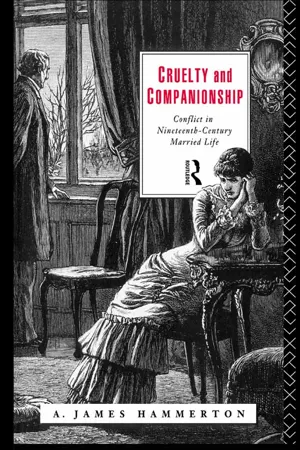
Cruelty and Companionship is an account of the intimate but darker sides of marriage in Victorian and Edwardian England. Hammerton draws upon previously unpublished material from the records of the divorce court and magistrates' courts to challenge many popular views about changing family patterns.
His findings open a rare window onto the sexual politics of everyday life and the routine tensions which conditioned marriage in middle and working class families. Using contemporary evidence ranging from prescriptive texts and public debate to autobiography and fiction, Hammerton examines the intense public scrutiny which accompanied the routine exposure of marital breakdown, and charts a growing critique of men's behaviour in marriage which increasingly demanded regulation and reform. The critical discourse which resulted, ranging from paternalist to feminist, casts new light on the origins and trajectory of nineteenth century feminism, legal change and our understanding of the changing expression of masculinity.
- 248 pages
- English
- ePUB (mobile friendly)
- Available on iOS & Android
eBook - ePub
About this book
Part I
WORKING-CLASS MARRIAGE
INTRODUCTION
The dramatic effects upon the structure of the working-class family resulting from the pressures of industrialization and urbanization are well known. Rather less well known until recently have been the tensions making for conflict between family members which were intensified by the changes. The breakdown of village culture, the replacement of seasonal work-disciplines by those of the factory or workshop, the rise of wage-labour and the ideal of the male breadwinner’s ‘family wage’ capable of supporting a dependent family, together with new religious and secular controls over behaviour, all placed enormous stress on family relationships in a domestic setting that was, relatively, more isolated. From the beginning the male breadwinning ideal was threatened by the cheaper, unskilled labour of women and children, which provoked persistent fears of the undermining of men’s natural family authority.1 But achievement of the ideal family form of male breadwinner and dependent, home-making wife, partly modelled upon the increasingly pervasive middle-class prescription, was no guarantee of domestic felicity. Economic marginality, pressures from large numbers of children (and larger numbers of births) and separate, homosocial cultures of husbands and wives provided fertile ground for sexual antagonism. The familiar burdens for women of household budgeting on inadequate income, which so often resulted in self-deprivation, was very likely to stimulate resentment, whether or not it was expressed overtly. Less familiar conflict could arise from uneven access to vital skills like literacy, which until later in the nineteenth century was rarely achieved by more than one family member, and, in those districts where this was more likely to be the wife, resentments stemming from implied threats to male authority might be aggravated.2 Only at the end of our period did some evidence of the decline in the birth-rate begin to emerge among the working class,3 but it is likely that issues arising from contested control of sexuality and reproduction had provided an additional domestic battleground for much longer, which may well have been deepened by pressures of urban crowding and poverty.
Conflict arising from such issues could be expressed in a variety of forms, but for the working class the most visible form, and the one most likely to leave surviving records, was domestic violence. The violence, of course, was most often men’s violence, which was often only the concluding act following other events, grievances and arguments. But the public visibility of the resulting violence offers the best way of understanding working-class marital conflict and the way it affected both family experience and the wider perception of the idea of the family. It is probably no accident that the increasing criticism of family violence charted in this section coincided with a general decline in recorded levels of violent crime. We cannot be certain whether or to what extent English society was becoming less violent during the nineteenth century, but there is no doubt that critical scrutiny of violence was intensified, and that the family, seen increasingly as a locus of conflict, received a large share of the scrutiny. The next two chapters are concerned as much with the direction and evolution of this discourse of criticism as with the effects of violence on women and their various responses to it, ranging from dogged submission to overt resistance and appeals to the law. Criticism of male behaviour was at odds with an idealized model of manliness focusing on the respectable ethic of self-improvement, which was expected to flourish in a domestic setting. The contradictions and doubts are apparent in the debate which followed the Haynau incident and other reflections of working-class men on the problems of domesticity. By the end of the nineteenth century the criticism had turned to regulation, as both feminists and conservatives attempted to reform men’s behaviour to conform more faithfully with middle-class ideals. For feminists the critique was an essential element in their wider thinking about the ideology of the family and gender equality; for the state the critique contributed to a more general approach to welfare in which surveillance and regulation were integral to social policy.
1
THE TARGETS OF ‘ROUGH MUSIC’: RESPECTABILITY AND DOMESTIC VIOLENCE
On Midsummer’s day, 1883, in the Yorkshire village of Welburn, a villager, who ‘had become notorious as a wife-beater’, was treated to ‘the almost obsolete practice’ of stang-riding, the traditional northern version of ‘rough music’, a noisy custom of popular protest intended to demonstrate collective disapproval of local offences against communal norms. According to the Folklore Journal’s correspondent, ‘five young men’ mounted a masked effigy of the offender in a cart, yoked ‘a lot of juveniles’ to the shafts and paraded through the village chanting an old doggerel rhyme and beating the effigy, which was later burnt in the fields. At various spots on the road a speech was recited, and a police constable reported that about two hundred spectators gathered. The men called at the offender’s house and asked him ‘to pay for it’. When the case was brought to the Malton Sessions on 14 July the magistrates insisted that the demonstration was a ‘silly old custom which ought to be put a stop to’ and had constituted an illegal obstruction of the highway. Despite that they dismissed the case, agreeing that the men ‘thought they were not creating an obstruction’. They also recommended that the case should be recorded in the Folklore Journal.1
On the basis of many accounts such as these historians have constructed an interpretation of the nature of English rough music rituals in the nineteenth century which has evolved to the point of uncritical repetition. According to this view late eighteenth-century England witnessed a shift in the targets of local popular justice through rough music rituals from nagging or violent wives and adulterers to wife-beaters.2 Whatever its origins, the change is often seen as part of a wider growth of community intolerance towards violence generally and domestic violence in particular. At the general level, evidence of an absolute decline in violent crime during the nineteenth century, while problematic in its origin, reflected the change.3 A more critical climate of opinion also opposed and abolished ritualized violence associated with aristocratic privilege and male codes of honour, such as duelling.4 This process is usually associated with a hardened attitude to domestic violence and more rigorous legal control, and some historians have claimed that the new attitude did act as an effective discipline. One recent study of violence between working-class men and women in London argued that some real changes in behaviour were evident by mid-Victorian times, that domestic assaults genuinely declined and that wives traded their new-found security for relative loss of power in the family, increased isolation and conformity to standards of respectability influenced by middle-class values.5
The evidence of growing intolerance in the nineteenth century to violence generally, and violence to women in particular, is undeniable, apparent in legislation as well as judicial and public attitudes. At the same time the case for a uniquely intolerant attitude to wife-beating in England can be overstated, and this section will explore different aspects of overstatement. More particularly, evidence of changing attitudes does not establish corresponding changes in men’s behaviour to women, and the link between the two remains, at best, tenuous. Even much of the evidence usually cited to support the shift in attitude does not suggest dramatic change so much as inconsistency and ambiguity, which was marked by the coexistence of tolerance and condemnation of domestic violence. The inconsistencies were evident at least as early as the seventeenth century, and continued well into the Victorian period. A reassessment of the targets of rough music rituals should shed some light on this process, but the inherent unreliability of so many accounts of these incidents suggests the need to consider them alongside other evidence of changing values. Respectable working-class men were often deeply implicated, in contradictory ways, in changing attitudes to domestic violence, and what follows will highlight their attitudes and conduct.
The Welburn ‘stang-riding’, cited above, amply demonstrates the tenuous nature of many reports of rough music rituals against wife-beaters, especially by the later nineteenth century. Significantly, the ‘five young men’ chose the evening of 21 June, or Midsummer’s day, a traditional date for community celebration and carousing, for their action, suggesting that the urge for a good time weighed at least as strongly as outrage against the offending husband. The actors in the ritual were all men and boys, and while we know nothing of the composition and attitudes of the crowd of two hundred who gathered, a crowd would not be difficult to attract at 8 p.m. on Midsummer’s day, whether for a street football game – with which the magistrates equated the event – or a stang-riding. The magistrates’ response, both in airily dismissing the case and in referring it to the Folklore Journal, suggests that by the 1880s such events, while regarded as a public nuisance from adolescents out for a lark, were coming to be seen as quaint anachronisms. Any dissension provoked by the event seems to have been between two generations of men. The targeting of a violent husband for the riding remains significant, but in most respects the event fell far short of the popular enforcement of community moral standards stressed in the literature on charivaris.
By the 1880s, perhaps, when rough music was at best a lingering relic of an earlier tradition, such ambiguity was to be expected. But E. P. Thompson, who first advanced the thesis of a shift in the targets of rough music in 1972, himself stressed the tenuous nature of the change. His article in Annales, ‘“Rough Music”: Le Charivari Anglais’, pioneered what has come to be the conventional wisdom about these rituals in England, but his argument was marked by caution. Thompson suggested, guardedly, that the rising concern to protect wives from the violence of their husbands may have been an early indication of the advanced breakdown of a previously secure patriarchal structure and set of values, so that the brutal husband, rather than, for example, the virago, became the most common focus of collective righteous indignation. He was careful to add that the evidence for such a shift actually signifying patriarchal decline was tenuous, its meaning uncertain. The shift in targets was clear enough, but it was expressed in rituals that were dominated, though not monopolized, by men and boys, whose motives may have been caught up with patriarchal gallantry and civility at a time when some of the social protection traditionally offered to women by the law, the church or customary opinion had largely evaporated.6 His caution was underlined in a 1981 article from a French conference on charivaris where he stressed the need for a long-term research programme to decode the ‘symbolic vocabularies’ of charivaris.7
If Thompson was cautious in his conclusions the same cannot be said for some of his successors who have drawn on his work. Edward Shorter, in his The Making of the Modern Family, intent on showing that charivaris were the key instrument by which traditional communities imposed patriarchal norms on individuals with what he called a ‘steely force’, concluded from Thompson’s evidence that the shift in English targets represented ‘the early modernization of domestic relationships’. For him the increase in rough music rituals against wife-beaters simply reflected the wider diffusion of more egalitarian relationships in England, so that earlier vestiges of patriarchal authority, like wife-assault, became intolerable to the community and the rebuke of violent husbands became more common. By contrast, when a similar degree of egalitarianism developed in France, the charivari had already died out as an active custom before it could be turned against violent husbands.8 More recently, John Gillis, in For Better For Worse: British Marriages, 1600 to the Present, drawing particularly on some Welsh evidence, simultaneously expanded on Thompson’s argument and turned it on its head. He argued that during the early nineteenth century the sexual balance of power shifted, that women became more independent with the beginnings of mining and industry and that this was reflected in changes in the communal politics of courtship and marriage.9 While he followed Thompson’s view of the shift in rough music targets, he attributed the change more to women’s growing independence than their vulnerability.
It takes little scrutiny of nineteenth-century rough music rituals to suggest that some of these interpretations might be exaggerated, and, to go further, that the general claim that attitudes hardened towards violent husbands during the nineteenth century has been overstated. First, it’s useful to recall that if, indeed, there was an upsurge in popular rituals against wife-beating, other traditional targets continued to be charivaried throughout the nineteenth century – notably violent or nagging wives, adulterers and other notorious deviants like homosexuals. Some dramatic evidence of widespread misogyny in late eighteenth- and early nineteenth-century popular culture emerges in Anna Clark’s recent study of rape, which found that rough music could be used against rape victims who prosecuted their attackers, but rarely against rapists themselves.10 Moreover, while there is little indication of rough music against violent husbands in the seventeenth century, there is evidence of even late Elizabethan writers like Thomas Lupton favouring harsh popular retribution against them.11 Martin Ingram’s study of seventeenth-century charivaris reminds us that the balance of authority between husbands and wives in early-modern England varied considerably, that assertive and active wives were appreciated and that there was much uncertainty as to which version of the old proverb was preferable: ‘better to marry a sheep than a shrew’, or ‘better to marry a shrew than a sheep’.12 It’s a reasonable surmise that there was similar ambivalence towards violent husbands well before the late eighteenth century. This is confirmed in work on seventeenth-century charivaris outside England. Natalie Zemon Davis, drawing on English as well as French evidence, argues persuasively that the frequent resort to the ambiguous notion of ‘woman on top’ in the world of play made the option of ‘unruliness’ for women a more conceivable one in family life.13 By the end of the eighteenth century, then, rough music episodes betrayed as much continuity with the past as change.
Furthermore, if all these rituals, as most writers suggest, were directed, willy-nilly, at any signs of instability in the patriarchal system, which was perceived to be threatened by excessively violent husbands as much as by the inversion of husbandly authority represented by nagging or violent wives, it is also evident, as Thompson noted, that the individual targets were selected very carefully, usually in terms of their known personal history within the community. Hence, while not all wife-beaters might be punished, those who had already committed other aggravating acts, or who had antagonized influential neighbours, would be the most likely victims.14 It’s clear both from folklore eviden...
Table of contents
- Cover Page
- Half Title Page
- Title Page
- Dedication
- Copyright Page
- Table of Contents
- Acknowledgements
- Chronological chart
- General Introduction
- Part I: Working-class marriage
- Introduction
- Part II: Middle-class marriage
- Introduction
- Conclusion
- Appendix 1: A note on sources: court records and family history
- Appendix 2: Street ballads celebrating the attack on General Haynau
- Appendix 3: Lancashire dialect poetry on domestic relationships
- Notes
- Bibliography
- Index
Trusted by 375,005 students
Access to over 1.5 million titles for a fair monthly price.
Study more efficiently using our study tools.
Frequently asked questions
Yes, you can cancel anytime from the Subscription tab in your account settings on the Perlego website. Your subscription will stay active until the end of your current billing period. Learn how to cancel your subscription
No, books cannot be downloaded as external files, such as PDFs, for use outside of Perlego. However, you can download books within the Perlego app for offline reading on mobile or tablet. Learn how to download books offline
Perlego offers two plans: Essential and Complete
- Essential is ideal for learners and professionals who enjoy exploring a wide range of subjects. Access the Essential Library with 800,000+ trusted titles and best-sellers across business, personal growth, and the humanities. Includes unlimited reading time and Standard Read Aloud voice.
- Complete: Perfect for advanced learners and researchers needing full, unrestricted access. Unlock 1.5M+ books across hundreds of subjects, including academic and specialized titles. The Complete Plan also includes advanced features like Premium Read Aloud and Research Assistant.
We are an online textbook subscription service, where you can get access to an entire online library for less than the price of a single book per month. With over 1.5 million books across 990+ topics, we’ve got you covered! Learn about our mission
Look out for the read-aloud symbol on your next book to see if you can listen to it. The read-aloud tool reads text aloud for you, highlighting the text as it is being read. You can pause it, speed it up and slow it down. Learn more about Read Aloud
Yes! You can use the Perlego app on both iOS and Android devices to read anytime, anywhere — even offline. Perfect for commutes or when you’re on the go.
Please note we cannot support devices running on iOS 13 and Android 7 or earlier. Learn more about using the app
Please note we cannot support devices running on iOS 13 and Android 7 or earlier. Learn more about using the app
Yes, you can access Cruelty and Companionship by A. James Hammerton in PDF and/or ePUB format, as well as other popular books in History & Modern British History. We have over 1.5 million books available in our catalogue for you to explore.