- 320 pages
- English
- ePUB (mobile friendly)
- Available on iOS & Android
eBook - ePub
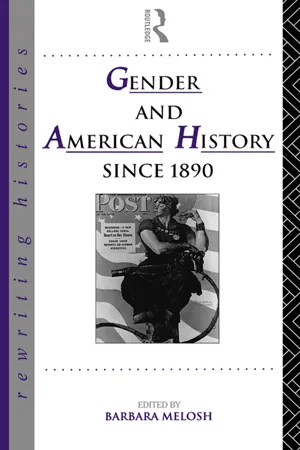
Gender and American History Since 1890
About this book
These essays chart major contributions to recent historiography. Carefully selected for their accessibility and accompanied by headnotes and study questions, the essays offer a clear and engaging introduction for the non-specialist. The introduction describes the emergence of gender as a subject of historical investigation and in ten essays, historians explore the meanings and significance of gender in American history since 1890. The volume shows how the interpretation of gender expands and revises our understanding of significant issues in twentieth-century history, such as work, labour protest, sexuality, consumption and social welfare. It offers new perspectives on visual representations and explores the politics of historical subjects and the politics of our own historical revisions.
1
Introduction
Sex is announced in the first sentence of our social lives. As a baby is born under the bright lights of a twentieth-century American delivery room, the physician declares, “It’s a boy!” or “It’s a girl!” With recent advances in prenatal testing, some expectant parents can even identify the sex of their growing fetuses. As adults, we experience gender as a fundamental part of identity, inseparable from the self. In much contemporary science, biological determinism is gradually replacing an older emphasis on environment, giving new weight to the view of sexual difference as natural, as proceeding from immutable biological difference.
The authors represented in this anthology reject that view. Even the title proclaims a critical stance, for if sexual difference is natural, it can have no history and requires no explanation. The term “gender,” used by every author in this volume, itself signals a certain position in contemporary debates about sexual difference. In 1975, Gayle Rubin’s influential essay “The Traffic in Women” proposed a usage that has been widely adopted.1 “Sex,” she argued, should indicate the biological fact of difference: the chromosomes, hormones, and characteristic anatomical differences associated with male and female. “Gender,” by contrast, would signify the cultural elaborations upon sexual difference, “a socially imposed division of the sexes” (Rubin, p. 179). Rubin viewed biological sexual differences as real and necessary, but she argued that cultural interpretations of these differences exaggerated the extent of difference (pp. 178–80). Her distinction at once conceded sexual difference and rejected it as a sufficient explanation for the sexual inequality and female subordination observable in virtually every human society.
Following Rubin, women’s historians have adopted the term to signal a view of sexual difference as simultaneously arbitrary and deeply embedded – not grounded in the facts of biology, but nonetheless rooted in history and social structure. Though feminists do not share any single view of the relationship of sex and gender, most reject an essentialist position – the view that biology imposes fixed boundaries on male and female behavior, potential, or aspiration. The question of biological difference may never be fully answered, given the complex intertwining of nature and nurture in human development. Meanwhile, it seems reasonable to assume that sexual inequality (readily observable) rather than biological difference accounts for women’s subordinate position in social life.
To the general reader, “gender” might seem to fit easily within the concerns and vocabulary of women’s history, and indeed, for many of the authors in this volume, a focus on gender proceeds from within a commitment to the field of women’s history. But “gender” has also come to connote a departure from women’s history and a searching critique of its politics and intellectual rationale. Historian Joan Wallach Scott has argued that women’s history risks undermining its own political commitments to sexual equality.2 Ironically, the demonstration of women’s historical “otherness,” Scott argues, ultimately reinforces a sense of sexual difference as fixed and immutable. Acknowledging the tremendous vigor and productivity of women’s history, such critics have also noted its relative isolation. “Though women’s historians have taken up interpretive issues and evidence of related fields such as labor history or political history, the transmission has seldom worked the other way: women’s history itself remains “other,” defined as marginal in relation to a partial history that still claims a more universal status for itself.
It is not enough simply to add women’s history to the burgeoning specialties of the historical profession, most women’s historians would agree. Scott argues further that it is not enough to rewrite history by considering the evidence of women’s lives. Instead, we must recognize the defining role of gender as a historical category: a powerful construction about difference that not only shapes sexual division of labor but also deeply informs how historical subjects have imagined politics and society at every level. For Scott, the very language of “women’s history” falsely suggests that women have a history separate from that of men. On the contrary, Scott argues, history itself is written within and helps to reproduce prevailing constructions of gender. The historian’s task, then, is to expose the exclusions and bias of historical claims that neglect women’s lives, and to reveal the fundamental place of gender in social life and culture. In this formulation, gender is not “other,” but is inevitably at the center – pervasive and embedded in the structures of language that define all human experience, past and present.
Historians of gender insist on the universality of that category. Men as well as women are gendered historical subjects, these historians remind us. In addition, they view male and female gender as complementary, cultural categories that define one another. Thus femininity takes on meaning in relation to masculinity; manhood relies on the category of womanhood. Recovering a history of masculinity, then, is an essential task for historians of gender, and recent journal articles and conference presentations demonstrate the heightened attention to male gender.3 However, we currently know much more about the history of female gender, since most scholarship about gender has been done by women’s historians. Thus, this volume includes some essays that deal with manhood and masculinity, but it reproduces the imbalance of existing scholarship in its more extensive discussion of female gender.
Every essay in this volume uses the term “discourse,” testament to the wide ripples cast by French theorist Michel Foucault and the influence of his post-structuralist history.4 Broadly defined, post-structuralism refers to theories that posit knowledge as constructed and partial and that reject claims to authoritative accounts. For post-structuralist literary critics, for example, there is no single Hamlet; instead, the meaning of the play changes as different audiences encounter it. Other important figures in post-structuralist theory include literary critic Jacques Derrida and psychoanalyst Jacques Lacan. Within the discipline of history, Joan Wallach Scott has most fully embraced poststructuralist theory and is its most eloquent spokesperson.5
Translated in the early 1970s, Foucault’s work challenged the foundations of history as a discipline; his theory questioned the validity of an approach that assumed that the past could be reconstructed with some accuracy on the basis of empirical examination of documents and records. Instead, Foucaultargued that historical work essentially invented the past. The historian’s questions, the procedures of deciding what counted as evidence, assembling of evidence into categories, shaping an interpretation – the activities of historical work all imposed a new and necessarily arbitrary order on the chaos and disorder of events. For Foucault, knowledge – including historical knowledge – was always invented and implicitly coercive, an imposition of order that excluded and silenced some voices. He called for a more self-conscious historical practice that focused attention on its own procedures, avoided pronouncements and definitive interpretation, and sought to describe the production of knowledge and its historical effects.
In Foucault’s work, and for the many others who use it, “discourse” refers to unities of theme and shared conventions of knowledge. For example, ideas about sexuality constitute a discourse, and in the twentieth century, medicine and psychoanalysis establish many of the conventions of knowing and describing sexuality. Debates about biological difference constitute another discourse, one that would overlap the discourse on sexuality. The concept of a discourse demands a broad research strategy that crosses traditional disciplinary boundaries: potential sources for the history of sexuality, for example, would include not only psychoanalytic or medical texts but film, fiction, visual art, advertising, marriage manuals, courtship practices, sexual behavior, and law. Post-structuralists use the term “cultural texts” or “texts” to emphasize the connections among such apparently disparate social forms and cultural representations, and also to signal an interpretive approach that claims all of these forms as evidence of discourse. Foucault expressed considerable caution about the idea of discourse itself, warning that it too was a construction subject to the historian’s bias. However, in practice, most post-structuralists (including Foucault) have taken discourse as real and historically accessible and have emphasized its powerful, even determining, social effects. In contrast to earlier readings that take cultural texts as reflections of social life, post-structuralists argue that discourse can itself determine or constitute social life. This position is signaled in terms like the “cultural work” or “ideological work” of the text, “ideological production,” and “construction.”
Thus, the discourses of gender do not merely comment upon or passively mirror sexual difference; rather, discourses define and create what it means to be male and female. Following this post-structuralist argument, most of the authors in this volume use the term “social construction.” That usage takes Rubin’s formulation of sex and gender another step, implying a categorical rejection of any argument that would concede a “natural” distinction between the sexes. For post-structuralists, all of social life is understood through and defined by language; there can be no appeal to “realities” that bypass systems of interpretation.
Historians of gender have pushed against the boundaries of women’s history to argue that cultural constructions of sexual difference fundamentally inform history. Thus the discourses of gender not only regulate the social behavior of men and women in sexuality, family, and work, but they also become ways of ordering politics and of maintaining hierarchies of all kinds. “Gender” describes a fundamental understanding of difference that organizes and produces other relationships of difference – and of power and inequality.6
Post-structuralist assumptions about knowledge and its construction also imply the need for a new kind of historical writing, done in a self-critical voice that would acknowledge the partiality of historical knowledge and the historian’s own implication in the construction of gender. Many of these essays demonstrate the search for new ways of writing history as the authors ponder the problems of evidence and historical interpretation and seek to convey the multiplicity of positions from which historical subjects understood and enacted their lives. As historian Nancy Hewitt and others have pointed out, a critical history of gender must also scrutinize its own claims about the priority of gender.7 Even as the authors represented here consider the weight of gender in American history, they also take account of other significant differences – such as race, class, and sexual orientation – as categories and cultural identities that inform gender and social life.
Post-structuralism supports feminist challenges to the disciplines, and its theories have touched most of the authors represented here. Most notably, these essays demonstrate the influence of post-structuralist attention to language; the authors develop new insights about their subjects through close readings of many kinds of cultural texts, from sex manuals to paintings to symbolic action on the picket line. However, the common vocabulary of terms such as “discourse” and “social construction” is slightly misleading. Few of these authors, and few historians working today, have followed post-structuralist theory to its limit. They have borrowed some ideas from post-structuralist theory, or found it congenial with earlier commitments to interdisciplinary scholarship, but they do not share its ultimate skepticism about historical knowledge. Most would also reject the post-structuralist premise that there can be no distinction between discourse and social experience.
Christina Simmons focuses on the discourses of sexuality in the early twentieth century, but she explains the discourse itself as a response to women’s changing social positions in the early twentieth century and as an effort to name and control changes in sexual practices that predated the articulation of new sexual ideology. Joanne Meyerowitz maintains the same distinction between ideology and experience; indeed, she finds patterns in working-class women’s lives that suggest the limited reach of a middle-class discourse of sexuality. George Chauncey, Jr., and Donna Penn couch their arguments more fully within social constructionist frames, examining competing discourses of sexuality in gay and lesbian history. Ellen Wiley Todd, Melissa Dabakis and I take visual representation as one aspect of the construction of gender, but all probe the relationship of such images to social experience as well as to other texts; discourse is not all. Gail Bederman’s essay represents perhaps the fullest realization of a post-structuralist historical method, for she analyzes gender as it is implicated in and fundamentally shapes the discourses of race and of political power. Jacquelyn Dowd Hall and Linda Gordon have called for revisions of labor history and social welfare history that would recognize the profound significance of gender, but both find their intellectual homes within social and women’s history. Gordon, in addition, has been a vigorous and trenchant critic of Scott and of the uses of post-structuralist theory.8
These essays suggest the outlines of an emerging history of gender in the twentieth-century United States, and they illustrate some of the questions and kinds of evidence that are currently shaping this work. Building on the social and women’s history of the past twenty years, the authors explore twentieth-century constructions of gender as aspects of post-Freudian culture and the changing structure of capitalism. Nineteenth-century Victorian culture described sexual difference in terms of the duties and obligations that followed from men’s and women’s inherent characteristics. Women’s moral superiority made them ideal wives and mothers, charged with the solemn responsibility of guiding errant children and men. Manly character derived from the stern masculine control of sexual impulses and emotion and from steady and resolute application to work. This formulation provided ideological support for an economic structure that increasingly relied on wage work done outside the home and that celebrated striving and unrestrained competition in the quest for profit and productivity.
By the early twentieth century, discernibly different conceptions of gender had begun to displace Victorian manhood and womanhood. With popularizations of Freud, psychoanalysts, medical practitioners, sexual theorists and a broad range of middle-class commentators criticized what they portrayed as Victorian repression and affirmed sexual expression as part of modern marriage. In contrast to Victorian images of women (or at least ladies) as passionless, twentieth-century pundits acknowledged female sexuality and approved women’s sexual expression within marriage. Freudian views of sexuality bolstered emerging homosexual identities: Freudian paradigms for psychosexual development placed new emphasis on object choice (the sex of one’s sexual partner) as a central category of sexuality. Within a burgeoning consumer economy, nineteenth-century ideas of character, demonstrated through hard work, discipline, and restraint, yielded to twentieth-century versions of self-fulfillment through sexuality, family, leisure, and consumption. Paid work, a predominantly masculine realm in the nineteenth century, became increasingly “feminized,” both as more women entered the labor force and as new managerial and sales jobs required men to practice traditionally feminine strategies of persuasion.
In addition to uncovering historical changes in ideas of sexual difference, historians of gender have also emphasized the wide reach of such paradigms of difference. Formulations of difference not only shape historical experiences of maleness and femaleness, but they also inflect economic and political structures. Historians of gender have begun to investigate the gendered meanings of consum...
Table of contents
- Cover
- Half Title
- Title Page
- Copyright
- CONTENTS
- List of Illustrations
- Editor’s Preface
- 1. Introduction
- Part I: Sexuality and Gender
- Part II: Work and Consumption In Visual Representations
- Part III: Gender as Political Language
Trusted by 375,005 students
Access to over 1.5 million titles for a fair monthly price.
Study more efficiently using our study tools.
Frequently asked questions
Yes, you can cancel anytime from the Subscription tab in your account settings on the Perlego website. Your subscription will stay active until the end of your current billing period. Learn how to cancel your subscription
No, books cannot be downloaded as external files, such as PDFs, for use outside of Perlego. However, you can download books within the Perlego app for offline reading on mobile or tablet. Learn how to download books offline
Perlego offers two plans: Essential and Complete
- Essential is ideal for learners and professionals who enjoy exploring a wide range of subjects. Access the Essential Library with 800,000+ trusted titles and best-sellers across business, personal growth, and the humanities. Includes unlimited reading time and Standard Read Aloud voice.
- Complete: Perfect for advanced learners and researchers needing full, unrestricted access. Unlock 1.5M+ books across hundreds of subjects, including academic and specialized titles. The Complete Plan also includes advanced features like Premium Read Aloud and Research Assistant.
We are an online textbook subscription service, where you can get access to an entire online library for less than the price of a single book per month. With over 1.5 million books across 990+ topics, we’ve got you covered! Learn about our mission
Look out for the read-aloud symbol on your next book to see if you can listen to it. The read-aloud tool reads text aloud for you, highlighting the text as it is being read. You can pause it, speed it up and slow it down. Learn more about Read Aloud
Yes! You can use the Perlego app on both iOS and Android devices to read anytime, anywhere — even offline. Perfect for commutes or when you’re on the go.
Please note we cannot support devices running on iOS 13 and Android 7 or earlier. Learn more about using the app
Please note we cannot support devices running on iOS 13 and Android 7 or earlier. Learn more about using the app
Yes, you can access Gender and American History Since 1890 by Barbara Melosh in PDF and/or ePUB format, as well as other popular books in History & North American History. We have over 1.5 million books available in our catalogue for you to explore.