- 356 pages
- English
- ePUB (mobile friendly)
- Available on iOS & Android
eBook - ePub
About this book
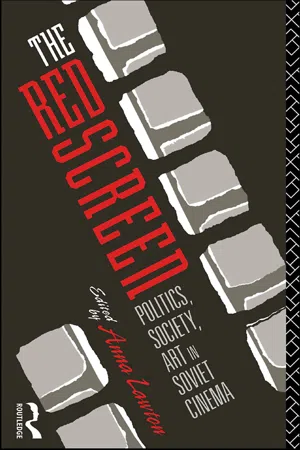
This original collection of essays encompasses seventy years of Soviet cinema from the perspective of twenty academics of different backgrounds and nationalities. The book highlights significant moments in the history of Soviet cinema, providing a challenging montage of detailed `close-ups'. This gives the reader a clear understanding of the aesthetic developments and sociopolitical function of Soviet cinema.
Information
PART ONE
From Potemkin to the Elbe
CHAPTER 1
Government Policies and Practical Necessities in the Soviet Cinema of the 1920s
KRISTIN THOMPSON
Among scholars in the field of cinema who do not study the Soviet film specifically, a myth seems to persist. Many still believe that the Soviet government’s 1919 decree nationalizing the cinema industry automatically meant that the Government undertook to subsidize film production fully. Lunacharsky’s universally quoted attribution to Lenin of the comment that the cinema was, for the Soviets, the most important of the arts has come to imply that the State put a high priority on supplying the industry’s needs. In this view, the slow recovery of the industry after the Revolution, and even the existence of the montage movement, become attributable primarily to the lack of raw stock and equipment caused by the flight of pre-revolutionary producers and to the hardships of the Civil War period.
A number of historians who have concentrated on economic aspects of the Soviet silent era have shown that the Government gave direct subsidies to the film industry only on a limited and inadequate basis; that from 1921 on the industry was expected to put itself on a self-sufficient footing; and that initially the means by which it was expected to do so was by importing and distributing foreign films.1
Revenues from the showing of imported films were crucial to the industry’s recovery. Similarly, all new raw stock and equipment, beyond the small supplies available after the Revolution, had to be brought in from capitalist countries. After 1924, government subsidies increased somewhat, with the purchase of one million rubles’ worth of stock in Sovkino by various government agencies, although credit and the rental of foreign films remained important to Sovkino’s survival. Given these facts, it is desirable to take a closer look at how the Soviet film industry went about its dealings abroad, and how those dealings related to government policy.
THE CIVIL WAR PERIOD: 1918–21
The Moscow Cinema Committee and the Petrograd Cinema Committee were formed in early 1918. Both needed raw stock to be able to produce films, but little was available. The departure of many pre-revolutionary Russian filmmakers, taking their stock and equipment with them, intensified the problem, and the Moscow Soviet’s decree of 17 July 1918 that all raw stock be registered with the city government caused many of those supplies remaining in private hands to be hidden away.2
All this set the stage for the appearance of Jacques Cibrario, a private film-dealer who wrote to the Moscow Cinema Committee in May, proposing that he be designated an agent and sent abroad to purchase whatever materials the Committee needed. The Cibrario affair has often been treated primarily as a sort of tragicomic footnote to the history of the early Soviet cinema, but it seems more likely that it was one of the key events of that period. Narkompros (the Commissariat for Public Enlightenment) had just taken over control of the Moscow Cinema Committee (later the VFKO, or All-Russian Photographic and Cinematographic Section of Narkompros) in May, putting Preobrazhensky in charge of it. In July, Preobrazhensky hired Cibrario to go abroad as the Committee’s representative. Apparently the million dollars deposited in the National City Bank of New York came from the All-Russian Central Executive Committee; Babitsky and Rimberg mention a successful application to that group by the Committee in 1918.3 Cibrario travelled to New York City and proceeded to siphon off large portions of the fund through a dozen dummy companies, allegedly with the cooperation of at least one major American equipment firm. The Soviet authorities did not react to the fraud until mid-1921; on 1 August, Cibrario was arrested and charged with appropriating the Soviet government’s money; the subsequent lawsuit was eventually thrown out of court in December on the grounds that the United States did not recognize the Soviet government, and hence the latter had no right to use the American legal system.4
This episode is one of the few early cases where the Soviet government gave a substantial direct subsidy to the film industry, and the results were disastrous. The country had little enough precious valiuta (foreign currency) on hand without flagrant waste of this sort. Historian Louis Fischer has estimated the total gold reserves on hand in Russia at the time of the Bolshevik Revolution at $500,000,000. Since the holdings were at the same basic level in 1921, we must conclude that few other industries received such favorable gifts of valiuta, given that the Soviets were exporting virtually nothing in the years between.5 When one considers that approximately one five-hundredth of the exportable currency of the new regime was allocated to the rebuilding of the cinema industry, the damage inflicted by Cibrario begins to seem more extensive. Moreover, in 1918, a million dollars would have bought over a thousand professional camera outfits and comparably large quantities of raw stock, processing equipment and finished films. Spent wisely, it would certainly have been enough to outfit several Soviet production units, as well as to provide some foreign films to keep the theaters running.
Nor is there any apparent reason why Committee officials should have made the monumental error of sending an unknown representative into a country that was hostile to the Soviet Union and had no trading relations with it. A far more logical move would have been for some Committee members themselves to go to a much closer and more obvious spot to buy the material: Berlin. Germany had one of the three most important raw-stock manufacturing firms in the world (Agfa), it had a growing domestic production sector, and it boasted a major manufacturer of lighting equipment (Jupiter). Indeed, these are precisely the goods the Soviet industry bought in extensive quantities beginning only four years later.
Moreover, Germany had the obvious advantage of being the only country in the world that had diplomatic and trading relations —albeit somewhat tentative ones—with Soviet Russia as of July 1918. A trade arrangement had been signed in April, in the wake of the Brest-Litovsk Treaty. In addition the German film industry was cautiously interested in opening trade relations with Russia. The German-Russian trade agreement led the main German trade paper, the Lichtbildbühne, to urge film companies to investigate the possibility of dealing with the Russians before they were beaten to the punch by the French, the Italians and the Americans; it published the address of the new export office in Berlin, where export forms were available.6 Representatives of the Russian film industry bearing valiuta in the form of German marks might well have been welcomed.
Indeed, the Petrograd Cinema Committee seems to have tried this more pragmatic approach. In late September the Lichtbildbühne reported that the large government-supported Universumfilm AG (Ufa) had been negotiating for some time and had finally, after many difficulties, arranged to send its films to Russia, to be distributed by the Petrograd group. Taylor claims that, also during September, the Petrograd Cinema Committee had arranged to buy raw stock from the German Kodak firm, “but it was overruled by the government because it involved too many risks on the Soviet side”.7 Whether these two arrangements were part of the same or separate deals, they had no result—and, in any case, they probably came too late in the First World War ever to have been carried through.
Nevertheless, in retrospect it appears that the only plausible way either the Moscow or Petrograd committees could have made successful purchases abroad would have been to act quickly in the summer of 1918 and buy their supplies in Germany. As it was, the fact that Moscow’s million dollars literally went west during the Cibrario affair may well have made the Government reluctant to entrust valiuta or any kind of large subsidy to the cinema industry. In this sense, the Cibrario affair could have been a major contributory factor in setting the Soviet film industry’s recovery back three or four years.
For the rest of the period of the Civil War economy, the Russians remained diplomatically and economically isolated, with little chance to acquire materials abroad legally. The nationalization decree of 27 August 1919 worsened the raw-stock situation as more private cinema producers emigrated. The nationalization culminated, Taylor argues, with the decision on 5 November 1920 to pay cinema workers with state funds. Given that most resources were going into the military at this point, the subsidy was minimal. In other nationalized industries, the “wages” were given in the form of rations and services, and the same was probably often the case in the film industry.8 Since the Government also had made theater admissions either free or very cheap during the Civil War period, the film industry had no way to build up capital. It survived by showing old films, making new ones on what little raw stock was available, and buying smuggled foreign goods.
THE NEW ECONOMIC POLICY: THE GOVERNMENT AND THE FILM INDUSTRY
During the entire NEP period—which for the film industry lasted effectively until about 1931—the Government’s main policy in relation to film was to try to create a central organ which could regulate and coordinate the activities of the various private and regional film companies and which could itself make and distribute films with the type of ideology desirable for the new Soviet society. At every stage through the changes of the VFKO into Goskino (1922) and Goskino into Sovkino (1924–5), the goal was for the Soviet film industry to become self-supporting and to make a profit. This profit could then be used to expand the industry, particularly by setting up thousands of exhibition facilities to serve the far-flung regions of the Soviet Union—that is, the “cinefication” project. At every stage, the Government’s lack of ability or inclination to subsidize the film industry caused problems —either through a basic weakness in the industry itself, or through a perceived overdependence on the import-export trade with capitalist companies abroad.
The NEP was announced in March 1921, it was gradually introduced over the next few months, and it was declared officially on 9 August 1921. The main immediate impact of NEP on the film industry was local: the resurfacing of hoarded raw stock, distribution prints, and equipment—though not in quantities sufficient to create a wide expansion of the industry—and the formation of a number of small private firms.
The beginning of the NEP was followed by the Anglo-Russian Trade Agreement of 24 June 1921, an agreement that effectively broke the Allied blockade of Soviet exportation of goods and gold. By the end of 1921, Russia had signed trade agreements with a number of other nations, including Germany.9 One might expect that another attempt by the film industry to buy goods abroad might have occurred at about this time, yet none did. Possibly there was still hope that part of Cibrario’s million dollars could be recovered through the American courts—though when that hope was dashed in December there was no new allocation of valiuta by the Government to allow the film industry to buy a large quantity of stock and equipment abroad. Moreover, during 1921 the foreign film press was remarkably silent on the prospect of renewed trade with Russia. One of Britain’s leading trade papers, The Bioscope, for example, made no reference to the topic during 1921. I suspect that the European film industry was far more concerned in 1921 with the struggle against the newly dominant Hollywood cinema, and with the prospect of a feared “German invasion” of exports, than with the dubious possibilities of film trade with Russia.
The only country that seemed seriously interested in trade with the Soviets was Germany, and commentators there were cautious. The editor of the Lichtbildbühne noted on 23 October 1920 that the British and the Russians were negotiating, and concluded vaguely that “The German film industry must study the basic Russian situation and keep track of the progress of things with unceasing vigilance, if it doesn’t want to be too late”.10 When Lenin announced the NEP, the Lichtbildbühne recommended that German companies send representatives to Russia to ascertain its film needs, since “it is only a question of time until German films come to Russia”.11 But it was only after the Treaty of Rapallo was signed in April 1922 that legal German-Soviet film trade began. The Soviet film industry’s breakthrough in its import-export situation, and hence in its general recovery, occurred at that time.
Despite the slow recovery in the film industry created by the NEP, governmental policy and neglect hindered its benefits. In 1924 historian Nikolai Lebedev complained:
If the Party had, in good time, at the beginning of NEP, evaluated the significance of the film industry and had assigned to this area a sufficient number of organizers on a sufficient scale, we would at the present time have not only a profitable Soviet film industry, but we would have been quite capable, technically, of organizing the production of new films filled with revolutionary content.
The VFKO, he concluded, was not able to control the...
Table of contents
- COVER PAGE
- TITLE PAGE
- COPYRIGHT PAGE
- INTRODUCTION: AN INTERPRETIVE SURVEY
- PART ONE: FROM POTEMKIN TO THE ELBE
- PART TWO: FROM THE THAW TO THE NEW MODEL
- NOTES ON CONTRIBUTORS
Trusted by 375,005 students
Access to over 1.5 million titles for a fair monthly price.
Study more efficiently using our study tools.
Frequently asked questions
Yes, you can cancel anytime from the Subscription tab in your account settings on the Perlego website. Your subscription will stay active until the end of your current billing period. Learn how to cancel your subscription
No, books cannot be downloaded as external files, such as PDFs, for use outside of Perlego. However, you can download books within the Perlego app for offline reading on mobile or tablet. Learn how to download books offline
We are an online textbook subscription service, where you can get access to an entire online library for less than the price of a single book per month. With over 1.5 million books across 990+ topics, we’ve got you covered! Learn about our mission
Look out for the read-aloud symbol on your next book to see if you can listen to it. The read-aloud tool reads text aloud for you, highlighting the text as it is being read. You can pause it, speed it up and slow it down. Learn more about Read Aloud
Yes! You can use the Perlego app on both iOS and Android devices to read anytime, anywhere — even offline. Perfect for commutes or when you’re on the go.
Please note we cannot support devices running on iOS 13 and Android 7 or earlier. Learn more about using the app
Please note we cannot support devices running on iOS 13 and Android 7 or earlier. Learn more about using the app
Yes, you can access The Red Screen by Anna Lawton in PDF and/or ePUB format, as well as other popular books in Media & Performing Arts & Film History & Criticism. We have over 1.5 million books available in our catalogue for you to explore.