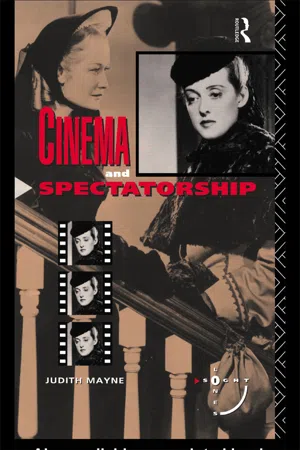
Cinema and Spectatorship is the first book to focus entirely on the history and role of the spectator in contemporary film studies. While 1970s film theory insisted on a distinction betweeen the cinematic subject and film-goers, Judith Mayne suggests that a very real friction between "subjects" and "viewers" is in fact central to the study of spectatorship.
In the book's first section Mayne examines three theoretical models of spectatorship: the perceptual, the institutional and the historical, while the second section focuses on case studies which crystallize many of the issues already discussed, concentrating on textual analysis, the `disrupting genre', `star-gazing' and finally the audience itself. Case studies incude the place of the spectator in the textual analysis of individual films such as The Picture of Dorian Gray; the construction of Bette Davis' star persona; fantasies of race and film viewing in Field of Dreams and Ghost; and gay and lesbian audiences as "critical" audiences. The book provides a very thorough and accessible overview of this complex, fragmented and often controversial area of film theory.
- 198 pages
- English
- ePUB (mobile friendly)
- Available on iOS & Android
eBook - ePub
Cinema and Spectatorship
About this book
Information
Part I
THEORIES OF SPECTATORSHIP
1
THE SUBJECT OF SPECTATORSHIP
The notion of cinema as an institution is central both to spectatorship as defined in 1970s film theory and to more recent reformulations. In order to contextualize this discussion of spectatorship, it is important to understand what is meant by the idea of cinema as an “institution” and what it means to define the cinematic spectator as part of this institution. Two enormously influential works, both published in 1970 in France (and in English translation shortly thereafter), established a frame of reference for questions of the subject, representation, and discourse which would be taken up by film theorists in their exploration of cinema as an institution. Louis Althusser’s essay “Ideology and Ideological State Apparatuses (Notes Toward an Investigation)” contains many of the assumptions about the nature of ideological representation which would be applied to film, while Roland Barthes’s S/Z, a detailed reading of the novella Sarrasine by Honoré de Balzac, was perhaps the most influential single work to define the scope of textual analysis in 1970s film theory, that is, analysis of both the structures of film representation and of what exceeds, problematizes, or otherwise puts those structures into question.
Althusser’s essay challenged the traditional Marxist notion of ideology as “false consciousness” or simple distortion of the economic realities of a given culture. Althusser draws a parallel between the traditional Marxist definition of ideology and the way dreams were understood prior to Freud: “the purely imaginary, i.e. null, result of ‘day’s residues,’ presented in an arbitrary arrangement and order…. This is exactly the status of philosophy and ideology…in The German Ideology” (1971:159–60). Freud insisted upon the complex function of dreams, and Althusser similarly argues that ideology cannot be dismissed as the simple distortion of the economic base. Althusser emphasizes, rather, that ideology, in his famous definition, “represents the imaginary relationship of individuals to their real conditions of existence” (162). This definition of ideology became one of the most basic working assumptions of all 1970s film theory. The key shift here is the move away from ideology as false consciousness, and toward a concept of ideology that emphasizes not only its interpretive function, but its necessary function in any culture. At the same time, Althusser emphasizes that ideology “has a material existence” (165), and therefore needs to be understood and analyzed in similarly material terms. It is not enough, in other words, to demonstrate how ideologies of, for instance, religion, gender roles, and the arts “support” and “reflect” the capitalist mode of production; rather, the internal and “relatively autonomous” (to use Althusser’s phrase) structures of these ideologies require analysis.
For the study of cinema, Althusser’s intervention was taken as validation of the view that in order to understand how cinema functioned ideologically, it was not enough to submit films to a test to determine a political content distilled and rendered from the vehicle of the film. Rather, it was the “vehicle” itself—the situation of film viewing, the nature of film language—that required explanation. Even more important for the study of cinema was Althusser’s insistence that “there is no ideology except by the subject and for subjects” (170). Ideology consists, then, of the very process of “ ‘constituting’ concrete individuals as subjects” (171), of effects of recognition and identification, of structures of address. Althusser uses the term “interpellation” to define this process whereby individuals respond to ideologies by recognizing themselves as the subjects of ideology. Again, the importance of such a notion of ideological interpellation for the study of film cannot be overestimated, for what Althusser’s analysis foregrounds is the need to understand just how and why ideological systems interpellate their subjects so effectively. Study of interpellation, or the subject effect in film, then, was designed to explore how film-goers become subjects, how the various devices and components of the cinema function to create ideological subjects.
The details of how the various ideological systems “interpellate” are not worked out in Althusser’s essay (aside from a rather cursory exploration of Christian ideology). But in Roland Barthes’s S/Z, film theorists found a literary model for analysis of the subject effect, one which became enormously important in the development of textual analysis in film studies. Indeed, many of the names recognized as most important to textual analysis in film had close affiliations with Barthes—Thierry Kuntzel and Stephen Heath were his students (Kuntzel’s first contribution to film textual analysis was published in a special issue of Communications guest-edited by Barthes; Heath wrote a full-length study of Barthes in French), and Raymond Bellour was a longtime colleague. Now Barthes was not a Marxist, at least not at all in the same way as Althusser (who was a member of the FrenchCommunist Party), yet ideology also is at the core of his analysis of how the narrative seduces the reader through the interaction of a variety of codes, formalized vehicles of meaning.
More specifically, Barthes’s analysis of Sarrasine, his breakdown of the tale into 561 units of meaning, or “lexia,” engages with the structure of narrative—with how, that is, a narrative text organizes meaning and addresses its readers in specific ways. Two procedures of Barthes’s analysis in S/Z are particularly relevant to the development of film studies. First, the working distinction of the analysis is between the “readerly” (le lisible) and the “writerly” (le scriptible). The concept of discourse—of the conventions of language—is crucial; whereas “readerly” discourse presents the reader “with a world that is coherent, well-ordered and already meaningful,” the writerly “does not assume the meaningfulness and coherence of discourse but rather challenges it, and in so doing challenges the reader as well, shaking his or her assumptions and conventions about literature and about one’s very judgement of reality in the day-to-day world” (Mayne 1977:42). The distinction between the readerly and the writerly appears to reflect the distinction between realist and experimental writing, but Barthes undoes any such easy opposition by proposing what he calls the “limited plurality” of the realist text, a plurality uncovered by the strategies of reading. This “limited plurality” challenges the order and coherence of realism, allowing for possibilities of multiple, shifting, and sometimes contradictory meanings.
Second, Barthes proposes five codes to organize his reading of the novella. While it could be said that the codes are defined somewhat arbitrarily, they offer a unique example of analysis that combines several points of reference—cultural and psychoanalytic as well as narrative. In other words, Barthes’s reading refuses to foreground any one code as the ultimate determination of meaning. Rather, the very nature of reading occurs through the constant interplay of various codes. Three of these codes (the hermeneutic code, whereby a question is posed and answers delayed; the semic code, whereby characters are created and defined; and the proairetic code, or code of actions, whereby events are defined in a structured way) concern narrative devices, particularly insofar as realism is concerned. The remaining two codes—the referential code and the symbolic code—refer more to cultural knowledge and to the body as theorized in psychoanalysis, respectively. Of course these two codes are narrative codes as well, but with more specifically defined cultural and psychoanalytic contours.
Put another way, then, Barthes’s analysis defines an approach to the study of textuality that “reads” in a “writerly” fashion, attentive not to any single determination but rather to how textuality is formed by the interplay of different discourses—political, narrative, psychoanalytic.While S/Z may appear to be far more engaged in the details of representational strategies than Althusser’s account of ideology, it is important to understand the interplay between these approaches in order to situate the evolution of 1970s film theory. For both Althusser and Barthes, ideology—whether it be the ideology of Christianity or the ideology of realism—must be understood, first and foremost, as a representational system which addresses subjects. Furthermore, the very process of reading is foregrounded as a means of comprehending the complex ways in which subjects are addressed. Here, there is a significant divergence between Althusser’s and Barthes’s positions. In another context, Althusser coined the phrase “symptomatic reading,” that is, a reading which is attentive not only to the apparent dominant structures of a text but also and especially to what is omitted, repressed, or otherwise marginalized (1968:28–9). To read symptomatically is to read against the grain of the text, that is, to read critically. Barthes’s notion of a “limited plurality” in realist discourse is just such a reading. But whereas Barthes reads against the grain and discovers that the codes of realism are far less coherent than what immediately appears to be the case, Althusser makes a sharp distinction between the recognition of ideology and true knowledge of its functioning:
you and I are always already subjects, and as such constantly practice the rituals of ideological recognition, which guarantee for us that we are indeed concrete, individual, distinguishable and (naturally) irreplaceable subjects…. But to recognize that we are subjects and that we function in the practical rituals of the most elementary everyday life (the hand-shake, the fact of calling you by your name …)—this recognition only gives us the “consciousness” of our incessant (eternal) practice of ideological recognition—its consciousness, i.e. its recognition— but in no sense does it give us the (scientific) knowledge of the mechanism of this recognition.
(172–3)
In order to achieve this scientific knowledge, Althusser claims that “we have to outline a discourse which tries to break with ideology, in order to dare to be the beginning of a scientific (i.e. subjectless) discourse on ideology” (173). For the introductory purposes of this chapter, it is important to comprehend the different stakes attributed to analysis of the subject and ideology. The “subjectless” discourse on ideology would be virtually impossible in Barthes’s account, in which there are multiple subject positions but never a discourse without a subject.
The difference in question is one of the most misunderstood aspects of 1970s critical theory, the difference between the “individual” and the “subject.” One is not a subject, although one responds to numerous subject positions; too often the claim, by 1970s theorists, that the “subject” is a discursive position and not a real person is taken to mean that the experiences of living, breathing communities comprised of individuals are not of interest to the loftier preoccupations of theorists. To be sure, some 1970s theorists were not in the least bit interested in the lives of real people, but more relevant to the present discussion is the critique that was made of the tendency in middle-class, Western cultures to understand the “real person” in terms of a universal “human nature”—that is, as an entity outside of history, outside of social constructions, yet available to common sense or consciousness. That the immediate association between subject positions and real people is nonetheless quite difficult to shake is amply demonstrated in Althusser’s essay, where despite the initial distinction between subjects and individuals, the confusion persists (Heath 1979).
The very possibility of imagining a “discourse without a subject” points to another important distinction between Althusser’s and Bar-thes’s different accounts of ideology and the subject. The move from structuralism to post-structuralism is generally seen as one of the most significant shifts in contemporary critical theory (Lentricchia 1980). If structuralism assumed the ultimate readability of discourse and the attendant possibility of deciphering the meanings attributed to its codes, post-structuralism is less optimistic about any such finalizing knowledge of textuality. Rather, post-structuralists assume—and Barthes’s analysis of Sarrasine has been a model for such investigation—that structures and codes are always provisional, and that a reading of what falls through the cracks of dominant structures is ultimately more productive. While I am putting Althusser in the “structuralist” camp and Barthes in the “post-structuralist” one, these divisions and shifts are never so clear-cut, since there are plenty of post-structuralist elements in Althusser’s work, just as the 561 lexia in Barthes’s analysis reveal the structuralist legacy. Indeed, Althusser’s notion of symptomatic reading is post-structuralist, but his assumption that it is possible to move outside of ideology is not.
The examples of these influential works by Althusser and Barthes illustrate the importance of the subject, of discourse, of textual and ideological analysis. Methodologically, and following from the distinctions and similarities I have outlined between Althusser and Barthes, the contributions of 1970s film theory may be defined along two axes. First, the works of Jean-Louis Baudry and Christian Metz in France, and Laura Mulvey in Great Britain, have been most important to the definition of how the cinema functions as an institutional apparatus, a standardized arrangement of component parts, a machine with a variety of interlocking functions. The emphasis, in their analyses, is on the cinematic institution insofar as certain structures are virtually always part of what constitute the pleasures of film-going. For all three of these theorists, these pleasures are identified through the insights of psychoanalysis as they illuminate the study of ideology. Virtually all theorists of the apparatus assume a monolithic quality to the cinema, that is, the cinema works to acculturate individuals to structures of fantasy, desire, dream, and pleasure that are fully of a piece with dominant ideology.
This monolithic quality of the cinema is double-edged, referring simultaneously to large structures of the cinematic experience, at least insofar as mainstream film is concerned, as well as to the need to redefine those large structures so as to assure their continuing relevance. For Baudry, the cinema creates a regressive state in the spectator, a return to the sensations of infantile wholeness, and for Metz, that regressive state encourages the possibilities to reactivate the “imaginary signifier,” that is, a host of traumas associated with the development of subjectivity—voyeurism, the primal scene. For Mulvey, the mainstream cinema is made to the measure of male desire, and the various devices central to the classical Hollywood cinema all serve to facilitate the identification of the male spectator with his like, the male protagonist on screen. In other words, then, theorists of the apparatus are concerned to demonstrate how the large structures of the cinema operate.
Second, while often informed by apparatus theory, the works of Raymond Bellour, Stephen Heath, and Thierry Kuntzel are more specifically concerned with how the cinematic institution functions in textual terms. Methodologically, then, this means that the concern is with detailed analysis of individual films insofar as they represent the cinematic institution. If theorists like Metz, Baudry, and Mulvey demonstrate the institutional qualities of spectatorship by examining the (classical) cinema in general, textual theorists take as their point of departure the micro-structures of the film text. All of these theorists, whether concerned with the apparatus or with the individual text, end up at the same point, the analysis of cinema as an institution; but in order to arrive at this understanding they take very different points of departure. The primary cinematic tool for textual theorists was a Steenbeck editing table or an analyst projector whereby the individual film is broken down into its smallest components in order to discern the structures central to classical film. Individual shots are timed, dialogue is transcribed and measured in relationship to image/sound relationships, editing patterns are recorded, systems of similarity and difference underpinning narrative and ideological meanings are constructed. For those preoccupied with the cinema as an apparatus, the primary tool is observation and analysis of the cinema in a situational sense—the nature of film viewing and the features common to all or most films.
I want to emphasize that my division of the most influential 1970s film theorists into the “apparatus” and “textual analysis” tendencies is provisional. I am aware, as well, that such a categorization of “important figures” does not entirely do justice to the actual historical development of film theory in the 1970s, particularly insofar as journals were concerned. Of course, the contributions to the journals most central to theoretical discussions were usually signed by individuals, although one important exception to the rule was Cahiers du cinema, where jointly authored texts or texts signed only collectively were common. Individual journals also were affiliated with various positions concerning film spectatorship; in France, for instance, debates between Cahiers du cinema and Cinéthique (where one of Baudry’s most influential essays was published) were common. One such debate concerned the possibility of anything in film akin to Barthes’s “limited plurality,” and in essays that have been enormously influential in film studies, the Cahiers’s editors argued that some exceptional films contain an “internal criticism … which cracks the film apart at the seams. If one reads the film obliquely, looking for symptoms; if one looks beyond its apparent formal coherence, one can see that it is riddled with cracks: it is splitting under an internal tension which is simply not there in an ideologically innocuous film” (Comolli and Narboni 1969/ 1977:7). The symptomatic status of this category of films is most worked out in the Cahiers’s collective analysis of John Ford’s Young Mr. Lincoln (Cahiers du cinema 1969/1972). Essays in Cinéthique were far less concerned with explorations of individual Hollywood films, and more concerned to demonstrate the homogeneity of the classical cinema.
Common to both apparatus and textual theorists was an emphasis on psychoanalysis far more pronounced than one finds in Althusser or Barthes, and many of the debates that occurred in film studies concerned precisely this emphasis. Indeed, in Britain the focus on psychoanalysis in Screen—arguably the most influential journal for film studies—initiated a conflict among the editors and an eventual departure of several of them (see Screen Editorial Board 1975; Buscombe, Gledhill, Lovell, and Williams 1975–6). In the US, Screen in particular and French theories of representation in general were often criticized in the pages of journals like Film Quarterly (where the English translation of an essay by Baudry appeared with something close to an apology) and Jump Cut for their uncritical use of psychoanalysis, particularly insofar as questions of gender and feminism were concerned (Lesage 1974).
Textual theorists used psychoanalysis in order to demonstrate how the most specific devices of the classical Hollywood cinema—like the use of close-ups, the relationship between sound and image, the use of shot-reverse shot—positioned spectators in such a way as to be defined within scenarios of desire theorized by psychoanalysis. Apparatus theorists explored parallels between film viewing—sitting still in a darkened theater before a screen—and situations central to psychoanalytic understanding of the subject—dreams and regression in particular. Indeed, if there is any single common denominator to all of 1970s film theory, it is the appeal to psychoanalysis as the privileged term for an understanding of how the cinema operates as an ideological medium. Now what is at stake here is not just the prominence of psychoanalysis, but more specifically of psychoanalysis as companion to ideological analysis. In other words, virtually all of the characteristics of the cin...
Table of contents
- COVER PAGE
- TITLE PAGE
- COPYRIGHT PAGE
- ILLUSTRATIONS
- ACKNOWLEDGEMENTS
- INTRODUCTION
- PART I: THEORIES OF SPECTATORSHIP
- PART II: READINGS OF SPECTATORSHIP
- WORKS CITED
Trusted by 375,005 students
Access to over 1.5 million titles for a fair monthly price.
Study more efficiently using our study tools.
Frequently asked questions
Yes, you can cancel anytime from the Subscription tab in your account settings on the Perlego website. Your subscription will stay active until the end of your current billing period. Learn how to cancel your subscription
No, books cannot be downloaded as external files, such as PDFs, for use outside of Perlego. However, you can download books within the Perlego app for offline reading on mobile or tablet. Learn how to download books offline
Perlego offers two plans: Essential and Complete
- Essential is ideal for learners and professionals who enjoy exploring a wide range of subjects. Access the Essential Library with 800,000+ trusted titles and best-sellers across business, personal growth, and the humanities. Includes unlimited reading time and Standard Read Aloud voice.
- Complete: Perfect for advanced learners and researchers needing full, unrestricted access. Unlock 1.5M+ books across hundreds of subjects, including academic and specialized titles. The Complete Plan also includes advanced features like Premium Read Aloud and Research Assistant.
We are an online textbook subscription service, where you can get access to an entire online library for less than the price of a single book per month. With over 1.5 million books across 990+ topics, we’ve got you covered! Learn about our mission
Look out for the read-aloud symbol on your next book to see if you can listen to it. The read-aloud tool reads text aloud for you, highlighting the text as it is being read. You can pause it, speed it up and slow it down. Learn more about Read Aloud
Yes! You can use the Perlego app on both iOS and Android devices to read anytime, anywhere — even offline. Perfect for commutes or when you’re on the go.
Please note we cannot support devices running on iOS 13 and Android 7 or earlier. Learn more about using the app
Please note we cannot support devices running on iOS 13 and Android 7 or earlier. Learn more about using the app
Yes, you can access Cinema and Spectatorship by Judith Mayne in PDF and/or ePUB format, as well as other popular books in Media & Performing Arts & Film History & Criticism. We have over 1.5 million books available in our catalogue for you to explore.