- 200 pages
- English
- ePUB (mobile friendly)
- Available on iOS & Android
eBook - ePub
About this book
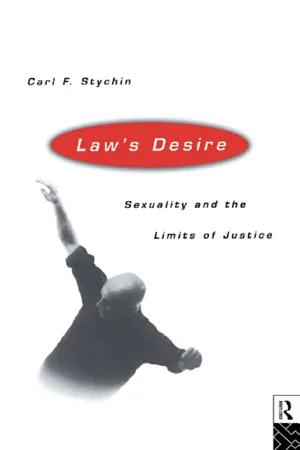
The law is one of the primary means through which sexuality is constructed, monitored and controlled. In this much needed book, Carl Stychin provides a critical examination of the relationship between law and sexual orientation in the United States, the United Kingdom and Canada. The author exposes the connection between the law and sexual control through an exploration of key questions of current interest and controversy. He examines the motivations behind legal restrictions, and the impact on sexual subcultures and dominant society.
1
IDENTITIES, SEXUALITIES,
AND THE POSTMODERN
SUBJECT
An analysis of funding by the National
Endowment for the Arts
In this first chapter I examine the ongoing issue of arts funding by the National Endowment for the Arts (NEA) in America. Perhaps more than any single area of legal regulation in the United States (other than sodomy laws themselves), the NEA has featured as an arena of controversy in the past several years. This is due to the focus of attention on how funded (and ‘ defunded’) cultural works touch issues of lesbian and gay sexuality. The conflict over arts funding heats up with a certain regularity and often with a fierce intensity, such as in the campaign by Patrick Buchanan to unseat George Bush for the Republican presidential nomination in 1992. Claims that the President was ‘ soft’ on arts funding for gay-themed works were framed as an example of weakness in the face of subversive forces at work within the nation.
The NEA funding controversy highlights several themes which will prove central to the studies in this book. First, the implicit justification for the legal initiatives is that cultural representations have a tremendous power to promote sexual practices and identities and to erode the ‘ core’ values of America itself. Second, the issue demonstrates the centrality of rights in American constitutional discourse and the power of free speech rights to ‘ trump’ competing rights claims. The question of whether it is permissible for the legislature to provide funding for some artistic endeavours and not for others based on sexual content becomes transformed into an appeal to the language of rights by lesbians and gay men, as well as by religious minorities and ‘ mainstream’ America. Third, the debates in Congress over NEA funding suggest that proponents of legal restriction on funding explicitly accept the social constructedness of sexual identity, since the rationale behind legal intervention in large measure is the cultural seductiveness of representation and its power to seduce the unwary into a homosexual ‘ lifestyle’.
In response to this perceived threat, the late 1980s and 1990s have seen numerous attempts to make grants to artists conditional upon assurances that their works do not depict the obscene. Some of these political interventions have been successful, and the contestation over the issue continues. Without question, the debate has largely focused upon the funding of artistic works which present lesbian and gay images. Grants have been denied to artists whose works depict a lesbian or gay identity, and even when grants have been approved, the storm of controversy has not dissipated. Not surprisingly, this environment of content-based control of artistic funding gave rise to questioning of the constitutionality of explicit Congressional restrictions and their application by the NEA.
In this chapter, I first review the chronology of events in the NEA saga and the constitutional implications raised. I then argue that the constitutional analysis of this issue was less than robust given the constraints of American rights discourse. I develop an alternative approach which draws upon a number of theoretical strands — postmodernism, poststructuralism, and critical film and literary theory — and I argue that the restrictions on arts funding amounted to a fundamental violation of American constitutional values because, when successful, they have denied some citizens the right to articulate a political identity. This theoretical framework informs my analysis throughout the book. In order to substantiate this thesis, I analyse postmodern theories of the subject and their role in the cultural conditions of postmodernity; in this way I hope to provide a theoretical foundation for understanding how identities are formed and expressed in the cultural environment of the late twentieth century. Next, I focus on the importance of constructing new forms of political subjectivity through cultural production and consumption. This analysis of discourse theory will be explored using a vision of equality that emphasises the dialogic — the fundamental right to participate in a conversation in an ongoing attempt to define and contest identity. After establishing this theoretical groundwork, I turn to an example of particular relevance to the NEA — the formation and articulation of a gay identity within our cultural environment. Particular cultural practices will be explored in order to establish that restrictions on arts funding that limit the articulation of a gay identity are a denial both of the right to political expression and of a dialogically based right to the equal protection of the law. Moreover, such restrictions are unenforceable in a sense because they misconceive the role of culture and the diverse meanings of a representation. The uncontrollability of representations, in terms of their meaning to cultural consumers, ensures that any representation may become the basis for the forging of a new and potentially subversive political identity. Restrictions, then, are objectionable both because they are contrary to American constitutional values and, moreover, because they are impossible to enforce effectively due to the unpredictability of the ways in which a cultural artefact will be deployed.
THE NEA AND THE LIMITS TO
REPRESENTATION
Recent political intervention in the National Endowment for the Arts has become well known and continues to raise controversy. Some background on the disbursement of grant money may provide a useful starting point for analysis. The NEA was created in 1965 as a means for public financial support of the arts through an agency with independent grant-making powers. The Endowment's mandate is to sponsor works of artistic or cultural significance through grants to individuals of exceptional talent. The Endowment was intended to be free from political influence in its grant-making decisions, which were to be based upon the recommendations of peer review panels of professional artists expert in particular fields. The final funding decisions have always rested with the Chairperson of the Endowment, an appointment made by the President of the United States, with the advice and consent of the Senate.1
It is not surprising that funding decisions in the past have occasionally given rise to controversy. Since the creation of the NEA, there has been criticism of individual funding decisions and general policy, often centring upon competing claims of cultural elitism and populism. In addition, dramatic budget-cutting in the name of national debt reduction produced an angry response from the arts communities in the early 1980s. However, the vehemence of the reaction to two funding decisions that came to light in 1989 was unprecedented and underscored how a new cultural agenda was being set in place. The first was the posthumous NEA-sponsored travelling exhibition entitled Robert Mapplethorpe: The Perfect Moment. This was scheduled to appear at the Corcoran Gallery in Washington D.C., but was cancelled by the Gallery in response to political pressure. The Mapplethorpe retrospective included his controversial X Portfolio, largely consisting of sadomasochistic gay male imagery. It also included the Υ Portfolio, which comprised Mapplethorpe's frequently criticised photographs of African American men. The second work was by artist Andres Serrano, who had received NEA funding for his Piss Christ, a plastic crucifix submerged in a glass tank of urine.
In response to these funding decisions, Senator Jesse Helms intervened as a critic of the NEA. His attack alternated between the ‘ blasphemy’ of Serrano's Piss Christ and the ‘ perversity’ of Mapplethorpe's X Portfolio. In calling for an end to government subsidy of projects akin to these, Helms considered at some length the implications of Mapplethorpe's photographs. For the Senator, this work ‘ha[d] a political and social dimension’ :
the art critics acknowledge that Mapplethorpe's obscene photographs were an effort to gain wider exposure of, and acceptance for, homosexuality -which happens to be the stated political goal of all homosexual pressure groups. For instance, the catalog for the Mapplethorpe exhibit at the Whitney Museum of Modern Art concedes that Mapplethorpe felt sadomasochism … was an almost obligatory subject for him to treat and that “he reported it not as a voyeur, but as an advocate.”2
Thus, it was the power of representations not only to expose a lifestyle to public view, but to further the acceptance and promotion of that lifestyle that was particularly troubling for Helms. This is the political dimension of the work which provided a rationale for a political response to its subsidy by a governmental agency.
Senator Helms proposed a statutory restriction as a condition for the appropriation of funding for the NEA, which he introduced on 26 July 1989. It provided that: None of the funds authorized to be appropriated pursuant to this Act may be used to promote, disseminate, or produce -
(1) obscene or indecent materials, including but not limited to depictions of sadomasochism, homo-eroticism, the exploitation of children, or individuals engaged in sex acts; or
(2) material which denigrates the objects or beliefs of the adherents of a particular religion or non-religion; or
(3) material which denigrates, debases, or reviles a person, group, or class of citizens on the basis of race, creed, sex, handicap, age, or national origin.3
Clearly, Helms sought to respond directly both to the Mapplethorpe exhibit and the Serrano piece. With respect to Serrano, clause (2) attempted to foreclose such a funding decision in the future. With respect to Mapplethorpe, the prohibition on the obscene and indecent, and the explicit references to sadomasochism, homo-eroticism, and children cut a sufficiently wide swathe to include all of the photographs that Helms found offensive.
The original wording of the ‘Helms Amendment’ also was significant for the way in which it focused attention on group rights as a justification for restrictions on arts funding. Those groups that warranted protection from the ‘ harm’ included religious minorities as well as racial, sexual and other groups. Clauses (2) and (3) explicitly deployed the language of group harm inflicted through another's self-expression. Previously, this argument had been used primarily by minority groups in the context of racial and sexual hate speech. Helms' appropriation of the idea of harm caused by representation also had a superficial resemblance to arguments developed by anti-pornography feminists.4 In this context, though, the language of minority protection from hateful representations is reworked in order to protect the sensibilities of mainstream America and the American Christian community. The supporters of the amendment sought to analogise the treatment of Christians at the hands of Serrano to intolerance directed against religious and racial minorities. As one Congressman pondered:
one wonders how many of those who are aggressively opposing the setting of these standards would be doing so, if it had been a photo of Martin Luther King or a symbol of the Jewish faith that had been submerged in a bottle of urine at taxpayers' expense.5
Furthermore, it was alleged that the constitutionally imposed separation of church and state in America was infringed by government-funded ‘anti-Christian’ art. Opponents of the amendment also argued within a framework of religious faith, emphasising not only their own deeply felt Christian beliefs, but also the dangers of religious fanaticism implicit in ‘an amendment which would give an Ayatollah Khomeini or the like the right to veto the grants of the National Endowment for the Arts’.6
After Congressional debate, the amendment was modified through the withdrawal of clauses (2) and (3) and the removal of the reference to indecency in clause (1). The focus thus shifted away from Serrano and religious offensiveness, and towards work that might be considered obscene. The justification for the amendment thus became more obvious and was clearly targeted at the Mapplethorpe exhibit. Simply put, it was argued that the taxpayer should not be expected to fund cultural work that is obscene, pornographic, or as Senator Helms argued, vulgar, sick, and unspeakable. However, there also was included a new provision which stated that work with serious artistic value was not precluded from receiving funding. But for those members of Congress supporting the bill (and indeed for most of those opposing it) there seemed no issue as to the merit of Portfolio X itself — one member claimed that ‘99.9% of Americans would categorically define [it] as obscene garbage’.7 Some politicians went further, and attributed an overwhelming symbolic value to any representation of gay sexuality, finding that NEA funding decisions exemplified an ongoing battle against the ‘eroding [of] the moral structure of our country’ by something ‘inherently evil’.8 For one member of Congress, the battle lines were all too clear, and this controversy was:
the symptom of a moral decay in a society that has lost the ability to say that there are standards in this world that govern mankind down through time and that are valid, traditional family values, where we have the courage as leaders of the country to stand up and say what is junk and what is good literature, what is pornographic, and what we are going to tolerate.9
In fact, the determination of what is unacceptable was explicit in the ‘Helms Amendment’. The intent was to ensure that funds would not be made available to artists who would then produce a work that might be considered obscene and, given the definition, that meant anything that depicted the undefined ‘homo-erotic’. Moreover, because the amendment included in its list of prohibited representations ‘individuals engaged in sex acts’, the further inclusion of the term ‘ homoeroticism’ logically implied something other than the depiction of same-sex acts. It suggested rather that funding of any representation of lesbian or gay sexuality was foreclosed. Carole Vance has argued that the amendment had a particular ‘linguistic elasticity’ because it left unanswered the question of whether peer review panels should reject all proposals that might offend any group, and whether any representation that the proponents of the amendment would object to is then necessarily deemed obscene.10 Finally, the phrase ‘may be considered obscene’ suggested that the discretion left to the Endowment was sufficiently wide as to be beyond review in court.
There were other feats of linguistic gymnastics in the amendment. The exempting clause that permitted funding of works of serious value was difficult to square with the rest of the amendment. If a peer review panel determines that a project is worthy of funding, does it, by definition, possess serious artistic value which overrides the other statutory clauses? If that is the case, however, then the entire amendment becomes devoid of meaning, since it merely reiterates what already was obvious; namely, that funding is to be awarded on the basis of artistic excellence. The amendment also implied that representations of sadomasochism, homoeroticism, and the other examples necessarily are obscene by reason of content alone. However, in American constitutional law the definition of obscenity, which can be legally proscribed, is narrow, and convictions under obscenity law are extremely difficult to obtain.11 The narrowness of this legal test appears to be replaced by a much broader definition that turns on offensiveness to groups in general. Finally, as a symbolic matter, the grouping together of homoeroticism, sadomasochism, sexual acts, and the exploitation of children further reinforces the construction of lesbians and especially of gay men as perverse and degenerate.
Despite its apparent incoherence, the ‘Helms Amendment’ was far from ineffective both symbolically and practically. It easily passed into law and, in response, recipients of funding were required to certify that no federal funds would be used to promote material that could be deemed obscene, including, but not limited to, the various categories of representation prohibited by the amendment. Not long thereafter, Congress also enacted a number of structural changes to the National Endowment for the Arts. The composition of peer review panels was to explicitly reflect ‘diverse artistic and cultural points of view’ and to include non-artis...
Table of contents
- Cover
- Half Title
- Full Title
- Copyright
- Dedication
- Contents
- Acknowledgements
- INTRODUCTION
- 1 IDENTITIES, SEXUALITIES, AND THE POSTMODERN SUBJECT : AN ANALYSIS OF FUNDING BY THE NATIONAL ENDOWMENT FOR THE ARTS
- 2 OF PROHIBITIONS AND PROMOTIONS
- 3 THE PORN WARS: FEMINISM AND THE REGULATION OF GAY MALE PORNOGRAPHY
- 4 OF REPRESENTATION AND REALITY
- 5 INSIDE AND OUT OF THE MILITARY
- 6 EQUALITY RIGHTS, IDENTITY POLITICS, AND THE CANADIAN NATIONAL IMAGINATION
- 7 UNMANLY DIVERSIONS: THE CONSTRUCTION OF THE HOMOSEXUAL BODY (POLITIC) IN LAW
- 8 TOWARDS A QUEER LEGAL THEORY
- Notes
- Index
Trusted by 375,005 students
Access to over 1.5 million titles for a fair monthly price.
Study more efficiently using our study tools.
Frequently asked questions
Yes, you can cancel anytime from the Subscription tab in your account settings on the Perlego website. Your subscription will stay active until the end of your current billing period. Learn how to cancel your subscription
No, books cannot be downloaded as external files, such as PDFs, for use outside of Perlego. However, you can download books within the Perlego app for offline reading on mobile or tablet. Learn how to download books offline
Perlego offers two plans: Essential and Complete
- Essential is ideal for learners and professionals who enjoy exploring a wide range of subjects. Access the Essential Library with 800,000+ trusted titles and best-sellers across business, personal growth, and the humanities. Includes unlimited reading time and Standard Read Aloud voice.
- Complete: Perfect for advanced learners and researchers needing full, unrestricted access. Unlock 1.5M+ books across hundreds of subjects, including academic and specialized titles. The Complete Plan also includes advanced features like Premium Read Aloud and Research Assistant.
We are an online textbook subscription service, where you can get access to an entire online library for less than the price of a single book per month. With over 1.5 million books across 990+ topics, we’ve got you covered! Learn about our mission
Look out for the read-aloud symbol on your next book to see if you can listen to it. The read-aloud tool reads text aloud for you, highlighting the text as it is being read. You can pause it, speed it up and slow it down. Learn more about Read Aloud
Yes! You can use the Perlego app on both iOS and Android devices to read anytime, anywhere — even offline. Perfect for commutes or when you’re on the go.
Please note we cannot support devices running on iOS 13 and Android 7 or earlier. Learn more about using the app
Please note we cannot support devices running on iOS 13 and Android 7 or earlier. Learn more about using the app
Yes, you can access Law's Desire by Carl Stychin in PDF and/or ePUB format, as well as other popular books in Law & Gender & The Law. We have over 1.5 million books available in our catalogue for you to explore.