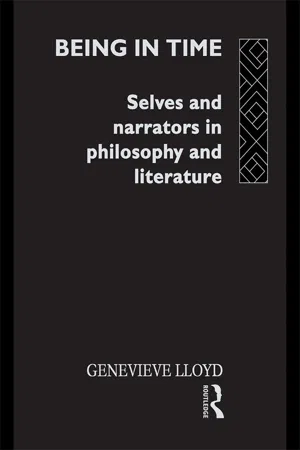
Genevieve Lloyd's book is a provocative and accessible essay on the fragmentation of the self as explored in philosophy and literature. The past is irrevocable, consciousness changes as time passes: given this, can there ever be such a thing as the unity of the self? Being in Time explores the emotional aspects of the human experience of time, commonly neglected in philosophical investigation, by looking at how narrative creates and treats the experience of the self as fragmented and the past as 'lost'. It shows the continuities, and the contrasts, between modern philosophic discussions of the instability of the knowing subject, treatments of the fragmentation of the self in the modern novel and older philosophical discussions of the unity of consciousness. Being in Time combines theoretical discussion with human experience: it will be valuable to anyone interested in the relationship between philosophy and literature, as well as to a more general audience of readers who share Augustine's experience of time as making him a 'problem to himself'.
- 200 pages
- English
- ePUB (mobile friendly)
- Available on iOS & Android
eBook - ePub
About this book
Information
Chapter 1: Augustine and the ‘problem’ of time
The connections between the idea of narrative and philosophical reflection on time and consciousness go back as far as Augustine’s Confessions—that remarkable venture into autobiography, written by the Bishop of Hippo around AD 396. What philosophers most often quote from Augustine’s discussion of time in Book XI of the Confessions1 is his famous remark that he knows well enough what time is, as long as no-one asks him, but is reduced to bewilderment if asked to define it. His positive account of time is usually regarded as something of an oddity—a curiously implausible reduction of the reality of time to the workings of the human psyche. Time, he argues, rather than being an ‘objective’ feature of the world, is a ‘distension’ of the soul. The mind stretches itself out, as it were, embracing past and future in a mental act of attention and regulating the flow of future into past. Taken in isolation from the autobiographical reflections which frame it in the Confessions, such claims about time do seem implausible. As a theory of the nature of time, such a radical psychologizing of its reality must seem counter-intuitive.
Although Augustine presents his view as a theory of time’s nature, his interest in that question is framed by reflection on the experiential and emotional dimensions of being in time. Such concerns are, perhaps all too readily, now commonly regarded as extraneous to philosophical enquiry; but they are integral to Augustine’s treatment of time. In the Confessions he attempts to take account of time as it bears on human existence—to engage with the ways in which time makes him ‘a problem to himself’. The work tells the story of his gradual coming to understand what it is to be a consciousness in time. If we are to understand fully what he has to say about time, we must take seriously the fact that it occurs in the context of an autobiography. The philosophical content of the work is interwoven with its narrative form.
The relations between God’s eternity and the temporality of the individual soul, for example, can seem extraneous to Augustine’s treatment of the nature of time—a theological excursion which is irrelevant to philosophical content. But to ignore the theological context is also to set aside the literary structure of the work. The central significance of his religious belief is enacted in the narrative form of the work as a whole. Augustine, in the role of the narrator, is able to see each event in relation to a recounted past. Everything finds its place in relation to the crucial event— his conversion to Christianity. The narrator’s complete vision here represents the human approximation to the complete knowledge of a changing reality which Augustine attributes to God. In the position of the protagonist in the narrative, Augustine sees his life only in a confused way. His past is continually re-shaped by the addition of new experience and by expectations of the future which are continually revised in the light of that experience. In the position of the narrator, in contrast, he presents himself as seeing each event in a fixed relation to a past which has achieved its final form. From this god-like perspective, the self has a completeness and stability which the protagonist cannot attain. Through the act of retrospective narration, Augustine is able to achieve a view of himself as object which eludes him in the midst of the life he now narrates. His narrated life takes on a unity, a wholeness.
The narrator has knowledge denied to the protagonist of how the story goes on. He is able to bestow unity and meaning on the events of a life directly experienced as fragmentation. The autobiographical form of the work can in this way be seen as the vehicle of an attempt to achieve an elusive goal which being in time puts out of reach. God is envisaged as having a completeness of self-knowledge in which no aspect or element of his being remains absent or opaque. The human mind, in contrast, cannot have it all at once. But the distension of the soul—epitomized for Augustine in memory and enacted in narrative—functions as a semblance in the midst of time of the standing present of eternity. Past, present and future, in Augustine’s theory of time, are held together in a unifying act of attention; and this extended present of the act of attention—modelled on God’s eternal self-presence— finds expression in the autobiographical form of the work as a whole.
To properly understand what Augustine has to say about time then it is crucial to see the interconnections between philosophical content and literary form. But the content of earlier sections of the work is also important to understanding what he is about in internalizing time to the mind. The philosophical discussion in Book XI is not an answer to a timeless philosophical question as to the nature of time. It is rather an attempt to resolve a problem posed to consciousness by the human experience of time. What exactly is Augustine’s ‘problem’, and how does it relate to the nature of time? To answer these questions we must examine both his account in earlier sections of the Confessions of the ways in which he has become a ‘problem to himself’, and the philosophical picture to which he responds with his daring assertion that time is nothing more than the distension of the soul.
LIVING WITH ‘HALF A SOUL’: AUGUSTINE ON GRIEF
Augustine describes two major episodes of grief in the Confessions. First, in Book IV, he recounts his youthful response to the death of a friend. The description of grief is here interwoven with reflections on friendship which echo themes from the concluding books of Aristotle’s Nicomachaean Ethics, especially the idea of the friend as ‘another self’. Because he lives outside himself, pouring out his soul ‘like water upon sand’ (IV, 8; 79), the young Augustine experiences grief as a disorienting loss of self. He becomes a puzzle to himself—a stranger, tormented in his own country and finding even his own home ‘a grotesque abode of misery’. Familiar places become unbearable in the experience of this new, strange absence for they no longer whisper ‘Here he comes!’ as they would have, had he only been absent a while (IV, 4; 76).
In the immediate experience of grief, Augustine cannot understand what is happening in his own soul. Reflecting on it now in memory, he comes to an understanding of what was lacking in his apparent possession of selfhood before his friend’s death. His misery, it now seems to him, came from his soul’s being directed outside himself—from its being ‘tethered by the love of things that cannot last’, so that it is then agonized to lose them (IV, 6; 77). Reflection on this past loss makes visible flaws in his early loves. He had loved something mortal as though it could never die, as something more than human. This defect of love has rendered his soul ‘a burden, bruised and bleeding’, which he cannot set down. The loss of a friend loved as another self makes the soul a burden to itself. But this loss only makes visible a wretched state of separation from himself which was already there, fuelled by the attachment to something external. ‘Neither the charm of the countryside nor the sweet scents of a garden could soothe it…. Everything that was not what he had been was dull and distasteful. Where could I go, yet leave myself behind? Was there any place where I should not be a prey to myself?’ (IV, 7; 78).
With self bound up with what is external, grief becomes intermingled with the fear of death. Augustine is obsessed by a ‘strange feeling’, quite the opposite of the altruistic desire of friends ready to die for each other’s sake. Sick and tired of living, he is yet afraid to die. Death, which has snatched away his friend, seems the most terrible of enemies, likely to seize all others too without warning. He wonders that other men should live when his friend is dead, having loved him as though he would never die. And still more he wonders that he himself, having been his ‘second self’, the ‘half of his soul’ should remain alive. ‘I felt that our two souls had been as one, living in two bodies, and life to me was fearful because I did not want to live with only half a soul. Perhaps this, too, is why I shrank from death, for fear that one whom I had loved so well might then be wholly dead’ (IV, 6; 78).
Augustine is delivered from this early grief by the passage of time and the possibilities it brings of new friendship. Time, which never stands still nor passes idly without effects upon the feelings, works its wonders on the mind. As it passes, it fills him with fresh hope and new thoughts to remember. Little by little it pieces him together again by means of the old pleasures he had once enjoyed. But time, by bringing new attachments, brings also new vulnerability—new captivations of the heart by the ‘huge fable’ of friendship—‘the long-drawn lie which does not die with the death of any one friend’ (IV, 8; 79).
Augustine’s powerful evocation of the pleasures of friendship in Book IV, section 8, is double-edged. The mutual learning and teaching, the laughter and kindness, the shared pleasures of books, the regrets at absence, the glad welcomes of return are tokens of affection between friends. Signs read on the face and in the eyes, spoken by the tongue and displayed in countless acts of kindness, all ‘kindle a blaze to melt our hearts and weld them into one’. But they hold the ‘germ of sorrow still to come’. The delights of friendship, especially those centring on the spoken word, are woven into a fable—a long-drawn lie which our minds are ‘always itching to hear, only to be defiled by its adulterous caress’ (IV, 8; 79). He loved this fable instead of God. The passage of time, though it may heal a specific grief, is itself now seen as a source of anguish—of separation and internal fragmentation of the self.
What the passage of time cannot deliver, however, Augustine finds in his own activity of narration. Reflection on memory— foreshadowing the later, more extended philosophical discussion of time—yields the kind of self-knowledge in which he sees his deliverance from the anguish of temporal experience. Memory, a ‘sort of stomach for the mind’ in which grief can be reflected on without grief, allows him to recover himself (X, 14; 220). Through self-reflection he turns away from the love of changeable things— from friends conceived as other selves—to his own self. His reflections on past grief, and on the memory through which he is able to reflect thus, here prepare the way for the discovery of the distension of the soul, through which he will both understand and escape from the distress of the temporal. Time’s destructive flight into non-existence is countered by the act of memory. Having found in his own soul the act of attention which approximates in its all-encompassing presence the ‘standing present’ of eternity, he will now be free to love changeable and mortal things in God, who is never lost. No longer clinging to the external and thus clasping sorrow to itself, his soul is freed to a new joy.
The second major episode of grief recounted in Augustine’s narrative concerns the death of Monica, his mother. It is separated from the earlier grief by the crucial event which forms the pivotal point in the Confessions—his conversion to Christianity. He now knows of the ‘eternal wisdom’ which creates ‘all things that ever have been and all that are yet to be’, while yet it itself ‘simply is’, subject to neither pastness nor futurity. Monica’s death is preceded by a conversation in which she speaks with Augustine of this eternal wisdom. They felt their minds touch it, he tells us, for one fleeting instant, before returning to the sound of their own speech, in which each word has a beginning and an end (IX, 10; 197–8).
Enlightened by this moment of contact with eternity, Augustine, as we might expect, presents his second grief as in marked contrast with the earlier one, although his immediate emotional response to it is, to his chagrin, not fully in accord with what he now knows of time and eternity. The ‘great wave of sorrow’ which surges in his heart is, he thinks, at odds with his religious beliefs; and his misery at finding himself so weak a victim of these human emotions becomes an added source of sorrow. Grieved by his own feelings, he is tormented by a ‘two-fold agony’. He is plunged again into the restlessness and oppressiveness of grief. But little by little memory returns, bringing back to him his old feelings about his mother accompanied by the comfort of tears.
In his earlier discussion of grief, Augustine reflected on why it should be that tears are sweet to those grieving and found no clear answer. Weeping now becomes the expression of a hope which eluded him at the death of his friend. ‘I had no hope that he would come to life again, nor was this what I begged for through my tears. I simply grieved and wept, for I was heart-broken and had lost my joy’ (IV, 5; 77). In that context tears are sweet only because in his heart’s desire they take the place of his friend (IV, 4; 76). His new grief, in contrast, is integrated into his own confession and transformed into prayer for his mother’s soul. Memory is gathered up in a move forward in the hope of eternal life.
Augustine’s new-found religious faith makes of this grief a different experience from his earlier hopelessness in the face of loss, even if his emotions lag behind his intellect. The two griefs express different responses to time. In the second episode, the destructive passage of time is framed by the soul’s journey towards eternity. Memory of what he has lost is no longer a source of misery, but a delight in the life which held the seeds of transformation into contact with the eternal. Eternity is here not an empty abstract contrast with the reality of time, but a fullness of presence to be attained after death—a fullness towards which the soul strains during life and of which it gets occasional glimpses. This shift in the emotional resonances of grief foreshadows the later discussion of time. The soul’s stretching out in memory, though itself a source of distress at the lack of self-presence, becomes—through the narrative act, centred on the significance of his conversion—the basis for a reaching-out of a different kind, from time into eternity. The reflections on grief foreshadow Augustine’s discovering in the distension of the soul an image of eternity. The ‘problem’ of time is resolved through finding unity amidst fragmentation. This unifying of the fragments of experience is epitomized in memory, articulated through metaphors drawn from the unity of speech, and acted out in autobiographical narration.
Memory represents for Augustine the soul’s inward turning, away from the delights of the world grasped through the senses, to search for the good and the eternal within itself. The search echoes the famous passages in Plato’s Symposium describing the soul’s ascent from things of sense towards the intelligible forms known through the higher faculties of the soul. In Augustine’s version of this journey, memory represents a higher stage than sense, marking the crucial inward turning which will yield the desired contact with the eternal. To reach God, he thinks, he must carry self-reflection from sense, which he shares with the animals, on to the extraordinary human power of memory. He compares memory to a ‘great field or a spacious palace’, a ‘store-house for countless images of all kinds which are conveyed to it by the senses’ (X, 8; 214). In its ‘vast cloisters’ are the sky, the earth, the sun, ready at his summons. But memory, as well as bringing the world into the self, also contains the self. He finds himself, along with other things, within this ‘vast, immeasurable sanctuary’; and yet it is a faculty of his soul (X, 8; 215–16).
Reflection on memory makes the self an object of wonder—an astonishment previously reserved for the contemplation of the world with its ‘high mountains, the huge waves of the sea, the broad reaches of rivers, the ocean that encircles the world, or the stars in their courses’ (X, 8; 216). Although the soul’s search takes it beyond memory to intellect, it is in some ways memory that best represents the crucial shift to the self, encompassing in its cloisters even the supposedly higher faculty of intellect. For Augustine, memory retains a certain primacy in understanding the nature of the mind. Mind and memory, he says, are one and the same (X, 14; 220). To understand memory is to understand the self: ‘I am working hard in this field, and the field of my labours is my own self’ (X, 16; 222–3). He has become a problem to himself— a problem which is to be resolved through the investigation of his self, his memory, his mind. Awe-inspiring though the pro-found power of memory is, it is identified with his mind, with himself.
What, then, am I, my God? What is my nature? A life that is ever varying, full of change, and of immense power. The wide plains of my memory and its innumerable caverns and hollows are full beyond compute of countless things of all kinds…. My mind has the freedom of them all. I can glide from one to the other. I can probe deep into them and never find the end of them. This is the power of memory! This is the great force of life in living man, mortal though he is.
(X, 17; 224)
Intellect may transcend that form of memory which retains sensory images, grasping rather ‘the facts themselves’ (X, 10; 217). But even this achievement of intellect is framed by memory. The power of intellect resides just in its capacity to gather things which, although they are muddled and confused, are already contained in memory: ‘…once they have been dispersed, I have to collect them again, and this is the derivation of the word cogitare which means to think or to collect one’s thoughts’ (X, 11; 218). It is memory, with its capacity to make all things present, that yields the clue to the idea of eternity. It is like a mental replica of the world, but it contains more—intellect, and even God himself. It thus offers possibilities of understanding and dealing with time of a kind which eludes the soul in its thought about the physical world as object. Even the immutable God has deigned to be present in memory, and forms there a ‘safe haven’ for the mind. Memory provides the material for reflection which allows Augustine to find in God the ‘gathering-place’ for his ‘scattered parts’; and as a ‘sort of stomach for the mind’ (X, 40; 249), retaining experience without its original ‘taste’, it allows the reflection which is impeded by the immediacy of emotion. Memory and self-knowledge thus belong together. The turning away from world to self which it epitomizes yields a self-knowledge in which Augustine will find the divine. The self becomes visible through a kind of detachment—it draws back from the mindless world to turn its gaze on consciousness. It is the incapacity of that mindless world of physical motion to reveal what is involved in being a mind, capable of understanding time and eternity, that Augustine stresses in his discussion in Book XI of the nature of time. Let us now look at his own account of what it is to be in time in relation to what he sees as the inadequacies of the Aristotelian treatment of the relations between time and consciousness.
THE ‘MEASURE OF MOTION’: AUGUSTINE AND ARISTOTLE
Augustine’s psychologizing of time aims both to secure the reality of time and to resolve puzzles about its measurement. On either side of the present, he reasons, lies an abyss of non-existence. And even the present, in abstraction from the mind’s attention, collapses internally into a non-existent future and an equally nonexistent past, on either side of a durationless instant in which nothing can happen. His arguments for internalizing the reality of time to the mind centre on puzzles about measurement. What, he asks, do we measure when we measure time? Not the future; for it does not yet exist. Nor do we measure the past, for it no longer exists. Do we then measure time ‘as it is passing’? But, if so, while we are measuring it, where is it coming from, what is it passing through, and where is it going? It can, it seems, only be coming from the future, passing through the present, and going into the past. ‘In other words, it is coming out of what does not yet exist, passing through what has no duration, and moving into what no longer exists’ (XI, 21; 269).
We are left then with a paradoxical passage from non-existence, through a fleeting, existence-bestowing ‘present’ into non-existence again. The fragile hold of the present on reality, moreover, is itself encroached upon by the surrounding, voracious non-existence of future and past. The measurement of time in the fleeting present, as it passes, cannot be insulated from the puzzles that beset the measurement of non-existent past and future. The only time that can be called present is an instant—if we can conceive of such a thing—that cannot be divided even into the most minute fractions. However a point of time as small as this passes so rapidly from the future to the past that its duration is without length; for, if its duration were prolonged, it could be divided into past and future. When it is present, then, it has no duration. But such a present can hardly be thought of as bestowing reality on that strange being or non-being which comes out of, and vanishes into, nowhere. There is for Augustine another dimension too to the implication of the present in the non-existence of past and future. The present itself participates in non-being; for if it were always present and never moved on to become past, Augustine reasons, it would be not time but eternity. If, therefore, the present is time only by reason of the fact that it moves on to ...
Table of contents
- Cover Page
- Title Page
- Copyright Page
- Acknowledgements
- Introduction
- Chapter 1: Augustine and the ‘problem’ of time
- Chapter 2: The self: unity and fragmentation
- Chapter 3: The past: loss or eternal return?
- Chapter 4: Life and literature
- Conclusion: philosophy and literature
- Afterword
- Bibliographical essay
- Notes
Trusted by 375,005 students
Access to over 1.5 million titles for a fair monthly price.
Study more efficiently using our study tools.
Frequently asked questions
Yes, you can cancel anytime from the Subscription tab in your account settings on the Perlego website. Your subscription will stay active until the end of your current billing period. Learn how to cancel your subscription
No, books cannot be downloaded as external files, such as PDFs, for use outside of Perlego. However, you can download books within the Perlego app for offline reading on mobile or tablet. Learn how to download books offline
Perlego offers two plans: Essential and Complete
- Essential is ideal for learners and professionals who enjoy exploring a wide range of subjects. Access the Essential Library with 800,000+ trusted titles and best-sellers across business, personal growth, and the humanities. Includes unlimited reading time and Standard Read Aloud voice.
- Complete: Perfect for advanced learners and researchers needing full, unrestricted access. Unlock 1.5M+ books across hundreds of subjects, including academic and specialized titles. The Complete Plan also includes advanced features like Premium Read Aloud and Research Assistant.
We are an online textbook subscription service, where you can get access to an entire online library for less than the price of a single book per month. With over 1.5 million books across 990+ topics, we’ve got you covered! Learn about our mission
Look out for the read-aloud symbol on your next book to see if you can listen to it. The read-aloud tool reads text aloud for you, highlighting the text as it is being read. You can pause it, speed it up and slow it down. Learn more about Read Aloud
Yes! You can use the Perlego app on both iOS and Android devices to read anytime, anywhere — even offline. Perfect for commutes or when you’re on the go.
Please note we cannot support devices running on iOS 13 and Android 7 or earlier. Learn more about using the app
Please note we cannot support devices running on iOS 13 and Android 7 or earlier. Learn more about using the app
Yes, you can access Being in Time by Genevieve Lloyd in PDF and/or ePUB format, as well as other popular books in Philosophy & Modern Literary Criticism. We have over 1.5 million books available in our catalogue for you to explore.