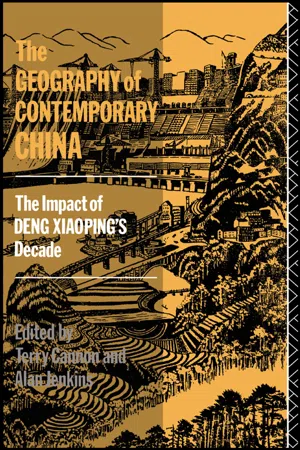
Deng Xiaoping's rule has seen fundamental economic change in China. This book considers the impact of these years on China's physical environment, as well as its people, industry, agriculture and trade. It also assesses the contribution of a decade of Chinese politics towards geopolitics. The book provides an introduction to Communist China, setting its spatial and environmental themes in the historical, political and economic framework so crucial to a proper understanding of this country and the fifth of the world's population it contains. It is particularly suited to courses on China, its geography and development strategy. After the bloody events of Tiananmen Square in June 1989 China's geopolitics will continue to hold the world's attention. With this in view the book also provides guides to further reading.
Introduction: a basic guide to developments from 1949 to 1989
Terry Cannon and Alan Jenkins
In September 1976, Mao Zedong (Mao Tse-Tung), one of this century’s major political leaders, died in Beijing (Peking), the capital of the world’s most populous country. The significance of the subsequent immense changes in economic and social policy, and their consequences for the country’s geography, can only be understood in the context of the events of the previous years. During the period of Mao’s leadership China’s communists emphasised rural collectivisation, central planning plus state control and ownership of industry, and limited contact with the outside world.
These policies became identified as essential components of socialism in the country. China’s post-Mao leadership, dominated by Deng Xiaoping (Teng Hsiao-Ping), emphasised economic growth, the role of the market, family farming, much more foreign trade, and investment from the West and Japan. It claimed that these very different policies—the so-called economic reforms—were necessary to overcome the problems which Maoism created, and that they too are socialist.
Our book is focused on this fundamental shift in direction, and its impact on the geography of the country. The introduction helps to explain what is entailed in the policy changes and the political and economic justifications for them. For those readers with little knowledge of China, it is an important chapter for helping to make sense of the book. It tries to explain the major policies of the communist-led government which came to power in 1949 after years of civil war and Japanese invasion, and the major shifts in policy since then.
PARTY AND GOVERNMENT AS FACTORS IN CHINA’S DEVELOPMENT
In China the role of the state, and the Communist Party of China (CPC) which dominates it, has been crucial in determining what economic and environmental changes take place. It is difficult to understand the country’s geography without knowing something of the role of the state since the CPC came to power, and especially of the sharp contrasts between those policies in operation up to 1976, and those of the economic reform period which has followed with the 1979 rise to power of Deng Xiaoping and his leadership. While the bulk of the book emphasises the geographical situation since 1979, here in the Introduction we try to explain the main issues in the policy developments since 1949 and their contrasts to the post-1979 reforms. (A brief summary of the major policies is given on pp. 24–7.)
Conflict and disagreement over policy
The dominance of a single party in China can give the impression that the state acts in uniform and harmonious agreement upon unanimously-agreed policies. This is far from the case, though disagreement is more convoluted and less visible than in multi-party states, where differences of opinion are public and between obvious groupings. In China, argument goes on within the CPC, and divisions can be so intense that leaders who lose power struggles are denounced as counter-revolutionaries, and coups d’état have been used to remove opponents.
It is much more difficult to display popular discontent about the state’s behaviour, though not impossible. The second half of Deng’s decade has been marked by many very significant signs of dissaffection by important sections of the people. Widespread urban opposition to the negative impacts of the economic reforms grew in the latter half of the 1980s, and there was a resurgence of demands for more democracy. The events of Spring 1989, involving mass popular protests in many cities, and their brutal suppression by Deng Xiaoping and his supporters (led by the Prime Minister, Li Peng), make it unclear what is going to happen to economic policy and hence to their geographic impact.
Our original idea for this chapter, before the massacres, was to summarise the impact of a decade of influence of Deng’s leadership. The tragedy of 4 June 1989 and its aftermath marks the end of that decade in a manner which highlights the conflicts that arose under the reform policies. It also signifies the beginning of a process of change, and as we write the Introduction it is unclear to what extent the post-Mao policies will remain intact.
Geography and economic policy
This book’s central theme is the nature and extent of the changes since Mao’s death. In the following chapters, various spatial and environmental issues are investigated. These include the physical environment and how, given its fragility, it is being managed; the impact of historical influences, as in the relationship between the previously more-developed coast and less-developed interior; how the new rural policies have changed China’s landscape; how the new economic policies and pressure on couples to have only one child are affecting the relationship between an increasing population and limited fertile land; how regional differences are changing under the impact of rapid industrialisation and slow transport development; the extent that the surplus population released from agriculture is contributing to urbanisation; the impact on China’s geography of the increased trade and investment from the West and Japan, and whether it is leading to increased inequality between the developed coast and the less-developed interior. Are regional contrasts and inequalities increasing throughout China as a result of the new policies? These are some of the spatial and environmental themes investigated.
The book’s central argument is that China’s geography has significantly changed as a result of the policies of the post-Mao leadership. This introduction emphasises the period 1949 to 1976 because to understand the changes a basic understanding of ‘Maoist’ China is needed. We then more briefly consider the main directions in economic policy after Deng’s ascendancy in 1979. Our aim here is to enable readers who know little about China to understand the general development policies resulting in the geographic changes set out in later chapters. The Introduction and later chapters also reveal the impact of China’s natural conditions and human geography on development opportunities.
Background to 1949
In 1949 the Communist Party of China (CPC) became the effective government of the country after victory in the civil war against the Guomindang (Nationalist Party). The CPC faced the immediate problem of rebuilding a society and economy that since the 1920s had suffered civil war, Japanese invasion and then again civil war. There were also more fundamental problems, rooted in the inherited exploitative system fostered under the Emperors. Whatever the achievements under that Imperial past, the economy had failed to make the technological and organisational breakthrough to ‘modernity’ achieved by the West and Japan.
The CPC achieved its victory on the basis of mass support for its struggle against the Japanese invasion, and the land reform implemented in the areas it controlled in the previous decade. But it inherited fundamental problems, and there were few guidelines for resolving them. China’s population was increasing, the fertile land was limited. The modern sector of the economy was restricted to the port cities, largely fashioned by Western imperialism, and the Japanese-developed industry in the northeast (Manchuria).
In 1949, Mao Zedong, Chairman of the CPC, proclaimed that China had ‘stood up’ and that the party would build a ‘prosperous and flourishing country’. Forty years later this remains to be achieved, and argument goes on as to whether Mao’s own methods have delayed reaching this goal or made it more possible. Certainly the policies which followed him have negated his ideas as to what are proper socialist policies. However, the growth in prosperity evident for many people in the 1980s under Deng’s leadership has led to its own problems. These are turning out to be as difficult to resolve as those for which Mao’s policies are indicted.
FROM LIBERATION TO THE DEATH OF MAO
The Communist Party can be seen as but one group of Chinese reformers of the last century or so who wanted China to withstand outside aggression and achieve modernity. Although there are disputes about how the party interpreted socialism and communism, and the extent to which it departed from Marxism or Soviet thinking and practice, there can be no doubt that the CPC believed that economic growth and modernity was to be achieved through ‘building socialism’.
In practice this meant that the Communist Party of China controlled political power and made the central decisions on economic and social policy. The Soviet Union initially became the model for the organisation of government and society. In the post-1949 economy there were three key areas which can be identified as its declared socialist elements:
in rural affairs, the collectivised ownership of land and other means of production, and a state-directed plan for the procurement of foodstuffs and industrial crops;
centralised control over the accumulation and reinvestment of capital, in combination with state ownership of major industries and financial institutions (and, in effect, local state ownership of smaller-scale enterprises);
restrictions on the impact of foreign capital and external economic factors while pursuing ‘self-reliance’.
We look at each of these elements and their implementation in the period 1949 to 1976. All of them have been affected drastically by the policy changes pursued by the post-Mao leadership under the direction of Deng Xiaoping, and later we describe how far (at least, until mid-1989) they were being ‘reformed’. In many senses it is clear they have been reversed rather than reformed.
Rural China: land and collectivisation
After 1949 the new government completed the land reform already begun in areas it had controlled in the civil war. This massive redistribution of land away from landlords and the richest peasants was welcomed by the majority, who were poorer peasants. But for the leadership, this greater equalisation of land-holdings was a temporary objective. Private family farm-holdings were not regarded as socialist policy, and in any case many in the party argued that the allocation of land would not remain equitable for long. New divisions, exploitation and uneven land ownership quickly showed signs of re-emerging.
Perhaps there were other motives that caused the party to sweep away this newly created pattern of family farming. The land reform did not generate much capital for family or state investment. From the mid-1950s the CPC enforced the collectivisation of rural land, equipment and animals. The new collectives were given production targets to supply the state with part of their output of grain and industrial crops (e.g. cotton) at state-defined prices. This tied them into the national plan through the local administrative structure. Targets and prices were transmitted downward through the provincial structure to the individual commune and thence to the team.
Collectives offered the means of pooling labour-power and capital to transform rural China. Communal labour facilitated the improvement of land, the construction of dams to conserve limited rainfall, and irrigation systems. It enabled surplus to be generated to pay for schools and health centres, often the first ever available to ordinary people in many rural areas.
From the perspective of the central government, collectivisation may have offered a pragmatic means of getting secure and cheap grain and other crops and selling them at state-defined prices. Whatever the reasons, the CPC transformed rural China into larger and larger collective units. In 1958 the co-operatives set up after 1954 were merged into the People’s Communes. The rhetoric of the time told us that this was essentially voluntary and popular. However the evidence now is that this move was forced through rapidly by Mao Zedong and others in the face of opposition from within the party and with little support from the peasants.
The introduction of the People’s Communes was linked with the Great Leap Forward (GLF) of 1958–60, a foolhardy attempt to achieve full communism virtually overnight. ‘Free’ collective kitchens, communal childcare and universal industrialisation were promoted by Mao Zedong throughout the countryside. The idea was that mass enthusiasm and the new larger collective organisation would produce rapid economic growth.
The reality was that China plunged into disaster. The years 1959–61 witnessed a famine across large parts of China. Outsiders have only in recent years recognised the extent of that disaster, and the Chinese authorities are still reluctant to discuss it openly. At the time, a few Western observers, using interviews with refugees in Hong Kong and other sources, correctly told of the horror, but their accounts were not widely believed. The evidence we now have, including that from the 1982 Chinese census, reveals the worst disaster in the world this century, far outstripping the recent Ethiopian famines in absolute numbers. It appears that over the three years 1959–61 there were between 14 million and 26 million excess deaths attributable to hunger and associated illness.
A revised form of commune, which survived the criticisms of the GLF and was intended to extract China from the famine disaster, became the basic building block of rural economy and government until the post-Mao changes. On average a commune had about 15,000 members, but numbers varied from around 80,000 in the densely settled fertile areas of eastern China to 8,000 or less in sparsely populated mountainous or arid areas.
The commune was both a production organisation and a unit of government. It was divided into production brigades, which were in turn subdivided into work teams. Generally the brigade accorded with the ‘natural’ village, so to an extent the peasantry lived in a traditional setting. But the organisation of rural life was completely transformed from its former pattern. Generally families had only a small private plot on which they might grow what vegetables they wished and perhaps keep a pig or poultry. Often there were restrictions on the sale of this produce in the limited private markets. (Note that most policies varied in time and space; we are here describing the general pattern for the period 1958 to 1976.)
Peasant life was largely organised around the collective, in which the basic unit was the production team. This organised labour and capital, and distributed rewards. The key to the team’s development role was the work-point payments system. This was like a dividend: work points represented a claim on the collective output of the team, supposedly proportionate to individual effort. Rural electrification, small-scale rural industries (e.g. brick works), irrigation schemes, clinics and schools could be built by mobilising labour which did not have to be immediately paid in cash. The work would be done in return for work points, since this increased people’s eventual claim to the produce of the team.
Periodically, the team would distribute produce and income to the families on the basis of the work points the family had earned and the income the team had gained through selling its produce on the state-controlled markets. Whereas in other Third World states ‘surplus’ rural labour migrated to the cities, this did not occur in China (but see Chapter eight).
The collective mobilisation of labour provided a means of utilising this ‘surplus’ labour which increased production and investment. Many foreign observers (including the present authors) were attracted by this development model, which seemed to offer development while apparently avoiding those ...
Table of contents
Cover Page
Title Page
Copyright Page
Figures and Tables
Contributors
Preface
Basic Information
Chronology: From Opium War to Deng Xiaoping
Chapter One: Introduction: A Basic Guide to Developments from 1949 to 1989
Chapter Two: Regions: Spatial Inequality and Regional Policy
Chapter Three: History: Historical Perspectives on the Current Geography of China
Chapter Four: Environment: Understanding and Transforming the Physical Environment
Chapter Five: People: Demographic Patterns and Policies
Chapter Six: Rural China: Old Problems and New Solutions
Chapter Seven: Industry, Energy and Transport: Problems and Policies
Chapter Eight: Urbanisation: Processes, Policies and Patterns
Chapter Nine: Foreign Investment and Trade: Impact on Spatial Structure of the Economy
Chapter Ten: The Environmental Impact of Economic Development: Problems and Policies
Chapter Eleven: Defining and Defending the Chinese State: Geopolitical Perspectives
Postscript: The Impact of China’s 1989 Crisis on Regional Development and Spatial Change
Trusted by 375,005 students
Access to over 1.5 million titles for a fair monthly price.
Study more efficiently using our study tools.
Frequently asked questions
Yes, you can cancel anytime from the Subscription tab in your account settings on the Perlego website. Your subscription will stay active until the end of your current billing period. Learn how to cancel your subscription
No, books cannot be downloaded as external files, such as PDFs, for use outside of Perlego. However, you can download books within the Perlego app for offline reading on mobile or tablet. Learn how to download books offline
Perlego offers two plans: Essential and Complete
Essential is ideal for learners and professionals who enjoy exploring a wide range of subjects. Access the Essential Library with 800,000+ trusted titles and best-sellers across business, personal growth, and the humanities. Includes unlimited reading time and Standard Read Aloud voice.
Complete: Perfect for advanced learners and researchers needing full, unrestricted access. Unlock 1.5M+ books across hundreds of subjects, including academic and specialized titles. The Complete Plan also includes advanced features like Premium Read Aloud and Research Assistant.
Both plans are available with monthly, semester, or annual billing cycles.
We are an online textbook subscription service, where you can get access to an entire online library for less than the price of a single book per month. With over 1.5 million books across 990+ topics, we’ve got you covered! Learn about our mission
Look out for the read-aloud symbol on your next book to see if you can listen to it. The read-aloud tool reads text aloud for you, highlighting the text as it is being read. You can pause it, speed it up and slow it down. Learn more about Read Aloud
Yes! You can use the Perlego app on both iOS and Android devices to read anytime, anywhere — even offline. Perfect for commutes or when you’re on the go. Please note we cannot support devices running on iOS 13 and Android 7 or earlier. Learn more about using the app
Yes, you can access The Geography of Contemporary China by Terry Cannon,Alan Jenkins in PDF and/or ePUB format, as well as other popular books in Social Sciences & Chinese History. We have over 1.5 million books available in our catalogue for you to explore.