- 176 pages
- English
- ePUB (mobile friendly)
- Available on iOS & Android
eBook - ePub
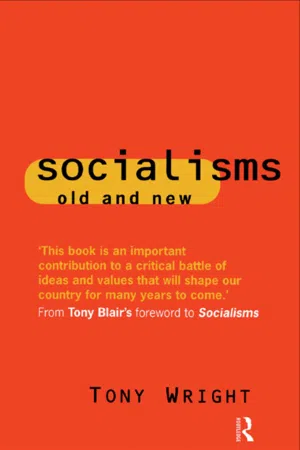
Socialisms: Old and New
About this book
This is a revised and updated edition of Tony Wright's critically acclaimed work that first appeared a decade ago. It provides a lucid and accesible survey of the major strands of socialist thinking right up to the present day and includes an assessment of the renewal of socialism in Britain. It is an indispensable text for students and a stimulating guide to socialism past and present. But it is also a book with an argument. Tony Wright makes the case for a socialism that learns the lessons of its own history, roots itself in an ethic of community and applies traditional values in new ways. It is a book for everyone who wants to understand where socialism has come from - and where it might still be going.
Information
1
Traditions
The resulting controversy, between many groups and tendencies all calling themselves socialist, has been long, intricate and bitter.(Raymond Williams)
The history of socialism is the history of socialisms. Moreover, it is a history not of fraternal plurality, but of rivalry and antagonism. The battle lines have often changed (Marxists versus anarchists, collectivists versus syndicalists, reformers versus revolutionaries, communists versus social democrats, Trotskyists versus everybody else, new socialists versus old socialists), but battle lines there have always been. Many socialists have reserved their sharpest arrows for attacks on other socialists, while almost all socialists have found it necessary to fight on at least two fronts at the same time. The arena of battle has also changed significantly over time, to take in new places, contestants, and traditions. The dramatic collapse of the communist regimes at the end of the 1980s is the most recent, and most momentous, development in this unfolding story.
WORDS AND TRADITIONS
The scene was set when Marx and Engels launched their first attacks on those earlynineteenth- century socialists they branded ‘utopian’ (in particular, Saint-Simon, Fourier and Owen). These writers, with their ‘fanatical and superstitious belief in the miraculous effects of their social science’, were judged to be not merely irrelevant to the developing class struggle but objectively reactionary in relation to it. In the same period Marx denounced the ‘amateurism’ of the ‘French tendencies’ (i.e. Proudhon) and set out to wage war on all such ‘idealism’ in the name of a scientific class theory. In the mid-1840s, solicited as a correspondent by Marx, the anarchist socialist Proudhon replied in these terms:
Let us seek together, if you wish, the laws of society, the manner in which these laws are realised, the process by which we shall succeed in discovering them; but, for God’s sake, after having demolished all the a priori dogmatisms, do not let us in our turn dream of indoctrinating the people; do not let us fall into the contradiction of your compatriot Martin Luther, who, having overthrown Catholic theology, at once set about, with excommunication and anathema, the foundation of a Protestant theology. For the last three centuries Germany has been mainly occupied in undoing Luther’s shoddy work; do not let us leave humanity with a similar mess to clear up as a result of our efforts. I applaud with all my heart your thought of bringing all opinions to light; let us carry on a good and loyal polemic; let us give the world an example of learned and far-sighted tolerance, but let us not, merely because we are at the head of a movement, make ourselves the leaders of a new intolerance, let us not pose as the apostles of a new religion, even if it be the religion of logic, the religion of reason.
This approach did not commend itself to Marx, nor to the Marxist tradition in general (a fact of some significance in view of the centrality of Marxism in the development of socialism). Socialism was not seen as a mansion with many rooms, but as a house of theory and practice in which dissenting traditions were shown the door in just that spirit of ‘excommunication and anathema’, of which Proudhon warned.
Marx emphatically and precisely saw the assault on, and defeat of, other available socialist traditions as an essential part of his original project (and a continuing preoccupation); so much so that he began by rejecting even the word ‘socialism’ because of its prevailing utopian connotations. The word had first appeared in England in the 1820s in an Owenite context, then in French usage in the 1830s. Its origins indicate its resonance. It was used to characterize the schemes of social reconstruction being advanced in England and France at that time by Owen, Saint-Simon and others, and to describe the adherents of these schemes (‘socialists’). In seeking to counter such idealism, Marx needed a political vocabulary that would differentiate his position and distance it from these prevailing socialisms. Hence, in 1848, the world was presented not with the socialist but the Communist Manifesto. At this time the word ‘communist’ was associated with a more abrasive tradition, revolutionary, egalitarian and proletarian, as exemplified by Babeuf and the left wing of the French Revolution.
It was this tradition, of revolutionary class action, that Marx wanted to draw upon in opposition to the prevailing varieties of ‘socialism’. Looking back forty years later, Engels wrote that ‘We could not have called it a Socialist manifesto. In 1847, Socialism was a middle-class movement, Communism a working-class movement. Socialism was, on the continent at least, respectable; Communism was the very opposite.’ Even in subsequent years, when usage had changed and blurred, it seems that Marx always retained a certain antipathy to ‘socialism’ as both word and concept (reflected in its pejorative appearances in Capital, usually referring to Proudhon and the utopians). However, as the nineteenth century progressed, socialism established itself as the general word and Marxism increasingly established its proprietorship over it.
Having entered this linguistic minefield, some further cautious exploration is appropriate. The diversity of socialist traditions has been reflected in the variety of socialist usage, and in the shifts in usage over time. Even when the linguistic ascendancy of ‘socialism’ was established, wrested by the Marxists from the utopians and the anarchists, ‘communism’ retained a variety of usages both old and new. For example, it was preferred by William Morris because it carried a traditional meaning of revolutionary class action to secure property in common. In England, at least, this served to distinguish it from Fabian ‘socialism’ in the 1880s and 1890s. The word could also refer to an original or primitive communism before class society, while it developed a further and more familiar meaning as a future, higher stage of social development beyond the socialism that would be the immediate successor to class society. It was launched on a new lease of life when, in 1918, the Bolsheviks appropriated it to mark their split from an allegedly degenerate European socialism and to claim an authentic historical pedigree. From that moment communism became Communism, and it was difficult thereafter to retrieve its other usages.
Matters were made no clearer by the fact that in becoming communists the Bolsheviks and their satellite parties did not relinquish their claim to be ‘socialists’ but instead now claimed to be the only authentic socialists. They sought to wrest any title to the name from the European socialist tradition that had called itself Social Democratic in the late nineteenth and early twentieth centuries as it combined its Marxist doctrine with party organization. In Europe before 1914 ‘social democracy’ meant organized Marxism; after 1917 it came to mean organized reformism. The communists, appropriating Marx, not only denied the socialist credentials of social democracy, but attacked it (at one period as ‘social fascism’) as essentially reactionary and counter-revolutionary. Some socialists responded to these developments by coining the term ‘democratic socialism’ to describe a position that was non-communist and critical of undemocratic socialism as practised by the Bolsheviks, but at the same time was not merely reformist or ameliorative but remained committed to the reorganization of society on a socialist basis. This was a difficult position to sustain, but the need for it was a reflection of the fragmentation of socialism that had taken place. In a sense, democratic socialists were social democrats who meant it. A further linguistic footnote was provided by those social democrats in Britain who, in the early 1980s, became Social Democrats. Intended to signify their affiliations with a wider tradition, this change was also interpreted as an attempt to convert social democracy from a tradition within European socialism to a position outside and in opposition to it. It ended badly.
This excursion into the political language of socialism has raised many issues that will require further consideration later. For the moment, though, it is sufficient to record that the variety of socialisms is amply reflected in the varieties of socialist usage. This also serves as a reminder of those developments that have contributed to the evolution of socialism. For example, Marx’s early antipathy towards ‘socialism’ is a reminder that there was socialism before Marx (just as there have remained socialisms alongside and outside Marxism). There is now socialism after Marx. The point here is not to play the familiar game of ransacking history for the precursors of socialism, from Thomas More to Plato and beyond, but to register the fact that the historical development of socialism has usually been viewed through the prism of the theoretical supremacy of Marx and the organizational dominance of Marxism.
This is especially the case with the ‘utopian’ socialists, traditionally dismissed by the Marxist tradition for their inferiority to the ‘scientific socialism’ that was developed by Marx and Engels. Indeed, the terms of this dismissal are such that it seems that the historical function of the utopians is to be superseded by Marxism. Yet the work of these early-nineteenth-century writers retains interest and significance, and does contribute to later socialist traditions. This is true of Owen’s vision of social harmony through cooperation, of Fourier’s scheme for community production that would nourish individuality rather than repress it, of Saint-Simon’s plan for the reorganization of the social and economic order, and of Proudhon’s mutualism that represented a form of decentralized producer democracy. When all the usual criticisms are made (that Saint- Simon did not mention capitalism, that Fourier was dotty, that Proudhon was full of contradictions, etc.), and when the obvious theoretical inferiority of these writers to Marx is acknowledged (as it loudly was by Marx), the fact remains that they did represent the first intellectual challenge to industrial capitalism and its ideology of liberal individualism, and did build a bridge to later socialist traditions.
Thus Proudhon nourished an anti-collectivist tradition, Owen a cooperative tradition, Fourier a libertarian tradition, and Saint-Simon a technocratic tradition. This indicates how misleading it is simply to dub them ‘utopian’, thereby suggesting a uniformity instead of the imaginative diversity of these early-nineteenth century socialisms. For Marx, however, they were essentially the same: not, as is usually suggested, because they could not say who was to bring about social change nor how they were to do it, but because they fundamentally misunderstood the nature of the social process. The lack of an agency was a reflection of this, as was their proclivity to indulge in moral appeals and undertake experiments in communal living. By contrast, Marx offered an account of the social process in which theory and practice were united and morality merged with necessity. Historical development was to be explained in terms of material forces which gave rise to forms of class society. Its present form was capitalism, or bourgeois society, a system of exploitation that operated through the extraction of surplus value from wage labourers. However, in creating a proletariat, capitalism had also created the agency whereby it would itself be transcended. The revolutionary victory of this exploited class, a particular class that was also a ‘universal’ class because it was the carrier of a general liberation, would mark the end of class society and the rediscovery by humanity of its essential (but previously estranged) species-being. Against such a prospectus, the offerings of the ‘utopian’ socialists could indeed seem rather paltry.
If there were socialist traditions before Marxism (or the foundations for such traditions), there were also socialisms alongside Marxism during the nineteenth century. Again, the tendency has been to view these traditions from the perspective of a Marxism that had consolidated its hold on European socialism by the final quarter of the century. Thus the progress of Marxism is conventionally charted in terms of Marx’s intellectual victories over Lassalle, or political victories over Bakunin. Yet this obscures the extent to which a socialist tradition of state action in the conditions of a widening franchise (for example, associated with Louis Blanc in France and with Lassalle in Germany) was taking shape from the middle of the nineteenth century, and was not suddenly born in a later ‘revisionism’. Similarly, Marx’s contest with the anarchist Bakunin in the First International has often been presented by orthodox Marxists as an irritating distraction from the historic march of ‘scientific socialism’, instead of as evidence of the continuing appeal of a non-collectivist tradition that had been associated with Proudhon (‘the master of us all’ according to Bakunin) and which was to be taken up by anarchist communists like Kropotkin and by the syndicalists. There was also an insurrectionary tradition, linked with the name of Blanqui, that saw revolution not as the movement of a class but as the work of a conspiratorial elite of professional revolutionaries. Lenin was to provide a reminder of this tradition.
It is against this complex background that the period of ascendancy of Marxism within European socialism should be seen. This ascendancy was secured when, from the 1870s, socialism became both theory and movement with the development of workers’ organizations in the main European countries. Because of its theoretical sweep, and the role it assigned to working-class political action, Marxism was well placed to provide the ideological underpinning of workers’ parties. This was precisely the role that it did play during the period of the Second International from the late 1880s through to 1914. In the words of George Lichtheim, distinguished historian of socialism, Marxism ‘functioned as an integrative ideology’ in these years. However, it would be misleading to regard this apparent integration as evidence that the variety of socialist traditions had at last been reduced to unitary form. The attempt was certainly made to make Marxism perform this function; but the attempt failed.
The need for an integrative ideology was apparent to any observer of European socialism in the 1880s. Three main traditions were in evidence. There was Marxism, now organized as ‘social democracy’. There was anarchism, and its anarcho-syndicalist derivatives. There was also reformism, most explicitly seen in English Fabianism but evident too in the democratic collectivism espoused by the ‘possibilists’ in France, headed by Paul Brousse. Thus the Second International was born out of two rival congresses convened simultaneously in Paris in 1889, by the Marxists and the possibilists (the latter were even alleged to have waylaid provincial delegates at the railway station and misdirected them to their own congress). The anarchists, meanwhile, devoted their considerable energies to causing disturbances at both of these congresses. The engine of the Second International was the German Social Democratic Party, which had itself been formed at a unity congress between the German socialists in 1875 at Gotha and had later adopted a thoroughgoing Marxist programme at Erfurt in 1891. This German party, led by Bebel and Liebknecht, then set about making the Second International in its own image.
It should be noted that socialism’s centre of gravity, originally located in France and Britain, had now shifted decisively eastwards, to Germany. The Germans had created a united party and, in the face of the anti-socialist laws, had constructed an impressive organization and a mass following. By 1890 the party had won the support of about a fifth of the German electorate. Its prestige was enhanced by the traditional association of its leaders with Marx (until his death in 1883) and Engels (who lived on until 1895). It is not surprising that socialists elsewhere endeavoured to emulate the Germans by setting up their own Social Democratic parties, or that the Germans were the driving force of the Second International. They led the struggle against the anarchists (‘anarchism’ had now become the catch-all category to describe all disbelievers in a disciplined party equipped with a ‘scientific’ doctrine), and anarchist ideas were finally purged from the International in 1896. The Germans also endeavoured through the International to impose some unity on socialism in France, where the rich variety of socialist traditions was still much in evidence. The French Marxists, led by Guesde and organized since 1879 in the Parti Ouvrier Français, found themselves opposed on two socialist fronts by the syndicalists and the possibilists (as well as other independent groupings on the Left). These differences within French socialism kept spilling over into the International, an embarrassing reminder of socialist disunity.
Just as the German Marxists had dispatched the anarchists, they finally managed to discipline the wayward French socialists. At the 1904 congress of the International, in many ways its high-water mark, the ‘revisionists’ (notably Bernstein), who wanted to adjust both the economic and political analysis of Marxism in the light of changing circumstances, were roundly condemned and traditional doctrine reaffirmed. This position was then imposed on the member parties of the International and the French socialists were called upon to unite on this basis. This they did when Jaurès, socialist idealist and outstanding leader of French socialism until his assassination in 1914, agreed to bring his members into the new party, the name of which (Section Française de l’Internationale Ouvrière, SFIO) was a reminder of its origins. Thus French socialism was formally united from outside, an expression of the dominant position of German social democracy within European socialism and of its ability to impose an organizational model and doctrinal basis on the international movement. In turn, this enabled the International to engage in impressive displays of solidarity against bourgeois nationalism and war and in affirmations of international proletarian brotherhood. European socialism seemed to have forged a unity out of its divergent traditions, courtesy of the German social democrats. Moreover, this unity seemed to be rooted in a secure theoretical position.
This security was provided by ‘Marxism’. The inverted commas are necessary here to indicate the role played by this body of doctrine during the Second International period. It should be recalled that the term ‘Marxist’ (and its variants) was originally deployed as a form of sectarian abuse against Marx’s party, by Bakunin and his followers, a reply in kind to the language of sectarian vilification (‘Proudhonism’, ‘Bakuninist’, etc.) that Marx himself had developed and deployed. Gradually, however, the term lost its negative sectarian connotations and assumed a more positive orientation. The publication of the first volume of Capital in 1867 extended Marx’s authority within European socialism, as did his role in the production of the basic documents of the International Working Men’s Association (First International). The dramatic, if brief, revolutionary events of the Paris Commune in 1871 also had the effect of promoting Marx’s reputation outside socialist circles. Thus, in the period between the First and Second Internationals the ideas of Marx and Engels became recognized as the basis of ‘scientific socialism’, of which they were the acknowledged founders. Their work now provided the reference point for socialist argument within and between different traditions, just as it also reshaped the conceptual vocabulary of socialism.
MARXISM AS IDEOLOGY
This extending influence in turn provided the basis for the mobilization of ‘Marxism’ as an integrative ideology by the Marxist element of German social democracy. It was not enough that the ideas of Marx should gradually be assimilated by the various schools of European socialism; Marxism-as-system should be established as the unitary doctrine of the international socialist movement. So ‘Marxism’ was marshalled into this role of official doctrine, an assertion of theoretical supremacy described (by the historian Georges Haupt) as ‘this process of hegemonization’. This entailed an emphasis on its scientific status and completeness. The leading figure in this assertion of the ideological hegemony of Marxism was Karl Kautsky, theoretician-in-chief of German social democracy and dubbed the ‘pope of Marxism’, who deployed it against what he described as the prevailing ‘eclectic socialism’ (composed of elements from Marx, Lassalle, Bakunin, Proudhon, Rodbertus, etc.). The theoretical victory of Marxism would eradicate such eclecticism, and would also ensure the political victory of the Marxists. This process was encouraged by Engels, and the ‘dialectical’ materialism developed in his polemic against the materialist philosopher Dühring (Anti-Dühring) contributed greatly to the promotion of Marxism as a system. As a system, it was a self-contained proletarian science, and as such gave an intellectual backing to the social democratic political stance of separateness from the institutions of bourgeois society.
It was in this context that ‘Marxism’ functioned as the ideological underpinning of the Second International. It was deliberately employed in this way by the German Marxists, initially within German social democracy and then internationally. It was used to turn socialism into a unitary tradition, securely anchored in a body of scientific doctrine bequeathed by its undisputed founding fathers. Other traditions could be attacked in its name and their adherents brought to heel. Bridges could be built to it from more distant traditions, such as that elaborately constructed by Plekhanov from Russian populism. It was all very impressive. It was also a sham. Dissenting traditions were not in reality subsumed or subjugated, either by Marxist science or by political muscle.
This was evident in the resurgence of syndicalism that unsettled the ranks of social democracy in the late nineteenth and early twentieth centuries. Even in England, Beatrice Webb could note in her diary in 1912 that:
Syndicalism has taken the place of the old-fashioned Marxism. The angry youth, with bad complexion, frowning brow and weedy figure is nowadays a Syndicalist; the glib young workman whose tongue runs away with him today mouths the phrases of French Syndicalism, instead of those of German Social Democracy.
Similarly, despite the denunciation of ‘revisionism’ and the assertion of Marxist orthodoxy by the Second International, reformist tendencies had not in fact been suppressed either theoretically or practically. The revisionists had shattered the notion of a single, uncontestable, ‘Marxism’ at the level of theory, while the political practice of the orthodox was opening up a widening gulf between revolutionary theory and the actual business of social democratic politics. The period of the Second International has been called the golden age of Marxism. It was also the period when what Marx merely described as his theory of ‘critical materialist socialism’ was converted into ‘Marxism’ and presented as the complete theory of a unitary socialism. In fact, th...
Table of contents
- Cover Page
- Title Page
- Copyright Page
- Preface by Rt Hon. Tony Blair MP, Leader of the Labour Party
- Preface to the second edition
- Preface to the first edition (1986)
- ACKNOWLEDGEMENTS
- 1: Traditions
- 2: Arguments
- 3: Doctrines
- 4: Methods
- 5: Structures
- 6: Actors
- 7: Futures
- 8: A new socialism?
- Further reading
Trusted by 375,005 students
Access to over 1.5 million titles for a fair monthly price.
Study more efficiently using our study tools.
Frequently asked questions
Yes, you can cancel anytime from the Subscription tab in your account settings on the Perlego website. Your subscription will stay active until the end of your current billing period. Learn how to cancel your subscription
No, books cannot be downloaded as external files, such as PDFs, for use outside of Perlego. However, you can download books within the Perlego app for offline reading on mobile or tablet. Learn how to download books offline
Perlego offers two plans: Essential and Complete
- Essential is ideal for learners and professionals who enjoy exploring a wide range of subjects. Access the Essential Library with 800,000+ trusted titles and best-sellers across business, personal growth, and the humanities. Includes unlimited reading time and Standard Read Aloud voice.
- Complete: Perfect for advanced learners and researchers needing full, unrestricted access. Unlock 1.5M+ books across hundreds of subjects, including academic and specialized titles. The Complete Plan also includes advanced features like Premium Read Aloud and Research Assistant.
We are an online textbook subscription service, where you can get access to an entire online library for less than the price of a single book per month. With over 1.5 million books across 990+ topics, we’ve got you covered! Learn about our mission
Look out for the read-aloud symbol on your next book to see if you can listen to it. The read-aloud tool reads text aloud for you, highlighting the text as it is being read. You can pause it, speed it up and slow it down. Learn more about Read Aloud
Yes! You can use the Perlego app on both iOS and Android devices to read anytime, anywhere — even offline. Perfect for commutes or when you’re on the go.
Please note we cannot support devices running on iOS 13 and Android 7 or earlier. Learn more about using the app
Please note we cannot support devices running on iOS 13 and Android 7 or earlier. Learn more about using the app
Yes, you can access Socialisms: Old and New by Tony Wright in PDF and/or ePUB format, as well as other popular books in Politics & International Relations & Communism, Post-Communism & Socialism. We have over 1.5 million books available in our catalogue for you to explore.