eBook - ePub
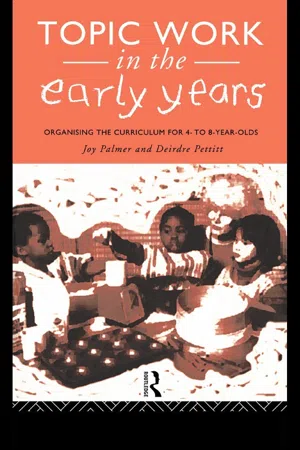
Topic Work in the Early Years
Organising the Curriculum for Four to Eight Year Olds
- 192 pages
- English
- ePUB (mobile friendly)
- Available on iOS & Android
eBook - ePub
Topic Work in the Early Years
Organising the Curriculum for Four to Eight Year Olds
About this book
For more than twenty years, topic work has been accepted as the natural way to teach young children in their first years of school. The introduction of a subject-based curriculum in England and Wales has led to intense questioning of that assured position. Teachers and others are wondering whether the topic approach can fulfil the requirements of the National Curriculum and whether in any case it is necessarily the best way of teaching young children. The authors of Topic Work in the Early Years argue that the answer is yes in both cases although neither this nor any other strategy should be used exclusively in the classroom. With the help of detailed case studies, they give guidance on the planning and assessment of topic work within and across subjects and show how topics can be planned to fulfil specific curricular requirements while retaining the particular virtues of the topic approach: flexibility in the use of time and resources, the chance for coverage of certain areas in greater depth, and differentiation of tasks among children at various stages of their development. Individual chapters cover planning and assessment of topic work across the curriculum, cross-curricular issues and topic work in the core subjects of the National Curriculum as well as history and geography. Overall this book provides a comprehensive source of reference for any teacher organising learning in the early years.
Information
Chapter 1
Topic work In the early years
Introduction
This book arises out of our own experience of teaching young children, our work with students in teacher education and our in-service work with teachers. All these experiences have led us to the conclusion that topic work has and should continue to have an important role to play in the curriculum for young children. We wish to share with our readers our reasons for coming to this conclusion. Topic work is widely used. This book attempts to justify and exemplify its use.
The framework within which schools and teachers implement the curriculum is shaped by the statutory provisions contained in the various National Curriculum documents. How, and to a more limited extent when, the knowledge, skills and understandings of the core and foundation subjects, religious education and cross-curricular themes are translated into schemes of work was left to teachers. In the 1990s the government, anxious to see success for its reforms, may move more and more towards control of methods of implementing the curriculum. An early indication of this trend was the commissioning of the discussion paper entitled ‘Curriculum Organisation and Classroom Practice in Primary Schools’ (Alexander et al. 1992). The implications of this discussion paper were that teachers must be able to justify their practices, including topic work. The discussion paper stated
If it can be shown that the topic approach allows the pupil both to make acceptable progress within the different subjects of the National Curriculum and to explore the relationships between them, then the case for such an approach is strong on both pedagogic and logistical grounds. If however, the result is that the difference between subjects is extinguished the strategy is indefensible.
(Alexander et al. 1992)
The paper went on to criticise topic work which is undemanding, wastes children’s time, does not make full use of the National Curriculum programmes of study and which limits such subjects as art, history and geography. It did not deny that ‘the topic approach in skilled hands can produce work of good quality’ (ibid.) and praised the move from ‘divergent’ topics with considerable choice to ‘broad-based’ topics and ‘subject-focused’ topics. (The former are where a theme such as transport ‘is used to bring together content and skills from several subjects’ (ibid.) and the latter ‘where pupils concentrate on a limited number of attainment targets from other subjects’ (ibid.)) Subject-focused topics are preferred in the discussion paper because ‘they can be planned more easily in relation to the standing orders and can provide more appropriately for the sequential development of pupils’ knowledge understanding and skills’ (ibid.).
In respect of this preference for subject-based topics, it can be argued that there are times when broad-based topics could be seen as more important to children’s learning and to the development of the subject(s) being taught. At other times, subject-focused topics might be more appropriate. In making this judgement the difficulty of planning to meet statutory orders ought not to be an excuse for abandoning broad-based topics. In this book, examples of both sorts of topics will be advanced although in some cases the distinction will not be clear cut.
The discussion paper referred to the whole primary curriculum and was intended to be a forum for discussion for everyone concerned with that curriculum. Primary schooling in England and Wales is organised in various ways to accommodate children between the ages of 5 and 11. Parents are not required to send children of 4 years old to school but many do so even where there is good nursery provision. (In that case children frequently attend nursery but are sent to school at 4.) There are many terms which are used to identify different age groups of children and these differ between countries. It has been decided, in this book, to use the term ‘early years’ to refer to children aged between 4 and 8 years old who are in school. In the discussion paper some points were specific to older primary children, such as whether or not they should be taught by subject specialists. However, much else applied equally to younger and older children.
Having defined the age range to be discussed, it is necessary to ask to what extent suggestions which are put forward about topic work in the early years differ from those which might have been made for older children. The answer is not very much. There is a huge range of attainment and ability to be catered for in any primary classroom. As children get older the curriculum provides for higher levels of cognition and more extensive knowledge. However, at any age, the essential factor is the view of learning which pervades our thinking. Broadly, it is held that teaching for learning, however it is implemented, builds on existing knowledge and experience and the schemata which each learner has constructed in the mind. Given this view it may be that the principles we suggest for the curriculum including topic work obtain generally.
Although an age range has been demarcated for analysis, this view of learning (which will be elaborated on later) raises further questions about whether it is appropriate to make sharp divisions between children related to age, rather than experience and attainment. It is at least possible that the way schools have been organised has had some effect on references to ‘the 4-year-old’ or ‘the 7-year-old’. Perhaps we should consider whether there is any such thing as a typical or normal child of any age. Of course this consideration raises enormous practical difficulties in schools. Selections of content and ways of organising knowledge must, in reality, be made to meet the strengths of the majority of children. Classes in the early years are frequently, but not invariably, age related. Within any class, levels of experience and attainment will differ not only between but also within curriculum areas. And this will also apply to affective, physical and social levels. Matching is a key issue for all teachers (Ausubel 1968, Bennett and Desforges 1988), and it may be that topic work facilitates this task.
This book makes suggestions about content which are mainly derived from the National Curriculum at Key Stage 1. (This is not a simple procedure for authors or teachers because it seems to change almost daily.) Nevertheless, while it is not intended to limit suggestions to the National Curriculum, no apologies are made for its use. This is what teachers must do and its aims are, perforce, theirs. As noted above, at least for the time being, much of how to implement the curriculum rather than what it should consist of is left to schools. We suggest that topic work is an opportunity for the exploration of subject matter in depth. Given the pressure for linear coverage in the curriculum, there may be a danger of sacrificing depth for quick movement up the levels of the National Curriculum, and topics may redress the balance. Teachers’ aims will include appropriate depth. However, if topics themselves become too diffuse they may defeat the aim of giving children space and time to think, to ask questions, to use and apply their knowledge and to begin to take some control over their own learning. The paradox is that this aim may require that a topic has defined boundaries and does not seek to cover every area of the curriculum. Information overload may not just be a problem for teachers (Desforges and Cockburn 1987), it may also be a problem for children. Teachers who aim for understanding—which takes time to learn—may have to limit content to ensure that what is covered is covered thoroughly (Brophy 1989).
In the first chapter we elaborate on the infant teacher’s task and set this in the context of the National Curriculum. We suggest how and why topic work can be used in this task to promote the learning of young children.
In subsequent chapters we turn to classroom practice in the use of topics and themes. Chapter 2 is about planning, assessment, evaluating and recording. Each of the following chapters takes a curriculum area as its focus and shows how a topic may be developed, taking account of teaching and learning processes and presenting case studies and examples. The curriculum areas selected to illustrate our ideas are English, mathematics, science, history, geography, and cross-curricular issues. The importance of other subjects in the National Curriculum and religious education is clear. Where these can arise in the topics we develop, they have been included. The selection made derives from specific expertise and is limited by space. In considering those subjects we have been able to cover in some depth, readers may be able to identify others which could be used as unifying elements in a topic. Throughout, we draw on many sources, but our debt to the practising teachers and students with whom we have worked is evident. We acknowledge this debt and their expertise, and in what follows our intention is not to prescribe but to suggest what we have learned and are still learning about young children thinking and learning in classrooms.
THE BACKGROUND ISSUES
The infant school and the teacher’s task
We believe that teaching in the early years of schooling is both an intellectually and a physically demanding task. No one should ever underestimate what young children can do and the challenges they present to teachers. The first two or three years of formal schooling which children have is a period to which they bring widely differing experiences and levels of attainment. The combination of the wide ranging areas of experience to be taken into account, together with individual differences in ability and attainment, demands the total commitment of teachers, and we take their task very seriously indeed.
Some of the aims of early years teaching are probably generally accepted. Teachers have always tried to implement a ‘broad and balanced curriculum’ which includes an introduction to knowledge valued by our society. Socially valued knowledge, as far as schooling from 5 to 16 is concerned, has been written in the National Curriculum under subject headings, and although the various non-statutory guidelines frequently point to the connections between subjects, it seems clear that each of the working parties engaged in advising on content was satisfied that its own discipline had distinctive knowledge claims, principles and ways of thinking. No one would deny that interesting discoveries are made on the margins between subjects and by applying models from one subject to illuminate another. Beyond schooling from 5 to 16, and indeed within it, subjects amalgamate or are narrowed down into many different sub-areas. However, the organisation of knowledge into the subjects of schooling from 5 to 16 seems at least as reasonable as any other. Moreover, it is possible that the subjects selected, which have evolved over time as those considered appropriate for school, have done so because they reflect the culture of the day (i.e. they differ from the elementary curriculum of relatively recent years and certainly look very different from that studied by Shakespeare). In this culture, school subjects as they are presently conceived seem to be a reflection of what is useful and interesting to the population.
A relevant question may be to ask whether knowledge should be organised differently for young children. It might be surmised that young children are also interested in knowledge which their culture embodies. Other ways of organising knowledge have, however, been recommended for the primary school. For example, in 1989 Her Majesty’s Inspectorate (HMI) identified content categories: human and social, linguistic and literary, mathematical, moral, physical, scientific, spiritual and technological (DES 1989c). They added further lists of concepts, skills and attitudes derived from these categories. Without disputing the value of any of these categories, they do seem, however, to be more limited than the present curriculum and to derive from a subject basis. It may, therefore be sensible to retain the organisation of knowledge into subjects as a starting point for the organisation of the curriculum, quite apart from the fact that the National Curriculum has done precisely this. As has been pointed out: ‘Subjects, as conventionally defined, are the major component of even the most espousedly undifferentiated curriculum’ (Alexander 1984).
Organising knowledge in the curriculum directly from children’s interests might be ideal, given the skill to guide such interests, whether we like it or not, towards the attainment targets of the National Curriculum. In practice (a) the interests of a class of children will vary, (b) the sheer size of classes poses enormous difficulties, and (c) it may be that teachers’ skills should be employed to widen children’s horizons and engender interests rather than follow them. These points and our acceptance of knowledge organised by subjects are not antithetical to a child-centred approach. There is no necessary conflict between subjects and the existing knowledge and experience of the child, any more than there is between the latter and ad hoc categories of human experience.
Finally, the empirical view of knowledge coherently and fully argued in, for example, Blenkin and Kelly (1987) must be acknowledged. This view, which cannot be dealt with adequately here, contains a defence of a skillsbased, process-oriented curriculum. Within this large corpus of work we find the best of progressive education summarised as:
the attempt to treat a child as a child, the emphasis on education through experience and learning by discovery, the view of knowledge as integrated or at least not compartmentalised, the attention to developmental stages and the definition of education and curriculum in terms of processes.
(Blenkin and Kelly 1987)
Some of this is incontestable. However ‘developmental stages’ are at least problematic (Donaldson 1978) and may be seen as defined by contexts. More important perhaps, is that the difficulty of implementing a curriculum on this basis is such that its ideals seem rarely to be implemented in practice (Alexander 1984, Desforges and Cockburn 1987). In our view, however, the following criticism carries most weight:
[I]t is evident that some drastic decisions have to be made about curriculum priorities in the light of judgements about what it is reasonable to attain rather than dreams about what is desirable. In addressing this problem some experts (for example Blenkin and Kelly 1983) have suggested the adoption of a process curriculum. In brief, this entails the identification of significant learning and thinking processes with which we wish children to engage. A curriculum is then built around the design of opportunities to acquire and exercise such intellectual facilities.
There are problems with this approach, not least of which are (a) there is lack of agreement on whether it is sensible to conceive of learning processes independent of content; (b) there is lack of agreement on what such processes might be; and lists of skills can run to thousands of elements. In short the idea might not provide the economies of time necessary to putting it into practice even if the general model were tenable.
(Desforges and Cockburn 1987)
Item (a) seems a little unfair. Content is not seen as unimportant in a unified curriculum, but to some extent knowledge is seen as more important than processes.
Having looked, necessarily rather briefly, at different ways of organising knowledge and therefore of organising the curriculum, we have come down on the side of using subjects as a basis. In our detailed descriptions of how this might work and at the same time retain children at the centre, we try to show that the aims of teachers to implement a ‘broad and balanced curriculum’ need not abandon progressive ideals of the best sort.
In addition to cognitive content, teachers include in their aims the social, emotional and moral development of children. As well as being important in their own right, these are inextricably interwoven with the attainment of knowledge, skills and understandings of the more formal sort. Perhaps at any age relationships with teachers and peers are crucial, but early years teachers know that it is unlikely that young children can learn easily without confidence in their teachers and a secure environment. Teachers are both role model and guide. They must accept children as they are but present standards and values children can follow without denigrating the standards and values they bring to school.
Teachers in the early years of school also aim to ensure that children enjoy their activities and learn how to learn. Children are helped to develop a self-image that is positive enough to accept criticism, to be self-critical, to be curious and to feel free to make mistakes and learn from them.
The attainment of what are generally known as the basic skills, usually of literacy and numeracy, is a further aim. Learning basic skills is part of the entitlement of a...
Table of contents
- COVER PAGE
- TITLE PAGE
- COPYRIGHT PAGE
- ILLUSTRATIONS
- PREFACE
- CHAPTER 1: TOPIC WORK IN THE EARLY YEARS: INTRODUCTION
- CHAPTER 2: PLANNING, ORGANISATION AND ASSESSMENT OF THE CURRICULUM
- CHAPTER 3: HISTORY AND TOPIC WORK
- CHAPTER 4: SCIENCE AND TOPIC WORK
- CHAPTER 5: MATHEMATICS AND TOPIC WORK
- CHAPTER 6: GEOGRAPHY AND TOPIC WORK
- CHAPTER 7: CROSS-CURRICULAR ISSUES AND TOPIC WORK
- CHAPTER 8: ENGLISH AND TOPIC WORK
- NOTES
- REFERENCES
Trusted by 375,005 students
Access to over 1.5 million titles for a fair monthly price.
Study more efficiently using our study tools.
Frequently asked questions
Yes, you can cancel anytime from the Subscription tab in your account settings on the Perlego website. Your subscription will stay active until the end of your current billing period. Learn how to cancel your subscription
No, books cannot be downloaded as external files, such as PDFs, for use outside of Perlego. However, you can download books within the Perlego app for offline reading on mobile or tablet. Learn how to download books offline
Perlego offers two plans: Essential and Complete
- Essential is ideal for learners and professionals who enjoy exploring a wide range of subjects. Access the Essential Library with 800,000+ trusted titles and best-sellers across business, personal growth, and the humanities. Includes unlimited reading time and Standard Read Aloud voice.
- Complete: Perfect for advanced learners and researchers needing full, unrestricted access. Unlock 1.5M+ books across hundreds of subjects, including academic and specialized titles. The Complete Plan also includes advanced features like Premium Read Aloud and Research Assistant.
We are an online textbook subscription service, where you can get access to an entire online library for less than the price of a single book per month. With over 1.5 million books across 990+ topics, we’ve got you covered! Learn about our mission
Look out for the read-aloud symbol on your next book to see if you can listen to it. The read-aloud tool reads text aloud for you, highlighting the text as it is being read. You can pause it, speed it up and slow it down. Learn more about Read Aloud
Yes! You can use the Perlego app on both iOS and Android devices to read anytime, anywhere — even offline. Perfect for commutes or when you’re on the go.
Please note we cannot support devices running on iOS 13 and Android 7 or earlier. Learn more about using the app
Please note we cannot support devices running on iOS 13 and Android 7 or earlier. Learn more about using the app
Yes, you can access Topic Work in the Early Years by Joy Palmer,Deirdre Pettitt in PDF and/or ePUB format, as well as other popular books in Education & Education General. We have over 1.5 million books available in our catalogue for you to explore.