- 320 pages
- English
- ePUB (mobile friendly)
- Available on iOS & Android
eBook - ePub
Underground Humour In Nazi Germany, 1933-1945
About this book
Not all Germans living under Hitler succumbed passively to the rhetoric and horror of the Nazi regime. Covert popular opposition in the form of humorous resistance was wider spread than is commonly thought. Embracing jokes, stories and 60 cartoons, this is the only collection in English of underground anti-Nazi humour. It is, as such, an invaluable contribution to the social history of twentieth century Germany.
Trusted by 375,005 students
Access to over 1.5 million titles for a fair monthly price.
Study more efficiently using our study tools.
Information
Subtopic
Social HistoryIndex
History1 REPRESENTATIVES OF THE OLD ORDER
PRESIDENT VON HINDENBURG
In 1932, the last year of the Weimar Republic, political jokes began to circulate at an ever-increasing rate. Many centred on the President. In office since 1925, he stood for re-election in March 1932 and on that occasion just failed to get the absolute majority required by the constitution; a month later a second election resulted in an absolute majority for the old President. Hindenburg was then nearly eighty-five years old. By the majority of German moderates he was remembered from the war as a venerable father-figure,1 but by some merely as a man of average ability inexplicably elevated to mythological greatness,2 or as less a man than a national monument,3 or even, in stark contrast to both these images, as a ‘Zero paving the way for Nero.’4
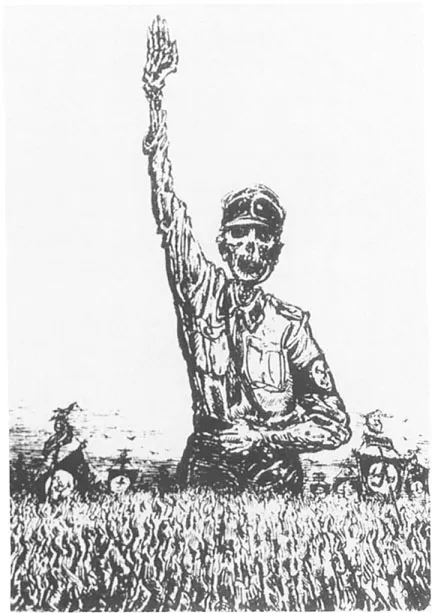
2 Hitler – a German fate
3 Potsdam, 21 March 1933
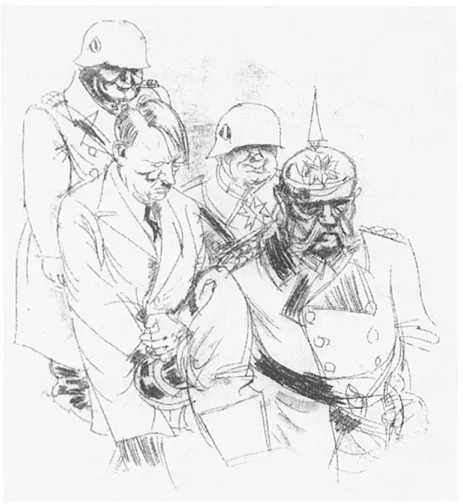
The President’s frequently vacillating attitude as Head of State during that turbulent year showed his age.5 Despite the now diminishing periods of mental lucidity,6 which became embarrassing toward the end,7 Hindenburg retained his distrust of ‘that Bohemian corporal’8 for a very long time. As late as 26 January 1933 – only four days before he appointed Hitler Reich Chancellor – Hindenburg declared that he would not think of such a possibility.9 According to another source the President is reputed to have said, ‘He can at best be made Postmaster General, then he can … my backside on the stamps!’10
It may well be that most of the jokes about the President’s senility originated in Goebbels’ Ministry of Propaganda, and might have been inspired by Hitler’s vindictiveness. When Hitler came to power, what Hindenburg thought of him can hardly have remained a secret to him.
Soon after 30 January 1933 (the day of Hitler’s appointment as Reich Chancellor), the following story circulated in Berlin:
[1] On the balcony of his palace the old President is watching the seemingly endless columns of Stormtroopers in their brown shirts marching past carrying their torchlights. Hindenburg, confusing this scene in his memory with his famous victory over Russia in 1914,11 asks his Secretary of State, ‘Meissner, is there no end to these Russian POWs?’12
Hindenburg eventually submitted to repeated demands by his immediate entourage13 to sign the document which effected Hitler’s chancellorship. This may be the background reflected in the following two jokes:
[2] A lady is waiting in the anteroom for an interview with the President. Before going in, she is about to unwrap a bunch of flowers she has brought along, when Secretary of State Meissner warns her, ‘Please don’t leave any paper lying about here, Madam; the old gentleman might sign it otherwise!’
[3] The Wilhelmstrasse14 has to be swept several times a day in order to prevent Hindenburg from signing any wastepaper lying about.
Even nastier:
[4] The Wilhelmstrasse is closed for traffic every morning from eight to nine in order to enable Hindenburg to have some exercise; he enjoys spinning a top without being endangered by traffic.
[5] Hitler has an audience with the old President. After he has left, Hindenburg asks his Secretary of State, ‘Tell me, Meissner, how long has Brüning been wearing a moustache?’15
[6] Which is the smallest concentration camp in Germany? Neudeck. It has only one prisoner: Hindenburg.16
This list of jokes about Hindenburg may best be concluded by relating an event which, though it may seem hardly credible, is nevertheless historically correct. When Hindenburg died on 2 August 1934, Hitler seized his chance to use the state funeral to promote his own Nordic fantasies. He gave the official farewell, which was broadcast, with these words: ‘And now, old warrior, depart on your journey to Valhalla!’17
And so the funeral of Germany’s grand old man, a life-long practising Christian, took place to the musical accompaniment of an orchestra playing Wagner’s Twilight of the Gods.’18
SECRETARY OF STATE DR MEISSNER
Dr Hans Otto Meissner (1880–1953) was the Head of the Presidential Chancellory under Ebert, von Hindenburg and eventually also under Hitler. Together with von Papen he was instrumental in bringing about the appointment of Hitler as Reich Chancellor.19 Although Meissner maintained his influential position as confidant of the aged President he did not attempt to enforce any restrictions on the new masters of Germany during the street excesses of the Stormtroopers in the early weeks of 1933.20 During the war Meissner was critical of Ribbentrop21 and also, in retrospect, of Hitler’s spellbinding effect on Oscar von Hindenburg, the President’s son and adjutant.22 Meissner was considered by contemporaries alternatively as a careerist23 or as the typical non-political senior civil servant.24 His ‘longevity’ as the servant of three régimes so utterly dissimilar to each other is reflected in these jokes:
[7] Meissner, the political quick-change artiste, is also known as the Chameleon.25
[8] Although the world has been submerged by another flood, much more devastating than Noah’s, someone did survive – Dr Meissner, on the top of the Himalayas.26
VON PAPEN
Franz von Papen (1879–1969) became the penultimate Reich Chancellor of the Weimar Republic when he succeeded Brüning in June 1932. General Kurt von Schleicher, who succeeded von Papen on 2 December 1932, had been responsible for von Papen’s appointment as he had for Brüning’s before him, in 1930.27 As the man behind the throne, the General became known, not inappropriately, as the ‘field-grey eminence’,28 and by the Nazis as ‘primo de Schleicheros’,29 because they suspected him of playing with the idea of a coup d’état.
As the new Reich Chancellor, von Papen soon won the old President’s confidence, and before long this confidence developed into a close friendship. Von Hindenburg approved of von Papen’s ‘cabinet of barons’,30 which was to include General von Schleicher as Minister of Defence.
Von Papen’s aristocratic background, his excellent horsemanship,31 his military service in an exclusive cavalry regiment before the war,32 and his connections with industry and the Catholic Church33 were all assets for his high office. On the debit side there was his character itself34 and certain aspects of his former diplomatic career35 and these...
Table of contents
- Cover
- Halftitle
- Title
- Copyright
- Dedication
- Contents
- List of illustrations
- Preface
- Introduction
- 1. Representatives of the Old Order
- 2. Hitler
- 3. Other Personalities of the Third Reich
- 4. Institutions of the Third Reich
- 5. The Jews
- 6. Aspects of the Third Reich
- 7. The Anschluss
- 8. The Third Reich as seen by Others
- 9. Hitler’s War
- 10. The End of the Third Reich, Year Zero and Aftermath
- Epilogue
- Sources of jokes
- Notes
- Glossary
- Bibliography
- Index
Frequently asked questions
Yes, you can cancel anytime from the Subscription tab in your account settings on the Perlego website. Your subscription will stay active until the end of your current billing period. Learn how to cancel your subscription
No, books cannot be downloaded as external files, such as PDFs, for use outside of Perlego. However, you can download books within the Perlego app for offline reading on mobile or tablet. Learn how to download books offline
Perlego offers two plans: Essential and Complete
- Essential is ideal for learners and professionals who enjoy exploring a wide range of subjects. Access the Essential Library with 800,000+ trusted titles and best-sellers across business, personal growth, and the humanities. Includes unlimited reading time and Standard Read Aloud voice.
- Complete: Perfect for advanced learners and researchers needing full, unrestricted access. Unlock 1.5M+ books across hundreds of subjects, including academic and specialized titles. The Complete Plan also includes advanced features like Premium Read Aloud and Research Assistant.
We are an online textbook subscription service, where you can get access to an entire online library for less than the price of a single book per month. With over 1.5 million books across 990+ topics, we’ve got you covered! Learn about our mission
Look out for the read-aloud symbol on your next book to see if you can listen to it. The read-aloud tool reads text aloud for you, highlighting the text as it is being read. You can pause it, speed it up and slow it down. Learn more about Read Aloud
Yes! You can use the Perlego app on both iOS and Android devices to read anytime, anywhere — even offline. Perfect for commutes or when you’re on the go.
Please note we cannot support devices running on iOS 13 and Android 7 or earlier. Learn more about using the app
Please note we cannot support devices running on iOS 13 and Android 7 or earlier. Learn more about using the app
Yes, you can access Underground Humour In Nazi Germany, 1933-1945 by Dr F K M Hillenbrand,F. K. M. Hillenbrand in PDF and/or ePUB format, as well as other popular books in History & Social History. We have over 1.5 million books available in our catalogue for you to explore.