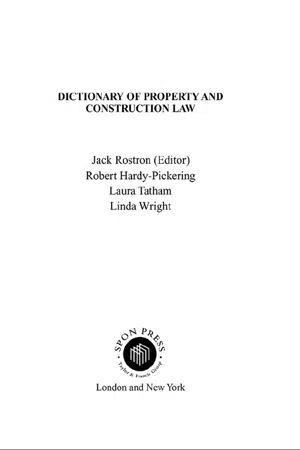
This is a new dictionary which provides a clear and concise explanation of terms used in land, property and construction law and management. The four key areas of coverage are: planning/construction law, land law, equity/trusts and finance and administration. It will be a useful reference for property and building professionals and a personal purchase for students of property and construction law on building, construction management, estate management and law courses.
Jack Rostron is an experienced author and editor whose 1997 Spon title Sick Building Syndrome has been well received and widely reviewed. His co-authors contribute the necessary specialist knowledge from their respective fields of teaching and legal practice.
eBook - ePub
Dictionary of Property and Construction Law
- 208 pages
- English
- ePUB (mobile friendly)
- Available on iOS & Android
eBook - ePub
Dictionary of Property and Construction Law
About this book
C
CAB Citizens Advice Bureau.
calendar month One of the periods of 28, 30 or 31 days in which a calendar year is divided. For leap years, a period of 29 days occurs in February.
calendar year A period of 365 consecutive days, or in a leap year, 366 consecutive days including the 29th February.
call loan A repayable loan, redeemable in full on demand.
called up capital Proportion of the issued share capital of a company that had actually been called up.
calls In company law a term used for the demands from a company to its shareholders to pay a certain sum in respect of their shares.
capacity A person's ability to enter into a legally binding agreement including contract and trusts.
capital Accumulated wealth. A portion of wealth which is set aside for the production of additional wealth. Specifically, the funds belonging to the partners or shareholders of a business invested with the expressed intention of them remaining permanently in the business.
capital adequacy Test of whether an organisation has the minimum value of reserves to run its business.
capital allowances Allowances set against income tax or corporation tax available to organisations for the depreciation of capital assets.
capital appreciation Increase in the value of a capital asset over a stated period, which is normally expressed as a percentage of the original value.
capital asset (fixed asset) Assets of material value that are long life and are held to be used in the business rather than for re-sale or conversion into cash. Examples of capital assets would include land, buildings, plant and machinery.
capital budget The sum allocated by an organisation for future capital expenditure.
capital expenditure Sums of money spent on improving and acquiring capital assets as distinct from revenue expenditure on such matters as maintenance.
capital gain In terms of Capital Gains Tax, the increase in value of capital assets. Under legislation Capital Gains Tax is payable when certain items are disposed of and at certain occasions.
capital improvement Capital works undertaken on an asset with a view to enhancing its value. It does not include repairs or maintenance.
capital market Market in which capital is raised by industry, government and local authorities. Funds are normally raised through the issue of shares, bonds, debentures, loan stock, etc.
capital money Funds paid to trustees under the Settled Land Act 1925. Under the Act settled land is: (1) Limited in trust to any person by way of succession. (2) Limited in trust for any person in possession. (3) Limited in trust for a contingent estate. (4) Limited to or in trust for a married woman. (5) Charged with any rent charge for the life of any person. The instrument by which land is settled is called the settlement.
capital receipts In respect of local authority housing money received from the sale of capital assets, mainly council housing and land. Currently central government controls how such funds may be used.
capital value The capital value of an asset, as opposed to an annual or periodic value, such as rent.
capitalised interest Bridging interest accumulated on loans released during the development period. (See bridging interest.)
capite, tenure in Holding land directly from the Crown.
capricious A concept developed by Templeman J in Re Manisty's Settlement (1974) Ch 17 in which he upheld a power of very considerable breadth. His example of a capricious power was one in favour of the residents of Greater London which was, he suggested, invalid because the terms of the power negative any sensible intention on the part of the settler and any sensible consideration by the trustees of the exercise of the power. The concept applies to both discretionary trusts and powers.
caps Used on adjustable rate mortgages (ARMs) to limit the interest rate and/or the payment. Most ARMs have a periodic cap that is around 2% per year and a life cap of around 5%–6% over the life of the loan. ‘Payment only’ caps sometimes create negative amortisation where the principal balance of the loan increases rather than decreases over time.
caravan A mobile home which is capable of being moved from site to site. Normally used for short periods of time as a holiday residence.
Caravan Sites and Control of Development Act 1969 This Act gave local authorities new powers to control caravan sites, including a requirement that all caravan sites had to be licensed before they could start operating (thus partly closing loopholes in the planning and public health legislation). These controls over caravan sites operate in addition to the normal planning system; so both planning permission and a licence have to be obtained. Most of the Act dealt with control, but local authorities were given wide powers to provide caravan sites.
care and repair A colloquial term describing agency services to assist elderly home-owners with housing maintenance, adaptations, etc. (See staying put.)
care contract An agreement making provision for care arrangements between two parties, e.g. social services and registered social landlords. Such agreements are enforceable by law.
care in the community A central government policy for releasing certain classes of inmate or patient from hospitals and institutions and arranging for care in the community.
carriageway A highway, along which there is a right to drive vehicles and possibly to lead or ride animals and to pass on foot, unless exempt by statute.
case A court action, often referring to the particulars of a specific action.
case stated A statement of facts prepared by a court or arbitrator for the decision of a higher court on a point of law.
cash back A sum of money paid by a property owner to a potential tenant in times of over-supply.
cash book In book keeping the book of prime entry where all receipts and payments are recorded. Receipts are shown as debits and payments as credits.
cash cow A term deriving from the Boston matrix to describe a product with a high market share within an established market which produces a steady flow of cash.
cash flow The movement of money both in and out of an organisation within a specified period.
cash flow forecast Forecast of expected payments and receipts within a given period. Although an organisation may have a healthy reserves and assets position it may experience severe problems if it does not have sufficient to cover cash commitments.
cash limit Limits on actual spending. In the case of social housing the Department of Environment, Transport and Regions (DETR) will set a cash limit for the Housing Corporation each year.
casting vote A deciding vote. In common practice the vote given to the chair of a meeting to be used if the votes cast for and against a particular resolution are the same. The arrangements concerning the right to casting vote are usually contained in the Articles of Association.
catch up repairs Repairs required to bring a property into good condition.
category 1 housing Defined in circular MHLG 82/69 as . . . ‘self contained dwellings to accommodate one or two older people of a more active kind.’ This circular is no longer mandatory.
category 2 housing Defined in circular MHLG 82/69 as . . . ‘accommodation in grouped flatlets to meet the needs of less active older people.’ The circular is no longer mandatory.
caution The Land Registration Act 1925 allows any person interested in land to lodge a caution with the Registrar, requiring notification of any dealings in the land. The Act introduced a system whereby all land in England and Wales is subject to compulsory registration on first conveyance or sale of the freehold or grant of a lease for more than 21 years.
caveat A warning.
caveat actor Let the doer beware.
caveat emptor Let the buyer beware; a maxim indicating that any risk is upon the buyer and not the seller.
caveat venditor Let the vendor beware.
CBI Abbreviation for Confederation of British Industry.
CECODHAS European Liaison Committee for Co-operative and Social Housing. It represents national member organisations in 16 European countries which are providers of social housing.
ceiling value The maximum compensation payable for compulsory acquisitions, normally associated with site value for unfit houses.
Central Statistical Office UK government department which collects and collates information concerning the national economy and reproduces this information in statistical form.
CEO Abbreviation for chief executive officer.
certainties, the three The necessary conditions for the creation of a valid private trust stated by Lord Eldon in Wright v Atkyns (1823) Turn & R 143 and by Lord Langdale in Knight v Knight (1840) 3 Beav 148.
Certificate of Incorporation Certificate issued to the shareholders of a company by the Registrar of Companies which brings a company into existence. It is issued following the submission of Memorandum and Articles of Association together with other documentation. A company has no legal existence until the certificate has been issued.
certificate of making good defects The certificate issued by an architect or surveyor under a building contract at the end of the defects liability period, indicating that the contractor has satisfactorily made good any defects. It has the effect of releasing the balance of retention money to the contractor.
certificate of origin Documentation stating the country of origin of any exported goods. The certificates are usually issued by the Chamber of Commerce in the country of origin and determine whether or not an import duty has to be paid and if it has, at what tariff.
certificate of practical completion A certificate issued by an architect or surveyor indicating that works have been substantially completed and the building is ready for occupation. The certificate allows the release of an agreed percentage of retention monies.
certificate of value A certificate signed and issued by the purchaser of property attesting the price paid, often for the purposes of stamp duty.
certificate, land A document under the seal of the Land Registry which contains the particulars of a piece of land.
Certified Accountant Member of the Chartered Association of Certified Accountants, one of the major bodies of accountants whose members are recognised as properly qualified to audit the accounts of limited companies.
certified copy A true copy, attested to be true by the officer holding the original.
cesser The premature cessation of a right or interest.
cessio bonorum The surrender by a debtor of his property to his creditors.
cestui que trust The beneficiary. One having an equitable interest in property with the legal title being vested to the trustee. That is, the person for whose benefit a trust is created.
cestui que use One to whose use the property was conveyed.
cestui que vie The person for whose life any land is granted. Thus, where ‘X’ is a tenant for the life of ‘Y’, ‘Y’ is a cestui que vie.
chain of title The chronological order of conveyance of a parcel of land from the original owner to the present owner.
chain transactions The situation in residential conveyancin...
Table of contents
- COVER PAGE
- DICTIONARY OF PROPERTY AND CONSTRUCTION LAW
- TITLE PAGE
- COPYRIGHT PAGE
- PREFACE
- FOREWORD
- A
- B
- C
- D
- E
- F
- G
- H
- I
- J
- K
- L
- M
- N
- O
- P
- Q
- R
- S
- T
- U
- V
- W
- Y
- Z
Trusted by 375,005 students
Access to over 1.5 million titles for a fair monthly price.
Study more efficiently using our study tools.
Frequently asked questions
Yes, you can cancel anytime from the Subscription tab in your account settings on the Perlego website. Your subscription will stay active until the end of your current billing period. Learn how to cancel your subscription
No, books cannot be downloaded as external files, such as PDFs, for use outside of Perlego. However, you can download books within the Perlego app for offline reading on mobile or tablet. Learn how to download books offline
Perlego offers two plans: Essential and Complete
- Essential is ideal for learners and professionals who enjoy exploring a wide range of subjects. Access the Essential Library with 800,000+ trusted titles and best-sellers across business, personal growth, and the humanities. Includes unlimited reading time and Standard Read Aloud voice.
- Complete: Perfect for advanced learners and researchers needing full, unrestricted access. Unlock 1.5M+ books across hundreds of subjects, including academic and specialized titles. The Complete Plan also includes advanced features like Premium Read Aloud and Research Assistant.
We are an online textbook subscription service, where you can get access to an entire online library for less than the price of a single book per month. With over 1.5 million books across 990+ topics, we’ve got you covered! Learn about our mission
Look out for the read-aloud symbol on your next book to see if you can listen to it. The read-aloud tool reads text aloud for you, highlighting the text as it is being read. You can pause it, speed it up and slow it down. Learn more about Read Aloud
Yes! You can use the Perlego app on both iOS and Android devices to read anytime, anywhere — even offline. Perfect for commutes or when you’re on the go.
Please note we cannot support devices running on iOS 13 and Android 7 or earlier. Learn more about using the app
Please note we cannot support devices running on iOS 13 and Android 7 or earlier. Learn more about using the app
Yes, you can access Dictionary of Property and Construction Law by J. Rostron,Robert Hardy-Pickering,Laura Tatham,Linda Wright in PDF and/or ePUB format, as well as other popular books in Business & Architecture General. We have over 1.5 million books available in our catalogue for you to explore.