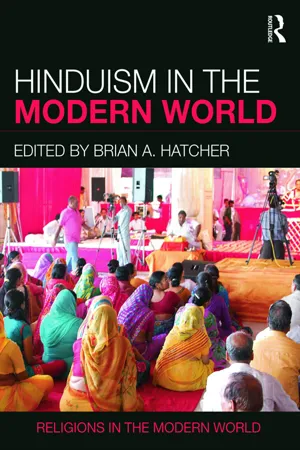
Hinduism in the Modern World presents a new and unprecedented attempt to survey the nature, range, and significance of modern and contemporary Hinduism in South Asia and the global diaspora. Organized to reflect the direction of recent scholarly research, this volume breaks with earlier texts on this subject by seeking to overcome a misleading dichotomy between an elite, intellectualist "modern" Hinduism and the rest of what has so often been misleadingly termed "traditional" or "popular" Hinduism. Without neglecting the significance of modern reformist visions of Hinduism, this book reconceptualizes the meaning of "modern Hinduism" both by expanding its content and by situating its expression within a larger framework of history, ethnography, and contemporary critical theory. This volume equips undergraduate readers with the tools necessary to appreciate the richness and diversity of Hinduism as it has developed during the past two centuries.
- 340 pages
- English
- ePUB (mobile friendly)
- Available on iOS & Android
eBook - ePub
Hinduism in the Modern World
About this book
Information
Part I
Hinduism Today
Three Perspectives
1 Hinduism in South India
As new technologies and new diasporas emerge across the world, as tourism and the marketplace offer new religious mobilities and goods, and as modern governance exerts its claim on ancient political structure, Hinduism in modern South India invents and adapts itself. One illustration is a weekly Telugu-language television program called Dharma Sandehalu (Doubts about Dharma) that is viewed both through a live broadcast and through YouTube recordings by more than five million viewers across Asia, the Middle East, and North America. The program features an expert on South Indian Hindu traditions who resolves callers’ dilemmas of practicing Hinduism amidst the exigencies and diversity of modern life. In another example, temples in the Hindu diaspora commonly adjust their ritual calendars to accommodate the work routines of host countries and extend maps of traditional Hindu sacred landscapes to include their new local geographies. The Sri Venkateshvara temple in suburban Pittsburgh, the oldest temple in North America, uses its hilly geographic setting to authenticate its belonging to the network of temples in the tradition of the famous hill temple of Sri Venkateshvara in Tirupati in South India. Almost every temple today has a cyber-presence: an elaborate website and Facebook pages that detail its origin stories and devotional experiences, web links to related temples, audiovisual streaming media of the worship rituals, and, often, facilities for ‘e-worship’ through which devotees can request and pay for particular rituals. Cell phone apps bring ritual procedures to handheld devices such as goddess worship in a South Indian format to an iPhone app. These new applications and mediations reflect the changing contours of sacred space and time and religious experience.
Modern adaptations, nevertheless, are embedded in histories and traditions that make regional forms of Hinduism distinctive. Modern South Indian Hinduism is best understood, not as one undifferentiated religion, but as a confluence of histories of rulership and patronage, lineages of spiritual authority, languages and styles of worship, and geographic and economic orders that are specific to South India. And modern South Indian Hinduism must also be understood as a negotiated identity within new contexts of race and culture. It is therefore important to take a longer view of South India than is provided by post-Independent India whose modernity downplays the enormously complex changes and exchanges that took place across Tamil, Kannada, Telugu, and Malayalam regions for many centuries, especially between the fifth and the seventeenth centuries. These regions not only had a variety of religious orientations that predate narrower definitions of ‘Hindu’ produced and contested during the period of British rule and beyond, but they also spawned a deeper cultural cross-fertilization between Hindu, Islamic, Jain, and Buddhist imaginations. For example, the city of Madurai (in modern-day Tamil Nadu) portrayed in the great Tamil epic Cilapattikaram (The Tale of an Anklet), ascribed to Ilango Atikal (about fifth century CE), depicts the strong currents (and uneasy undercurrents) between Jainism, Hinduism, Buddhism, and the so-called tribal religions that prevailed in this prosperous city of early South India. Between the fifteenth and the seventeenth centuries CE, engaging with an Islamic cultural and political climate, Hindu temple architecture borrowed distinct Islamic features such as arches, framed doorways, and stylized flower motifs. In the same way, the soaring roofs of a South Indian temple in a North American or European city are made possible only after the local Hindu community has negotiated its place through both tense and productive exchanges with other religious orders and with local laws of construction.
Thus, one way to discern the flows of the past in the modern and the interflows between different facets of the modern itself is to imagine a network—a necessarily fuzzy network—that gets created through reflections and reminiscences, people and precepts, and materials and methods. The portraits of South Indian Hinduism in this chapter illustrate different kinds of ancient and modern networks that are at play at consecrated sites, in worship rituals, in sacred embodiment, and, most of all, in devotees’ perceptions and experiences.
Networks of Narratives
Avani, a small, rocky, and temple-dotted village in Kolar district, about sixty miles from the silicon city of Bangalore in Karnataka, South India, is an excellent example of how South Indian landscapes fashion their identity around epic narrative. Avani inhabits the ancient pan-Asian epics of the Ramayana and the Mahabharata in a way that ensures its own place in the perpetuity of these epic traditions and simultaneously locates itself in a network of places and temples across South India that are connected to each other through these epics. Photographs of Avani along with narrative sketches on Internet sites indeed register Avani primarily as an epic landscape that is a necessary part of tours through Karnataka.
According to contemporary oral traditions of Avani, Rama, the central hero of the Ramayana, and his wife, Sita, stayed at Avani—a motif of association that recurs in many towns and temples. The landscape remembers sage Valmiki, the author of the Sanskrit Ramayana and also one of its visionary characters, through the Valmiki Parvata (Valmiki Hill) with its cave residence. But unique to Avani is the familial claim that it makes on Sita through one of the few Sita temples in India. In fact, the very name Avani, which means ‘earth’ in Sanskrit, foregrounds the story of how King Janaka found the baby Sita in a furrow while he was plowing his fields and adopted her as his daughter. (Sita is also called Avanisuta, child of the earth.) Just as Mithila in North India displays its affectionate custody over Sita who was born and grew up there, it is to Avani, the story goes, that the pregnant Sita retreated, heartbroken at Rama’s unjust—even if heart-torn—rejection of her. And it is here that she raised her twin sons in the sanctuary of Valmiki’s hermitage and the surrounding forest. Landmarks in Avani’s rocky terrain record these stories: Valmiki’s cave contains an antechamber where Sita is believed to have birthed her boys; Tottalagundu (cradle-rock) is the boulder upon which Sita nurtured them; Kudregundu (horse-rock) is where the teenaged twins precociously tethered Rama’s roaming sacrificial horse, challenging his kingship. The local community’s folklore attributes the reddish hue of the rocks to the tears of blood that Sita shed as she watched her husband and young sons wage their battle with each other below on the plains (Vijailakshmi 2014).
But Avani’s temples are also part of a South Indian network of rulerships and patronages, and they reflect the shifting religious preferences of many centuries of rulers. Although generally believed to have been built by rulers of the Nolamba-Pallava dynasty between the eighth and eleventh centuries CE, these temples successively saw new construction and renovation under later rulers such as the Chola kings. Avani’s rulers were either Shaivas or Vaishnavas (worshippers of Shiva or Vishnu, the two prominent Hindu gods), but they built temples that accommodated the more diverse religious constituencies of their kingdoms. Hence, many of Avani’s temples, although built by Vaishnava rulers, enshrine lingas which are iconic representations of the god Shiva, such as the Ramalingeshvara temple.
Avani also enshrines a story from the other inexhaustible epic, the Mahabharata. This story links both epics (the Ramayana and the Mahabharata) through the memory of one of the Mahabharata’s characters, the ageless bear-king Jambavan, who was Rama’s devotee from an earlier epoch. In the story, Krishna goes in search of a precious jewel called Shyamantaka whose loss is erroneously attributed to him, and finds that Jambavan has it. A struggle ensues. After twenty-one days of wrestling, Jambavan suddenly recognizes that Krishna is none other than his beloved Rama, reincarnated. Overcome with devotion, he immediately surrenders the jewel to Krishna. A temple on Avani’s Valmiki Hill celebrates this story, with local lore also claiming that Jambavan’s daughter (Jambavati) was given in marriage to Krishna here. These and other stories and their variants are part of Avani’s mythic memory and they continue to be expressed there in daily worship, votive rituals, and healing practices. What is also important to note is that in an implicit network, Avani’s Jambavan temple coexists with another rare Jambavan temple roughly 250 miles northeast of Avani, in Nellore (Andhra Pradesh). Called the Krishnaswami temple, it too celebrates the same origin story from the Mahabharata as the Avani temple. In this way, epic narrative yields many opportunities for claims and identities that do not—at least commonly—challenge one another but become part of the fuzzy network of shrines in South India discussed earlier.
Hindu Architecture of South India: Networks of Sacrality and Secularity
A temple is called kovil in Tamil, devasthana in Kannada, gudi in Telugu, and ambalam in Malayalam. Regional variations notwithstanding, the ambience of a contemporary South Indian temple in India is routinely busy: outside is a marketplace with stores selling prayer books, devotional music, icons, trinkets, and framed or glossy pictures of deities associated with the temple; vendors are selling flowers and fruits that are usable in worship or small compact baskets with ritual paraphernalia. The streets of more touristy temples, additionally lined with small restaurants, see large numbers of buses and cars that take pilgrims and tourists on regional circuits of sacred and heritage sites. The interior of a temple displays a different kind of busy-ness with worshippers waiting in lines to see the deities, offer pujas (worship), and be blessed by the priest. Although physical access to the innermost space of the shrine is limited to temple priests, these days, one is likely to find closed circuit television screens and loudspeakers in larger temples that provide the worshippers who are standing in line a mediated experience of the inner shrine. This reciprocal flow between ‘sacred space’ and ‘secular space’ (i.e. worldly, mundane) has modern makings, but as the history of South India shows, temples through the centuries have supported networks of interdependence between the commercial enterprise of local communities and the religious duties of temple administrations.
The modern form of the South Indian temple, traditionally classified as ‘Dravida,’ has evolved over nearly seven hundred years, with each ruling dynasty or patron often modifying existing structures. In early Hindu political theology (that put secular political order in conversation with divine order), deities and rulers shared a sovereign status: the deity was a supreme and timeless sovereign, and the ruler was temporal potentate. Through a system of endowments, the ruler would ensure continuity of worship for the deity. In return, the temple accorded special privileges at the temple to the ruler. This shared sovereignty over territory is marked by a tall flagpole (dhvajastambham) in the courtyard of South Indian temples, usually positioned in front of the main door. While modern temples will have structures such as the dhvajastambham, it is a symbol that today, in the absence of a king, can serve to evoke the sole sovereignty of the deity or, in the diaspora, convey the arrival and belonging of a religious community.
A South Indian temple has two defining axes: one is horizontal (east-west) and the other is vertical. These axes symbolize and materialize the relationship between the human and the divine, the mundane and the extraordinary. The horizontal axis along which a worshipper walks to reach the inner shrine draws out the earthly location of the divine. The vertical axis, expressed through tall gateways and roofs, connects the earthly to the cosmic. The most sacred intersection of the two axes is the inner sanctum itself. These understandings are calculated through a precise mathematics elaborated in various architectural and iconographic texts. Two keystone texts on the principles of Hindu architecture and material culture, the Manasara (‘essence of measurement’) and the Mayamata, are from South India (Howes 2003).
It is important to remember that subjective preferences ultimately determine the diverse ways in which worshippers engage with temple spaces. Typically, however, a worshipper enters a South Indian temple through an ornate, tall gateway (gopura). She moves toward the east-facing deity, passing through one or more pillared halls (mantapas) and reaches the main structure called the vimana that is comprised of the inner sanctum called garbha griha (womb- house) and an elaborate pyramidal-dome directly above the sanctum. The garbha griha is smallish and cave-like, usually lit only by the lamps that surround the deity (murti). The deity’s resplendent adornment reflecting in the lamplight creates an aura of auspiciousness and regality. The vimana is a precise mathematical configuration of a square plan on which the inner sanctum is built, while the pyramidal dome itself is a tiered projection of that plan. The vertical alignment suggests that the universe of secular forms and fantastical phenomena depicted in the pyramidal dome is ultimately born from the ‘womb’ that holds the deity. At the summit of the pyramidal dome-roof is a special kind of vase or pot (or a line of pots) called kalasha. While kalasha has many meanings, in essence, it symbolically contains the seed and the water of life. A circular pathway around the sanctum allows the worshipper to circumambulate the deity and thus express an intimate bond with an embodied, organic, and sovereign life-source.
The earliest phase (seventh to ninth CE) of South Indian temple architecture is associated with Pallava rulers who built rock-cut temples such as the chariot shrines (rathas) and the ‘Shore temple’ in Mahabalipuram in Tamil Nadu. The rathas depict scenes from the Puranas and the Mahabharata such as the descent of the heavenly river Ganga, or the warrior Arjuna’s penance. Later temples added elements that define the South Indian temple today such as pillared halls, passageways for circumambulation, and walled courtyards. The tenth to eleventh centuries marked another culturally effervescent era when massive structures reflected the power and wealth of kings. A vibrant center to this day for the worship of Shiva, the granite Brihadeeshwara temple at Thanjavur, built by the Chola kings in 1,000 CE, has a tower that is nearly 200 feet high with just the top of the pyramidal structure weighing nearly eighty tons. The twenty-five-foot tall Shivalinga is the largest in India. Nandi, Shiva’s bull—each deity has a distinctive animal as vehicle—is a twenty-foot long monolithic statue. During festive processions today, large bronze statues, the famous Chola bronzes, go out draped in silk, flowers, and jewels on chariots into streets of the town, reminding us of the public role of deities.
If grandeur through scale and embellishment came to signify Hindu architecture by the twelfth century, it was taken to even further heights by the Vijayanagara and Nayaka rulers between the fourteenth and eighteenth centuries. The South Indian temple as a ‘gigantic urban ensemble’ came to index the widening importance of the temple in urban life (Michell 1995: 149). While the garbha griha continued to be the focal spiritual point of the temple, expanding enclosures, walls and soaring gateways, and halls for cultural performances, discourses, and civic meetings transformed the temple into a temple complex that accommodated worldly exchange. Still in active worship today, the Virupaksha-Pampa (Shiva-Parvati) temple in Hampi, the former capital of the Vijayanagara Empire, is a classic example of accrued architectural form. While the sanctuary in this temple existed even in the ninth and tenth centuries, it was the many generations of Vijayanagara rulers from the fourteenth century who made the temple—with gateways, water tanks, colonnaded streets leading into the surrounding bazaar, and public celebrations such as the grand Navaratri festival—virtually iconic of ‘empire.’ The display of regality is an integral part of a tradition in Shringeri, Karnataka, which dates to the fourteenth century when the then guru of Shringeri’s monastic center (matha) strategically advised the two brothers, Hakka and Bukka, who soon established the Vijayanagara Empire. Tradition narrates that in gratitude, the brothers offered the guru the kingdom itself but, as a renunciant (sannyasi), he declined. He agreed instead to hold a symbolic royal court (durbar) for the ten days of Navaratri, the nine-night festival of the goddess in the Sharada temple there. Thus each night, even today, the matha’s guru, wearing royal insignia, presides over music and dance performances in a durbar setting in the main temple. Hundreds of people gather for his durbar in the large hall of the temple, ...
Table of contents
- Cover Page
- Half Title Page
- Series page
- Title Page
- Copyright Page
- Dedication
- Contents
- List of Maps and Images
- Acknowledgments
- Notes on Contributors
- Introduction
- Part I Hinduism Today Three Perspectives
- Part II The Colonial Backdrop
- Part III Movements and Relocations
- Part IV Networks of Meaning
- Part V Critical Social and Political Issues
- Glossary
- Index
Trusted by 375,005 students
Access to over 1.5 million titles for a fair monthly price.
Study more efficiently using our study tools.
Frequently asked questions
Yes, you can cancel anytime from the Subscription tab in your account settings on the Perlego website. Your subscription will stay active until the end of your current billing period. Learn how to cancel your subscription
No, books cannot be downloaded as external files, such as PDFs, for use outside of Perlego. However, you can download books within the Perlego app for offline reading on mobile or tablet. Learn how to download books offline
Perlego offers two plans: Essential and Complete
- Essential is ideal for learners and professionals who enjoy exploring a wide range of subjects. Access the Essential Library with 800,000+ trusted titles and best-sellers across business, personal growth, and the humanities. Includes unlimited reading time and Standard Read Aloud voice.
- Complete: Perfect for advanced learners and researchers needing full, unrestricted access. Unlock 1.5M+ books across hundreds of subjects, including academic and specialized titles. The Complete Plan also includes advanced features like Premium Read Aloud and Research Assistant.
We are an online textbook subscription service, where you can get access to an entire online library for less than the price of a single book per month. With over 1.5 million books across 990+ topics, we’ve got you covered! Learn about our mission
Look out for the read-aloud symbol on your next book to see if you can listen to it. The read-aloud tool reads text aloud for you, highlighting the text as it is being read. You can pause it, speed it up and slow it down. Learn more about Read Aloud
Yes! You can use the Perlego app on both iOS and Android devices to read anytime, anywhere — even offline. Perfect for commutes or when you’re on the go.
Please note we cannot support devices running on iOS 13 and Android 7 or earlier. Learn more about using the app
Please note we cannot support devices running on iOS 13 and Android 7 or earlier. Learn more about using the app
Yes, you can access Hinduism in the Modern World by Brian A. Hatcher in PDF and/or ePUB format, as well as other popular books in Theology & Religion & Hinduism. We have over 1.5 million books available in our catalogue for you to explore.