The Mythology of Modern Law is a radical reappraisal of the role of myth in modern society. Peter Fitzpatrick uses the example of law, as an integral category of modern social thought, to challenge the claims of modernity which deny the relevance of myth to modern society.
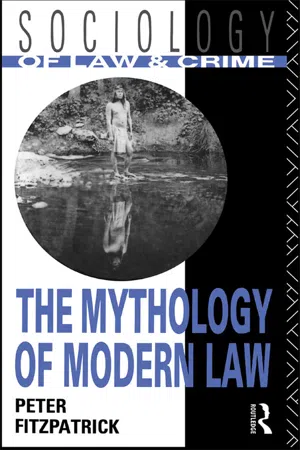
- 256 pages
- English
- ePUB (mobile friendly)
- Available on iOS & Android
eBook - ePub
The Mythology of Modern Law
1
MYTH AND THE NEGATION OF LAW
The primary aim of the critic is to see the object as it is really not
(Wilde in Ellmann 1988:137)
INTRODUCTION
The suspiciously simple argument of this chapter is that law as a unified entity can only be reconciled with its contradictory existences if we see it as myth. Such a claim may appear at first to compound contradiction. Modern law, after all, was formed in the very denial of that mythic realm which had so deluded the pre-moderns. My summary response is to agree but then to say that such a denial typifies a renewed and now modern mythology. In this negation of mythic being, there is a denial of that which gives law coherent existence. Negation through law is the negation of law. Yet, as I show in later chapters, it is this negative quality, this vacuity of law, which enables a mythic mediation to be effected between law’s contradictory existences and which enables the unity of law to be maintained.
Beginnings are always desperate. To sustain one already so comprehensively set in negation could prove peculiarly awkward. It may be better to start again. Borrowing a beginning from Foucault borrowing from Borges, there is a ‘certain Chinese encyclopaedia’ which, in classifying animals, begins’ (a) belonging to the Emperor, (b) embalmed,’ proceeds via ‘(e) sirens, (f) fabulous, (g) stray dogs’, and ends ‘(m) having just broken the water pitcher, (n) that from a long way off look like flies’ (Foucault 1970: xv). What Borges does here is to dispense ‘with the least obvious, but most compelling, of necessities; he does away with the site, the mute ground upon which it is possible for entities’ to co-exist as a classification which ‘we’ can understand (Foucault 1970:xvii—his emphasis).
Another provocation to discover the mute ground can be derived from the treatment of diversity in scientific fields. Take the not uncommon scientific controversy where seemingly opposed positions each supported by ‘unassailably “objective” evidence’ are both shown to be ‘valid’: an example would be ‘the complementarity principle of Bohr, affirming the right of coexistence of both a corpuscular and a wave concept of light’ (Weiss in Merton 1981:iv). What may be the case, Merton believes, is that in ‘each field of inquiry…the plurality of current theories, paradigms, and thought-style are not mere happenstance…. Rather, it appears to be integral to the socially patterned cognitive processes operating in the discipline’ (Merton 1981:v). When these processes are made explicit, they can reveal a unity in a field which previously seemed to be made up of diverse accounts. To take an instance: differing accounts of human evolution in paleoanthropology can become congruent when they are all seen as versions of the one myth (Landau 1991). In more conventional terms, we may agree that scientific advance often results, as in particle physics, from positing then seeking to discover an entity which would unify diverse but co-existing entities in the field. Contrawise, the accepted unity of a field may depend on connections operating but unrecognized within it (cf. Sheldrake 1981).
Myth, I will argue, is the mute ground which enables ‘us’ to have a unified ‘law’ and which brings together law’s contradictory existences into a patterned coherence. That coherence extends beyond Merton’s ‘cognitive processes’ and beyond the psychological categories to which myth in the modern period is usually subordinated, when it is recognized at all—categories of belief or of unconscious projection. Rather, the myth pursued here is every bit as sociologically elaborated as that which supposedly bound the primitives and the ancients. I will begin to develop the argument by indicating an intriguing paradox about law. There would seem to be a consensus on the object ‘law’ extending over the otherwise divergent accounts of it (see Duxbury 1987:29–31, 189–207; Sargent 1991). Some common conception appears to be compatible, for example, with both the sociology of law and the focus on legal doctrine. Yet the conflict between these two positions is supposedly fundamental. Jurisprudence is littered with isolated and opposed notions about law but the field retains a unity of engagement with law. To the extent that the keepers of one notion engage with another, it is to reduce that other notion to the terms of their own. Further thought and the accumulation of knowledge will eventually establish the rightness of one position over or rather than another. The immensity of effort so far unsuccessfully devoted to this consummation suggests that persistent irresolution is a more likely outcome. Might it not be that in such persistence there are enduring if opposed elements of law; and if we grant this, how can the opposition then be reconciled with a unified law? Obviously, I will be seeking the answer in myth. Obviously also, I cannot fairly accommodate all the mutually opposed conceptions of law. I will, instead, begin looking for an answer in an opposition that encompasses many others and marks the major divide in modern jurisprudence—that is, the opposition between law as autonomous doctrine and law as dependent on society.
THE ASSUMPTION OF LAW
Seeing law as autonomous doctrine is supposedly the antithesis of social approaches to law. The doctrinal study of law—or, in cognate terms, black-letter law, formalism or legal positivism—takes legal rules and reports of cases as the universe. This approach remains predominant in legal education and legal research. Ostensibly, it renders law as distinct, unified and internally coherent (Sugarman 1991:34–5). In its guise of analytical or positivist jurisprudence, it has assiduously protected law’s autonomy. Numerous, seemingly devastating assaults on this position have failed fundamentally to alter it. The remorseless observation of its divergence from the practice of law has not undermined the standard perception of its place at the foundation of that practice.
The form which this approach has recently taken within jurisprudence has been that of the elevation of the heroic champion—the champion as both protector of true knowledge and the pre-dominant figure in the field. The champion’s conceptual defence of law’s autonomy is promulgated and refined but eventually found wanting in some ways. The new champion’s rise is effected by the discovery of ways which significantly qualify the old position and by the provision of some generally acceptable protection of law’s autonomy to put in its place. The current champion remains H.L.A.Hart with his ‘concept of law’ (Hart 1961). The leading challenger is Ronald Dworkin with his notion of ‘law’s empire’ (Dworkin 1986). I will briefly consider each of these as intimations of myth.
Hart attacked the long dominant, and still influential, positivist conception of law provided by John Austin. Austin saw law as the command of a sovereign power which is generally obeyed by the populace: the relation between the sovereign and members of society is one of simple dependence (Austin 1861–3:1, 170–1–I). By paying some regard to sociolinguistic usage, Hart finds Austin’s conception to be deficient on several grounds. Most significantly, it ignores the various social uses of legal rules (Hart 1961:88). If we regard these, we find that people have an ‘internal’, participating approach to law in which they adopt a creative, reflective attitude to legal rules. We find them endowed with abilities to act on and evaluate legal standards of behaviour and to pursue the highly skilled enterprise of rule-following (Hart 1961:55–6, 96). This popular element proves, in Hart’s analysis, to be essential for law’s being. Having inserted this popular element into law so as to displace the current positivist champion, Hart proceeds to assume his mantle in a mystifying shift. Hart erases the element of the popular and reaffirms the positivist equation of law with official authority and with formal, pre-set meaning. The populace is thus excluded from law and relegated to a state of Austinian inertness. Hart achieves all this through forms of the mythic elevation of law and of the official voice as the source of law. The popular element is silenced in a fabulous story of law’s primal origin. I will consider all this in more detail in chapter 6 on ‘law as myth’. In short, what counts as law becomes exclusively and comprehensively determined by officials and the positivist enterprise is preserved.
Dworkin follows a path which parallels Hart’s remarkably. He equates Hart’s conception of law with a system of rules and then finds it inadequate because it does not accommodate other things integral to ‘our own practices’ in law (Dworkin 1968:60). In particular, the idea of a rule cannot include the use of principles in judicial decision-making. Principles, however, import an un-settling social dimension into law, thereby challenging its autonomy. Principles, as Dworkin recognizes, have a more extensive existence than that reflected in law (see e.g. Dworkin 1968:51). How then can law’s reliance on principles be reconciled with its autonomy?
The great answer eventually found by Dworkin lay in interpretation. This does not, at first, appear to be an auspicious resolution. The recent revival of interpretation in several academic fields has revealed the contingent or dependent nature of things usually assumed to have an autonomous existence. Nor does Dworkin seem to stint in his adoption of interpretation. With his consolidating work on Law’s Empire, Dworkin sees that empire as ‘defined’ simply by ‘an interpretative, self-reflective attitude’: ‘Law is an interpretive concept, which does not have an identity apart from the activity of interpreting law’ (Dworkin 1986:410, 413). In ways Dworkin is true to such a promiscuous and decidedly non-imperial basis for law. Seeing law as interpretative activity leads him to adopt an ‘internal, participants’ point of view’ on law (Dworkin 1986:14). Participants comprise ‘every actor in the practice’ of law and all ‘people who have law’, such as ‘citizens and politicians and law teachers’ (Dworkin 1986:13–14). To equate law with the diversity of participants’ perspectives is a truly radical step, one which would spectacularly justify Dworkin’s constant claim to be opposed to positivist jurisprudence. Yet this paradoxically diffuse empire soon assumes a more conventionally imperial dimension. By the end of Dworkin’s account, law has acquired a singular voice and a posited identity distinct from the diversity of interpretation. In the affirmation of empire, law becomes the preserve of officials who have ‘the last word’, even if the word is infused with the strivings of legal philosophers—the ‘seers and prophets’ of the law (Dworkin 1986:407, 413). There is mystery as to how such a transformation takes place (Duncanson 1989; Hunt and Kerruish: in press). The answer lies in operative forces infusing law—forces of infinite competence, perfectibility and cohering order. These forces elevate a particular and official interpretation of law and invest this law with abilities and values which render it transcendent and constant. Law is thus accorded a singularity and inviolability which more than match the efforts of prior positivists to secure its autonomy. As with Hart—as with Austin—law exists because ‘officials…take…decisions that commit a community to rights and duties that make up law’ (Dworkin 1986:97).
The relation between law’s autonomy and society in these accounts is thus somewhat paradoxical. With both Hart and Dworkin, law’s social being serves to reveal the inadequacy of the reigning positivist conception of law. That conception is shown to be inextricably dependent on a social dimension. But when it came to purifying law and sustaining the positivist enterprise, the social dimension was arbitrarily excluded and law’s dependence proved to be readily, if mysteriously, extricable. Law could thence occupy a transcendent position where it has no specific connection with society but nonetheless exercises a general domination over it. Positivist domination has to be constantly secured in the face of social challenges that would render law as something apart from what it is posited to be. Both Hart and Dworkin adopt their particular, limiting participants’ perspective partly to counter ‘external’ or ‘pragmatic’ perspectives that would reduce law in terms of social factuality (Dworkin 1986:95; Hart 1961:78).
The opposition that this imports between positivist and social accounts of law is very much overdrawn: the position of law in social accounts is not so simple and neither is it any less paradoxical than in positivist jurisprudence. The gist of these social accounts is usually taken to be that law, rather than dominating society, is itself wholly a product of society. It changes as society changes and it can even disappear when the social conditions that created it disappear or when they change into conditions antithetical to it. A pervasive administration and a renewed community are the social forms usually taken as effecting or resulting from the end of law (see e.g. Unger 1976). Yet if we observe these social accounts more closely, we can find a law that seems to be secure and persistent. The contradiction between this seeming autonomy and law’s social dependence is resolved, I argue, in the mythic elevation of law. The relation between law and such social forms as administration and community can thence be seen as a relation between mutually supporting mythic entities and not simply as one of opposition. But this is to anticipate much of my later argument and to summarize its detailed illustration in chapter 5. For the moment, I will pursue law and its distinct identity in these social accounts.
With some of these accounts the pursuit is too easy and need not take long. These are accounts from within law—accounts which take law as given and see its relation to society in such instrumental terms as bringing about change, problem-solving and policy implementation, or simply in terms of effectiveness. Thus, ‘socio-legal studies’ is an area usually seen as conducive to ‘understandings of the workings of law and to law’s effectiveness’: in this exercise ‘sociologists should be on tap but not on top’ (see Nelken 1981:36). There are other influential approaches broadly of this type. Sociological jurisprudence, for example, is essentially a view from within law. It is concerned with law’s effectiveness and with its capacity for ‘social engineering’, even if these concerns are, as it were, allowed to reflect back on the nature of law. This approach reaches something of an elaborated terminus in the work of Julius Stone (Stone 1966). The perspective called law in context provides a currently influential and more diverse instance. In some of its reaches, it is indistinguishable from conventional socio-legal studies, but it is sometimes concerned with the constitution of law in terms of context. Yet, as the name implies, law in context tends to posit a constant law in varying contexts.
Law’s singular presence is only somewhat less conspicuous in approaches that would thoroughly constitute law in terms of society, or see it as essentially dependent on society, or require it to be in phase with society. The sociology of law, to take the most prominent approach, has a large respect for general sociology but it confronts law narrowly, leaving it intact and even reinforced in law’s own terms. The mode of this confrontation is usually functionalist. Law is explained by the function it performs and in this it is seen as having a straightforward relation of effectiveness in its impact on behaviour, or in social change (see Black 1976). Functionalism simply assumes a constituting relationship between law and function. To indicate the limits of this approach, I will take the common attribution to law of the function of conflict resolution. Far from resolving conflict, law will often provide modes and occasions for its creation, expression and perpetuation, for sustaining one sphere of life in enduring conflict with another. Resolution may lie in the systematic nature of the conflict and in some other institutional site besides law, such as exchange (see e.g. Strathern 1985). Persistent conflict, rather than generating or invoking law, may sustain incompatibilities and indeterminancies that make legal resolution impossible. Anthropological accounts fare no better than the sociology of law. In concentrating doggedly on the functional category of dispute resolution, either the issue of constituting law is avoided altogether or we encounter the same difficulties as those just instanced for sociology. In the older tradition of comparative anthropology, the aim is certainly to fix law’s universal social character but this is done, unwittingly or otherwise, by taking attributes of Western law as given and reading them back into a supposed evolutionary or historical record (see Fitzpatrick 1985).
There are other sociological and evolutionary denials of law’s distinct identity and I will return to these in chapter 4. For the moment I will conclude this survey with the strongest and most intensely debated denial: that provided by Marxism. The terms of the debate have become rather worn but the outcome, or lack of it, remains instructive. A so-called vulgar and instrumental Marxism saw law as epiphenomenal. Its being was determined by an economic base or by its utility in class domination. That supposed position has never existed far from a concern with the autonomy of social forms (see e.g. Marx 1973:102–6). The usual response to an impertinent autonomy was to locate it within the determining dynamic or structure. Thus, with Pashukanis, the seemingly autonomous form of law is a product of commodity exchange conceived of in a Marxist frame—but Pashukanis also recognized that this was not a comprehensive notion of law (Pashukanis 1978: chapter 4). In the once greatly influential variant provided by Althusser, law would have a quasi-autonomy created by its part within a determining structure (e.g. Althusser 1971:124– 49). This provided an origin for the once closely observed idea of law’s relative autonomy but, with the undermining of the encompassing structure (see Hindess and Hirst 1977), nothing else was found to which the autonomy could be made relative. Law was left without any constraining connections to which it could be related. There followed a constant and still current advocacy on the ‘left’ of law’s self-sustained existence. Law had to be ‘taken seriously’ or one had to be sturdily ‘realistic’ about its necessity. Thus a ‘responsible socialism’—entailing much responsibility and little socialism—would exhort us to be realistic about the necessity for criminal law, and this not only because people are against crime and people have votes, but also because such law will in some ways have to be maintained in a future socialist society (see Cottrell 1984). This was a socialism of a broad or uncertain dispensation which could no longer be assuredly anticipated. In all, law no longer occupied a constraining structure or history.
Intellectually, the end of these various searchings for law’s comprehensively defining social foundation is marked by the ‘constitutive theory’ of law developed mainly in critical legal studies. In his seminal contribution, Klare, after rehearsing dissatisfactions with Marxist reductions of law, proceeded to discover that law acts on, even constitutes, society (Klare 1979; see also Poulantzas 1978:83, 87). Furthermore, law and society inextricably yet somehow distinctly constitute and inhabit each other (see e.g. Harrington and Yngvesson 1990). With the constitutive theory, there can no longer be any inexorable mode or structure of connecting law to society. There is an ascendant resolution of this division which brings matters full circle. Autopoiesis is a social account of law, yet one which would hermetically secure law by according it the self-creating power to absorb and order society in its own terms (see e.g. Teubner 1989). Quite apart from its particular virtues, autopoiesis can sustain its seemingly extravagant claim for law because it incorporates what I now indicate is a myth of law’s transcendence.
THE EVOCATION OF MYTH
Auden once asserted law’s mythic singularity and gently remonstrated against identifying ‘Law with some other word’ (Auden 1966:155). Of the two great traditions of conceiving law that we have considered, one would reduce law to the word authority and the other to the word society. The attempt to erect a posited being or a secure empire for law relied on social attributes of law, only then mysteriously to separate law from those attributes and set it above them. No less mysteriously, the attempt to identify law in social terms persistently invoked and eventually succumbed to law’s distinct identity. Yet social accounts of law also persisted in their claim to be foundational of law. Law transcends society yet it is of society. The boundaries of law are inevitably and palpably set in relation to society but even in the face of the overwhelming evidence of law’s social limits, popular belief in its transcendent efficacy persists (see e.g. Sarat 1990). This is not a matter of inconsistency or delusion. It is, as I will show in chapters 3 and 4, a matter of myth.
An Occidental encyclopaedia should presumably not be mute in uncovering the ground shared by these different perceptions of law. But where can we find an appropriate entry? ‘Myth’ would once have provided at least ‘some god endowed with contradictory attributes’ who could mediate between and encompass law’s transcendent and terrestrial existences and render the common ground between them eloquent with sacred meaning (Lévi-Strauss 1968:227). And there are indeed qualities of law which are also those of a god, at least one of a Christian persuasion. Law operates in a social world yet exists separate from and dominant over it. Law can relate integrally to that world without being existentially exhausted in the relation. It provides a principle and point of transcendent order and unity for the diversity of social relations and this as a matter of its own innate force (cf. Derrida 1990). It can transcend yet be in time to the effect that ‘law is a presence which implies the totality of its history’ (Goodrich and Hachamovitch 1991:174). It su...
Table of contents
- COVER PAGE
- TITLE PAGE
- COPYRIGHT PAGE
- THE MYTHOLOGY OF MODERN LAW
- SOCIOLOGY OF LAW AND CRIME
- PREFACE
- SERIES EDITORS’ PREFACE
- ACKNOWLEDGEMENTS
- 1: MYTH AND THE NEGATION OF LAW
- 2: MYTH AND MODERNITY
- 3: THE MYTHIC FOUNDATION OF MODERN LAW
- 4: THE MYTHIC CONSOLIDATION OF MODERN LAW
- 5: LAW AND MYTHS
- 6: LAW AS MYTH
- BIBLIOGRAPHY
Trusted by 375,005 students
Access to over 1.5 million titles for a fair monthly price.
Study more efficiently using our study tools.
Frequently asked questions
Yes, you can cancel anytime from the Subscription tab in your account settings on the Perlego website. Your subscription will stay active until the end of your current billing period. Learn how to cancel your subscription
No, books cannot be downloaded as external files, such as PDFs, for use outside of Perlego. However, you can download books within the Perlego app for offline reading on mobile or tablet. Learn how to download books offline
Perlego offers two plans: Essential and Complete
- Essential is ideal for learners and professionals who enjoy exploring a wide range of subjects. Access the Essential Library with 800,000+ trusted titles and best-sellers across business, personal growth, and the humanities. Includes unlimited reading time and Standard Read Aloud voice.
- Complete: Perfect for advanced learners and researchers needing full, unrestricted access. Unlock 1.5M+ books across hundreds of subjects, including academic and specialized titles. The Complete Plan also includes advanced features like Premium Read Aloud and Research Assistant.
We are an online textbook subscription service, where you can get access to an entire online library for less than the price of a single book per month. With over 1.5 million books across 990+ topics, we’ve got you covered! Learn about our mission
Look out for the read-aloud symbol on your next book to see if you can listen to it. The read-aloud tool reads text aloud for you, highlighting the text as it is being read. You can pause it, speed it up and slow it down. Learn more about Read Aloud
Yes! You can use the Perlego app on both iOS and Android devices to read anytime, anywhere — even offline. Perfect for commutes or when you’re on the go.
Please note we cannot support devices running on iOS 13 and Android 7 or earlier. Learn more about using the app
Please note we cannot support devices running on iOS 13 and Android 7 or earlier. Learn more about using the app
Yes, you can access The Mythology of Modern Law by Peter Fitzpatrick in PDF and/or ePUB format, as well as other popular books in Law & Jurisprudence. We have over 1.5 million books available in our catalogue for you to explore.