eBook - ePub
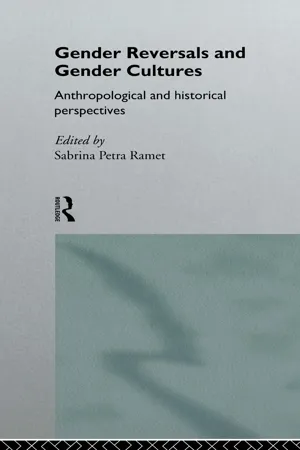
Gender Reversals and Gender Cultures
Anthropological and Historical Perspectives
- 256 pages
- English
- ePUB (mobile friendly)
- Available on iOS & Android
eBook - ePub
About this book
Gender Reversals and Gender Cultures is a collection of specially commissioned essays taking a cross cultural and cross historical perspective on the subject. The book documents the universality of gender reversals, with chapters ranging from early Christianity up to the present. It examines how gender reversals are bound up with taboo, and how this underlies various religious and ritual activities. Gender Reversals and Gender Cultures also shows how attitudes to gender-reversal can reveal much about a particular culture. Anne Bolin, Elon College, Judith Ochshorn, University of South Florida, Karen Torjesen, Claremont Graduate School, California, Julia Welch, Winfried Schleiner, Unive
Information
1
GENDER REVERSALS AND GENDER CULTURES
An introduction
The ancient Greeks told of a certain Teiresias, a legendary blind seer, born a man, who was miraculously transformed into a woman, returning to his male form only after having lived eight years as a woman. Later, according to the story, the divine royal couple, Zeus and Hera, turned to Teiresias to help them settle an argument. Each of them, it seemed, claimed that the other derived more pleasure from sex. Since Teiresias had the benefit of experience in both sexes, they asked him his opinion. Without a moment’s hesitation, Teiresias answered that the woman obtained far more pleasure from sexual relations than did the man. Hera was angered at this disclosure and punished Teiresias by blinding him; but Zeus compensated Teiresias by imparting the power of prophecy and by granting Teiresias a life lasting seven generations.1 For the Greeks, Teiresias’ sex change was, quite apart from Zeus’ intervention, the clue to his miraculous gifts and in time, he came to be described as “the greatest of the mythical seers.”2
The story of Teiresias is not an isolated example, however.3 On the contrary, the theme of gender reversal frequently occurs in ancient religion and mythology, as well as in ancient rituals, and has recurred in diverse societies in every era. But the significance attached to gender reversal varies greatly, depending on the context, the specific form of the reversal, and the given gender culture.
The concept of gender culture is crucial to an understanding of the phenomenon of gender reversal, because the latter arises within the parameters set by a gender culture and because it is a society’s culture that informs its members as to the meanings of specific forms of individual and collective behavior. This concept of “gender culture” is derived from the growing literature on the social construction of gender. In brief, this literature is concerned with how societies generate and enforce standards for expected gender-linked behavior, and socialize their members to abide by those standards.4 This literature is thus concerned also with issues of social control. Gordene MacKenzie probably speaks for most adherents of this approach when she writes that
Gender is…one of the most effective means of social control. From birth we are enculturated into a dual gender system, reinforced by all the major institutions.5
MacKenzie uses the terms “gender code” and “gender ideology” to refer to the relevant standards of behavior, warning that they are enforced by institutions which act as “gender police.”6 Martine Rothblatt uses the expression “gender dictates” to refer to the same standards, thus implying that they are dictatorial in character.7 Social constructionists are, accordingly, interested in the socialization processes which assure gender conformity, but there is no inherent requirement that a social constructionist deny the existence of innate psychological differences between the sexes (although some writers do so).
For the purposes of this book, I have elected to use the expression gender culture rather than one of the alternatives identified above. The advantages of this term are that it is nonjudgmental and that it links the concerns of this book with anthropological studies of culture and socialization, as well as with political culture theories, to which it is related, both by analogy and by parallel logic. For the sake of definitional clarity, let us take it that by gender culture is meant a society’s understanding of what is possible, proper, and perverse in gender-linked behavior, and more specifically, that set of values, mores, and assumptions which establishes which behaviors are to be seen as gender-linked, with which gender or genders they are to be seen as linked, what is the society’s understanding of gender in the first place, and, consequently, how many genders there are. Thus, among certain Indian nations of the Pacific Northwest, for example, there were (until the latter part of the nineteenth century) four or more genders; the possibility of having more than two genders was opened up by divorcing gender from sexual morphology and by associating gender rather, indeed primarily, with social role and labor tasks.8 Gender reversal may be understood to be any change, whether “total” or partial, in social behavior, work, clothing, mannerisms, speech, self-designation, or ideology,9 which brings a person closer to the other (or, in polygender systems, another) gender. Gender reversal need not involve an effort to blot out any memory of the person’s pretransformative past; indeed, except for twentieth-century transsexuals, many of whom create fictitious histories in the hope of concealing their gender transformation, most male-to-female gender reversals have been open and explicit. (Since women historically often tried to pass as men in order to breach career barriers, the opaqueness of their disguise was of the essence.) Among the Plains tribes in the nineteenth century, not only was cross-gender status explicit, but it was also most often partial. In fact, among the aforementioned nations, cross-gender status did not necessarily involve cross-dressing, and some cross-gender females continued to wear female clothes even though they were engaged exclusively in male tasks and took wives to take care of household tasks associated with females.10 Sexual behavior, however, is not considered directly relevant to the subject of gender reversal. Not only is same-sex sexuality a separate topic not to be confused with gender reversal, but in two-gender systems, in particular, it becomes semantically treacherous to speak of “same-sex” and “heterosexual” liaisons on the part of a cross-gendered individual. The confusion which can arise from these terms can be discerned in the disagreement among those therapists attempting to describe male-to-female transsexuals who are attracted to women; for some therapists, such transsexuals are “heterosexual,” for others, “homosexual.” When antonyms can be understood to mean the same thing, it is time to look for alternative vocabulary.
Gender cultures also define the limits of social tolerance and, in this regard, may be seen within the scope of the overarching cultural system as a whole. Cross-dressing, thus, while nowadays narrowly construed to refer but to dressing across gender lines, was at one time a much broader concept, referring to any breach across the rigid regulations governing attire. These regulations, found in all ancient societies including the Aztec and Inca, as well as in European society as late as the seventeenth century,11 were designed to keep people in their assigned places, and included often precise prescriptions relating to class, trade, and lineage, as well as gender. Often specific colors were off limits to certain groups: in the Ottoman Empire, for example, only Muslims were permitted to wear green, while in Tudor England purple cloth was reserved for persons of noble extraction.
But the scope of such regulations has been steadily narrowed, so that there are only three sectors in which attire is still strictly regulated: gender; certain occupations (such as clergy, nurses, policemen); and certain religious groups (for example, the specific clothing regulations of the Amish and, affecting also the level of gender, the requirement in some Muslim societies that women wear a veil). Violations of regulations of attire in these spheres are sensitive matters, and no one is surprised that the offense of impersonating a police officer is vigorously punished or that religious groups take seriously deviations from codes regulating attire. But the vast, all-encompassing regulation of all attire in society is largely a thing of the past. And as the purview of such regulations has narrowed, the meaning attributed to the act of donning the attire of the opposite sex has necessarily changed. Perhaps the single most important development which affected the way in which such cross-dressing has been understood was the decay of the old polytheist religions and the spread of new moral codes, as advanced first by the Orphics and later by the Christians.
Much as gender cultures vary over space and change over time, so too do the functions played by gender reversals. And it is this theme of the functions of gender reversals which will occupy my attention for the remainder of this introduction.
THE FUNCTIONS OF GENDER REVERSALS IN RELIGIOUS MYTHOLOGY AND RITUAL
The theme of gender reversal occupies a prominent place in the ancient cult of Inanna, in the Olympian religion of the ancient Greeks (most specifically in the cult of Dionysos), in Mahayana Buddhism, in Hinduism, and even in medieval Christianity. In its earliest incarnations, the capacity of the deities to change their gender at will and to project both female and male avatars was a natural corollary of the belief of the ancients in their deities’ capacity to adopt any form at will. Among the Aztecs, for instance, Quetzalcoatl, the sky god, was sometimes represented as a dragon, covered with feathers, over a serpent-like body; at other times, he was portrayed as a bicephalic amphibean.12 The Aztec god Xolotl, himself an avatar of Quetzalcoatl, had his own subsidiary avatars, including any of a number of animal forms, that of a dog being his most usual choice.13 Again, in Hindu mythology, Krishna, an avatar of the god Vishnu, transforms himself into a beautiful woman in order to destroy the demon Araka.14 Zeus, the supreme god of the Greek pantheon, is said to have assumed the form of a bull on at least one occasion, while Artemis was sometimes called the “bear-goddess”.15 And, of course, the ancient Greek deities had the power to cast spells changing humans into any of a number of animals or plants. In other words, gender reversals in certain polytheist religions are situated within the context of a wide array of transformations of form and presentation, none of which, however, imply a change of essence.
It was quite consistent with this notion that the adherents of certain cults would emulate their deities by donning animal masks and skins, or by cross-dressing. The ancient Sumerian goddess Inanna (also called Ishtar) is a good example of both gender ambiguity and gender reversal. She was described variously as the goddess of love and of war, and was said to live the life of a young man, engaging in warfare and avariciously seeking ever more lovers.16 In the ritual surrounding Inanna, she was said to turn men into women, and women into men, and at cultic celebrations of her glory each sex donned the garb of the other sex.17 In the Dionysian rites of ancient Greece, which endured as late as the seventeenth century CE, women dressed as men and men as women in celebration of a male deity renowned for his effeminacy. Philostratus, a third centur...
Table of contents
- Front Cover
- Half Title
- Title Page
- Copyright
- Contents
- Notes on contributors
- Preface
- 1. Gender Reversals and Gender Cultures: An introduction
- 2. Traversing Gender: Cultural context and gender practices
- 3. Sumer: Gender, gender roles, gender role reversals
- 4. Cross-Dressing and Cross-Purposes: Gender possibilities in the Acts of Thecla
- 5. Martyrs, Ascetics, and Gnostics: Gender-crossing in early Christianity
- 6. Cross-Dressing, Gender Errors, and Sexual Taboos in Renaissance Literature
- 7. Elena Alias Eleno: Genders, sexualities, and “race” in the mirror of natural history in sixteenth-century Spain
- 8. Becoming Male: Salvation through gender modification in Hinduism and Buddhism
- 9. Gender, Power and Spectacle in Late-Imperial Chinese Theater
- 10. Eroticism, Sexuality, and Gender Reversal in Hungarian Culture
- 11. Sacred Genders in Siberia: Shamans, bear festivals, and androgyny
- 12. There is More than Just Women and Men: Gender variance in North American Indian cultures
- 13. The Procreative and Ritual Constitution of Female, Male, and Other: Androgynous beings in the cultural imagination of the Bimin-Kuskusmin of Papua New Guinea
- Index
Trusted by 375,005 students
Access to over 1.5 million titles for a fair monthly price.
Study more efficiently using our study tools.
Frequently asked questions
Yes, you can cancel anytime from the Subscription tab in your account settings on the Perlego website. Your subscription will stay active until the end of your current billing period. Learn how to cancel your subscription
No, books cannot be downloaded as external files, such as PDFs, for use outside of Perlego. However, you can download books within the Perlego app for offline reading on mobile or tablet. Learn how to download books offline
Perlego offers two plans: Essential and Complete
- Essential is ideal for learners and professionals who enjoy exploring a wide range of subjects. Access the Essential Library with 800,000+ trusted titles and best-sellers across business, personal growth, and the humanities. Includes unlimited reading time and Standard Read Aloud voice.
- Complete: Perfect for advanced learners and researchers needing full, unrestricted access. Unlock 1.5M+ books across hundreds of subjects, including academic and specialized titles. The Complete Plan also includes advanced features like Premium Read Aloud and Research Assistant.
We are an online textbook subscription service, where you can get access to an entire online library for less than the price of a single book per month. With over 1.5 million books across 990+ topics, we’ve got you covered! Learn about our mission
Look out for the read-aloud symbol on your next book to see if you can listen to it. The read-aloud tool reads text aloud for you, highlighting the text as it is being read. You can pause it, speed it up and slow it down. Learn more about Read Aloud
Yes! You can use the Perlego app on both iOS and Android devices to read anytime, anywhere — even offline. Perfect for commutes or when you’re on the go.
Please note we cannot support devices running on iOS 13 and Android 7 or earlier. Learn more about using the app
Please note we cannot support devices running on iOS 13 and Android 7 or earlier. Learn more about using the app
Yes, you can access Gender Reversals and Gender Cultures by Sabrina Petra Ramet in PDF and/or ePUB format, as well as other popular books in Social Sciences & Social History. We have over 1.5 million books available in our catalogue for you to explore.