Monarchy, Aristocracy and the State in Europe 1300 - 1800 is an important survey of the relationship between monarchy and state in early modern European history. Spanning five centuries and covering England, France, Spain, Germany and Austria, this book considers the key themes in the formation of the modern state in Europe.
The relationship of the nobility with the state is the key to understanding the development of modern government in Europe. In order to understand the way modern states were formed, this book focusses on the implications of the incessant and costly wars which European governments waged against each other, which indeed propelled the modern state into being.
Monarchy, Aristocracy and the State in Europe 1300-1800 takes a fascinating thematic approach, providing a useful survey of the position and role of the nobility in the government of states in early modern Europe.
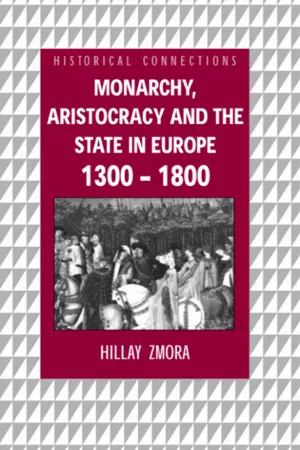
- 176 pages
- English
- ePUB (mobile friendly)
- Available on iOS & Android
eBook - ePub
Monarchy, Aristocracy and State in Europe 1300-1800
About this book
1 The dawn of modern times
The modern state was born in Western Europe in the fourteenth century, the natural child of war and taxation. It is perhaps an historical irony that this type of state – in which law reigns and deifies human rights – has such brutish ancestry. But it is not a paradox. The wars upon which the English and French kings embarked around 1300, and which were soon to spill over to the Iberian peninsula, proved an altogether new, radically new, phenomenon: unlike earlier conflicts, they were effectively interminable. Neither monarch could meet the costs of war on a continuous basis out of his own resources: while the ordinary revenues of the English Crown were estimated in 1284 at £27,000, the expenditure on war in 1294–8 totalled some £750,000. And it stands to reason that neither monarch could afford the prohibitively expensive machinery necessary to coerce these resources out of the country at large. They all had to impress on their subjects the urgency of the situation, to persuade them that the common good was at stake, that they needed to contribute in taxes to an effort on a dauntingly exceptional scale. Frequently enough war itself did the talking, so to speak. The danger it posed to life and property made people readier than they would otherwise have been to part with their money so as to pay for their defence. In any case, a fiscal administration had to be developed to handle the complex operation of collecting and spending of tax monies, as well as to service the usually enormous debts left in the wake of the latter activity. Insistent pressure of war thus led to the creation or expansion of state apparatus, and to the multiplication of the personnel dealing with paying and supplying the army. Such swelling bureaucracy was itself a drain on economic resources, which in turn meant that more taxes had to be levied or new financial sources opened up, and so on and so forth. As Samuel Finer has put it in connection with the so-called Hundred Years War (1337–1453): ‘The verdict of history – at least European history – is that war calls out a superabundance of military, administrative, and fiscal overkills which largely remain in place when peace returns. War has an administrative/ fiscal ratchet effect.’ On this account, wars made the states that made wars on each other. Yet the impact of war was not everywhere the same; it had significantly disparate consequences in terms of state forms.1
In England, the outbreak of war against France in 1294 was followed by a revolt in Wales and then an invasion into Scotland. The unquestionable emergency of the situation in the years 1294–7 enabled King Edward I to demand general taxation on plea of necessity. Taxes, previously sporadic, were now levied in three successive years. To some influential people this seemed to be heralding an expensive royal disposition, and before long a political crisis ensued. The Monstraunces of 1297 complained that ‘all the community of the land feel themselves greatly aggrieved that they are not treated according to the laws and customs of the land . . ., nor have they their liberties which they used to have’.2 Strong words, but the precise legal platform for resistance to royal demands was yet to be worked out. However frequent and enlarged in scope these demands grew, they could be and were construed as a mere extension of incontestable royal prerogatives. They could not be rejected so long as, because of war, evident necessity could be shown to exist. Precisely this predicament made it imperative somehow to limit and regulate the Crown’s ability to trench upon the wealth of its subjects. This could be achieved only through bargaining. Parliament was in effect prepared to offer more money than royal prerogative warranted in exchange for restraining the range of exactions that could be imposed in the name of royal prerogative. In other words, money was traded for constitutional power, whereby each party attained its immediate goal.
The final stage of this process was reached in the 1360s, the decade after the peace of Brétigny: the Crown, thanks to the habitforming effects of war and highly imaginative accounting by the Exchequer, managed to bring Parliament to convert the wool subsidy into a regular tax. Thus the crucial threshold was crossed separating occasional wartime taxation from permanent peacetime taxation. The price was that each grant required parliamentary consent, and that direct taxation could from then on be sought for no other purpose than the defence of the realm. Parliament became invested with the authority to adjudicate whether the king’s financial demands served the common profit and should therefore be given the common assent. A self-conscious political community came into being – the unintended and far-reaching consequence of the emergence of a system of public finance to pay war (it is noteworthy in this respect that it was in 1362 that Parliament pronounced English to be the official language in law courts). As early as 1370, then, England set off on that Sonderweg of co-operation which marked her political culture until the seventeenth century and beyond.3
In France, too, extraordinary taxes were converted into regular taxes around 1370. The turning point here was the capture in 1356 of King Jean II at the battle of Poitiers. Taxation was now irrefragably justified both by the doctrine of evident necessity and the ancient and honourable feudal tradition that obliged one to redeem one’s lord from captivity. In late 1360 a royal ordinance established the gabelle (indirect tax on salt) and aides for six years to pay for the king’s colossal ransom. As it happened, they were collected in all but two of the following fifty-seven years. Small wonder that the French franc takes its name from the inscription – Johannes Dei Gracia Francorum Rex – on a gold coin minted in 1360. The cessation of hostilities in the aftermath of the king’s release had a second consequence extremely conducive to taxation: multitudes of soldiers, schooled in nothing but combat, were demobilized and took to roaming in lawless bands, living off the people. ‘Robberies and pillages, arson attacks, larcenies, seizures of goods, violence, oppression, extortions [and] exactions’ became the daily experience. This made paying taxes an attractive proposition as never before, if, as King Jean II declared, they would finance the suppression of ‘the compagnies and the brigands’. In 1363 Estates representing Languedoïl consented to a fouage, or an apportioned hearth tax – the first direct tax to be raised in time of formal peace. In 1368 taxes were imposed also in Languedoc. They were designed to finance a military expedition led by Bertrand du Guesclin that would take the roving freelance soldiers out of the realm. These measures were as yet insufficient to form a convention, but they did set the decisive precedent of taxation with a view to maintaining an army in peacetime. After some vicissitudes in the following decades, these levies were restored in the fifteenth century to remain the basic royal taxes until the Revolution. As in England, war and taxation were turning the monarchy into a veritable national institution, thereby enormously expanding its potential. But unlike England, the years 1356–70 in France laid the foundation for an ‘absolute’ monarchy.4
In Castile of the fourteenth century a protracted war was no novelty. When, in the 1360s, the peninsula became a theatre of operations in the Anglo-French conflict, it had the formative experience of the reconquista behind it. And indeed, the pressures exerted from very early on by quasi-permanent warfare, coupled with the potent idea of crusading, made Castile fiscally precocious. They provided Castilian monarchs with a virtually unassailable justification for striking national taxes. This had already occurred under King Alfonso X (1252–84). But the really crucial date in this respect was 1342, when the Cortes granted King Alfonso XI the alcabala, a sales tax, for three years to defray the costs of the siege of Algeciras. During the reign of the first Trastámara king, Enrique II (1369–79), the alcabala appears to have been accorded every year. Under Enrique III (1390–1406) it was transformed into an ordinary source of income of the Crown, no longer requiring the prior approval of the Cortes. In 1394 the alcabala accounted for nearly 43 per cent of total royal revenue, and in 1429, 75 per cent. In the early sixteenth century it made up (together with the clerical tercias reales) some 80 or 90 per cent of the monarchy’s income. Thus, as in France, the most important national tax in Castile was created in the midfourteenth century in response to the exigencies of war, and soon turned into a regular impost unfettered by an obligation to secure the consent of representative assemblies. This made all the difference between Castile with its absolutist monarchy and Aragon or Navarre, where the Crowns remained tied down by the Cortes. Neither Aragon nor Navarre was in a position to institute an army and bureaucracy capable of undergirding a modern state.5
Thus, a novel kind of war – endemic and incessant – imploded what remained of the decaying ‘classic’ feudal order in Europe. The personal, trans-territorial, segmentary feudal arrangements proved woefully inadequate to the new circumstances. Rulers therefore had to appeal for aid, in a consistent manner, to a much wider constituency than their greater vassals. The demands of each monarch now came to impinge on all those living in an area over which that monarch could make a tenable claim to supreme jurisdiction. The construction of a system of public finance to pay for war and the appearance of consolidated territory proceeded in parallel. Here lay the origins of the unitary, ‘modern’ state. The term ‘modern’ is not an absolute, and is understood variously by historians and sociologists. In one prevalent use, the ‘modern state’ denotes the democratic, liberal state whose history can be traced back to c. 1300.6 But ‘modern’ may also be taken to mean primarily the effectiveness of the institutional organization of that state in comparison with other, contemporaneous states: a certain capacity to govern centrally and to mobilize human and material resources. It is true that in Western Europe the two aspects came to be wedded, and to have a certain causal relationship between them. But that is no good reason to confuse between them as necessary corollaries. Civil and political liberty, if allowed to take precedence over the needs of security and political control, might and sometimes did result in its own decline or even outright dissolution. ‘It has long been a grave question,’ President Lincoln pointed out during the Civil War, ‘whether any government not too strong for the liberties of its people can be strong enough to maintain its existence in great emergencies.’ In Western Europe this problem became massively relevant in the late fifteenth and sixteenth centuries, as an anarchic, multipolar system of states came into its own.
Italy and the Holy Roman Empire provide outstanding examples of failure to adapt to the new international environment. The successive waves of foreign invasions into Italy from 1494 onwards revealed that, for all their administrative sophistication, the Italian statelets were humiliatingly helpless in the face of so-called new monarchies. The French army ‘conquered Italy with a piece of chalk’, as Machiavelli put it: so weak was the resistance they encountered, that all the French needed to do was to mark houses where their soldiers were to be billeted.7 With the Empire, too, all was not well. A long period without grave external military threat deprived the monarchy of such opportunities as its Western counterparts had to offer itself as a credible focus of common fears and aspirations. It is emblematic in this comparative regard that the famous Golden Bull of Emperor Charles IV was enacted in 1356. Although strengthening the monarchy towards the outside, the Bull, if only endorsing and regularizing an existing situation, confirmed in law the regalian rights of the seven electoral princes (Kurfürsten). It laid down, for example, that no subject of an elector could be summoned to any tribunal outside that elector’s territory. The dualistic trend was not reversed in the fifteenth century, despite some experiments with general taxation. These miscarried one after another. The most ambitious attempt, the Common Penny of 1495, foundered like all the preceding ones on the opposition of the imperial Estates, especially the autonomous princes. These failures were compounded by the assumption by Habsburgs of the Spanish, Bohemian and Hungarian Crowns in the early sixteenth century. Their attention and resources spread thin, the Habsburgs were unable to achieve supremacy in the strategic core zone of southern Germany. These factors signalled that a centralized state, which in that period could only be constructed by and around a prepotent monarchy, would not come about in early modern Germany.8 Politically fragmented like Italy, that inert mass of a Holy Roman Empire of the German nation was to succeed Italy in the seventeenth century as Europe’s battleground, with horrific consequences to its inhabitants.
The German example raises with particular acuity the question of why the seigneurs in England, France and Spain did acquiesce in royal taxation that so prodigiously and conspicuously magnified the power of the Crowns. Was it not more in their interest to act like the German princes or the Polish magnates, and emasculate their monarchs? It is, after all, not for nothing that panstwo, the Polish word for ‘state’, derives from words referring to nobles (pan, pany) – so complete was their stranglehold on the monarchy. Were, in contrast, the Western magnates so myopic as not to realize that the power to tax would sooner or later give its possessor the power to coerce? The latter capability, at least in Max Weber’s classic definition, is the constitutive feature of the state: ‘a human community that (successfully) claims the monopoly of the legitimate use of physical force within a given territory’.9 Perhaps Weber’s formulation owed too much to his experience of Wilhelmine Germany, but it is nevertheless heuristically useful here as a point of departure precisely because it is so modernly categorical (and historically controvertible). From such a perspective, the lords, densely strewn over the Western European landscape, should have been the greatest single obstacle to state formation, to the reconstitution and consolidation of royal power after its breakdown in the ‘feudal revolution’ of c. 1000. Indeed, one of the twentieth-century’s most influential German historians, Otto Brunner, argued that the medieval polity could not be classified as a state, precisely because what distinguished the lords of that period was their legally sanctioned right to resolve their differences by means of feuding. ‘A world in which the feud is always a possibility,’ he wrote, ‘of necessity has a structure altogether completely different from the civil world of an absolute state which claims the monopoly of the legitimate use of force.’10 The implication is that for non-state polities such as the medieval monarchies to become states, they had either to eliminate or at least subjugate those self-reliant, armigerous lords. But the question then is how they could accomplish either task when, not being states, they had not yet possessed a monopoly of the use of physical force, legitimate or not. The motto of the redoubtable one-eyed Breton lord Olivier de Clisson (1336–1407), Pour c’est qu’il me plest, is likely to have rung true in more than a couple of ears. But whereas he sided with King Charles VI of France, whom he boasted to have made ‘roy et seigneur de son royaume’,11 many other lords were far less obliging.
Godefroi d’Harcourt, for instance: a puissant Norman lord, he picked a quarrel with King Philippe VI of France. In 1344 he was banished and his property confiscated. He went over to England, swore allegiance to King Edward III, and then facilitated the latter’s invasion into Normandy. Such was d’Harcourt’s clout, however, that when he later recanted, the French king was only too keen to embrace him.12 This pattern of breaking oaths and shifting loyalties according to expedient was quite widespread among the lords of the late Middle Ages. But the trend-setters of disloyal conduct were actually nearly always and everywhere members of the ruling House itself.13 And because the various European ruling dynasties were at once closely interrelated and constantly at each other’s throat, powerful lords suffered no shortage of both compelling and contrived causes to involve themselves in succession and other disputes, support one pretender against the other, tergiversate if need be, and bolster their own position into the bargain. Philippe de Commynes related that, during the parley between King Louis XI of France and Duke Charles the Bold of Burgundy and allied princes, so many men changed sides that the place where these transactions were struck was called the Market. A textbook case is the conflict between King Fernando of Spain and his son-in-law, Archduke Philip the Fair. The Habsburg arrived in Spain in 1506 with the intention of claiming a share in government. He chose his time well: the grandees of Spain were by then utterly disaffected with the strong-willed Fernando. So when Philip disembarked at La Coruña they ‘and so many other noble men, lords, knights and barons’ waited there to give him a regal welcome. Left without political and military backing, Fernando agreed to abdicate the regency in favour of Philip and to leave Castile for good. It is reported that at Villafàfilla, where the treaty was signed, Fernando spotted his former councillor Garcilaso de la Vega (father of the poet), and exclaimed, ‘You too, García?’ A few months later, after Philip the Fair’s sudden death, Garcilaso was restored to favour.14
To the modern eye such spectacles may appear rather quaint. Certainly they cannot be reconciled with modern legal concepts of the state. However, they should not necessarily be interpreted as indicating the non-existence of the state, nor otherwise its inveterate weakness. What they do point up is the very different characteristics and workings of the late medieval and early modern state,15 which was shaped in large measure by the place of lords in it. In a scintillating chapter in The Discourses, Machiavelli theorized that the presence or absence of a class of lords was constitutive of the two main types of polity: a republic, presupposing a certain degree of social equality, can never flourish in the former condition; a monarchy thrives on it.16 But between monarchies, too, there were significant structural differences, and in The Prince Machiavelli posited that the kind of lordly class on hand was a central factor in producing these differences:
The whole Turkish Kingdom is governed by one ruler, the others all being his servants . . . But the King of France is placed amidst a great number of hereditary lords, recognised in that state by their own subjects, who are devoted to them. They have their own hereditary privileges, which the King disallows only at his peril. If these two kinds of state are considered, then, it will be found that it is difficult to overcome a state of the Turkish type but, if it has been conquered, very easy to hold it. On the other hand, in some respects it is easier to conquer a state like France, but it is very difficult to hold it.17
It was easy to conquer a state like France, Machiavelli went on to explain, because it was always possible to find and win over some malcontent barons who wanted to change the regime. Even on this rather negative view of the lords, the Western monarchies could not help being conditioned by that class of powerful people; powerful not only because they maintained their own armed retinues, but also because, in marked contrast to Russia, for example, they enjoyed a degree of autonomous legitimacy. As Richelieu (tendentiously) reminisced in his memoirs, ‘the House of Montmorency, who from of old have been governors of Languedoc, have become so deeply imprinted on its people that they do not believe the name of the King to be but imaginary’. It is true that any ruler’s power normally exceeded that of any of the greatest magnates, and that the magnates rarely wanted or were able to unite against the ruler. But no ruler, even if he or she wished so, could constantly resort to force and intimidation to induce compliance in his or her mightier ‘subjects’, for this would have been prohibitively expensive and, certainly in the long term, a self-defeating exercise. In this regard at least, all Western monarchies were ...
Table of contents
- Cover Page
- Title Page
- Copyright Page
- Series Editors’ Preface
- Acknowledgements
- Introduction
- 1 The Dawn of Modern Times
- 2 The Changing Face of Nobility
- 3 A Question of Definition
- 4 From Consensus to Conflict
- 5 Court, Patronage and Absolutist Cohabitation
- 6 Epilogue
- Notes
- Select Bibliography
Trusted by 375,005 students
Access to over 1.5 million titles for a fair monthly price.
Study more efficiently using our study tools.
Frequently asked questions
Yes, you can cancel anytime from the Subscription tab in your account settings on the Perlego website. Your subscription will stay active until the end of your current billing period. Learn how to cancel your subscription
No, books cannot be downloaded as external files, such as PDFs, for use outside of Perlego. However, you can download books within the Perlego app for offline reading on mobile or tablet. Learn how to download books offline
Perlego offers two plans: Essential and Complete
- Essential is ideal for learners and professionals who enjoy exploring a wide range of subjects. Access the Essential Library with 800,000+ trusted titles and best-sellers across business, personal growth, and the humanities. Includes unlimited reading time and Standard Read Aloud voice.
- Complete: Perfect for advanced learners and researchers needing full, unrestricted access. Unlock 1.5M+ books across hundreds of subjects, including academic and specialized titles. The Complete Plan also includes advanced features like Premium Read Aloud and Research Assistant.
We are an online textbook subscription service, where you can get access to an entire online library for less than the price of a single book per month. With over 1.5 million books across 990+ topics, we’ve got you covered! Learn about our mission
Look out for the read-aloud symbol on your next book to see if you can listen to it. The read-aloud tool reads text aloud for you, highlighting the text as it is being read. You can pause it, speed it up and slow it down. Learn more about Read Aloud
Yes! You can use the Perlego app on both iOS and Android devices to read anytime, anywhere — even offline. Perfect for commutes or when you’re on the go.
Please note we cannot support devices running on iOS 13 and Android 7 or earlier. Learn more about using the app
Please note we cannot support devices running on iOS 13 and Android 7 or earlier. Learn more about using the app
Yes, you can access Monarchy, Aristocracy and State in Europe 1300-1800 by Hillay Zmora in PDF and/or ePUB format, as well as other popular books in History & European History. We have over 1.5 million books available in our catalogue for you to explore.