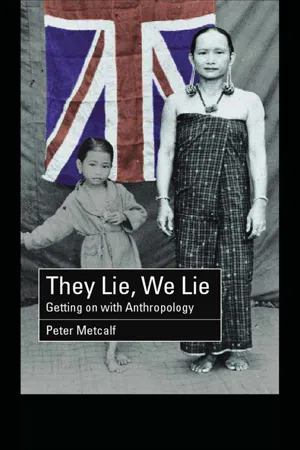
They Lie, We Lie is an attempt by an experienced fieldworker to engage recent critiques in ethnography, that is the writing of culture, made both from within anthropology and from such disciplines as cultural studies and post-colonial theory. This is necessary because there has been a polarization within anthropology between those who react dismissively to what Marshall Sahlins calls 'afterology' and those who find the critiques so crippling as to make it hard to get on with anthropology at all. Metcalf bridges this divide by analyzing the contradictions of fieldwork in connection with a particular 'informant', a formidable old lady who tried for twenty years to control what he would and would not learn. At each stage, the author draws out the general implications of his predicament by making comparisions to the most famous of all fieldwork relationships, that between Victor Turner and Muchona.
The result is an account that is accessible to those unfamiliar with the current critiques of ethnography, and helpful to those who are only too familiar to them. His discussion shows, not how to evade the critiques, but how in fact anthropologists have coped with the existential dilemmas of fieldwork.
- 168 pages
- English
- ePUB (mobile friendly)
- Available on iOS & Android
eBook - ePub
About this book
Information
1 Lies
This is an essay about lies: white lies and ones black as night, evasions, exaggerations, delusions, half-truths, and credible denials. Consequently, it is about art and literature, and specifically the art and literature of anthropology, as ambiguously manifested in our unique genre, the ethnography. It is a response from one discipline to the pervasive epistemological skepticism of our times. At the beginning of the twenty-first century, it is swimming against the intellectual tide to discuss the truths that ethnographies may contain, so let us instead see what profit there is in examining the kinds of lies in which they traffic.
It is a matter not only of lies told by anthropologists, however, but also of lies told to anthropologists. There is nothing self-evident about why anyone would bother talking to the would-be ethnographer - assuming they do - except perhaps for polite platitudes. In unfamiliar surroundings, he or she is usually socially inept, and often linguistically incompetent. Such people are generally avoided. Yet ethnographies are full of obliging informants, hastening to play Sancho Panza to the ethnographer’s Don Quixote. We have to ask ourselves what transactions of power and knowledge underlie their motives.
Moreover, having admitted informants, the presumed culture bearers, into the equations of deceit, we have to consider the conceptual premises and conversational constraints under which they select what to tell and how to tell it. Here again, nothing is self-evident.
“Something spoken which is not true”
Eve Danziger (1997) recounts a salutary experience among the Mopan Maya of Belize. To entertain some friends, she showed on VCR a cartoon version of Rudyard Kipling’s The Jungle Book.1 This was well received because it was interpretable even to the old people watching, but there were things that bothered them. At the beginning of the movie, the infant Mowgli is abandoned in the forest and raised by wild beasts. Later, he is seen playing happily with panthers and bears. Why, asked Danziger’s friends, didn’t the animals eat the child? Finally someone asked doubtfully if all this were really “true” - jaj in Mopan Maya. When told that it was not, her friends were shocked, even offended, and showed no further interest in the movie.
At first blush, this reaction seems only naive, and perhaps charmingly so - a more extreme version of the confusion that fans often display between a film star and the character he or she plays. (Groucho Marx claimed that the question he was most often asked was whether Harpo really could talk.) Danziger insists, however, that the reaction she encountered ran far deeper than this. In the first place, there are Mopan stories (kwenta) that do not seem so very different to The Jungle Book, concerning such things as half-human creatures who live in the forest, or the marriage of the sun and moon, but these stories are believed to be “strictly true.” Made-up stories are dismissed as baxul, “games” or “toys,” suitable only for children. Stories that are discovered to be untrue - fictions -are simply tus, “something spoken which is not true” (Danziger 1997: 4-9).
Knowing this much about kwenta, the reflex of someone with my training in the century-old anthropological tradition of theorizing about religion is to conclude that they are “sacred” texts. But this does not in fact get us very far. The stories are not particularly hedged about with taboos, nor situated in the midst of ritual, nor do they seem to tell any fundamental “truths.” Instead they are told for entertainment. There are no supernatural sanctions on errors, but skill at recounting them is appreciated. Viewed from this angle, the stories begin to resemble our notion of literature rather than esoteric lore, but there remains that awkward insistence that they recount literal truth.
This combination of truth and art is evidently difficult for Westerners, so much so that at the end of the nineteenth century Oscar Wilde could make a running joke of it. In The Importance of Being Earnest, Lady Bracknell responds to an accusation: “Untruthful! My nephew Algernon? Impossible! He is an Oxonian.” What provokes the accusation is a fictional brother, made up to provide excuses for not attending tedious social events, but the author of the fiction is unabashed: “To invent anything at all is an act of sheer genius, and, in a commercial age like ours show considerable physical courage. Few of our modern novelists care to invent a single thing.” In “The Decay of Lying” his protagonist inveighs against the modern novelist, who “presents us with dull facts under the guise of fiction.” Warming to his theme, he urges:
People have a careless way of talking about a “born liar,” just as they talk about a born poet. But in both cases they are wrong. Lying and poetry are arts - arts, as Plato saw, not unconnected with each other - and they require the most careful study, the most disinterested devotion.
(Wilde 1994 [1891]: 375, 972)
The fin-de-siècle skepticism of the next century might seem to have left little room for Wilde’s teasing, but it was noticeable that any talk of the artistry of ethnography still made us shift uncomfortably in our chairs, because it implied an equivocation with truth. An anthropology in Mopan would presumably not be encumbered with this implication.
Danziger, however, sees a different significance in Mopan attitudes to fiction, reflecting her background in linguistics. She finds a whole concept of speaking that is radically different to our own, one that challenges common assumptions about the nature of “speech act.” In contrast to most linguistic theory, Mopan do not place emphasis on individual agency and the speaker’s creativity. Instead, they explicitly stress the role of the hearers, and their obligation is to believe. Speakers must respect that intention in their hearers. “Something spoken which is not true” constitutes a rent in the social fabric; it is antisocial, and judged as such.
Mopan are not unique in their credulity. A body of research in social psychology has tested the reactions of experimental subjects to implausible or inconsistent claims, and confirmed a pervasive tendency of hearers to believe what they are told (DePaulo et al. 1996; Kashy and DePaulo 1996). This applies even to boasting (Schenkler and Leary 1982). Moreover, even when subjects had grounds to doubt statements, they tended to reduce the effect of claims rather than discounting them entirely (Jones 1979). This no doubt explains the curious tendency in academia for those who make the most inflated claims of originality and importance for their work - I name no names - to be most rewarded by the attention of their peers.
What differentiates Mopan reactions is the clear assignment of blame exclusively to the liar. They could never be induced to chuckle conspiratorially at P.T. Barnum’s famous maxim: “a sucker born every minute.” For them, trust is a higher social value than sophistication. Instead, they have a battery of conversational techniques -introductory caveats and explanatory preambles - designed to avoid the disrespect of misleading people, even unintentionally (Danziger 1997: 15-16). One can only wonder at such scrupulous honesty, and hope that it confers a special resistance to the hype of advertising to which the rest of us are so weakly vulnerable.
At the same time, however, it is hard to imagine how everyday conversation proceeds in the face of such demanding literalism. What room can there be for humor, or irony, or any form of verbal play? Thinking about the conventions that surround a staged drama, Danziger remarks:
By saying that Mopan reject the sort of experience common in the Euro-American theatre then, I am saying that this is a society in which (these levels of) metaphor and analogy are explicitly rejected as legitimate branches of self-conscious poetic expression.
(1997:11)
Justifiably, she sees her findings as subversive of current theories of cognition that take metaphor as a fundamental and universal vehicle of thought (Lakoff and Johnson 1980). They seem equally challenging to those theories of ritual and social action influential in the 1970s that relied on a dramaturgical analogy (Goffman 1963; Turner 1974). Meanwhile, care and modesty characterize Mopan sociality, and Danziger notes the “acceptability of silence in Mopan conversation” (1997: 16).
They lie, we lie
Nothing could be further from truth in the longhouses of central northern Borneo, among the Upriver People {Orang Ulu), where conversation flows as freely as the tumbling rivers. Longhouses seem designed to promote it: hundreds of people living under one roof, and no possibility of privacy, even if such a thing were conceived of, let alone desired. A wide veranda stretching the length of the house on the side facing the river is communal space, and people pass along it constantly, or gather to work together or socialize. On the landward side there is a row of family apartments, each opening on to the veranda, but even they are crowded with residents, and open to a constant flow of visitors.
When I began fieldwork there, in a Berawan longhouse at Long Teru, I soon learned that my hosts would not tolerate interviews using an interpreter. They valued conversation too much for that, and they would go to sleep, or wander off, rather than wait for the next round of translation. But in impromptu exchanges while bathing in the river, or strolling along the veranda, they would engage in rapid-fire joking and repartee. I never felt like anything other than a dullard in their company. They can tease mercilessly, enough to provoke tears of anger in grown men. (Women are seldom victimized to this extent.) Nor is satire restricted to verbal behavior: a favorite form of entertainment is to recall some gaffe or piece of clumsiness made by someone in the audience, and to jump up and act it out, complete with exaggerated gestures and foolish expressions. The imitator is immediately followed by another, and another, each adding new absurdities, concluding, in the most gratifying cases, with the victim himself.2 Even at rituals held inside family apartments or out on the veranda hilarity would often disrupt the rites themselves, and always they had to compete with the general hubbub of the crowd. In fact, a ritual was judged a failure that did not generate a noisy and uninhibited conviviality.
Not all vocalization is frivolous, however. At the other end of the spectrum are the formidable chants, sacred in the fullest Durk-heimian sense, that are heard only during death rituals. Incorrectly or improperly performed, even in tiny snatches, they have the power to kill. Not surprisingly, the bulk of Berawan interactions lie somewhere between these poles of levity and weightiness. Though I made no special study of them, there are characteristic Berawan modes of gossip and debate and so on. For obvious reasons, however, I paid closest attention to the genres of narration. Some of the stories my enquiries provoked were short, some long, most were informal and subject to constant interruptions by anyone who came by to hear what was going on. But sometimes I was met with the insistence that I consult a particular expert, and arrange a full and proper telling.
My contribution to these gatherings was usually a bottle or two of arak, a potent distilled liquor sometimes made in the longhouse, but nowadays often bought in a trade store. The prestation oíarak indicated simultaneously the formality of these occasions and their essential sociality. The audience comprised adults from neighboring rooms, and children from up and down the longhouse, little gangs of boys or girls of about the same age, who routinely passed the night in whatever room they happened to be when sleep overcame them. The hosts provided glasses and snacks and perhaps more arak, and only after some time did the storyteller introduce the evening’s agenda. Then the crowd would draw around, their faces lit by a wick lantern, and I would get out my notebook. The children began with rapt attention, and slowly dropped off, one by one, while the adults settled down to hear the story out, chewing betel, participating as required, and occasionally turning to explain something to me. From those slow and gentle evenings I gained a great deal of information, even if I did not follow everything. They were not, however, held for my benefit; they had occurred before I arrived at Long Teru, and they had an established literary form and social function.
There was a moment in those evenings when the narrator signalled his or her readiness to begin. I remember best one particular exponent, an old woman named Bilo (i.e. “Widow”) Kasi, who always began in the same way: she would fuss for a while getting comfortable, and asking people whether they had what they needed, then she would clear her throat, and, when she had everyone’s attention, announce in a firm voice the formula that provides my title:
Malut dé, malut kita.
The verb malut means “to lie,” dé is the third-person plural pronoun, and kita is the first-person plural pronoun; hence “they lie, we lie.” We should note also that Berawan, in common with many Austronesian languages, has verbs that do not inflect for tense. Consequently, it could as easily be “have lied” or “will lie” as “am lying.” So much for literal translation.
The phrase is surprising because it seems an odd moment to be talking about lying, but it cannot be shrugged off. On the contrary, it was clearly designed to accomplish exactly what Mikhail Bakhtin describes as the function of such openers, namely to establish the “stylistic aura” of the entire speech genre (Bakhtin 1986: 87-9).
If we take Kasi to be saying “they lied before, now I’m lying,” or something amounting to “it’s all lies anyway,” then the aura she establishes is one of profound skepticism towards all traditional knowledge.
This is the more inescapable in that Kasi cannot mean to imply that these stories are only what we might call fairy tales, some variant of “once upon a time.” Certainly her audience was partly made up of children - to begin with at least - but they were explicitly there to be instructed, not lulled to sleep.3 Moreover, the didactic quality was only slightly less obvious for the adults. It took no great familiarity with the Berawan world view to be confident that “they” are the ancestors, if only because the stories all concerned the doings of the ancestors: who migrated from here to there, and what adventures occurred along the way; in short, the familiar anthropological category of “oral history.” In the most chronologically remote episodes there were heroes who carved out river valleys and climbed to the stars, but as they grew closer to the present they took on a comfortingly factual quality - exactly the material I needed to unravel the tangled ethnological relations between the different communities. Meanwhile, those same ancestors stand at the very core of Berawan religion. They were invariably invoked in prayer, more so than the deities (Metcalf 1989: 64-8), and it was their awful presence at death rituals that made the death songs so dangerously sacred. The parallel structure of the phrase, with its repeated verb, is in itself suggestive of ritual language. No, Kasi was not telling fairy stories.
There is, however, another equally significant connotation to her phrase. In opposition to “they” stands a “we” that includes the speaker. Clearly, it means that small cohort of older people who know enough to relate Berawan tradition authoritatively. They stand between the ancestors and the audience. Perhaps what Kasi means to say is “if they lied, then I lie too.” In other words, she will tell the stories just as she heard them herself, sitting as her audience now does, before storytellers long since dead. In this way, Kasi makes herself the mouthpiece of the ancestors, and assumes something of their power.
Getting on with anthropology
What strikes me as quintessentially Berawan about Kasi’s phrase is its perfect balance between, on the one hand, a refusal to be impressed by anyone’s revealed truths, even their own, and, on the other, a pride in the community’s traditions bordering on chauvinism. The phrase produces mentally the same effect as a figure-ground reversal produces optically. Skepticism - empowerment; they replace each other instantaneously.
The attitudes to truth that the phrase succinctly expresses stand in stark contrast to those that Danziger found among the Mopan Maya. With its insistence on speaking as close as it possibly can to the literal truth at all times, Mopan discourse constitutes, on the level of what Claude Lévi-Strauss (1968) called pensée sauvage, an analogue of scientific discourse. The Mopan are thorough-going positivists. Meanwhile, the Berawan are just as thoroughly postmodern. Their notion of truth is dialogic in the fullest Bakhtinian sense; it exists only as a succession of mutually constructing speech events. Kasi’s formula might serve as a dedication to Jacques Lyotard’s influential essay The Postmodern Condition: A Report on Knowledge (1984), often taken as the manifesto of postmodernist philosophy, which proposes a model of knowledge as a kind of word game.
Kasi’s skepticism fits neatly with the iconoclast mood of postmodernism, but there is that other connotation of her phrase, one that runs directly counter to postmodernism’s nihilist tendencies. Evidently, for many postmodernists, their broad attack on the dichotomy of subject and object, the knower and the known, designed to topple Western science and Humanism, rushes on inevitably to a position in which, in Robert Scholes’ words, “since there is no truth, there is no error either, and all beliefs are equal” (1989: 56). Some embrace this position (Vattimo 1988), while others temporize (Levin and Kroker 1984), but the paralyzing effects of nihilism remain. Whatever impact this has on physicists studying nuclear particles or cosmologists theorizing about the Big Bang, the effect is devastating in anthropology, where there have always been anxieties about how far the observer can or should be removed from the observed.
Meanwhile, there is here a familiar logical conundrum of the type: all generalizations are ipso facto false. Those who assert unknow-ability assume a position of knowing. Even if they try then to rela-tivize their own position, claiming that their position is only one of many, they must still assert that that is true. As Pauline Rosenau concludes: “There is simply no logical escape from this contradiction except to remain silent” (1992: 90). This formal argument resonates eerily with ethnographic strategies: anthropology has a long tradition of relativism, that is, the insistence that other world views be taken seriously, in their own terms, and not dismissed as error. True, there have been schools of anthropology that have not been relativist, and there are limitations on relativism, but the strategy remains. When, however, postmodernists are said to “rela-tivize” their claims to knowing, they suggest an especial anthropological version of nihilism, the assertion that it is fundamentally impossible to know anything or say anything about another culture. This can lead to a kind of introverted essentialism, which authorizes ethnographers only to work in “their own culture,” however that may be constructed. In this way, anthropology’s traditional strategy of taking people outside themselves is inverted. Alternatively, it can produce a kind of esoteric apathy, based on the proposition that those who know do not speak, and those who speak do not know.
Postmodernist critiques were intended to prevent “business as usual” in Western scholarship, including anthropology. Not surprisingly then, they have a distracting effect on those who - for one reason or another - want somehow to get on with anthropology. For graduate students kee...
Table of contents
- Cover Page
- Title Page
- Copyright Page
- How am I to read this gesture?
- Illustrations
- 1 Lies
- 2 Struggle
- 3 Power
- 4 Ethnicity
- 5 Closure
- Notes
- References
Trusted by 375,005 students
Access to over 1.5 million titles for a fair monthly price.
Study more efficiently using our study tools.
Frequently asked questions
Yes, you can cancel anytime from the Subscription tab in your account settings on the Perlego website. Your subscription will stay active until the end of your current billing period. Learn how to cancel your subscription
No, books cannot be downloaded as external files, such as PDFs, for use outside of Perlego. However, you can download books within the Perlego app for offline reading on mobile or tablet. Learn how to download books offline
Perlego offers two plans: Essential and Complete
- Essential is ideal for learners and professionals who enjoy exploring a wide range of subjects. Access the Essential Library with 800,000+ trusted titles and best-sellers across business, personal growth, and the humanities. Includes unlimited reading time and Standard Read Aloud voice.
- Complete: Perfect for advanced learners and researchers needing full, unrestricted access. Unlock 1.5M+ books across hundreds of subjects, including academic and specialized titles. The Complete Plan also includes advanced features like Premium Read Aloud and Research Assistant.
We are an online textbook subscription service, where you can get access to an entire online library for less than the price of a single book per month. With over 1.5 million books across 990+ topics, we’ve got you covered! Learn about our mission
Look out for the read-aloud symbol on your next book to see if you can listen to it. The read-aloud tool reads text aloud for you, highlighting the text as it is being read. You can pause it, speed it up and slow it down. Learn more about Read Aloud
Yes! You can use the Perlego app on both iOS and Android devices to read anytime, anywhere — even offline. Perfect for commutes or when you’re on the go.
Please note we cannot support devices running on iOS 13 and Android 7 or earlier. Learn more about using the app
Please note we cannot support devices running on iOS 13 and Android 7 or earlier. Learn more about using the app
Yes, you can access They Lie, We Lie by Peter Metcalf in PDF and/or ePUB format, as well as other popular books in Social Sciences & Anthropology. We have over 1.5 million books available in our catalogue for you to explore.