- English
- ePUB (mobile friendly)
- Available on iOS & Android
eBook - ePub
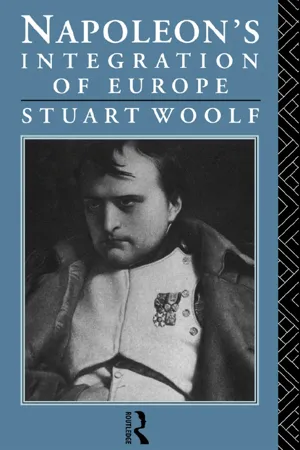
Napoleon's Integration of Europe
About this book
Histories of the Napoleonic period are almost exclusively biographies of the man, or political-military accounts of his wars. But such wars were only the first stage in a far more ambitious programme; the establishment of a rational state which would force the pace of modernising society. Through an examination of the experiences of French domination, Napoleon's Integration of Europe explores the implications of such a project for France and its relationship with the rest of Europe. It examines the problems of ruling a progressively expanding empire, as seen through the eyes of a trained corps of bureaucrates who were convinced that their scientific methods would enable them to understand and govern the mechanisms of society. However it also looks at the populations subjected to French rule, at the nature of their resistance and adaptation to the principles of the Napoleonic project. This book is the first overall comparative study of Europe in the Napoleonic years. It is a study not only of an early exercise in imperialism, but of the conflict that is aroused between the rationalising tendencies of the modern state and the spatial and cultural heterogeneity of individual societies. As well as a history of France, it is also a history of Italy, Germany, Belgium, Holland, Switzerland, Poland and Spain at a crucial moment in the history of each nation state.
1 The Revolutionary-Napoleonic ideals of conquest
Not everything that the wisdom of the legislator decrees for the good of one of the various nations under his dominion can be applied equally to all the others, as the natural differences among peoples in terms of climate, character, genius and customs play too great a role.(Kaunitz to the Empress Maria Theresa, 14 December 1769)1
A political State is a very difficult machine to direct, as general laws must often yield to circumstantial needs; if everything is to be subjected to a single regulation, it is impossible to maintain the form of policing and protection appropriate to the inhabitants of each part of an empire.(Jacques Peuchet, Statistique générale et particulière de la France et de ses colonies…, Paris, an XII (1803–4), vol. 1, p. vi)
THE FRENCH AND EUROPE
What did French men and women know about Europe at the end of the ancien regime? The question offers a convenient starting-point for a discussion of the quarter of a century in which French arms and Napoleon’s political ingenuity constructed and imposed on the greater part of the Continent their particular model of the modern nationstate.
A wealth of indications can provide us with at least an impressionistic response to so apparently simple a query. For the overwhelming majority of this profoundly rural society the ‘foreigner’ was any ‘stranger’ from distant parts. Frequently he was the product of the massive, ubiquitous machine of military conscription, which recruited some 2.5 million men (both French and others) between 1700 and 1789 and itself stimulated the flow of emigration. He was not necessarily unknown—for pedlars and migratory rural artisans regularly followed the same routes—but unattached to the standard networks of identification, kin and village, and frequently speaking a different native tongue. Few of the 1 million French men and women who took to the roads every spring and summer of the later eighteenth century ventured as far as Italy, Spain, Germany or the Low Countries; nor indeed were ‘national’ frontier posts so different in kind from the multiplicity of customs and toll barriers within France. For the other 20-odd million peasants, whose daily life was firmly rooted within the physical limits of walking distances, the elements of information about other peoples and states, on which they constructed their mental world, must have come essentially through the channels of such migrants, the lurid fireside fantasies of the soldiers, or the tales of pedlars’ chapbooks.
A mere generation later, as a result of Napoleonic conscription, every French peasant family must have acquired knowledge of one or more of the countries of Europe directly or indirectly, through the military experiences of relatives or neighbours. One can hypothesise that, in the early years, this immediate contact with other peoples and places must have juxtaposed uneasily with the traditional knowledge and practices, based on maps, memoirs and hearsay, of the pre- Revolutionary professional soldiers. How such experiences filtered into and modified the popular representation of the outside world is an interesting but ultimately probably unanswerable question.
Not only the peasantry, but also (as Daniel Roche has shown) the great majority of the local elites who provided the public of the enlightenment had rarely travelled afar, and then usually only to Paris. Their knowledge of foreign parts was based on the written ‘voyages’ of travellers and that more or less intense correspondence so characteristic of the ‘republic of letters’, occasionally enriched by meetings at their local academy or masonic lodge with the wealthy, cultured foreigner on his grand tour or the officer returning from foreign parts. Undoubtedly the numbers of educated and curious travellers increased continuously and rapidly in the latter decades of the century, possibly even more than the printed voyages and descriptions. Within this corpus of publications, Europe—and finally France as well—occupied an increasing space. The geographer Langlet-Dufresnoy could assert in 1742, following the publication of the great Jesuit Geographical, historical, chronological, political and physical description of the Empire of China and of Chinese Tartary (1735), that China—a recurrent ideal of western political thought— was known ‘with as much detail and precision as France or the states of Europe’.2 The attraction of these distant lands remained strong— as can be seen in the chinoiseries and Turkish motifs of the decorative arts—and was accompanied by the newer scientific and anthropological explorations and descriptions of the Australasian Pacific and extra-European worlds. But with the prolonged peace following the end of the Seven Years’ War (1763), this traditional cult of the unusual and the exotic, an extension of the ‘cabinet of marvels’, ceded prime of place to nearer and more easily accessible regions. In Boucher de la Richarderie’s vast listing of travel-books published as the Bibliothèque universelle des voyages in 1808, accounts of European countries constituted 35 per cent of the total of seventeenth-century publications, but 53 per cent of eighteenthcentury ones.3 Europe was ‘discovered’ by travellers and readers alike, assisted in their voyages by increasingly stereotyped descriptions and practical guides: no travellers of today, nurtured on their Blue Guides, would be surprised (except by the length of title) at L.Dutens’ Itinerary of the most popular routes, or Journal of a tour of the main cities of Europe, including…the time needed to go from one place to another, the distances in English miles…the most remarkable things to see…To which is added the exchange rate of moneys and a table of travel and linear distances.4
Europe was visited in its remotest parts, from Iceland and Scandinavia to Russia and Turkey. Geography and history went hand in hand, for—as Voltaire preached and practised—it was essential to describe to the reader the unfamiliar. Voltaire was well placed to do so, with 137 volumes of voyages as well as geographical dictionaries in his library of nearly 4,000 works. But, in general, the remoteness of the country was in inverse proportion to the informative detail authors of voyages provided about it. The countries of the grand tour continued to attract most attention. For the French reader and traveller, cultural and historical traditions ensured the continuing primacy of Italy, while Britain attracted ever greater attention, based on that intimacy resulting from a secular rivalry that now related to political structures as well as to economic activities. By the 1780s the major novelty was the massive increase in publications, travel and contacts with the German states, where commercial opportunities, administrative models and reforming princes aroused growing interest.
The dimensions of this fashionable boom in travel and travelogues of the late eighteenth century can be gauged by comparing Voltaire’s collection of voyages to the 700 books of geography and history in the 2,000-volume library of Adrien Duquesnoy, a little-known but influential administrator of the Consular years.5 But if travel was fashionable, its purposes had changed: it was pedagogic and utilitarian, philosophic and scientific. Rousseau had exalted the benefits that would result for mankind from a voyage round the world by philosophes; Duquesnoy, more mundanely, argued that through knowledge of foreign examples, ‘one can compare facts and theories, establish a body of principles and adopt a plan which will be practicable at home’.6
It was this particular interest for the classification of useful information that explains the rapid development of statistical topographies. Of German origin, a direct offshoot of the Kameralwissenschaft, these numerical descriptions of the physical environment, history, political structure, economic activities and social organisation of administratively delimited areas encapsulated at one and the same time the educated public’s thirst for easily acquired knowledge, the trader’s need for practical information and the scientifically oriented administrator’s search for classified and hence comparable empirical data. The statistical topography, the favoured mode of diffusing information about the departments in Directorial- Consular France, can be regarded as the logical culmination of the vast growth of interest in travel, in the double sense that it selected and moulded the information to meet the requirements of ‘social utility’, and turned attention from foreign parts to the ‘discovery’ of the homeland itself. In so doing, it combined the acquisition of useful knowledge as the basis for policy with the illustration of the progress of the different regions of France since the Revolution.7
It is obvious that Frenchmen’s knowledge of Europe was not limited to travel and travel books. The very propaganda of the philosophes, like the international expansion of economic activity in the later decades of the eighteenth century, thickened the intimate, complex, never interrupted web of personal contacts and interchange on which the European economy and culture had always depended. Observation of practices and methods employed in other societies and states stimulated a widely shared search for improvement, whether in the private or the public domain. It was precisely with this intent, for example, that Duquesnoy translated into French the major treatises on institutional means to deal with poverty published in Britain, the United Provinces, Philadelphia, Switzerland, Germany, Scandinavia and Italy.8 What to do with the poor was an issue to which late-eighteenth- century elites were particularly sensitive. But it formed part of a far larger problem of effective government, or ‘social utility’, which was in the forefront of the attention of French, as of other European savants and administrators, following on the wide-ranging and contradictory criticisms and preaching of the philosophes. The interest among the leading French intellectuals, both before and after 1789, in Scottish political economists and the late aufklärische Göttingen school of public administration derived directly from the apparent success of the analytical methods, and (at least in part) the solutions they proposed. What was needed, wrote Volney, was ‘a sufficiently large number of facts that can be compared with due reflection in order to extract from them other new truths or the confirmation of established ones, or even the disproof of accepted errors’.9
Direct observation and experience abroad was a precious asset (possibly because it remained so unusual), which came to be particularly valued by the Revolutionary political class and assisted administrative careers. Highly illustrative is the early career of C.E. Coquebert de Montbret, future head of the Napoleonic bureau of statistics and secretary-general of the ministry of manufactures and commerce: before the Revolution he had spent nine years at Hamburg as French commissioner of the merchant marine and consul, then to be employed by the Directory and Consulate as commercial and shipping representative at Dublin, Amsterdam and, after the peace of Amiens, at London.10 As significant was the request made by the thermidorian ministry of foreign affairs to the geographer and idéologue, C.- F.Volney, to prepare a list of Statistical questions for the use of travellers, so that the ministry’s diplomatic agents abroad could collect useful facts in a systematic manner.
It is evident that knowledge of Europe was acquired through many channels and functioned at different levels. In terms of private contacts, unquestionably the most diffuse and continuous level, networks of correspondents and relationships ignoring national frontiers had always existed, deriving from kin and patterns of sociability. The cosmopolitan veneer of aristocratic pretensions was based on the reality of a model of marriage in which status counted for far more than nation and encouraged matrimonial alliances that ignored national frontiers. Social modes (in which the French Court played the leading role) transcended the boundaries of the individual state and circulated across Europe in the persons of preceptors (such as Gilbert Romme), chefs, clothes designers or Casanova’s actresses. At the less mundane level of the ‘republic of letters’, authors—of whom Voltaire and Rousseau were only the most publicised and best known—and learned societies, especially the medical profession, transmitted cultural knowledge and models of comportment. At yet another level, economic exchange explained the wide-ranging information about Europe possessed by French commercial families.
The group of Frenchmen probably best informed about, and most sensitive to changes in European affairs, alongside, or even more than, official representatives, were the manufacturers and traders. Despite the loss of much of her empire in 1763, France had participated actively in the expansion of the international economy in the latter half of the century. The rapid growth in colonial trade, in which France divided the lion’s share with Britain, not only benefited the great ports of Bordeaux, Nantes and Marseille, but also had a multiplier effect on the general level of economic activity and urban demand. By the eve of the Revolution, re-exports to other European countries of colonial goods—sugar, coffee, tea, spices, rum, tobacco— amounted to about one-third of total French exports, while colonial demand in the Antilles and Spanish colonies—for silks and other luxury products, as well as slaves—absorbed perhaps a quarter of French industrial production. By the eve of the Revolution, British technological superiority in textile production and ironworks was impinging on traditional French export markets in the Levant and Mediterranean. But if the entrepôt trade was unquestionably the most rapidly growing sector of the French economy, some manufactures— especially silk and fashionable goods—and agricultural products such as wine benefited from the growth of both domestic and European markets. In a world of poor and seasonably impossible communications, the development of a national market in France was facilitated by an inland transport system admired by foreign travellers, even the British. The great centres were developing their trade contemporaneously within France and across Europe. Marseille was expanding its activities from its traditional Levant woollen exports to re-export of North American colonial goods; Bordeaux developed contacts with Hamburg, at the expense of Amsterdam; Paris and Lyon imposed their needs on the ports and sold their silks and fashion products throughout the interior. The Rhineland areas, Alsace, the Bishoprics and Lorraine, were drawn into the national network; exchanges with the Italian states and Spain developed primarily with Lyons and the Midi; above all, northern and eastern Europe—the German states, Poland and Russia—provided important markets via the Baltic and the fairs at Frankfurt and Leipzig, for French wines, silks and luxury goods.
Much attention has been paid, understandably, to the activities and merchants of the maritime ports. But the traders, merchants and merchant-manufacturers throughout the kingdom formed the infantry (or at best the non-commissioned officers) of this army of international trade. In an economy which remained overwhelmingly agricultural, the numbers and geographical range of activities of these manufacturers and traders should not be exaggerated. The market, for most producers and merchants, was an extremely local one, although indirectly through the exchange of goods, the links with the great ports and metropolises of Paris and Lyons, via river traffic and inland trading towns, were increasing rapidly. In the absence of a banking system, credit was in short supply at all levels, from the pedlars who stocked up at Lyons to the Alsatian calico print manufacturers reliant on the sleeping partnership of Basel bankers. Throughout France, along the frontiers and coasts, elaborate and sophisticated systems of smuggling involved entire villages and towns, from carters and bargees to respectable businessmen and Customs officers. Smuggling (except of domestic salt, a state monopoly) implied a considerable knowledge and network of supply routes and markets, at least across the neighbouring frontiers. Far more general were the regular and routine exchanges of manufacturers and merchants at their warehouses, or with clients on their order-books, either directly or on commission.
The eighteenth century witnessed a growing concern in the technical education of manufacturers and merchants, in France as elsewhere, with proposals of professional courses and publication of technical instructions and guides. The Encyclopédie had already popularised the technology of production, with articles by educated skilled artisans. Jacques Peuchet, former secretary of Morellet, saw the market for a Universal dictionary of trading geography, published in six volumes in the Years VII–VIII. But most manufacturers and merchants undoubtedly learnt their trade on the job. A small minority acquired their apprenticeship (and languages) abroad. The political vagaries of the Revolution increased their number, through the forced apprenticeship in foreign trading houses of many children of the wealthy bourgeoisie, such as the future prefect H.C.F. Barthélemy at Mainz, or the idéologue and civil servant J.M.de Gérando at Naples. The larger merchant houses, such as Briansiaux of Lille, were engaged in intense commercial correspondence with expeditioners and commissioners across all western Europe. Whether through direct experience or business correspondence, these manufacturers and merchants were acutely conscious of their reliance on the established trading routes around which they had so carefully cultivated their networks. Natural or man-made interruptions, such as through a poor olive crop in Apulia or threat of war in Poland, were registered immediately with the sensitivity of a thermometer. Whatever the geographical range—from the pre-Revolutionary small tobacco processor of Strasbourg trading across the Rhine to the Restoration Swiss merchant and liberal G.P.Vieusseux, who wrote accounts of the European-wide commerce in Scandinavian salted cod and Black Sea grain—knowledge of Europe was an essential pre-requisite for the businessman.
THE POLITICAL MODEL OF THE REVOLUTION
By 1789 the leading role of France in the forward march of civilisation was accepted by educated elites throughout Europe—even by the British. Although the reforms advocated by the philosophes seemed to have made far greater progress in other states, such as Tuscany, Austria, even the Russia of Catherine II, and although the economic success of Britain was undeniable, France—which usually meant Paris—remained the intellectual powerhouse of enlightenment ideas about how to improve the present and construct the future. Such a role was based on France’s remarkably high and intense level of philosophic and scientific enquiry. But it was also a consciously constructed reputation, based on a self-confidence in the superiority and leadership of French civilisation, that dated back to the cultural affirmations of the Court of Louis XIV and appeared continuously confirmed by the generalised acceptance of French as the language of international discourse. The cosmopolitan diffusion of the French model of aristocratic sociability, which imbued the practices and comportment of the European nobilities, underpinned such selfconfidence and paradoxically was reinforced by the abrupt and massive emigration of nobles with the Revolution.
Civilisation, a new word that entered the French language only in the mid-eighteenth century to describe the level of perfection of a society, was identified with the progress of reason. In the hands of so influential a writer as Voltaire, it was demonstrable through the evidence of history, from the millennial ‘barbarism’ and ‘superstitions’ that followed the fall of ancient Rome to the early manifestations of the new spirit of reason of the Renaissance, culminating in the current age of enlightenment. Each progressive age was characterised by the achievements of a particular people: in classical times the Greeks and Romans, in recent centuries the Italians, then the British and now the French.
This identification of the most advanced stage of civilisation with the French nation was consolidated by the Revolution, not only among the French themselves, but also initially among all who believed in progress. It was an identification based on optimism, faith in the possibility and reality of peaceful change, to which the first euphoric year of radical reforms seemed to bear witness. It is a truism—and misleading, at least in the short term—to explain the fundamental influence of the Revolution in the future development of western civilisation in terms of the universality of its political values. For some of its key ideas—such as ‘fraternity’—rapidly degenerated, at best into slogans, at worst into mockery, whether on the French political scene or in the territories ‘liberated’ by French armies; while others—such as liberty, equality or popular sovereignty—were to undergo deep and anguished redefinitions through the often fratricidal political struggle up to and beyond Brumaire, from which they emerged almost unrecognisably transformed.
Nevertheless, there are few indications that the French political and military class ever doubted its mission as vector of the most advanced form of civilisation, to be carried to, or imposed upon, less fortunate peoples. Already in October 1789 Mirabeau argued that:
The example of the French Revolution will only produce a greater respect for the law, a greater rigidity in discipline and social hierarchy in England. But there will be incalculable tremors in the Batavian provinces, where the revolutionary fever was cut short; in the Belgian provinces, where habits and opinions are restless and seditious; in the Helvetic cantons, unless the aristocrats double up in good sense and firmness…in the splendid provinces of Germany along the Rhine, unless their federal ties are rapidly strengthened.11
By August 1797, Bonaparte’s Italian army broadsheet could proclaim, with that irritating self-congratulatory complacency that never abandoned the French military presence: ‘Every step of the Great Nation is marked by blessings! Happy is the citizen who is part of it! Happy is he who can say about our great men: these are my friends, my brothers!’12 In May 1799, as the Austro-Russian armies seemed on the point of victory, General Masséna...
Table of contents
- Cover Page
- Half Title page
- Title Page
- Copyright Page
- Contents
- List of maps
- Preface
- 1 The Revolutionary-Napoleonic ideals of conquest
- 2 The tools of conquest
- 3 The practices of conquest: administrative integration
- 4 The practices of conquest: exploitation
- 5 Responses to conquest
- 6 Epilogue: the heritage
- Appendix: chronology 1789-1821
- Notes
- Bibliography
- Name index
- Subject index
Trusted by 375,005 students
Access to over 1.5 million titles for a fair monthly price.
Study more efficiently using our study tools.
Frequently asked questions
Yes, you can cancel anytime from the Subscription tab in your account settings on the Perlego website. Your subscription will stay active until the end of your current billing period. Learn how to cancel your subscription
No, books cannot be downloaded as external files, such as PDFs, for use outside of Perlego. However, you can download books within the Perlego app for offline reading on mobile or tablet. Learn how to download books offline
Perlego offers two plans: Essential and Complete
- Essential is ideal for learners and professionals who enjoy exploring a wide range of subjects. Access the Essential Library with 800,000+ trusted titles and best-sellers across business, personal growth, and the humanities. Includes unlimited reading time and Standard Read Aloud voice.
- Complete: Perfect for advanced learners and researchers needing full, unrestricted access. Unlock 1.5M+ books across hundreds of subjects, including academic and specialized titles. The Complete Plan also includes advanced features like Premium Read Aloud and Research Assistant.
We are an online textbook subscription service, where you can get access to an entire online library for less than the price of a single book per month. With over 1.5 million books across 990+ topics, we’ve got you covered! Learn about our mission
Look out for the read-aloud symbol on your next book to see if you can listen to it. The read-aloud tool reads text aloud for you, highlighting the text as it is being read. You can pause it, speed it up and slow it down. Learn more about Read Aloud
Yes! You can use the Perlego app on both iOS and Android devices to read anytime, anywhere — even offline. Perfect for commutes or when you’re on the go.
Please note we cannot support devices running on iOS 13 and Android 7 or earlier. Learn more about using the app
Please note we cannot support devices running on iOS 13 and Android 7 or earlier. Learn more about using the app
Yes, you can access Napoleon's Integration of Europe by Stuart Woolf in PDF and/or ePUB format, as well as other popular books in History & 19th Century History. We have over 1.5 million books available in our catalogue for you to explore.