eBook - ePub
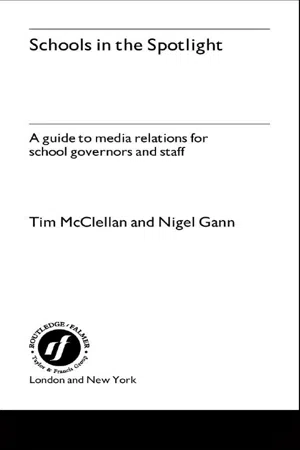
Schools in the Spotlight
A Guide to Media Relations for School Governors and Staff
- 128 pages
- English
- ePUB (mobile friendly)
- Available on iOS & Android
eBook - ePub
Schools in the Spotlight
A Guide to Media Relations for School Governors and Staff
About this book
What role does a school play in a community and society?
This book examines the need for educational establishments to review their position in the local community and to develop strategies to deal with the management of their image. Increasing parental choice means that schools must begin to adopt marketing concepts and tell people what is happening both inside and outside the classroom.
Techniques to generate, revisit and challenge a school's ethos are discussed together with ways of getting this message across to the wider community. Effective management of a school's image through judicious handling of the media can lead to better results, higher self-esteem for staff and pupils and a greater recognition of a school's contribution to a local community.
This book gives practical guidance on how to identify potential news items and how to convince local newspapers, television and radio organisations to use the story. The book contains many examples of how schools have put comprehensive framework to effective media communication and how to avoid potential pitfalls.
Information
Chapter 1
Schools and the public
A historical context
How schools have dealt with and been affected by the media. How things might be better.
The Information Revolution
We know so much more now about what affects our lives in this country than we did only a few years ago. We can watch parliamentary debates on the television and listen to them on the radio. We can see politicians, civil servants and leading professionals being grilled by aggressive interviewers – a Home Secretary being asked the identical question seventeen times in succession. We can demand to see our medical records, read the ingredients on a packet of food, compare the different performances of schools, colleges and universities in public examinations. If all else fails (and if we have the time), we can search millions of websites on the Internet. And, of course, if we want other people to know what is happening to us, and what we think about it, we can publish it in just a matter of minutes.
This explosion of information has applied mainly to the public sector. It gives the public rights and, to those of us who serve the public, it gives responsibilities. It is part of a cycle in which increased knowledge leads to greater accountability, which in turn leads to greater access, which itself in turn makes more information available. Within the cycle, the two areas of activity with which this book concerns itself – schools and the media – are inextricably linked. Schools and media organizations need each other and feed off each other. They have more interests in common than areas of conflict. Yet they are often seen as being in conflict. Many schools still see it as a priority to ‘keep out of the papers’ – except for prize day and the opening of the new school library. A call from a local journalist as often as not sends the shutters up. A call from a national tabloid can induce panic.
In this chapter, by way of introducing the theme of the book, we trace some of the significant changes that have taken place in the public perception of schools since the information explosion began in the early 1970s. We do this for two reasons. First, we want to use the brief case studies to show those types of relationships with the media which have, and those which have not, been helpful in the past. Second, we want to look at the ways in which schools have been required to ‘open up’ about themselves.
Three schools in Islington
Between 1965 and 1975, three Inner London schools hit the local and national headlines. In all three, the ‘presented problems’ were lack of discipline and low standards. In at least two of the three, however, the approaches to discipline and teaching methods were quite deliberate policies introduced by the headteacher and staff of the time. How could they have failed so badly either to understand the impact their policies would have, or to ‘sell’ their ideas?
At Risinghill Comprehensive School in Islington, the head-teacher’s ‘progressive’ ideas fell foul of the politicians. Islington has been for some years a fashionable place for politicians and media people to live. Even if they did not send their own children to these schools, they would certainly know people who did. As the former George Orwell School discovered more recently, no school in Islington can hide its problems. At William Tyndale Junior School, it was the parents – at least some of them – who objected to the new head and deputy’s style. In both these schools, it could be said, policies which might be – indeed, were – implemented quietly in hundreds of schools elsewhere in the country brought a school to its knees because staff were unable to persuade parents, local politicians and the media that their way of education worked. At the third school, it could be said, the senior staff had no deliberate policy: it just seemed that things were largely out of control. Once again, the case acquired a high profile because local (Labour Party) politicians were involved. But the school was not ‘brought down’. Instead, a new senior management team reinstated an orthodox approach, and trouble was kept more or less under wraps. The school survived – the one example of the three where it could be argued that incompetence in the job, rather than in the management of relationships with the public and the media, was the weakness. How could this be, in establishments traditionally so impervious to public scrutiny and criticism?
The two worst schools in London?
‘A school depends for a large part of its success on the confidence of parents’ (Macpherson, 1972). So wrote a reporter for the London Evening Standard in its feature on a large North London secondary school in 1972. The article was the first in an ‘occasional series’ on London schools. The school featured in this opening salvo happened to be – statistically – one of the least popular in London. It had a history of self-perpetuating low achievement. Earlier in its life, as a secondary modern in scruffy Victorian premises, it had played second – perhaps third or fourth – fiddle to other schools in an area where, because of the density of the population, parents could relatively easily exercise choice if they knew how to go about it. Just down the road, the former grammar school could effectively select its intake through parent interview. The school was also suffering from the ‘Risinghill effect’.
As Islington Green moved into its spanking new seven-storey premises in 1965, the Inner London Education Authority (ILEA) was closing down the nearest comprehensive after an unprecedented political campaign to which local and national newspapers had been recruited. Risinghill (see Berg, 1968), through its headteacher Michael Duane, had created a humane and supportive regime for children from one of the most disadvantaged parts of London. The aspect that gained most publicity was that the head refused to hit children, some of whom came from desperately poor, occasionally violent, backgrounds. With a perspective of thirty years, we can see now that Risinghill was just the first in a series of campaigns addressing, or playing on, the fears that parents have that schools might be running out of control.
By the time Islington Green was coming in for its (more than fair) share of newspaper coverage, seven years had passed since Risinghill had met its Armageddon. The ILEA’s admissions system aimed at completely comprehensive intakes for its secondary schools. Children were tested at the age of 10, placed in one of five ability bands, and distributed among local schools. But parents could appeal against their child’s placement. Few, though, appealed to have their child allocated to Islington Green. It takes many years for a community to stop talking about ‘the grammar’ and ‘the secondary mod’. The parents who had taken their own grammar school education for granted, and who were able to provide a supportive home environment, expected to have access to a grammar school equivalent. Former grammar schools, by their own interview procedures and by parental selection, were by and large able to maintain high rates of exam success. Former secondary moderns were seen as perpetuating failure in results. The introduction of the Certificate of Secondary Education in 1965 tended to exacerbate this division. It was seen by some as a second-rate examination for second-rate schooling.
Meanwhile, other differences could be easily observed. Former grammar school comprehensives tended to enforce strict rules about uniform and out-of-school behaviour. Former secondary moderns often had a more relaxed approach to discipline. They lived with the consequences: ‘One incident of violence in the playground and the news is buzzing round all the surrounding streets and takes a year or two to forget’, wrote the London Evening Standard (ibid.). Islington Green had, staff were told in 1972, the highest number of assaults on staff by pupils of any school in London.
Such attitudes to schools could be reinforced by the media. Local papers often wrote of ‘top schools’ and ‘sink schools’. When pupils at ‘top’ schools took drugs, thieved and rioted, newspapers were shocked at the disjunction between their behaviour and their environment. Reports tended to be of the ‘man bites dog’ variety. Such behaviour at a ‘sink’ school, however, was no cause for surprise. Rather, it reinforced the failure of the teachers, the parents, the local education authority, to alter the innate patterns of behaviour of ‘problem’ children.
In the case of Islington Green, the Evening Standard reported, ‘Twenty top ability children were directed there – and the parents of all but six managed to get them sent somewhere else instead’ (ibid.). The Daily Telegraph (1972) splashed the school’s ‘sink’ status when the chair of governors refused to have her own child attend the school. As a leading member of the local Labour Party, she had perhaps more clout than most. That section of the press with a political agenda supporting the Conservative Party and opposed to the comprehensive system predictably had a field day with the hypocrisy of the egalitarian socialists.
Schools have always found it very difficult to change their reputation – their ‘public image’. Judgements made about schools tend to focus on two pieces of evidence: the behaviour of the children, and the examination and test results. Schools can therefore easily get locked into an image that is self-perpetuating. Lazy journalists may look for incidents that confirm a public image of a school, just as they may look for, and report with relish, the predictable behaviour on an estate, or of a television star or a footballer.
Despite the appointment of fresh senior staff, the school continued to have public problems. Being in Islington within the eye of the media did not help. Fours years on, Peter Wilby reported, ‘confidence is restored but difficulties remain’; ‘Margaret Maden, like most comprehensive school heads, was chosen for her abilities as a manager and a projector of the school’s external image. . . . Miss Maden has won over parents, primary heads, journalists, local authority officials. The really difficult task – welding the school into a common unit, working towards common aims – remains, as it must after so short a time, incomplete’ (Wilby, 1976).
The media and educational reform
The power of the media to contribute to, if not actually bring about, political and legislative change was illustrated just a few years after the Islington Green saga. Since 1965 and throughout the 1970s, there had been a steady drip-drip of prejudice masquerading as public opinion about schools. The same themes predominated: standards and discipline. The Sutton Centre in Nottinghamshire, Countesthorpe College in Leicestershire, Madeley Court in Shrop-shire, Aberdeen’s Summerhill School all suffered similar fates (see Fletcher et al., 1985). Underneath the superficial shock-horror headlines lay a more pervasive theme: who owns our schools? Who decides what should happen in them? Before the 1960s, the answer to these questions was clear. It was the professional educationists – though local and national politicians might have some small influence.
The ownership of schools was much more obviously the battle-field in perhaps the most notorious educational media story of the century. The William Tyndale story contained the seeds of every subsequent piece of educational legislation between 1980 and 1997.
For the purposes of this book, the trials of William Tyndale Junior School in Islington illustrate how the failure of a school to take its community with it can have a dramatic impact on everyone concerned. In an Inner London school, a small group of staff introduced radical changes to the way children were taught. They introduced elements of freedom of choice and individualized learning, seeing ‘the system of teaching adopted by the school as a vehicle for social change’ (Auld, 1976: para 185). The school became an arena for a classic battle between ‘progressive’ radicals on the one hand and ‘conservatives’ on the other; one side advocating the child’s essential goodness and readiness to learn within a class-ridden and prejudiced society; the other promoting the importance of basic skills and the need for children to conform to expectations in order to maintain the stability of society:
The two-year power struggle at William Tyndale brought into sharp relief the question ‘Who controls schools?’ It created demands for a clearer settlement between local authorities, teachers, school governors and parents. It raised issues about teacher professionalism, the autonomy of headteachers, the authority of governors and the rights of parents. Events at Tyndale were as much about the fragmentation of responsibilities between the inspectorate, governors, staff, teachers and parents as a dispute over power. Tyndale also demonstrated conflicting definitions of progressive education and differing interpretations of the needs and aspirations of working-class children.
(Riley, 1998: 50)
The William Tyndale episode was played out in the full glare of the media’s attention. Both sides tried to enlist the national newspapers, while bemused parents wondered what to make of it and whom to believe. As at the Ridings schools some twenty years later, some members of the media both exploited, and were exploited by, the players:
The teachers were subjected to daily scrutiny and personal abuse in some papers. Among the pupils at William Tyndale was Paul Harter, who later became a film editor. He recalls the school as being a ‘wild’ one in which the children used to ‘chuck milk bottles at each other out of windows’. He also has vivid recollections of the role of the media. ‘We used to go journalist baiting, tell them all the lies you could imagine. This was an added bit of fun for us. We made up some great stories. We would find out what they wanted to know and we would make it up for them. There were always one or two around the gate. The news and the BBC were the most exciting. We’d be shouting obscenities’. Children such as Paul Harter undoubtedly relished the lime-light and contributed to the press near hysteria.
(Riley, 1998: 50)
The media campaign culminated in a bizarre game of Chinese Whispers, whereby an exercise given by the deputy headteacher to his class based on a quotation from William Blake – ‘The tigers of wrath are wiser than the horses of instruction’ – was turned by the Daily Mail into a line from Chairman Mao: ‘The smile on the face of the tiger is revolution.’ This single event might have stood as a metaphor for the entire episode.
By the autumn of 1976, the public had been well warmed up for a polemical debate about the nature and purpose of schooling. One of the major themes explored by the media over the ten years since Risinghill was ‘Are schools giving us what we want – or what we need?’ The overriding answer given by the media, on behalf of the public, seemed to be ‘probably not’. The media message was ‘Give us order and results.’ Meanwhile, education professionals were caricatured as saying, ‘We will help your children to be happy and fulfilled. If they get a few certificates too, so much the better.’ Of course, the scenario was far more complicated than that. Grace (1972) found that there was a much higher level of agreement between teachers and parents about the desired ends of schooling than was being presented in a simplified way by some of Fleet Street. Parents were keen that their children should be happy and fulfilled in school – though not to the total exclusion of academic success. Teachers wanted order and achievement, too. But the lines were being drawn. The dramatic intervention of the Prime Minister, Jim Callaghan, brought the debate into the political arena.
The end of consensus
Until 1976, everyone knew what they wanted from schools. Well, not quite, perhaps. But certainly much of the media behaved as if all that we expected of schools was self-evident. There was little or no debate outside the profession about the content of education – about what schools were supposed to give to children. In a speech delivered at Ruskin College, Oxford, in October 1976, Callaghan questioned the direction that education seemed to have been following over the previous few years – a view apparently based on his reading of the national press! He asked what the public, and what the government, had a right to expect of the education profession. Bernard Donoughue, who wrote much of the speech, had had his own children educated in Islington – giving the inner-city London borough a claim to be the driving force for all educational change over the succeeding years. Unsurprisingly, then, Donoughue’s view seemed as simplistic and as polarized as that of the media: ‘education was what really mattered. All this was being ruined by a bunch of middle-class ideologues who did not themselves have a proper experience of state education.’ (Interestingly, this argument has been echoed much more recently, when people arguing that early years’ education should be largely exploratory rather than didactic and content-based have been accused of middle-class elitism.)
Donoughue continues:
their prejudices were at the expense of working-class children. There was clear evidence that working-class parents and children wanted education and what they wanted was not the same as the middle-class Labour people from Islington, the trendy lecturers from higher education who wanted education at the expense of working-class kids. Jim [Callaghan] and I talked about this. Whenever I hea...
Table of contents
- Cover Page
- Title Page
- Copyright Page
- Chapter 1: Schools and the Public: A Historical Context: How Schools Have Dealt With and Been Affected By the Media. How Things Might Be Better.
- Chapter 2: Schools and the Media: Getting the Relationship Right: Dispelling Some Myths About the Media. Why Schools Need to Make Contact With Newspapers and Broadcasting Organizations.
- Chapter 3: Public Relations: Describes Some of the Basic Ideas Used By PR Practitioners and How They Are Relevant to Schools. Identifying Various Publics and the Creation of Appropriate Messages.
- Chapter 4: News Releases: Getting the Message Across: Describes How a News Release Can Be Compiled to Get Your Message Out to the Media. Why You Are Doing This. Some Dos and Don’ts.
- Chapter 5: Coping With Crisis: How to Deal With an Incident That Attracts Unwanted Media Attention. What to Do In an Emergency.
- Chapter 6: Managing the Message: How to Ensure That Your School Gets the Best Possible Coverage, Identifying All Target Publications, Organizations and Individuals.
- Chapter 7: In the Front Line: How to Appear At Your Best When the Media Want to Interview You.
- Chapter 8: Righting the Wrong: How to Complain and Get Redress.
- Chapter 9: Sharing the Vision: Making Public Relations and Media Relations Part of a Whole School Policy.
- Appendix 1: Case Studies
- Appendix 2: School Inspection
- Appendix 3: Contact Details for UK Media Regulatory Bodies
- Bibliography
Trusted by 375,005 students
Access to over 1.5 million titles for a fair monthly price.
Study more efficiently using our study tools.
Frequently asked questions
Yes, you can cancel anytime from the Subscription tab in your account settings on the Perlego website. Your subscription will stay active until the end of your current billing period. Learn how to cancel your subscription
No, books cannot be downloaded as external files, such as PDFs, for use outside of Perlego. However, you can download books within the Perlego app for offline reading on mobile or tablet. Learn how to download books offline
Perlego offers two plans: Essential and Complete
- Essential is ideal for learners and professionals who enjoy exploring a wide range of subjects. Access the Essential Library with 800,000+ trusted titles and best-sellers across business, personal growth, and the humanities. Includes unlimited reading time and Standard Read Aloud voice.
- Complete: Perfect for advanced learners and researchers needing full, unrestricted access. Unlock 1.5M+ books across hundreds of subjects, including academic and specialized titles. The Complete Plan also includes advanced features like Premium Read Aloud and Research Assistant.
We are an online textbook subscription service, where you can get access to an entire online library for less than the price of a single book per month. With over 1.5 million books across 990+ topics, we’ve got you covered! Learn about our mission
Look out for the read-aloud symbol on your next book to see if you can listen to it. The read-aloud tool reads text aloud for you, highlighting the text as it is being read. You can pause it, speed it up and slow it down. Learn more about Read Aloud
Yes! You can use the Perlego app on both iOS and Android devices to read anytime, anywhere — even offline. Perfect for commutes or when you’re on the go.
Please note we cannot support devices running on iOS 13 and Android 7 or earlier. Learn more about using the app
Please note we cannot support devices running on iOS 13 and Android 7 or earlier. Learn more about using the app
Yes, you can access Schools in the Spotlight by Mr Nigel Gann,Nigel Gann,Tim McClellan,Tim Mcclellan in PDF and/or ePUB format, as well as other popular books in Education & Education General. We have over 1.5 million books available in our catalogue for you to explore.