Meeting the needs of children at the same time as promoting family life is more than a question of resources: it needs a culture change in social services: a rediscovery and a modernization of the social action and community development traditions in social work. In Social Action with Children and Families the authors argue that ways must be found to work together to promote environments in which children can flourish, and to develop forms of public life which are friendly to children and their parents.
Recent changes in child care systems have put more pressures on those working in it. Social workers have become more open to public scrutiny and are expected to respond to problems rooted in social and economic aspects of their clients' or services users' lives. Legislation stresses working in partnership with parents, other professionals, and community groups.
The central aim of Social Action with Children and Families is to help those working in this field to find a new, more positive sense of direction and purpose. It will be invaluable reading to those studying social work, social policy and public administration as well as to all professionals working in these areas.
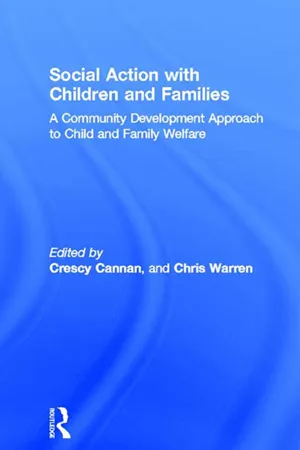
eBook - ePub
Social Action with Children and Families
A Community Development Approach to Child and Family Welfare
- 226 pages
- English
- ePUB (mobile friendly)
- Available on iOS & Android
eBook - ePub
Social Action with Children and Families
A Community Development Approach to Child and Family Welfare
About this book
Information
Part I
New strategies in social action
Chapter 1
Community development and children
A contemporary agenda
INTRODUCTION
Community development in Britain is in danger of being dominated by the demands of economists and planners. In this chapter I shall justify this statement, and go on to argue that it is an unhealthy state of affairs for community development in general and for work with children in particular.
There is an urgent need for community development to regain its confidence to articulate work on the so-called ‘soft’ issues of communities—community care, children, youth work—as compared with the ‘hard’ issues of economic development, employment and housing. The extent to which some inner-city areas, council estates and coalfield communities are experiencing increasing levels of deprivation makes this a political priority. The idea that ‘comfortable’ Britain can turn its back on this situation is both morally unacceptable and socially unrealistic.
It is in the most deprived areas that children suffer the worst injustices. The chapter will go on to outline ways in which community development can contribute significantly to giving them a voice. Fortunately, the danger of maintaining the false dichotomy between ‘soft’ and ‘hard’ issues is being recognised, and I conclude by making the case for integration between the two and for community development knowledge and skills to be re-assessed accordingly.
REGENERATION
In the mid-1980s, a community development project in Rochdale run by the Community Development Foundation helped to establish a community initiative among the town’s Kashmiri population. Aimed at creating a focal point for young people, the initiative grew out of a youth club set up by local people. For several years it was successful in attracting local authority grants and it operated as a generalist community resource. However, from the end of the 1980s it began to rely increasingly on grants and contracts from the Department of Employment and the European Social Fund, with the result that its activities became focused on employment training. Basically, it ceased to be a community development project.
The experience of the Kashmiri Youth project (KYP) of moving from a community to a predominantly economic framework has been mirrored in many community projects throughout the country. In KYP’s case it was the funding system that pushed it in that direction. In many other instances, however, the shift has been the result of the hold that the concept of regeneration has over practice and policy. If community development is now tied so closely to economics, the watchword that secures the link is ‘regeneration’. For the following reasons I believe that the dominance of this concept is in danger of subverting community development.
1 Regeneration is aligned to physical changes—factories, offices and housing—which lead to more jobs as well as improved housing standards. Historically, regeneration is a development planners’ concept, concerned above all with large-scale investment. When implemented in a crude form, as experienced in parts of London’s docklands in the 1970s, it produced a reaction from community groups committed to the future of neighbourhood as opposed to the development of enterprises across much larger areas. There have been improvements since then. Yet the importance of the physical environment in regeneration means that it can be antipathetic to the small scale and to differences between communities. This, as will be seen, is inherently problematic for community development.
2 Regeneration is overtly ‘top-down’. It works on the assumption that specified areas have ‘degenerated’ and expects agencies to formulate objectives and performance indicators to engineer change (sometimes literally). Community development principles of responding to felt/expressed needs and of proceeding at the pace of the community can go out of the window. There have been instances where consultants have recommended excluding local people from consultations for fear of upsetting the plans of developers and investors. That kind of thinking shows how easy it is for community groups to be conceived as means to an end, a way of smoothing or delivering a powerful regeneration programme controlled from outside the community. Community workers should be wary when they come across phrases such as ‘Local communities are key players in the regeneration process’! There is a real danger of ‘community pack-ages’ being imposed, flying in the face of different experiences, needs and resources of communities.
3 Regeneration is too narrow a concept for community development. Policy makers have become more aware that ‘effective regeneration requires attention to more than narrow economic or environmental initiatives’ (Thomas 1995:37). This is welcome. So too is the inclusion, in the bidding documents of the Single Regeneration Budget, of social as well as economic criteria. However, community development is too important to have to fit a single framework. If community development agencies rely exclusively on a strategy of trying to broaden the agendas of regeneration agencies, they miss the point that community development can be used in a wide range of situations, and that they can do this on their terms, not always those of planners and economists. Nowhere is this more important than in work with and for children whose situation in neighbourhoods is affected by a number of forces.
4 Regeneration falls into the trap of mystification. It is experienced as reification, of talking in the abstract language of things rather than the language of people and objects. It is best illustrated by regeneration’s use of the language of capacity building. I remain perplexed by this term because it appears to ignore the language of change and development rooted in community and adult education. It sits uneasily with community development’s concern with the tangible, the importance of acting within the experiences and culture of local people. For community development to allow its links with this tradition to atrophy would be an enormous loss.
5 Regeneration is atheoretical. There is little evidence to date that regeneration has developed its own theory about communities and community involvement. Community development can be accused of having confusing, poorly articulated theories, but theory it does have. As a result it is possible to debate why certain actions or approaches are or are not acceptable. There is a value basis to community development which is conspicuously absent from regeneration.
If the above critique is put in the historical context of community development, the extent to which the latter now exists predominantly in an economic framework becomes doubly apparent: the origins of community development lie in the social work and education sectors. Both have influenced the development of community development practice and theory. The problem has been that both failed to develop an economic analysis of ‘community’. They did not come forward with ideas for responding to the collapse of local economies. It is hardly surprising, therefore, that regeneration has claimed so much of the community development territory.
In terms of responding to the economic causes of fragmented, declining communities, the energy within the regeneration movement is obviously welcome. So too are the concerns of the government to ensure that its programmes are strongly community-based. My concern is that community development, in its eagerness to support regeneration programmes, risks losing its distinctiveness.
The case for a rigorous examination of whether or not community development is, unwittingly in most instances, acting as a handmaiden to prevailing political and economic imperatives, rests not only on an analysis of the limitations of a regeneration framework but also on an analysis of the issues and problems being experienced in Britain’s most deprived areas. It is to the latter area that we now turn.
COMMUNITIES, POVERTY AND CHILDREN
The test-bed for community development lies in its capacity to respond meaningfully to the question: who gets involved, who participates? Arguably it is not that difficult to achieve citizen participation of some kind. But community development should never be understood simply as a mechanism for facilitating general notions of participation. It must always be interested in the quality of participation, particularly as this relates to issues of gender, race and class. Community development exists because it has a value-based commitment to working with the excluded of society, those people who are too poor, too oppressed or too alienated to be confident about getting involved in community activities. And to support this commitment there are tried and tested methods and skills to draw upon in the practice and evaluation of community development.
In this sense, community development must judge itself harshly. It must constantly ask the question, who are the excluded and where do they live? From there it can work out the contribution it can make in different arenas:
• | Neighbourhoods which are being destroyed as a result of the interacting processes of decline: high unemployment, widespread poverty, sub-standard housing, a deteriorating environment, fear, mistrust, high mobility, etc. |
• | Networks of people who share a similar identity, problem or interest—for example, those who have the same faith, people who have the same housing tenure, parents of children at risk of drug misuse, victims of crime, etc. This way of understanding ‘community’, particularly as it relates to race, sexuality and gender, challenges much of the practice wisdom in community development. |
• | Agencies such as local authorities which have the capacity to respond strategically to economic and social problems in their areas. Community development can play a key role within such a framework. In the British context the experience of Strathclyde Regional Council from 1976 stands as an important source of information in this context—when we examine the French context we shall see that there is comparable material on strategic community development. |
• | Policies of government and the European Union which impinge directly upon the lives of people living in deprived communities and which can be influenced by community development ideas and experiences. |
If the starting point for community development is for it to position itself across these arenas in relation to an analysis of poverty, inequality and powerlessness, then the need for it to respond to the situation of children surely becomes unanswerable:
• | Poverty. The numbers of children and young people in the poorest families have increased rapidly. In 1979, 1.4 million dependent children were living in households with incomes below half the national average; in 1990/91 the figure was 3.9 million, an increase from one-tenth to one-third of the age group. The extent of child poverty has been confirmed more recently by the major report on poverty and wealth in the UK published by the Joseph Rowntree Foundation (Barclay 1995). |
• | Environment. There is increasing evidence of the effects on children’s health of traffic and other pollutants, as well as of the risks of accidents caused by the expansion of car ownership. |
• | Safety. Children no longer feel as safe in public places as they used to—hence the increase in journeys by car to school and elsewhere. Fear of attack, danger from traffic, concerns about drugs and crime are the key factors. |
The effects of poverty, environment and fear are to deny children the rights they should have to exist and play in neighbourhoods. This statement provides the opposite picture to media portrayals of some neighbourhoods as being under the control of children and young people—in this scenario it is the adults who are the victims: 10-year-olds harassing adult residents and riot situations developing.
Where does the truth lie in this conflicting portrayal of children’s lives in neighbourhoods? We have to look for the answer, it seems to me, in the value society puts, or does not put, on children and their need to develop and express themselves. When children and young people riot (Campbell 1993) or when pranks go wrong and cause injury or death, it is surely because children feel that they have been let down by adults.
We are in danger of cutting off ways in which adults can communicate and undertake joint activities with children outside home and institutional settings. In many areas resources for youth work, play schemes and adventure playgrounds have been reduced to an alarming extent. There appears to be a retreat by policy makers from supporting local people at the local neighbourhood level in terms of building relationships between people, especially those between children and adults. Ironically the experience of community workers is that the motivation of adults to become involved in community activities which benefit children directly is normally very strong. Hasler shows how important it is for community workers to take up children’s issues and to avoid using them as a means of simply getting at the adults: ‘The challenge is to see children and young people as part of the community in their own right’ (Hasler 199...
Table of contents
- Front Cover
- Social Action with Children and Families
- Title Page
- Copyright
- Contents
- Contributors
- Series editor’s preface
- Acknowledgements
- Introduction
- Part I New strategies in social action
- Part II New practices with children and families
- Index
Trusted by 375,005 students
Access to over 1.5 million titles for a fair monthly price.
Study more efficiently using our study tools.
Frequently asked questions
Yes, you can cancel anytime from the Subscription tab in your account settings on the Perlego website. Your subscription will stay active until the end of your current billing period. Learn how to cancel your subscription
No, books cannot be downloaded as external files, such as PDFs, for use outside of Perlego. However, you can download books within the Perlego app for offline reading on mobile or tablet. Learn how to download books offline
Perlego offers two plans: Essential and Complete
- Essential is ideal for learners and professionals who enjoy exploring a wide range of subjects. Access the Essential Library with 800,000+ trusted titles and best-sellers across business, personal growth, and the humanities. Includes unlimited reading time and Standard Read Aloud voice.
- Complete: Perfect for advanced learners and researchers needing full, unrestricted access. Unlock 1.5M+ books across hundreds of subjects, including academic and specialized titles. The Complete Plan also includes advanced features like Premium Read Aloud and Research Assistant.
We are an online textbook subscription service, where you can get access to an entire online library for less than the price of a single book per month. With over 1.5 million books across 990+ topics, we’ve got you covered! Learn about our mission
Look out for the read-aloud symbol on your next book to see if you can listen to it. The read-aloud tool reads text aloud for you, highlighting the text as it is being read. You can pause it, speed it up and slow it down. Learn more about Read Aloud
Yes! You can use the Perlego app on both iOS and Android devices to read anytime, anywhere — even offline. Perfect for commutes or when you’re on the go.
Please note we cannot support devices running on iOS 13 and Android 7 or earlier. Learn more about using the app
Please note we cannot support devices running on iOS 13 and Android 7 or earlier. Learn more about using the app
Yes, you can access Social Action with Children and Families by Crescy Cannan,Chris Warren in PDF and/or ePUB format, as well as other popular books in Medicine & Health Care Delivery. We have over 1.5 million books available in our catalogue for you to explore.