Knowing Your Place directs groundbreaking attention to the role of rural and urban places in identity construction. Written to redress the longstanding neglect and denigration of the rural, this book argues that the cultural dominance of the city has been reinforced by postmodern theory's near fixation on the urban and the sophisticated.
The essays explore rural identity in a number of cultures and situations, and look at issues of contemporary interest. Topics covered include the uses of popular and high culture, the explosion of high technology, the social and economic impact of ecological policy, the role of labor in the global marketplace, museum curatorship, and post-colonial politics. Throughout, the essays address the many ways in which place identity alters and influences the experience of race, class, gender and ethnicity.
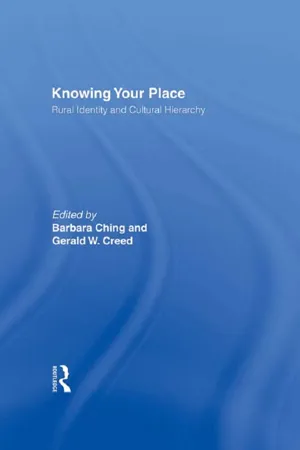
eBook - ePub
Knowing Your Place
Rural Identity and Cultural Hierarchy
- 285 pages
- English
- ePUB (mobile friendly)
- Available on iOS & Android
eBook - ePub
Knowing Your Place
Rural Identity and Cultural Hierarchy
About this book
Information
I ~ AISHA KHAN
Rurality and “Racial”
Landscapes in Trinidad
My family said don't marry an estate girl, marry a university girl. … Ask any family if they'd like their daughter to marry a fellow who works on a sugar estate or whose parents lived in a barracks. They'd be seen as having Madras blood in them, meaning a higher temper, quick to fight and pull arms [weapons], dark skin. For the dark part of the skin they say, ‘that is the Madras in you.’— Indo-Trinidadian friend, 1989
THIS chapter is an inquiry into social inequality and identity in Trinidad, West Indies, from a perspective still atypical in analyses of multicultural postcolonial New World societies. It argues that a significant dimension of definitions of self and other, us and them, in Trinidad is a rural/urban opposition that has not been sufficiently explored in cultural terms among Caribbean peoples. This rural/urban dyad is an essential component in a larger identity discourse which constitutes a metaphor for the tensions of empire in this postcolonial nation. In this discourse, mutually constitutive concepts of culture, race, class, and ethnicity are differentially valued, and thus comprise a cultural hierarchy that both shapes and interprets patterns of social stratification. The various stereotypes and other forms of representation that inform cultural hierarchies are constantly in dialogue, and at times in conflict with each other. In Trinidad, as elsewhere, cultural hierarchies are far from a gloss on political-economic constraints. While they interact with other dimensions of inequality to inform the way stratification is experienced by local communities and individuals (cf. Handler 1992), they do not do so in predictable or logically consistent ways. This chapter seeks to demonstrate the pivotal position of rural/urban oppositions in the cultural hierarchies of Trinidad, particularly their intimate relation to local ideas about “race” and its referents, “culture,” and “ethnicity,” among Indo-Trinidadians.
Occupation, too, plays a part in the discursive construction and lived experience of cultural hierarchy, and this category can also be viewed through the rural/urban opposition. Agricultural labor, whether slave or free, was a necessary factor in the establishment and maintenance of British Caribbean colonial societies; the consequent rise and importance of various forms of peasantries would become characteristic of the region. Since slave emancipation in Britain's colonies in 1838, Caribbean peoples have established many patterns of land occupancy and tenure alongside the dominant plantation system of agricultural production, a labor form which nevertheless persists in some areas today. One consequence of the intimate relationship between plantation labor and independent subsistence farming in the Caribbean is that for peoples of the region, land is both an economic and a symbolic resource (Besson 1992; Besson and Momsen 1987). Land may represent either the indignity of servitude or the dignity of autonomy and self-preservation.
Indians arrived in Trinidad in the mid-nineteenth century (1845–1917) as part of Britain's post-Emancipation indentured labor project (a policy in force throughout its sugar-producing colonies). For many decades after their arrival they remained geographically distinct from other populations because of their assignment to sugar estates (plantations). Although some Afro-Trinidadians and a few whites were also on the estates, Indians were predominant. Relegated by colonial authority to specific arenas of production, indentured Indians were literally placed in and figuratively associated with plantation agriculture. By contrast, Afro-Trinidadians became more thoroughly incorporated into town-centered occupations, and, from about the 1920s, were particularly well-represented in the petroleum refineries. Until the end of World War II, Indo-Trinidadians remained disproportionately involved in subsistence agricultural sectors; in the mid-twentieth century social and economic transformations and political independence began to reverse this concentration. The Indian immigrants initially found themselves with “black” grass-roots (poor and working-class) Trinidadians—who were socially and racially distinguished from the “colored” middle class, sharing the bottom of an ethnically segmented labor market and a cultural hierarchy fundamentally replicating British ideology. The early analogous structural positioning of “blacks” and “East Indians” and their gradual differentiation and dispersal did not, however, elide the tensions which grew between them, tensions that were a consequence of their competitive roles as workers.1 Nor did it erase the cultural association between Indians and agriculture which developed during plantation indenture. Agricultural production and manual labor became synonymous with “Indian Culture” and, in a reverse trajectory, with Indian heritage.
The labor histories of rural proletarian Indo-Trinidadians reveal an intimate association between the physical and psychological experience of estate (plantation) labor. Among them, a sensibility about agricultural work and the natural environment as powerful and life-shaping is tacitly implied or directly projected, though the ways these associations become configured as “rural,” and what “rural” signifies in social relations is not immediately obvious in this discourse. More evident are the various attributes of “rural” in identity discourse that seem to stand on their own, outside of geographic associations and, without necessary connection to actual experience in the countryside. However, the rural “countryside” constitutes a particularly resonant metaphor for Indo-Trinidadians as an ethnic group predominantly relegated through indentured labor to the rural proletarian sector of agricultural production. The countryside reveals what may be called a “racial landscape” in which the “racial” identities of ethnic groups are identified with particular types of place as a result of perceptions of cultural heritage and island social history. Through the lens of cultural hierarchy and the angle of rural/urban opposition, we can better see contradictions such as “racial” landscapes that persist in spite of demographic discrepancies. For example, in a study of contemporary agriculture in Trinidad, Harry (1993) found that almost two out of ten (18.5%) farmers in her sample were Afro-Caribbean, managing one-fourth of the cocoa and dairy farms she surveyed (1993: 208). Although there are Afro-Trinidadians involved in agricultural pursuits, and Afro-Trinidadians who have lived for generations in “rural” localities, they find their identity in imagery largely antithetical to farming—a cultural terrain preserved for Indo-Trinidadians.
Rural affiliation became an important element in Indo-Trinidadian identity for social and historical reasons linked to Indian, African, and British worldviews and to the colonial experience in Trinidad. As postcolonial conditions created a context in which racial and ethnic identities gained significance, the role of rural affiliation as a racial and ethnic marker was reinforced. Rurality was also perpetuated by its cultural connection with north/south regional divisions. However, it soon came into conflict with ideas of “modernity” and associated shifts in cultural hierarchies which disadvantaged rural affiliation and valued Western over Eastern categories. Class mobility seemed to require distance from a culturally devalued rural context, which, in turn, seemed to threaten Indo-Trinidadian ethnic authenticity. This contradiction has been overcome by the increasing cultural differentiation of negative “rusticity” from aspects of rural affiliation which are positively valued (see Creed and Ching, this volume). This distinction has been tapped by upwardly mobile Indo-Trinidadians to facilitate upward mobility within an “authentic” (read “rural”) context. In turn, then, racial and ethnic distinctiveness has been bolstered by the continued validity of “rural” and “rustic” as racial markers of Indo-Trinidadians. Yet each conveys significantly different messages about group history and identity.
Despite fewer Indo-Trinidadians in agricultural production, the image of “Ram, the barefoot Indian” (Hodge 1975: 35) remains. Local stereotypes of Indo-Trinidadians as “naturally” inclined to toil and soil, to putative land greed, and to an alleged shrewdness in orches-trating upward mobility are made credible on the basis of the organization of production historically and on the concomitantly unfolding concepts of race and culture. The identity processes in postcolonial Trinidad cannot be understood without attention to how rural/urban, class, and racial/ethnic categories interact, an interaction that must be examined in terms of cultural as well as structural hierarchies. I will demonstrate the importance of rural/urban oppositions in Trinidadian cultural hierarchies by first analyzing local ideologies of “race” and “culture” and their significance for representations of rurality. Then I will examine geographic places as symbolic constructs, with particular reference to the multi-layered meanings given to the four cardinal directions, north, south, east, and west. Finally, I discuss some ethnographic examples taken from Trinidad's “south” that reveal local perceptions of race, culture, and place, which in turn inform rural/urban dyads and the cultural hierarchies they help to sustain.
COLONIAL LOGIC AND POSTCOLONIAL LEGACIES
The originally unequal participation of Afro-Trinidadians and Indo-Trinidadians in the principal sectors of the national economy resulted in a division of labor in which the urbanization of Afro and the ruralization of Indo (Sebastien 1980: 126) prevailed in many parts of the island. Concentrations of particular populations in certain sectors of the island created what would remain, in popular wisdom, a mutually exclusive geography, where an Afro-Trinidadian, urban “north” is elevated in contrast to an Indo-Trinidadian, rural “south.” Therefore, even in the significant number of areas where population heterogeneity was, and is, the empirical reality, the metaphoric “racial” landscape still prevails.
As Helen Safa (1987) notes, the pivot of national identity in the Anglophone Caribbean is race. However, constructing interpretive categories of identity and distinguishing particular types of person according to these categories are complex exercises in Trinidad. Daniel Segal (1994) correctly points out that this complexity is not so much due to an “unusual degree of social heterogeneity” as it is due to an imagined pluralism, where the ancestral past is memorialized in a way that links and makes synonymous historical and contemporary diversity (1994: 223–25). As Trinidadians currently envisage their nation and the array of selves that constitute it, the cast consists of “living ancestors,” categories of person created in plantation political economy, the colonial moment that both enraced and socially positioned particular constituencies who retain these ancestral identities today—“Europeans” (“masters”), “Africans” (“slaves”), “East Indians” (“indentured laborers”) (1994: 223). History thereby remains a vital part of the present, rather than simply a background or a precondition.
Although these three most significant configurations—European, African, Indian—comprise a template for social identities among Trinidadians, the nature of colonial relations among the populace (notably sexual activity) was such that numerous permutations of identities based on ancestry emerged. Lacking the “one drop” rule of North American racial accounting, Caribbean societies, in general, do not operate on an exclusive binary opposition between “white” and “black.” Consequently, determining and debating ethnic and racial identities is an avid activity among Trinidadians. However, as I have argued elsewhere (Khan 1993), a dual discourse is evident within which showing too much preoccupation with race comes dangerously close to appearing “racial,” that is, to attributing validity to racial hierarchies, and thus evoking colonial hegemony. Hence, on the one hand, there exists the apparently self-evident structure of ranked social and cultural attributes; on the other hand there is the ideally preferable notion of democratic equality and autonomy.
Because it is a fraught construct, highly charged through the role it has played in both organizing and justifying plantation society, “race” is often glossed in terms of “color” or “culture.” Color, for example, as a descriptive register, can appear merely a statement of empirical evidence and therefore not a dilemma: assessment without judgement. While such terms as “brown” or “red” signify a mix of “races” (Euro and Afro), they remain a step away from harking back to that problematic colonial moment that racial accounting generally evokes. Even as it can represent “race,” therefore, color can also sidestepit; thus “color” may function as a euphemistic category of identity. The tensions of unequally evaluated cultural distinctions may, as well, be de-fused through a putative relativism that invokes neutrality: customs can differ without causing (or being caused by) social conflict, if they are located outside of “racial” phenomena; that is, when they are extra-historical with respect to New World contexts. The rural/urban opposition plays a similar role, affirming the “fact” of “race” and racial ranking by maintaining a discursive space that implicitly acknowledges these while employing an alternative idiom.
“Race,” as an interpretive category of identity in Trinidad, is understood to be constituted by essential heritable traits (biological foundations) that produce phenotypical markers (genealogical cues) that intimately articulate with and therefore mutually constitute culture (traditions and practices of forebears), and that can thus predict character and behavior which are perpetuated in the fundamental locus of the family—whether “African,” “European,” or “East Indian.” But there is another feature emblematic of “race” in Trinidad (and throughout the Caribbean), an additional way history remains part of the present, informing identity and the configuration of cultural hierarchies there. In the ideology of living ancestors, the present-day “collective characters from the colonial past” (Segal 1994: 223), history itself becomes an essential quality of personhood. That is, for those who have experienced them in the most disempowered ways (Africans and Indians), the social conditions of plantation political economy become part and parcel of “self.” In other words, these social conditions located in place become, in a sense, internalized as part of experience, not simply the site of experience.2 While historically a domain of industrial and other innovations connected with things urban, the plantation is associated with the countryside in the rural/urban dyad.
The postcolonial condition in Trinidad rests on a colonial legacy that is steeped in the plantation—an allegedly inescapable, essential quality derived from the experience of place. The notion of plural ancestries continues to shape Caribbean identity today, in contrast, for example, to identity in the United States, another locality with significant heterogen...
Table of contents
- Cover
- Half Title
- Full Title
- Copyright
- CONTENTS
- Preface
- Introduction
- 1 Rurality and “Racial” Landscapes in Trinidad
- 2 “Is It True What They Say About Dixie?”
- 3 “Ain't It Funny How Time Slips Away?”
- 4 “Campesinos” and “Técnicos”
- 5 Class, Gender, and the Rural in James Joyce's “The Dead”
- 6 The Roman du Terroir au Féminin in Quebec
- 7 Rurality, Rusticity, and Contested Identity Politics in Brittany
- 8 The Rise and Fall of “Peasantry” as a Culturally Constructed National Elite in Israel
- 9 The Alpine Landscape in Australian Mythologies of Ecology and Nation
- Contributors
- Index
Trusted by 375,005 students
Access to over 1.5 million titles for a fair monthly price.
Study more efficiently using our study tools.
Frequently asked questions
Yes, you can cancel anytime from the Subscription tab in your account settings on the Perlego website. Your subscription will stay active until the end of your current billing period. Learn how to cancel your subscription
No, books cannot be downloaded as external files, such as PDFs, for use outside of Perlego. However, you can download books within the Perlego app for offline reading on mobile or tablet. Learn how to download books offline
Perlego offers two plans: Essential and Complete
- Essential is ideal for learners and professionals who enjoy exploring a wide range of subjects. Access the Essential Library with 800,000+ trusted titles and best-sellers across business, personal growth, and the humanities. Includes unlimited reading time and Standard Read Aloud voice.
- Complete: Perfect for advanced learners and researchers needing full, unrestricted access. Unlock 1.5M+ books across hundreds of subjects, including academic and specialized titles. The Complete Plan also includes advanced features like Premium Read Aloud and Research Assistant.
We are an online textbook subscription service, where you can get access to an entire online library for less than the price of a single book per month. With over 1.5 million books across 990+ topics, we’ve got you covered! Learn about our mission
Look out for the read-aloud symbol on your next book to see if you can listen to it. The read-aloud tool reads text aloud for you, highlighting the text as it is being read. You can pause it, speed it up and slow it down. Learn more about Read Aloud
Yes! You can use the Perlego app on both iOS and Android devices to read anytime, anywhere — even offline. Perfect for commutes or when you’re on the go.
Please note we cannot support devices running on iOS 13 and Android 7 or earlier. Learn more about using the app
Please note we cannot support devices running on iOS 13 and Android 7 or earlier. Learn more about using the app
Yes, you can access Knowing Your Place by Barbara Ching, Gerald W. Creed, Barbara Ching,Gerald W. Creed in PDF and/or ePUB format, as well as other popular books in Social Sciences & Anthropology. We have over 1.5 million books available in our catalogue for you to explore.