eBook - ePub
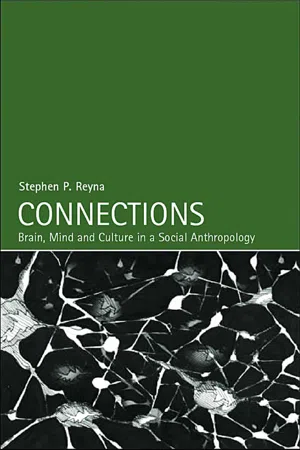
Connections
Brain, Mind and Culture in a Social Anthropology
- 240 pages
- English
- ePUB (mobile friendly)
- Available on iOS & Android
eBook - ePub
About this book
Have you ever wondered how the internal space of our brain connects with the external space of society? Drawing on hermeneutics and neuroscience Stephen Reyna develops an anthropological theory that explains the relationship between the biological and the cultural.
Recent popular interest in the brain is evident, and now social anthropologists are starting to consider connections between science and anthropology. Reyna is an anthropologist prepared to tackle big and difficult questions. This accessibly written book will cause quite a stir in anthropology, and will appeal to those interested in the mysteries of the brain.
Information
Chapter 1
Introduction
Only connect.
(E.M. Forster, Howard’s End, Chapter 22)
This book introduces cultural neurohermeneutics as a way of accounting for how people go about making connections, and it is the chore of this chapter to indicate how the case for such a hermeneutics will be made. The chapter oscillates back and forth between sentimental memories that are part of everyday life, and the terms of a project for investigating connections in such life. Let us begin with the sentimentality. I live in an old New England country house. The other day it was hot. I was throwing a stick for Sebastian to fetch. Sebastian was an old dog who acted as if it were his duty to humor people, up to a point; and owing to his age he believed that point was very quickly reached when they had him fetching their sticks. So Sebastian took his stick and went to cool himself under a honeysuckle between the house and the barn. It was midday and the dark green honeysuckle looked inviting. The dog had the right idea. I crawled in and sat beside him. He looked at me, puzzled, but when he realized that my presence did not signify the resumption of the stick game he put his head down and was soon asleep. I adjusted to the world under the bush. A dove cooed, as another had thirty years before.
It was 1969. Dazed from the intense hurly-burly of fieldwork, I walked out of the tiny Chadian village of Bembassa - some mud huts arranged in thirty or so households on the banks of the Shari River - on a path that went east; passed the fields where there had been sorghum at the last harvest; and on a mile or so to a vale that flooded during the rains and afterwards stayed green when everything else was bleached and arid. The day was hot, 100-degree Fahrenheit heat. A huge mas, a tamarind, was in the center of the meadow. As with the honeysuckle, I went and sat under it. When I looked up, there had been a rush of the sensation of the leaves’ deep greenery, more enveloping than that under the honeysuckle. Far above, dappled sunlight streamed through the topmost branches of the tree. I knew I was under a tamarind and that the Barma of Bembassa believed that their story, the history of the Kingdom of Bagirmi, had begun under a tamarind. Thinking about these Barma roots had triggered family memories.
One summer in the 1950s we traveled to my grandparents for a vacation in Iowa. Des Moines in August was hot like Chad, only more boring. My mother showed me photographs that were her mother’s. My grandmother had been born before the turn of the century, but the pictures were from an even earlier time, of relatives who had flourished after the US Civil War. The pictures were mostly of men, some women, a few of a whole family - staring out at you from the faded space of the photograph. My mother was a storyteller, so she connected, as best she could, the people in the pictures with their lives.
Among the women there had been a line of Priscillas. The first lived about the time of the Civil War, another a generation or so later, and finally my mother, who was born in 1918. The family had lived in West Virginia during the Civil War. There were six sons. Three fought for the Union. Three fought for the Confederacy. The six sons’ mother tended the sick and wounded during the war, riding out at night - not sidesaddle, ‘like a woman’, my mother was careful to note, ‘but astride, like a man’. At the very end of the war, amidst the chaos of disintegrating armies, she was riding home from her nursing when a man jumped out of the darkness, grabbing her horse’s bridle. She slashed at him with her riding crop - a ‘good cavalry saber cut’, my mother editorialized. He collapsed. It was a son badly wounded.
I remember coming across the faded picture of a dour woman just after my mother had told me this, and asking, ‘Was that her?’ To which the response came, ‘I don’t know.’ In the end, after looking at all the pictures, most of the time she did not ‘know’ anything about them and she commented - part joke, part irony - ‘They’re not really moving pictures.’ The pictures were a disappointment, stories untold. The boredom of Des Moines returned. That was almost forty-five years ago. Now there is a picture of my mother, an old Priscilla, staring out with a silent smile, seeming about to say something - she who has been dead for nearly two decades. The family album consists of disconnected photographs: a dour woman of the 1860s, a smiling one of the 1960s.
The preceding has depicted everyday lives summoned in sentimental memories. It is time to proceed to develop some terms for the investigation of such life. A region where there are families, clans, governments, or other sorts of institutions, is a space of human structures. Now there are antecedent regions of human structure, and there are subsequent ones, and antecedent regions become subsequent ones. The photographs framed spaces of family. There was the earlier picture of the dour woman and the later one of my mother. Somehow the two spaces, separated in geography and time, were connected. This book takes the injunction ‘Only connect’ terribly seriously, offering a view of a connector that strings structural antecedents to their consequents, making string being possible for human structures. Let us elaborate by specifying what is meant by this term, an elaboration that will return us both to the honeysuckle and the tamarind.
STRING BEING
I became an anthropologist because of a need shared with my mother: to tell true stories about people. Actually, I became something of a hybrid: a Boasian social anthropologist. In the winter of 1883 Franz Boas had been frozen into Baffin Island in the Canadian Arctic.1 This obliged him to live for a year with the Eskimos. He discovered, as he told his fiancée in a letter to her in 1884, that ‘I am now truly just like an Eskimo’ (in Müller-Wille 1998: 17), and he believed that this ‘filled up the lacunae of my knowledge’ about them (in Collins 1964: viii). The greater knowledge Boas acquired of a people, whom earlier anthropologists had called ‘savages’, and whom he now knew to not be ‘uncivilized’ (Müller-Wille 1998: 17), led to his questioning of these anthropologists.
Consequently, Doctoraluk - Big Doctor, as the Eskimos called him - at Columbia University at the turn of the twentieth century, devised an anthropology that, like the New York buildings being constructed around him, was colossal: the grandest human science explaining social, cultural, and biological phenomena, and their inter-relations, in all places and over all times. So vast an enterprise had to have four fields - cultural anthropology, archeology, linguistics, and biological anthropology - in order to realize these explanatory goals. The first three fields were to help anthropologists understand social and cultural phenomena. The fourth was to facilitate an understanding of human biology; and it was believed that by nesting all these fields together in a common discipline, understanding would be forthcoming of the intimacies between biological and sociocultural realities.
Most of my 1960s Columbia University professors - including Marvin Harris, then occupying Boas’s office - raged at Boas, but in the end it was an anger of sons. They might not like Daddy, but they were like him. They were formulating a cultural materialism, but it was a materialism adjusted to the confines of the four-field approach and to understanding relations between the biological and the cultural. There were endless examinations that demanded: ‘Defend the four-field approach’; and defend it I did, becoming in the process a Boasian.
Social anthropology, on the other hand, was a British enterprise. It had begun in earnest in 1922 with the publication of A.R. Radcliffe-Brown’s The Andaman Islanders and Bronislaw Malinowski’s Argonauts of the Western Pacific, and had focused more narrowly upon explaining the structure and function of particular ‘primitives’ at specific points in time.2 By the 1960s my Columbia professors all agreed with the apostate social anthropologist Edmund Leach that it was a time for Rethinking Anthropology (1961), which, in their revisionism, meant that social anthropology was the past, cultural ecology the now. But I intended to work in Africa, and African anthropology at the time was largely British social anthropology. This meant reading Radcliffe-Brown, Evans-Pritchard, Fortes. So, if not a bona fide product, in the sense of being trained by one of these masters, I certainly knew what they were about, and fully intended to base my Barma ethnography upon sound social anthropological principles, by making a contribution to descent group theory. Serendipitously, then, I became something of a Boasian social anthropologist. This work seeks to end the serendipity by offering a rationale for such anthropology. Study of the Barma had begun in 1968.
Now it was three decades later. I was a gada - what the Barma called a ‘whitebeard’ - sitting under an old bush with an ancient dog, reminiscing. Remembering that New York City police were abusing people of color. An officer with a broomstick had sodomized a Haitian in a Brooklyn police station. Another guy, who had committed the crime of trying to get into his apartment building, was shot forty-three times by an elite police squad. Remembrance of one butchery evoked another. I had been reading about European struggles for mastery of the world at the beginning of the nineteenth century. These had been decided at the Battle of Waterloo, where the Emperor Napoleon and the Duke of Wellington fought, slaughtering thousands upon thousands upon thousands in the process. One moment the Emperor was up, his cavalry charging; the next he was down, his cavalry mangled corpses. Great Britain was the hegemon.
These memories under the honeysuckle elicited recollections of being under the tamarind and of first fieldwork. I remembered upon arrival in Bembassa, politely but firmly demanding to be taken to their unilineal descent groups. The villagers, upon hearing this demand, looked at me with uncomprehending incredulity, the sort that postmodernists reserve for metanarratives. The next six months revealed that, while the Barma might once have had lineages, I had probably missed them by a century or so, which put a crimp in any desire to contribute to descent group theory.
So I had gone back to basics, trying to make sense of the everyday lives of people who lived in Bagirmi. Ahmet’s marital tribulations came to mind. Ahmet was a young man in the village married to a still younger Amina. Her body had a lithe elegance that stimulated miyawa (‘adolescent male’) imaginations up and down the Shari River. She was pusa noko ojo, a ‘real knockout’, and she was smart enough to know that this was the case. Ahmet, on the other hand, was too young to have amassed himself the considerable bride-wealth it took to marry her. In fact, he was an unambitious guy, who sat around all day with an overturned cardboard box in front of him, on top of which were a few kola nuts, some tea, and sugar for sale. Ahmet sold little. He was diffident. Some of the villagers thought of him as a ‘loser’. He had only been able to marry Amina because his family was wealthy by Bembassa standards and had paid his bridewealth. Amina may have realized that she was stuck with a loser. She left.
This was during the dry season when last year’s fields were being burnt and elephants were in the vicinity, noisily bending trees back and forth - like dentists extracting teeth - to get at their soft innards. Ahmet, on recognizing Amina’s departure, stood up behind his box, stripped naked and ran for it -east, in the direction of the tamarind, into a bush full of hazy smoke and elephants working their trees. Now it is not the height of rationality to run bare-assed through the drifting haze of elephant-studded burning fields. Ahmet had cracked. Village mates ran off after him, caught him, and returned him to his mud house.
Remembering Ahmet’s story brought back Musa’s. Part of my investigations of Bagirmi had been on the margins of the kingdom to try to understand how tributary groups were organized into the polity. In order to make this study, I had lived with the Abu Krider, an Arab ‘tribe’, who sometimes were and sometimes were not loyal tributaries. Musa, sadly now dead, worked with me on this phase of the research. Musa and I were something of a roadshow wandering from village to village doing fieldwork. We must have seemed an odd couple. He, with flowing robe and dark aviator glasses, was tall and slender. I, attired in short pants and a sweaty T-shirt, was rotund with a beard; to one observer ‘Père Noël bizarre’. Musa was debonair, and a bachelor, normally at dusk it was goodbye Steve, hello young ladies - and, perhaps, with nasip (luck) there would be some niknik (intercourse). Then, it all changed. It became a time of masass (sorcery). Goodbye niknik, hello celibacy and the solace of anti-sorcery medicines.
As I sat under the honeysuckle, these memories were like old photos. Frozen moments: people of color in New York going about their ordinary lives, then blasted; Napoleon going about his extraordinary life before Waterloo, then blasted; Ahmet with Amina, then nuts; Musa, before sorcery, then a frightened celibate - snapshots of realities once vivid, now fading, hinting at stories just as had my family pictures.
There was a problem. The problem was ontological. Ontology is the branch of philosophy that philosophers up to the eighteenth century used to call metaphysics, and that positivists since Comte in the nineteenth century condemn as balderdash. This later judgment seems excessive. Ontology ‘aims at discovering a framework for understanding the kinds of things that constitute the world’s structure’ (Fetzer and Almeder 1993: 101). Now some frameworks for understanding the world are better than others, and it is the search for these that gives ontological investigations merit.
The ontological problem arises because the world is just not constituted as isolated photographs. The snapshots succeeded each other, one after another. First photograph: there were some people of color in New York living their lives. Second photograph: they were sodomized or dead. First photograph, Napoleon was Emperor; then, photograph two, he was not. Once Ahmet and Amina, photograph one, were together; then, photograph two, they were not and Ahmet was catatonic. Once Musa, photograph one, sought nocturnal niknik; then, photograph two, he fought sorcery. The everyday hustle and bustle of people going about their business - social ontology, if you will - is strung out over time, like a movie. This stringing of antecedent to subsequent social being might be playfully imagined as ‘string being’. What in a preliminary fashion is such being? String being is a characteristic of human events. Henri Lefebvre developed a ‘science of space’ (1991 [1974]: 7) for the social sciences. Such a notion is important for understanding string being. However, in order to understand space, a further concept, that of abstraction, requires explication because, as I use the concept of space, it can involve abstraction. The dictionary defines ‘abstract’ as something ‘derived’ or ‘extracted’. An abstraction is some form of symbol, or groups of symbols, derived either from reality or from other symbols. A ‘symbol’ is something that stands for something else. The ‘something else’ that a symbol stands for is what it is derived from. Ideas and concepts are abstractions. The concept of a ‘dog’ is a symbol that is derived from - that is, stands for - the reality of Sebastian.
There are levels of abstraction distinguished in terms of how near a concept is to reality. The notion of ‘closeness’ to reality refers to how much thought has to be performed after one senses reality before one arrives at the abstraction. Concepts that ‘directly report’ reality are those that give a name to sensations of realities, with no further thought required. ‘Observation’ is the term for the sensing - that is, seeing, smelling, hearing - of reality. Less abstract concepts are reports of observation. You sense something. You say what it is. See a dog, say it is a ‘dog’, no further thought required.
Concepts that do not directly report reality, but which are derived from those that more or less do, are more abstract. So, for example, you can directly see somebody ‘running’, but you cannot see their ‘speed’. The term ‘informational sentences’, as used here, refers to directions that tell people how to derive more abstract concepts from observations, or vice versa.3 To calculate runners’ speed, you have first to see where they started, then see where they ended, to get the distance they ran. Next you have to see how long it took them to do the running, to get the amount of time it took them to run. Finally, to derive their speed from these observations, you have to divide the time the running occurred into the distance run. ‘Running’ you observe. ‘Speed’ is a greater abstraction you can get by performing various calculations about what you observe of the running.
‘Space’ is place. It is place in a double sense. ‘Abstract space’ is the places where different abstractions about reality occur. It might be thought of as being like a photograph. ‘Real space’ is the reality from which abstract space is derived. It is whatever has been captured in the photograph. ‘Social space’ is abstract or real places of human interactions. The mother after the Civil War striking her son, Napoleon battling Wellington, occur in real social space. There is a key informational sentence that instructs how to derive abstract from real social space: events in real social space must be demonstrated to exhibit structure, before they can be welcomed into some abstract social space. Events exhibit structure if it is demonstrated in some way that they a...
Table of contents
- Cover
- Half Title
- Title Page
- Copyright Page
- Contents
- List of illustrations
- Preface
- List of abbreviations
- 1 Introduction
- Part I Bungled connections
- Part II The connector
- Part III Coda
- Notes
- References
- Index
Trusted by 375,005 students
Access to over 1.5 million titles for a fair monthly price.
Study more efficiently using our study tools.
Frequently asked questions
Yes, you can cancel anytime from the Subscription tab in your account settings on the Perlego website. Your subscription will stay active until the end of your current billing period. Learn how to cancel your subscription
No, books cannot be downloaded as external files, such as PDFs, for use outside of Perlego. However, you can download books within the Perlego app for offline reading on mobile or tablet. Learn how to download books offline
Perlego offers two plans: Essential and Complete
- Essential is ideal for learners and professionals who enjoy exploring a wide range of subjects. Access the Essential Library with 800,000+ trusted titles and best-sellers across business, personal growth, and the humanities. Includes unlimited reading time and Standard Read Aloud voice.
- Complete: Perfect for advanced learners and researchers needing full, unrestricted access. Unlock 1.5M+ books across hundreds of subjects, including academic and specialized titles. The Complete Plan also includes advanced features like Premium Read Aloud and Research Assistant.
We are an online textbook subscription service, where you can get access to an entire online library for less than the price of a single book per month. With over 1.5 million books across 990+ topics, we’ve got you covered! Learn about our mission
Look out for the read-aloud symbol on your next book to see if you can listen to it. The read-aloud tool reads text aloud for you, highlighting the text as it is being read. You can pause it, speed it up and slow it down. Learn more about Read Aloud
Yes! You can use the Perlego app on both iOS and Android devices to read anytime, anywhere — even offline. Perfect for commutes or when you’re on the go.
Please note we cannot support devices running on iOS 13 and Android 7 or earlier. Learn more about using the app
Please note we cannot support devices running on iOS 13 and Android 7 or earlier. Learn more about using the app
Yes, you can access Connections by Stephen Reyna,Stephen P. Reyna in PDF and/or ePUB format, as well as other popular books in Social Sciences & Cognitive Neuroscience & Neuropsychology. We have over 1.5 million books available in our catalogue for you to explore.