eBook - ePub
Teaching Thinking Skills Across the Primary Curriculum
A Practical Approach for All Abilities
- 142 pages
- English
- ePUB (mobile friendly)
- Available on iOS & Android
eBook - ePub
Teaching Thinking Skills Across the Primary Curriculum
A Practical Approach for All Abilities
About this book
This book presents a practical and universal framework for the teaching of thinking skills and problem-solving across the primary curriculum, using examples of topics from the National Curriculum, classroom techniques, and tried-and-tested activities which systematically develop pupils' thinking and problem-solving skills. While accommodating the need of all learners to develop effective thinking skills, the book also caters to the need to differentiate learning activities to extend the more able learners. Written by a team of teachers who recognize the day-to-day problems that face their colleagues in the classroom, this accessible, jargon-free book will be welcomed by teachers, SENCOs and ABCOs alike.
Information
So What’s New About Teaching Children to Think? |  |
My thought is me: that’s why I can’t stop. I exist by what I think . . . and I can’t prevent myself from thinking. J.-P. Sartre, La Nausee (1938), ‘Lundi’ |

The purpose of this section is to explore some issues raised in the many debates over what is meant when we are urged to teach children to think. All of us would argue that ‘thinking’ is the natural and automatic response of human beings to their environment. So why do we need to be urged to develop ‘thinking’ in our classrooms? What’s new?

Reflect on the following comments and decide whether you agree or disagree with what is being said. Add your own ideas to the collection of thoughts and opinions.
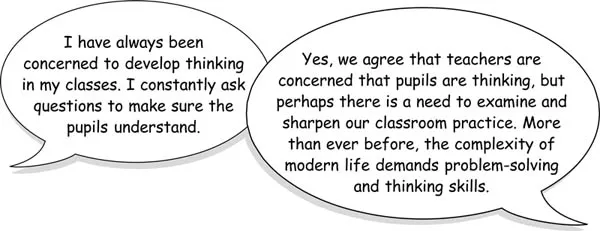
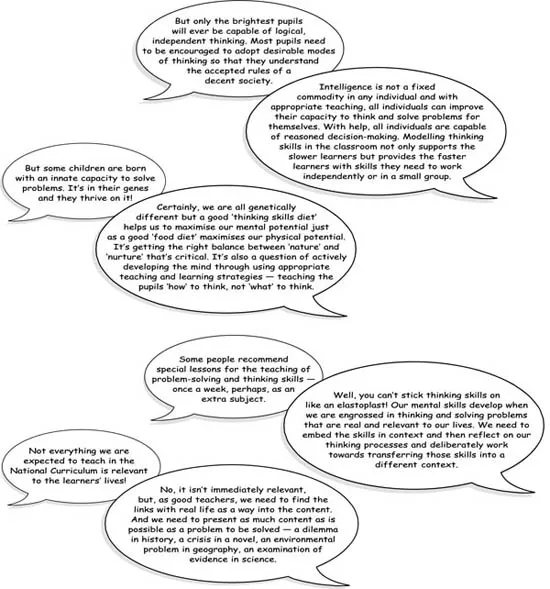
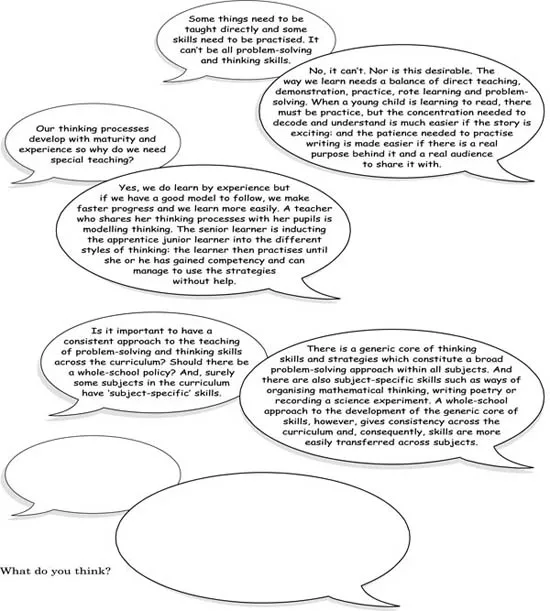

Reflect for a while about the importance of teaching children a range of problem-solving and thinking skills. Undoubtedly, we all try to incorporate strategies for teaching ‘thinking’ into our lessons already. Perhaps we can extend and consolidate what we are doing. Perhaps we need to strengthen the ways we teach ‘learning how to learn’ skills.
Remember that any developmental change in our classroom practice takes time to consolidate!
So often we say, ‘But I taught the pupils how to do that in a numeracy lesson only a month ago!’ And we constantly complain that the skills we taught in mathematics seldom transfer to science or geography or that the skills of using punctuation haven’t transferred to other areas of the curriculum.
Perhaps we can improve our ‘teaching for transfer of skills’ and so save a lot of time and effort.
Why do so many children ‘forget’ what we thought they knew? Why do we need to say the same things over and over again? Why do we need to give constant reminders?
Perhaps we need to help the children to crystallise what they know and can do. Perhaps we need to spend more time reflecting on what skills they are developing.

Recently, there has been a surge of government interest in the teaching of thinking and problem-solving skills and schools are being asked to target the development of these skills across the curriculum. It is apparent that many pupils are failing to reach the higher levels of the National Curriculum and this is particularly apparent with regard to very able pupils who should be attaining the highest levels. It is suggested that the reason for this is that pupils cannot cope with the higher order questions, which need problem-solving approaches (Office for Standards in Education (OFSTED) 1994). However, we would stress very strongly that ‘problem-solving and thinking skills’ are not only for very able children: when all children are taught how to use a range of thinking and problem-solving skills and strategies, then all children’s attainment levels rise.
So, as teachers and parents, we need to audit what we are currently doing with regard to the development of pupils’ capacities to use thinking and problem-solving skills. And the audit should involve both home and school practice, since the education of the young should be a working partnership between parents and teachers. It is important to emphasise again that extending and consolidating a thinking skills and problem-solving approach to the curriculum supports the less able in the development of their potential by giving them the framework for the mental ‘scaffolding’ they need. At the same time, the more able rapidly acquire the skills they need for independent and group activities. However, classroom work that systematically develops thinking does encourage and promote greater differentiation of pupil response but when the ethos of the class is that everyone matters and everyone has both strengths and weaknesses, then it is OK to be different and to show varying abilities.
Theoretical Background to the Model of Problem-Solving and Thinking Skills Used Throughout this Text
In the mid-1980s, Belle Wallace and Harvey B. Adams surveyed the main thinking skills packages that were already published and they visited key areas in the world where there were major thinking skills projects in operation. Then, adopting an eclectic approach that embraced the most successful elements of the range of thinking skills programmes they had evaluated, they conducted an action research project with groups of disadvantaged learners and their teachers over an intensive period of ten years. Strategies and methodologies were trialled, evaluated and reflected upon by the researchers, the participating teachers, a group of educational psychologists and, importantly, the pupils. The key to the success of the action research lay in the quality of the reflection, consequent rethinking and trialling of the thinking skills and problem-solving strategies being used. This process culminated in the publication of TASC: Thinking Actively in a Social Context (Wallace and Adams 1993), which sets out a generic framework for the development of a thinking and problem-solving curriculum.
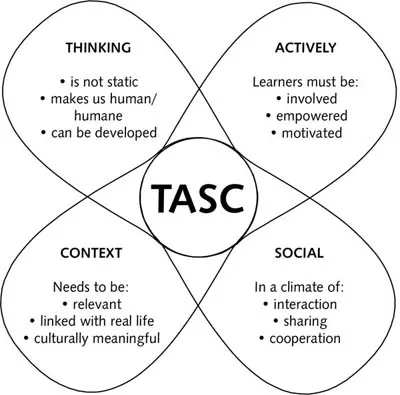
The major tenets of TASC
Would you like to add any more ideas to the basic tenets of TASC?
The remainder of this chapter examines the TASC framework: the theoretical base, the teaching methodology and the range of core skills and strategies that should be incorporated in any programme claiming to develop a problem-solv...
Table of contents
- Cover Page
- Half Title page
- Title Page
- Copyright Page
- Contents
- Notes on Contributors
- Acknowledgements
- For Teachers, Parents and Children
- Introduction
- 1 So What's New About Teaching Children to Think?
- 2 Introducing TASC Across a Whole Key Stage — a Case Study
- 3 Developing Problem-solving and Thinking Skills in Literacy
- 4 Developing Problem-Solving and Thinking Skills in Numeracy
- 5 Developing Problem-Solving and Thinking Skills in Science
- 6 Developing Problem-Solving and Thinking Skills Through an Art and Literacy Project
- References and Useful Resources
- Index
Trusted by 375,005 students
Access to over 1.5 million titles for a fair monthly price.
Study more efficiently using our study tools.
Frequently asked questions
Yes, you can cancel anytime from the Subscription tab in your account settings on the Perlego website. Your subscription will stay active until the end of your current billing period. Learn how to cancel your subscription
No, books cannot be downloaded as external files, such as PDFs, for use outside of Perlego. However, you can download books within the Perlego app for offline reading on mobile or tablet. Learn how to download books offline
Perlego offers two plans: Essential and Complete
- Essential is ideal for learners and professionals who enjoy exploring a wide range of subjects. Access the Essential Library with 800,000+ trusted titles and best-sellers across business, personal growth, and the humanities. Includes unlimited reading time and Standard Read Aloud voice.
- Complete: Perfect for advanced learners and researchers needing full, unrestricted access. Unlock 1.5M+ books across hundreds of subjects, including academic and specialized titles. The Complete Plan also includes advanced features like Premium Read Aloud and Research Assistant.
We are an online textbook subscription service, where you can get access to an entire online library for less than the price of a single book per month. With over 1.5 million books across 990+ topics, we’ve got you covered! Learn about our mission
Look out for the read-aloud symbol on your next book to see if you can listen to it. The read-aloud tool reads text aloud for you, highlighting the text as it is being read. You can pause it, speed it up and slow it down. Learn more about Read Aloud
Yes! You can use the Perlego app on both iOS and Android devices to read anytime, anywhere — even offline. Perfect for commutes or when you’re on the go.
Please note we cannot support devices running on iOS 13 and Android 7 or earlier. Learn more about using the app
Please note we cannot support devices running on iOS 13 and Android 7 or earlier. Learn more about using the app
Yes, you can access Teaching Thinking Skills Across the Primary Curriculum by Belle Wallace in PDF and/or ePUB format, as well as other popular books in Pedagogía & Educación general. We have over 1.5 million books available in our catalogue for you to explore.