We Are But Women sets the history of Irish women in the context of the broad sweep of Irish history, dealing even-handedly with the diverse traditions of unionism and nationalism. Through an examination of exemplar individuals and organisations, the book traces the growth of Irish awareness of such `women's issues' as emancipation, divorce and abortion. Above all, it acknowledges the key role played by women in finding a solution to the Irish Question.
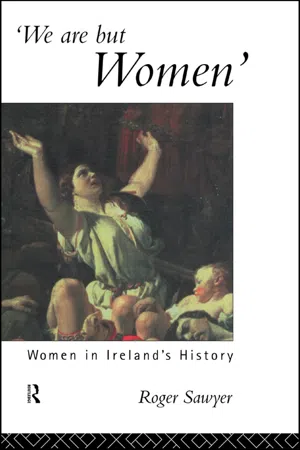
- 232 pages
- English
- ePUB (mobile friendly)
- Available on iOS & Android
eBook - ePub
1
FROM THE BEGINNING
It was a woman who founded, or found, Ireland, according to the earliest legend contained in the lost manuscript, The Book of Druim Snechta.1 Banba was there while Noah was building his ark, and the Flood did not reach the top of her chosen peak. But another tradition credits Cessair, supposedly a different woman, with peopling the place. She did so because she and her group of fifty women and three men were all turned away by Noah, who regarded them as a motley collection of thieves, not to be trusted on board his vessel. However, few Irish citizens seem aware of these primordial, mainly female settlers. Such has been the unconscious and conscious selection process leading to the curriculum of Irish patriotism that different heroines have been remembered. Ask an Irish boy or girl who has passed through the Republic’s educational system to name the first woman who has influenced the story of his or her nation, and Queen Maeve2(Medb) will invariably be mentioned. From palaeolithic times, when the island had been uninhabited, until about the eighth century AD, the principal source of information about prehistory and early history was, as is usual with ancient cultures, oral tradition. In the case of Ireland an especially rich heritage of stories, female-dominated to a large degree, was handed down by word of mouth almost to the present day. A large proportion of the rural inhabitants of modern Ireland, and many who only recently migrated to towns and cities, are only separated by a generation from a peasant oral tradition which goes back more than two thousand years. This means that, to the extent that they have not assimilated the values of late twentieth-century industrialized society, they have been influenced by a broad spectrum of powerful myths and legends in which females often had the upper hand and were invariably centrally or obliquely crucial to the development of the divers tribes which led to the formation of provinces and kingdoms and, eventually, to the present divided island. Illiteracy undoubtedly gave the story-tellers freedom to embellish; but the scribes of the seventh to the twelfth century (and some as late as the fourteenth century) who devoted their attention to recording traditional narratives had few inhibitions when it came to imposing their own interpretation of events. One of the pursuits of modern Gaelic scholars is to disentangle the tale from the teller.
Some methods of detection also have to be employed if one is to penetrate nineteenth- and twentieth-century distortions made by well-meaning Gaelic revivalists on the one hand and would-be educators on the other. In the twentieth century in particular, because of national—and nationalist—education, coupled with misplaced prudery, the race-memory has been subject to censorship, much of it unconsciously imposed. And yet the consequent ignorance was not suffered by the recent illiterate forebears of the mass of the agricultural community. The story-tellers in their midst carried in their minds the mixture of history and fable that for the first millenium of its existence had not been written down and for the next millenium was only available to most people by word of mouth.
Naturally historians have felt themselves to be under an obligation to separate fact from fiction. Cessair and her followers posed obvious problems, and so did Tuatha De Danann: ‘the Peoples of the Goddess Danann’; another group listed among the first five of the early influxes of colonizers was a distinctly masculine tribe, the Fir Bolg, whose name has long been taken to mean ‘the Men of the Leather Bag’, though it is more probable that Bolg was an ancient deity; then there were two other groups named after their leaders, Partholon and Nemed. Danann was herself called ‘mother of the gods’ and, in this time of female warriors, her peoples, led by a king, had to cope with rivals, the Fomoire, among whom women outnumbered men by three to one. The Fomorians had four ships’ crews, each of 50 men and 150 women. The matriarch of this formidable fleet was Lot, who had swollen lips in her breast, four eyes in her back and strength equal to that of her entire tribe. Not unexpectedly, in their quest to interpret events, historians have reacted differently to this sort of material: some have embraced it; others have seemed to be embarrassed by it. One easy way out has been to consign all these pre-Scottish colonizers, bar the Fir Bolg, who seem really to have existed and to have come from Britain, to the realms of fairy tales. The Fir Bolg might have disappeared too, but for the need to have a native population to serve in Maeve’s army.
For present purposes, however, the distinction between fact and fiction is of minor importance. What is of value is the perception of Irish womanhood that led to the creation or exaggeration of the legendary figures and, conversely, the perception that real people derived from larger than life heroines whose supposed deeds generated so much inspiration. One precedent that the legends set which influenced practice for many centuries was the paramount importance of the views of wives and mothers in decisions concerning royal succession. This was seen, for example, when Nuada, King of Tuatha De Danann lost an arm and was no longer regarded as fit to rule. The succession was by no means clear-cut and the choice, a controversial one, was taken against the wishes of the men. The women decided to form an alliance between their tribe and the Fomoire by electing to serve under the son of a Fomorian king.
Women, often in bewildering disguise, were sometimes seen as being in some special way in touch with the supernatural and, because of this, were regarded as either embodying sovereignty or being its source. The medieval manuscripts in which the oral traditions were first encapsulated comprise what are normally referred to as four cycles, labelled the Mythological, the Ulster, the Fenian, and the Historical. In the Mythological cycle one is not surprised to find that sovereignty derives from bizarre supernatural forces and, given that feminine attributes are all-pervasive in the Other World, women must be the dispensers of power here on earth. Male influence may be absent altogether according to Irish and Welsh tradition, as it is in the version given in ‘The Adventure of Conle’ of the Celtic realm of the supernatural: ‘There is no race there but women and maidens alone.’3 This cycle is characterized by man’s wish to obtain knowledge, and therefore power, through magical means; in the Ulster cycle, although magic is still present, the priority shifts to will power: the stories tell of an heroic age, of Maeve and her contest with Ulster’s hero, CuChulainn. In the Fenian tales the emphasis moves to the romantic, as is most easily seen in ‘The Pursuit of Diarmaid and Grainne’, an account of seduction by the female, and elopement, which has more than an echo of Arthurian legend about it. Finally, the Historical cycle, as its title suggests, is not predominantly magical, heroic or romantic; nevertheless it embodies these qualities to a degree as it describes dynastic succession and the fortunes of the royal houses of Ireland. Here women are very much the embodiment of sovereignty. Maeve of Connaught had made at least three kings by offering them ‘my own friendly thighs’;4 it is a different Maeve, the Queen of Leinster, who looms even larger in this respect in the Historical cycle. She ‘would not allow a king in Tara without his having herself as wife’.5 In all she was wife to nine kings in Ireland.
Despite Maeve of Leinster’s statistical superiority, it was Maeve of Connaught who stirred the imagination of those who followed in the wake of the late Victorian and Edwardian cultural revivalists. The uneducated classes had long enjoyed hearing about the exploits of the Irish Amazons; suddenly, buoyed up by the centenary celebrations of the 1798 rebellion and at a time when reform and extension of education had become an issue, men and women of distinctly superior education became aware of a heritage which included her in the front rank of a large caste of fabulous women. The lid of this treasure trove of literary assets—for such it was perceived to be—had been lifted in 1872, when Standish O’Grady, having nothing much to do one wet day, discovered his country’s ancient history on the bookshelves of a country house. However, his enthusiasm did not infect like-minded individuals until 1878, when the first volume of his two-volume History of Ireland appeared.6 As a result of O’Grady’s decision to brush the dust off tales which had always been there, but which few had had eyes to read, a considerable number of worthy writers took up the cause of the Irish literary revival, which had previously been left to a few pioneers (see Chapter 3, below). Unionists(among whom O’Grady was numbered) and nationalists who varied from ardent separatists to simple lovers of all things Irish—all laboured to bring the traditional Gaelic myths and legends into the literary mainstream. There was a vast input, and much of it was hardly worth the trouble, partly because at first the leading lights of what had become a movement were unable to understand the original Gaelic texts, and partly because detailed attention to urination, copulation and other taboo subjects offended against the contemporary moral code; it was not in keeping with the puritan conscience of Ireland—Catholic or Protestant. Nevertheless influential literary figures and their disciples made the best of things, according to their lights. As Lady Gregory was to put it to the people of Kiltartan, ‘I left out a good deal I thought you would not care about for one reason or another.’7
It was the Ulster cycle which best survived the manner of its rebirth, and which, nearly a century after Ireland rediscovered it, still makes a major impact on those who choose to study it or those who have it thrust upon them; not so much because it tells of a beleaguered Ulster taking on ‘Ireland’ in ways which, fundamentally, are not altogether different from the position today, but because of the extraordinary women who people the narratives. Apart from Maeve, and Deirdre (whose love-life has a self-contained legend of its own), there is a whole host of peculiar female characters with varying degrees of eccentricity or magic attaching to them: Scathach, Aife, Finnabar, Macha, Nes and many others, down to the meanest bondmaids. Unfortunately, though, twentieth-century readers and listeners, from national school children to university graduates, have been exposed to two completely alien versions of all these figures. Earlier generations of students are likely to have been acquainted with the works of Sir Samuel Ferguson, who ruthlessly suppressed all bawdy elements, or of Lady Gregory who, as was only to be expected, sanitized them altogether. Indeed, if the parent of one of today’s Gaelic scholars should investigate his offspring’s impressions he would wonder if the old Irish heroes and heroines of his day were the same legendary characters as the ones that are currently being studied.
Sir Samuel Ferguson’s Maeve (he spelled her name ‘Maev’) might well be described as Ireland’s Boadicea, but only in the sense that both women were embodiments of the concept of the warrior-queen; Boadicea (strictly ‘Boudicca’) reacted, Maeve chose to act. With her ‘King Consort’ Ailill, the Queen of Connachta initiated and carried through a number of epic exploits that have been perceived by many to be reminiscent both of the siege of Troy and of the quest for the Golden Fleece. Much of her time was spent attacking Ulster (Ulaid), a larger kingdom than the province of today. At a time when there were five kingdoms, Maeve was the prime mover against Conor Mac Nessa’s kingdom, and CuChulainn was her great adversary. She is best known for those of her adventures which are recorded in ‘Tain Bo Cuailnge’, variously rendered as ‘The Cattle-Spoil of Quelgny’, ‘The Driving Away of the Bull of Cooley’ or simply ‘Cattle Raid of Cooley’. The first man to writedown the key traditional stories was probably Senchan Torpéist, senior poet in Ireland in the seventh century, and what he and those who followed him recorded just does not square with the varnished representations which became popular some thirteen centuries later.
The early records are invaluable for the light which they throw on the activities and attitude of a pagan and barbaric people; they enable researchers to flesh out an otherwise obscure period. Generally, though, they do not relate epic narratives: much of their subject-matter reveals, not very surprisingly, preoccupation verging on obsession with the various ways in which men and women can fight and kill each other. In short, on the evidence of the authors’ accounts of Maeve’s and CuChulainn’s priorities, the early inhabitants of Ireland, like the early inhabitants of most places, were savages. To that comment, however, must be added the paradoxical rider that interspersed in their savagery were flashes of insight into the human condition as it then appeared, and which one hopes were not merely additions of later minds. Even an ardent admirer of ‘this epic material’, though, found some elements of it (the same elements which have led to the label ‘epic’ being withheld by scholars) puzzlingly amorphous: ‘why is all this medley amalgamated in this saga in the form in which we now have it?’8
At one level too much has been read into what Stephen Gwynn9 believed was the greatest of these early romances, a powerful mixture of history and myth. The parallel is drawn between the quest for Helen of Troy and the capture of the famous brown bull kept on Carlingford peninsula, efforts to purchase it having led to ill-treatment of Maeve’s messengers. It is argued that, just as it cannot have been Helen’s face alone that launched a thousand ships, there is much more to Maeve’s war than a wish to acquire a bull merely because her husband, Ailill, had one. Surely, at the very least, one should see the contest between the male and female champions in terms of a dual personification: of Ulster beset by the rest of Ireland. But too much can be made of the ingredients which lead to this impression, significant though they are—with hindsight. The romance lacks the Homeric qualities which the Fergusons would have liked to find in it, and so they did their best to add them and, while they were at it, they excised the crude elements. Sir Samuel, who, despite a recent claim to the contrary,10 ‘never mastered the language’,11 regretted what he termed ‘turgid extravagances and exaggerations, the additions apparently of later copyists’12 and lamely defended scenes that might not be so easily explained away by saying that ‘much of the material of the best classic literature is as crude and revolting as anything in Irish or Welsh story’.13
Today there is no need for such apologies. And, as long as he is aware that there are two Queen Maeves of Connaught (and why this is so) whoever seeks to identify primordial Irish womanhood need not be misled. The original was as brutal and aggressive as any legendary man, and offered her favours to anyone who might advance her ambitions. Having read both the earliest and the refined versions, the reader need have little difficulty in appreciating that, compared with the lot of women in many other cultures, Irish women started from a position of strength. For the stories not only reveal that as a personality Maeve was unique; they show that as an example of a woman’s ability to command respect and to influence Ireland’s history, she was one of many.
After succeeding in her various martial quests, including making off with the brown bull, Maeve lost the battle of Slewin, in West Meath, after which she escaped to her royal residence. Eventually she was killed by a sling-shot while bathing in the Shannon. Conor, the Ulster king, had been killed by the same method by Maeve’s nephew, Keth, having been lured within range by Connaught women who shared some of their monarch’s propensities.
Inevitably Maeve has become a symbol of female dominance; but according to other traditions of similar antiquity—looking to Ulster and Scotland, rather than to Connaught—women had also achieved the more effective dominance that is associated with their beauty and subtlety rather than their ruthlessness in conflict. There is more than one symbol of this form of dominance, but the one chronologically closest to Maeve in the surviving manuscripts is the beautiful virgin Deirdre (Derdriu), Conor’s protégée, who had fallen in love with a courtier, Naisi (Noisiu), and eloped with him to Scotland. The divergence between the earliest accounts and those of the Victorians is no less noticeable in the treatment of Deirdre than it is in the case of Maeve. A powerful bond of physical love is common to both periods, but there the similarity, apart from the names of the dramatis personae and the geographical locations, ends. In the old account Deirdre’s evil influence is forecast before her birth, and she seduces her man virtually by force, while the later version of her story has all the overtones and omissions that one comes to expect. As the climax approaches, the lovers are lured back to Ulster and betrayed, and, in the nineteenth-century rendering of the romance—which is clothed anachronistically in the imagery of amour courtois, or courtly love, Naisi is told by Deirdre that a life in hiding has no disadvantages as his presence is all that she needs. His reply conveys a message that directly contradicts all the assumptions that have long been associated with the Maeve tradition:
Not so with me. Love makes the woman’s life
Within-doors and without; but, out of doors,
Action and glory make the life of man.14
Within-doors and without; but, out of doors,
Action and glory make the life of man.14
Other distinctions are shown in the exchanges between Deirdre and Naisi at their first meeting. In the Gaelic version, having seen a raven drinking blood in the snow, Deirdre said, ‘I could desire a man who had the three colours there: hair like the raven, cheeks like blood and his body like snow.’ Told that such a one was at hand, she found him with the cattle and ‘made as though to pass him and not recognize him’:
That is a fine heifer going by’, he said.
‘As well it might’, she said. ‘The heifers grow big where there are no bulls.’
‘You have the bull of this province all to yourself’, he said; ‘the king of Ulster.’
‘Of the two’, she said, ‘I’d pick a game young bull like you.’15
‘As well it might’, she said. ‘The heifers grow big where there are no bulls.’
‘You have the bull of this province all to yourself’, he said; ‘the king of Ulster.’
‘Of the two’, she said, ‘I’d pick a game young bull like you.’15
The Deirdre story not only illustrates the diverse traditions of the twentieth century’s heritage, it highlights the superiority of the ancient approach in certain areas, particularly in its choice of imagery, and it shows why later writers have seen in the Gaelic narratives a patchwork containing raw material for an epic that was never written.
Even allowing for the accretions of later cultures, the main stepping stones of the legends, which are arguably exaggerations of real events, led to a dual concept of women which as well as entering into folklore had its longevity guaranteed by being embodied in noble houses. The Maeves, with their leadership and aggression, gave birth to one stereotype; the Deirdres and Grainnes, with initiatives in the field of passion, gave birth to another. Those of the lower orders are more colourfully represented in the old accounts. They may be called upon to taunt the enemy with their bare breasts, while the Victorian ‘peerless maid’ is less excitingly one of ‘the simple country people’.16 But such is oral tradition that only the remarkable are likely to acquire names, achieve immortality and become cultural stereotypes; and it has to be remembered that in their time Maeve and Deirdre were not remarkable merely because of their sex, any more than Conor or CuChulainn were celebrated because of theirs—they were famed and honoured for what they were and did. Indeed, Conor, as Conor Mac Nessa, owed his accession to the monarchy to the power and influence of his mother, Nessa.
The very use of the term ‘stereotype’ diminishes some of the most vivid characters of the pagan era. Maeve and Deirdre, one can be sure, had little that was commonplace about them; later ages have over-simplified these and other larger-than-life individuals, just as striking personalities in subsequent periods have been reduced to their more easily remembered features. Their unconscious contribution to later perceptions of the role of women in Ireland has been based on generalizations of traditions connected with their names. But though the traditions which stem from these very different contemporaries are distinct, they do not necessarily conflict. Each in her own way holds men in thrall. As is only too obvious, they have practically nothing in common with two of their New Testament contemporaries, Martha and Mary, exc...
Table of contents
- COVER PAGE
- TITLE PAGE
- COPYRIGHT PAGE
- FOREWORD: LADY FISHER
- PREFACE
- ACKNOWLEDGEMENTS
- 1: FROM THE BEGINNING
- 2: IN THE ASCENDANT
- 3: IRISH CULTURAL REVIVAL
- 4: WOMEN’S RIGHTS AND SEPARATISM: TOWARDS A FREE STATE
- 5: WOMEN AND THE SOCIAL CONSEQUENCES OF IRISH INDEPENDENCE
- 6: WOMEN AND THE SOCIAL CONSEQUENCES OF IRISH DEVOLUTION
- 7: ATTITUDES AND THEIR OUTCOME: SOUTH AND NORTH
- 8: EMANCIPATION AND UNITY
- NOTES
- BIBLIOGRAPHY
Trusted by 375,005 students
Access to over 1.5 million titles for a fair monthly price.
Study more efficiently using our study tools.
Frequently asked questions
Yes, you can cancel anytime from the Subscription tab in your account settings on the Perlego website. Your subscription will stay active until the end of your current billing period. Learn how to cancel your subscription
No, books cannot be downloaded as external files, such as PDFs, for use outside of Perlego. However, you can download books within the Perlego app for offline reading on mobile or tablet. Learn how to download books offline
Perlego offers two plans: Essential and Complete
- Essential is ideal for learners and professionals who enjoy exploring a wide range of subjects. Access the Essential Library with 800,000+ trusted titles and best-sellers across business, personal growth, and the humanities. Includes unlimited reading time and Standard Read Aloud voice.
- Complete: Perfect for advanced learners and researchers needing full, unrestricted access. Unlock 1.5M+ books across hundreds of subjects, including academic and specialized titles. The Complete Plan also includes advanced features like Premium Read Aloud and Research Assistant.
We are an online textbook subscription service, where you can get access to an entire online library for less than the price of a single book per month. With over 1.5 million books across 990+ topics, we’ve got you covered! Learn about our mission
Look out for the read-aloud symbol on your next book to see if you can listen to it. The read-aloud tool reads text aloud for you, highlighting the text as it is being read. You can pause it, speed it up and slow it down. Learn more about Read Aloud
Yes! You can use the Perlego app on both iOS and Android devices to read anytime, anywhere — even offline. Perfect for commutes or when you’re on the go.
Please note we cannot support devices running on iOS 13 and Android 7 or earlier. Learn more about using the app
Please note we cannot support devices running on iOS 13 and Android 7 or earlier. Learn more about using the app
Yes, you can access We Are But Women by Dr Roger Sawyer,Roger Sawyer in PDF and/or ePUB format, as well as other popular books in History & Irish History. We have over 1.5 million books available in our catalogue for you to explore.