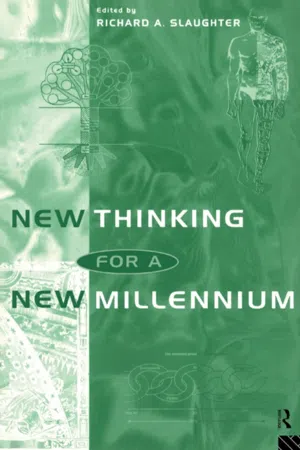
In this book, Richard Slaughter draws on the relatively new but rapidly developing field of futures studies to illustrate how our thinking must change in order to deal with the challenges presented by the new millennium. In doing so he brings together the latest work from some of the leading international names in futures thinking.
Part One considers the foundations of futures thinking in history, literature and ideas. Part Two explores some of the ways that futures studies have been and are being applied in different educational contexts around the world, from pre-school to postgraduate levels. Part Three takes the crucial step from institutional learning to social learning, and explores how futures provides us with insights which can help guide our society into the new millennium, together with suggestions for the development of the field itself.
This book is essential reading for teachers, students and anyone interested in the perils and promise of the twenty-first century.
eBook - ePub
New Thinking for a New Millennium
The Knowledge Base of Futures Studies
- 260 pages
- English
- ePUB (mobile friendly)
- Available on iOS & Android
eBook - ePub
About this book
Trusted by 375,005 students
Access to over 1.5 million titles for a fair monthly price.
Study more efficiently using our study tools.
Information
Topic
EducationSubtopic
Education GeneralPart I
Foundations of futures studies
Chapter 1
What do we mean by futures studies?*
Wendell Bell
Today, ‘Spaceship Earth’ has become a compelling and familiar metaphor, conjuring a picture of all the people on earth hurtling through space, dependent for life support on each other and the planet’s limited resources. But there is another equally compelling metaphor needed to make the story complete. It is the image of ‘Time Machine Earth’: the inexorable movement through time from out of the past into the future. Thus, not only are all people on earth space travelers, they are also time travelers. Their tickets through time, however, are good only for a one-way trip. They can travel only forward toward the future.
The future, of course, is still being made. It is what people can shape and design through their purposeful acts. To act intelligently, people need to know the consequences of their own actions, of others’ actions and reactions, and of forces beyond their control. These consequences can only occur in the future. Thus, people try to know not only what is happening, but also what might happen, what could happen, or, under particular conditions, what will happen in the future. Using such conjectural knowledge, people orientate themselves in the present and, pursuing their projects, navigate through time and physical and social space.
A new field of social inquiry has been created whose purpose is the systematic study of the future. It is sometimes called ‘futures studies’, ‘the futures field’, ‘futures research’, ‘futuristics’, ‘prospective’, or ‘prognostics’, and its practitioners are known as ‘futurists’. Futurists aim to discover or invent, propose, examine and evaluate possible, probable, and preferable futures. They explore alternative futures in order to assist people in choosing and creating the most desirable future. My purpose in this chapter is to describe some fundamental features of this new field.
HISTORICAL BACKGROUND
The universality of time perspectives
Conceptions of time and the future exist in every known society. They can be seen, for example, in the practice of divination, which is aimed generally at discovering the unknown, sometimes specifically at knowing the future. Such divination has been carried out by a variety of methods, from watching cheese coagulate to observing shoulderblades cracking in a fire to examining the entrails of small animals.
References to the future can be seen, also, in rites de passage in which ceremonial activities recognize transitions to future social roles, such as those involved at birth, coming of age, marriage, and death. They can be seen in religious rituals aimed to control the future, such as appeals for plentiful supplies of game, large yields of harvests, or the ample fertility of women of the tribe.
They can be seen, too, in the individual development of each person. The ability to anticipate the future begins soon after birth as children learn that their behavior brings reactions from other people. As children get older, they expand their time horizon, both into the past and into the future. As they learn language, they also learn the time perspectives that are dominant in their culture.
Finally, conceptions of the future can be seen in the history of the development of calendars and clocks. The Gregorian calendar which was constructed in 1582, for example, was a culmination of a long human concern with the movements of astronomical bodies which are themselves a universal measurement of time. It is still in use with an error of only about one-half a minute a year, while, today, advances in the measurement of time have moved to extraordinary precision with the development of the ‘atomic clock’ based on radiation of the cesium-133 atom and, beyond that, to an even more accurate sapphire-crystal technology that loses only one-100,000 millionths of a second per year.
This is not to say that there are no variations in conceptions of time comparing different societies. There obviously are. The meaning and importance of time and precision in everyday life, for example, may vary both from some societies to others and sometimes from one section of the same society to other sections. Nevertheless, conceptions of time and the future exist—and have existed—in human consciousness everywhere.
The shift from space to time in utopian thought
Although there were precursors, Thomas More’s Utopia published in 1516 was a watershed. By the end of the sixteenth century, the term ‘utopia’, coined by More and literally meaning ‘no place’, referred both to an entire genre of fiction and a conception of an ideal place. Until the end of the eighteenth century, utopias tended to be located geographically distant from, but contemporaneously with, existing societies. More’s Utopia itself, for example, was situated well beyond the farthest known place from Europe. Typically, a fictional traveler arrives, often by shipwreck, at some distant place inhabited by some strange and different people, lives there for a period of time, and then returns to Europe to tell his fellow Europeans about the people, society, and culture of the distant land (Manuel and Manuel 1979). In so doing, the traveler, in effect, critically evaluates the known existing society, the inadequate ‘what is’ being contrasted with the more perfect ‘what might be’ or ‘what could be’ of the fictitious utopian society.
At the end of the eighteenth century, a significant shift from space to time took place in utopian writing. The typical setting of the ideal society (or its opposite, the dreadful society or ‘dystopia’) radically changed from some other geographical place at the same time to often the same place but at a future time. Condorcet, the aristocrat and supporter of the French Revolution, for example, using the social science of his day, accurately described many aspects of the coming future society, and Sebastien Mercier placed his fictional utopia in the year 2440. Thousands of writers have since followed their examples and placed the ‘Other’, more preferable—or more undesirable—society, in the future (Manuel and Manuel 1979).
Along with this shift from space to time as the location of the ‘Other’ came additional changes in utopian thought. One was that the perfect world could actually occur within a real society in this life on earth and not after death in heaven. Another was that change toward a more perfect world could be designed and directly brought about by human action. For More, only God could create perfection and it was not an earthly possibility. For Condorcet, humans could create a better world by their own actions here and now on earth.
Recent origins of futures studies
The modern futures field was clearly visible by the 1960s. The publication of The Image of the Future by F.L.Polak in 1951 was a major sign-post and The Art of Conjecture by B.de Jouvenel which appeared in 1964 was another. Polak used the concept of ‘image of the future’ to analyze the rise and fall of civilizations and Jouvenel brought many of the principles of futures studies together under the same cover for the first time. Other signs of the new field included the creation of professional societies. In 1966, for example, the World Future Society was established by Edward Cornish and others and it has become one of the largest of the many futures organizations. In 1967, an international group that was to become the World Futures Studies Federation held its first meeting in Oslo, Norway. And in 1968, the late Aurelio Peccei and others founded the Club of Rome, which, although it has remained small, became one of the most influential futures groups during the 1970s. By 1977, when the World Future Society published The Study of the Future, Cornish was able to report on a considerable amount of futures research and to identify a growing community of futurists.
Many different paths of development led to contemporary futures studies. A few examples may illustrate their diversity. One path is found in the work of W.F.Ogburn and his associates on the analysis of social trends and on the role of technology in social change (President’s Research Committee on Social Trends 1933). Among other things, Ogburn was a co-founder and the first president of the Society for the Study of Technology, a forerunner of the modern-day profession of technology assessment.
Another path was through national planning. Beginning with the national mobilizations of World War I, the ad hoc character of planning was replaced by full-time bureaucracies organized to attend to the details of planning for the future. Futures thinking through national planning continued during the Great Depression of the 1930s; was promoted by Communist Russia, Fascist Italy, and Nazi Germany; expanded with the military and economic mobilizations of World War II; spread to Eastern Europe after World War II; and, finally, diffused to third-world countries.
Another path of development was in the hundred or so new states that have been formed since the mid-1940s, mostly from the former colonial territories of European countries in Africa, Asia, the Caribbean, and the Pacific. In each of the new states, new national citizenries were formed and new national leaders came to power. They faced the decisions of nationhood, those choices that had to be made in order to create a politically independent nation-state and that were to establish the future character of the new nation. At the most mundane level, flags had to be designed, national anthems written, and national trees, flowers, birds, and even national heroes chosen. More important, geographical boundaries often had to be drawn (e.g. between India and Pakistan), forms of government decided upon and constitutions written and voted upon. New national histories were prepared in which history was re-interpreted in order to construct a past worthy of the aspirations of the new nationstates. At the most subtle level, within each of the new states the psychological character, the economy, the society, and the culture of the newly independent people were often debated, as to what they ought to become and why. The debate itself was both a struggle to be free of the past of colonial domination and a search for distinctive nationalist images of the future on which the future itself could be constructed.
Another strand in the development of futures studies was operations research and the ‘think tanks’. Near the beginning of World War II, a team of scientists incorporated the then-new technology of radar into a system of air defense for Britain. Its tremendous success, along with other such military projects, led to the formation of other teams of scientists to deal with the problems of war management. In 1945, to keep such capabilities available to the US Army Air Corps, General H.H.Arnold arranged for a Research and Development unit to continue in operation. The RAND Corporation became one of the most influential of the many institutes, centers, and other organizations that engaged in ‘thought research’ and that became known as ‘think tanks’ (Dickson 1972).
Most of what RAND produced had to do with futures thinking in some way: policy alternatives, designs, suggestions, warnings, long-range plans, predictions, and new ideas. By 1970, RAND had added nonmilitary projects to its agenda, and they accounted for about a third of its activities. RAND workers developed scenario-writing, computer simulations, technological forecasting, the Delphi technique, program budgeting, cost-effectiveness, and systems analysis. It was a school for futurists, including T.J.Gordon, O.Helmer, and H.Kahn. It spawned a number of other organizations including the Institute for the Future, Kahn’s Hudson Institute (Dickson 1972), and Gordon’s The Futures Group.
RAND, unintentionally, even aided the development of the new futures field by the negative reactions to itself, because some futurists were motivated to counter its presumed pernicious influence by moving into peace research and deliberately banning military topics and funding from their work (Jungk and Galtung 1971). There is a cautionary tale here that should not go unnoticed. From the beginning, RAND was mobilized to focus on military and largely establishment views and purposes. Despite its innovative contributions to futures research and the controversies among its own experts, RAND was a creature of its clients. It was narrowly restricted in its world views.
The Commission on the Year 2000 of the American Academy of Arts and Sciences marked another turning point in the development of futures studies. Chaired by D.Bell, it met in 1965 and 1966 and its participants were mainstream, establishment intellectuals who represented the elite American universities, government, some major corporations, and some of the largest foundations. Although the Commission itself did not continue in existence, it gave an impetus to futures studies, resulting in 1967 in the publication of a special issue of Daedalus, ‘Toward the year 2000: work in progress’, Kahn and Wiener’s The Year 2000, and, eventually, additional futures work by some of its own members as well as by other people. Most important, it gave academic and scholarly respectability to futures studies.
Parallel developments in the policy sciences and in evaluation research also contributed to the futures field. H.D.Lasswell, D.Lerner and others proposed the formation of the policy sciences in 1951. The two purposes were (1) to study the policy and decision-making processes themselves and (2) to provide information to assist decision-makers in their tasks. Lasswell was among the first scholars to see that decision-making and policy-making necessarily rely on anticipations of the future and he formulated the idea of the ‘developmental construct’, which is somewhat similar to the concept of ‘image of the future’. He called his method of futures research ‘developmental analysis’.
Evaluation research is the attempt to assess the consequences of various organized social actions, such as social programs, after they have occurred. Have they, for example, achieved their goals effectively? The proximate origins of evaluation research go back to the 1930s, especially to the evaluation of programs designed to deal with economic depression. Today, it is a gigantic industry. The psychologist, D.T. Campbell, has likened the evaluation researcher to a person sitting on the stern of a ship looking backward and reporting to the captain where he has been.
But evaluation research has been merging with the policy sciences and becoming more future oriented. The reason is that the ‘evaluation of any particular project has its greatest implications for projects that will be put in place in the future’ (Cronbach et al. 1981:7). In the new view, program development is a series of interactive cycles: planning, implementation, evaluation with feedback to planners, more planning, changes in implementation, re-evaluation with more feedback that results in policy modifications, etc. Thus, the evaluation researcher is becoming, contrary to Campbell’s early view, more like a person sitting on the bow of a ship looking forward and reporting to the captain where he is going.
A NEW FIELD OF INQUIRY
The above brief review of some of the origins of the modern futures field is by no means complete. Many other precursors or sources of influence could be mentioned, such as the science fiction of Jules Verne and various writings of H.G.Wells; the counter-culture, anti-Vietnam War, and Black Power protests of the 1960s; and the environmental movement of the 1970s (Dator 1979). Soon after 1970, of course, when Alvin Toffler’s best-selling Future Shock was published, concern with the future became fashionable.
The futures field is still young and developing, and some writers fear that it is too fragmented even to be called a ‘field’ at all (Marien and Jennings 1987a). It is, admittedly, diverse in its subject matter and in the backgrounds of its practitioners. The latter range from aeronautical engineering and physics to journalism and management consulting to, increasingly, political science, sociology, and other social sciences. Calling futures studies a ‘multi-field’, perhaps, or a field with a ‘transdisciplinary matrix’ might be most appropriate (W.Bell 1987).
Yet, today, futurists have formed themselves into loose communities of full-time scholars and professionals and their activities have been institutionalized within hundreds of organizations, such as business firms, government agencies, centers, institutes, university teaching programs, and professional societies. The last are many and farflung geographically, from the Association Internationale Futuribles (of France) and the Institute Neuvas Alternatives, SA (of Mexico) to the Japan Society of Futurology and the Chinese Future Society.
Abstracts of nearly 10,000 futures-relevant books, reports, and articles appeared in the volumes of Future Survey Annual between 1979 and 1989—and this does not include futurist materials in languages other than English. Of the 324 active futures-relevant journals being published in 1986, 91 percent were begun since the end of World War II and 70 percent were started after 1970 (Marien with Jennings 1987b: 187). This is not to say that growth has been steady. Rather, there have been ups and downs, as illustrated by the membership of the World Future Society which had rapid growth from its inception in 1966, reaching a peak of more than 50,000 members in 1979, sliding to 22,500 in 1985, and coming up again to 26,000 in 1987. In 1980, over 5,500 people from 30-plus countries attended the First Global Conference on the Future in Toronto, Canada amid ...
Table of contents
- Cover Page
- Title Page
- Copyright Page
- Illustrations
- Contributors
- Introduction
- Part I: Foundations of futures studies
- Part II: Futures thinking and education
- Part III: Social learning for a new millennium
Frequently asked questions
Yes, you can cancel anytime from the Subscription tab in your account settings on the Perlego website. Your subscription will stay active until the end of your current billing period. Learn how to cancel your subscription
No, books cannot be downloaded as external files, such as PDFs, for use outside of Perlego. However, you can download books within the Perlego app for offline reading on mobile or tablet. Learn how to download books offline
Perlego offers two plans: Essential and Complete
- Essential is ideal for learners and professionals who enjoy exploring a wide range of subjects. Access the Essential Library with 800,000+ trusted titles and best-sellers across business, personal growth, and the humanities. Includes unlimited reading time and Standard Read Aloud voice.
- Complete: Perfect for advanced learners and researchers needing full, unrestricted access. Unlock 1.5M+ books across hundreds of subjects, including academic and specialized titles. The Complete Plan also includes advanced features like Premium Read Aloud and Research Assistant.
We are an online textbook subscription service, where you can get access to an entire online library for less than the price of a single book per month. With over 1.5 million books across 990+ topics, we’ve got you covered! Learn about our mission
Look out for the read-aloud symbol on your next book to see if you can listen to it. The read-aloud tool reads text aloud for you, highlighting the text as it is being read. You can pause it, speed it up and slow it down. Learn more about Read Aloud
Yes! You can use the Perlego app on both iOS and Android devices to read anytime, anywhere — even offline. Perfect for commutes or when you’re on the go.
Please note we cannot support devices running on iOS 13 and Android 7 or earlier. Learn more about using the app
Please note we cannot support devices running on iOS 13 and Android 7 or earlier. Learn more about using the app
Yes, you can access New Thinking for a New Millennium by Richard A. Slaughter in PDF and/or ePUB format, as well as other popular books in Education & Education General. We have over 1.5 million books available in our catalogue for you to explore.