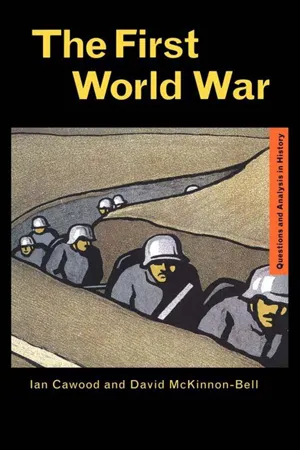
The First World War examines the outbreak, events themselves and aftermath of the Great War, and the political, social and economic effects on the European countries involved. Important themes explored include :
* recruitment and propaganda
* women's involvement in the war
* protest and pacifism
* the links between the war and the revolutions in Russia and Germany.
- 192 pages
- English
- ePUB (mobile friendly)
- Available on iOS & Android
eBook - ePub
The First World War
About this book
1
THE OUTBREAK OF WAR
BACKGROUND NARRATIVE
As every student knows, Archduke Franz Ferdinand, the heir to the Austro-Hungarian throne, and his wife, Sophie, were shot and killed by the Bosnian Serb terrorist Gavrilo Princip on 28 June 1914. Popular feeling in Austria and Germany took the form of riots and the destruction of Serb businesses, but the Austrian government saw it as an opportunity to crush Serbia, whose enlargement following the Balkan Wars of 1912 and 1913 blocked Austria’s attempted expansion into the east, and whose championing of Slav independence threatened to destabilise the multi-racial composition of the polyglot Austro-Hungarian Empire. Austria’s delay in asking redress of the Serbs was caused by her need to consult with Germany, her chief ally since 1879. The resulting German guarantee of full support for any action that Austria might take, on 5 July (the so-called ‘blank cheque’), has convinced many historians, most notably Fritz Fischer, that Germany was inciting Austria to act and thus precipitate a European war.1 Whatever the truth of this, Serbia’s refusal to agree to all of Austria’s excessive demands led to Austria declaring war on Serbia on 28 July and resulted in the fatal acceleration of the ‘July Crisis’. First, Russia came to Serbia’s assistance, mobilising her vast army, then Germany, conscious that she faced enemies on two fronts, declared war on Russia and invaded France, who would be able to put an army in the field first, in accordance with the Schlieffen Plan. In order to defeat France quickly, Germany invaded through Belgium, breaching Belgian neutrality, and thus gave Britain good reason to enter the war on France’s side. Although unenthusiastic, Asquith’s Liberal government recognised that, in defending Belgium, Britain was protecting her national interests, and, thereby, preventing Germany from dominating the continent.
A clichéd view of the reaction to the outbreak of war, encouraged by the governments of the powers, sees popular support throughout Europe. Images of cheering crowds, attacks on enemy foreigners and masses of eager conscripts and volunteers seem to bear witness to this. But it would be a mistake to assume that all Europe responded in this fashion. Those who saw the war as an interruption in a fight for equality, such as some members of the women’s suffrage movement and, most notably, many leading socialists, believed that the ruling classes had deliberately sought conflict to distract popular support away from them. Jean Jaurès, the leader of the French Socialists, said as much and was murdered by a ‘patriot’ on 31 July. The elderly, with their memories of the previous conflicts, such as the Franco-Prussian War of 1870–1, the Boer War of 1899–1902 and the Russo-Japanese War of 1904–5, were far less enthusiastic, and it seems that reaction in the towns, with the swiftness of news, rumour and excitement, was more positive on the whole than in the countryside, where people faced the prospect of 1914’s harvest being disrupted by the departure of young men and the ravages of marching troops. Even in the cities, the initial enthusiasm was hardly universal, and often did not survive the autumn.
In part the ‘mood of 1914’ stemmed from a naive belief in every state that the war would be brief and that one’s own military prowess would inevitably triumph within months. Everything would be ‘over by Christmas’. This is evident in popular misconceptions about the nature of the coming conflict as much as in the inadequate preparations made by the governments of Europe. The French military commander Foch once remarked that ‘every war is fought on the basis of the last one’. However, the war that began in Europe in 1914 was so wholly unlike the previous European conflicts in the 1860s and 1870s that every preparation made on the basis of these experiences proved inadequate within months.
ANALYSIS (1): WERE THE GREAT POWERS ECONOMICALLY AND MILITARILY PREPARED FOR WAR?
By 1914, Germany, having experienced a spectacular industrial revolution, was rapidly overhauling Britain as Europe’s foremost industrial power. Germany’s industrial achievements were impressive. GNP grew by 600 per cent during the Imperial era. In 1913, she mined 277 million tons of coal – second only to Britain. She milled more steel than Britain, France and Russia combined. Giant German cartels like Siemens and AEG dominated European electrical markets. German chemicals consortia produced most of the world’s dyes and industrial acids. Overall Germany exported nearly as much as Britain.2
Alongside this, her population had increased from 49 million in 1890 to 66 million in 1913, second only to Russia among the European powers. Furthermore, industrial development had been accompanied by the evolution of an excellent rail network and canal system, and a huge merchant navy – all of which in turn stimulated industry still further, and all of which were essential prerequisites of a wartime economy.
This economic strength translated easily into military power. The German High Seas Fleet possessed 13 dreadnought battleships, compelling the British to bring their capital ships back to the North Sea. Although smaller than the Royal Navy, Germany’s fleet was more modern, and boasted superior shells and night training. Her army was smaller than Russia’s and only matched France’s in size, but Germany could mobilise 8 million reservists and, due to superior training, deploy them at the front lines, unlike her rivals. Furthermore, Germany benefited from superior staff training, advanced technology (especially heavy artillery) and an excellent railway network, ensuring rapid mobilisation. Defence spending had increased from $204 million in 1910 to $442 million in 1914, with a compliant Reichstag’s approval in 1913 of a new military budget. Germany was consequently spending more on her military than either France or Russia.
However, this military muscle bred over-confidence. The German government made very few preparations for a long war before the outbreak of hostilities. Observers, from the elder Von Moltke (commander of the Prussian army in 1870–1) to Walther Rathenau, President of AEG, had warned that future wars would be long ones, won by the economically best-equipped side. However, the Kaiser’s government and generals had not grasped this, and only after 1912 did the younger Von Moltke begin to address Germany’s possible wartime economic needs.
These were many, and serious problems existed. Germany possessed fine agricultural land and German farmers produced more crops per hectare than any other country, even the USA. However, because of the demands of the growing urban population, one-third of food consumed in Germany was imported, notably grain from the USA and Russia. This would prove a vital weakness in wartime, when Germany became vulnerable to blockade by Britain. The government dismissed this possibility, as they believed that Britain would not fight, and they relied upon Von Tirpitz’s much-vaunted navy to prevent a blockade. Such lofty assumptions would prove fatal. Germany also imported a wide range of crucial industrial raw materials such as oil, rubber and nitrates, without which her industries would struggle in wartime. Little thought had been given before 1914 to how to obtain these products.
Germany went to war possessing only one military plan, the Schlieffen Plan. This envisaged a rapid campaign against France in the west, whilst Britain stood aside and Russia mobilised slowly. With France eliminated (in six weeks!), the German army would turn on Russia, defeating them in six months. Following this assumption, the German government had made few preparations for the kind of war they actually faced. Only with the failure of the Schlieffen Plan did Germany contemplate economic mobilisation to meet the demands of the war.
Russia had been industrialising rapidly before 1914, but it remained at a relatively early stage in its development, and war on the vast scale of 1914–18 was beyond Russia’s capacity to cope. Russia had a huge population (170 million) and vast natural resources; however, she found these assets very difficult to exploit. Her population was young – 49 per cent were too young to be conscripted – and it was widely dispersed across the largest state on earth. Finally, it was deemed impossible to mobilise the millions belonging to Russia’s alienated ethnic minorities, because their loyalty could not be relied upon after decades of ‘russification’. An attempt in 1916 to conscript Moslems from Turkmenistan resulted in revolt.
Unlike Germany, Russia could at least feed herself. However, despite good harvests, a German blockade meant that Russia lost export markets (Germany had been Russia’s biggest customer for grain, which accounted for 85 per cent of all exports), denying the state valuable income at a time when it needed to increase revenues. The financial crisis was worsened by the decision to ban the sale of vodka. Intended to make the workforce more productive, instead workers and peasants bypassed the edict by distilling their own illegal spirit. All that was achieved was to reduce the state’s income by 650 million roubles per annum as it possessed a monopoly on the production and sale of vodka.
Transport was Russia’s greatest headache. The Black Sea and Baltic ports were blockaded, and the only alternative routes for external trade were Vladivostock on the Pacific coast (5,000 miles away from the front line), Archangel in the North, which was ice-bound six months of the year, and Murmansk, ice-free, but which had no rail link with Moscow and Petrograd in 1914. Indeed Russia’s railway network was poorly maintained, and was spread very thinly in a massive country. Germany had ten times more railways per kilometre than Russia.
Like her rivals, Russia had not anticipated the demands of a long European conflict. Between January and July 1914 Russia’s biggest rifle factory, the Tula works, made only 16 rifles, due to strike action. When war broke out, the state mobilised 1.4 million men, supplying them with weapons and ammunition from existing stockpiles, but after September the situation rapidly deteriorated. State arsenals in 1914 possessed only 40 heavy guns, with 1,000 shells per gun; once these were fired, they were rationed to two per day. Only 290 million bullets were produced per year, but 200 million would be fired each month! Consequently, Russian soldiers ran short of bullets and shells by the New Year. By 1915, Russia was only producing 25 per cent of what she needed, and there were 6.5 million men under arms but only 4.6 million rifles.3
Yet, after the dramatic defeat by Japan in 1905, the army and navy had been substantially modernised. Defence received 33 per cent of government revenue. Russia’s army numbered 1.4 million men, significantly larger than Germany’s. Even Von Moltke seemed impressed, ‘Russian preparedness for war has made great strides since the Russo-Japanese War.’4 A General Staff had been created. However, the army was still dominated by the aristocracy who resented the new ‘bourgeois’ professional soldiers, and, consequently, there was a lack of cooperation between cavalry, infantry, artill...
Table of contents
- Cover
- Half Title
- Title Page
- Copyright Page
- Table of Contents
- Series preface
- Acknowledgements
- Introduction
- 1 The outbreak of war
- 2 Recruitment and propaganda
- 3 Total war - economic mobilisation and the war economy
- 4 The women's war
- 5 The changing role of government
- 6 Protest and pacifism
- 7 The fall of the Russian and German governments
- 8 Victory and defeat
- Notes
- Bibliography
- Index
Trusted by 375,005 students
Access to over 1.5 million titles for a fair monthly price.
Study more efficiently using our study tools.
Frequently asked questions
Yes, you can cancel anytime from the Subscription tab in your account settings on the Perlego website. Your subscription will stay active until the end of your current billing period. Learn how to cancel your subscription
No, books cannot be downloaded as external files, such as PDFs, for use outside of Perlego. However, you can download books within the Perlego app for offline reading on mobile or tablet. Learn how to download books offline
Perlego offers two plans: Essential and Complete
- Essential is ideal for learners and professionals who enjoy exploring a wide range of subjects. Access the Essential Library with 800,000+ trusted titles and best-sellers across business, personal growth, and the humanities. Includes unlimited reading time and Standard Read Aloud voice.
- Complete: Perfect for advanced learners and researchers needing full, unrestricted access. Unlock 1.5M+ books across hundreds of subjects, including academic and specialized titles. The Complete Plan also includes advanced features like Premium Read Aloud and Research Assistant.
We are an online textbook subscription service, where you can get access to an entire online library for less than the price of a single book per month. With over 1.5 million books across 990+ topics, we’ve got you covered! Learn about our mission
Look out for the read-aloud symbol on your next book to see if you can listen to it. The read-aloud tool reads text aloud for you, highlighting the text as it is being read. You can pause it, speed it up and slow it down. Learn more about Read Aloud
Yes! You can use the Perlego app on both iOS and Android devices to read anytime, anywhere — even offline. Perfect for commutes or when you’re on the go.
Please note we cannot support devices running on iOS 13 and Android 7 or earlier. Learn more about using the app
Please note we cannot support devices running on iOS 13 and Android 7 or earlier. Learn more about using the app
Yes, you can access The First World War by Ian J. Cawood,David McKinnon-Bell in PDF and/or ePUB format, as well as other popular books in History & Social History. We have over 1.5 million books available in our catalogue for you to explore.