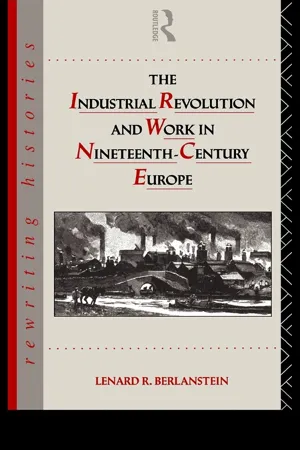
The Industrial Revolution is a central concept in conventional understandings of the modern world, and as such is a core topic on many history courses. It is therefore difficult for students to see it as anything other than an objective description of a crucial turning-point, yet a generation of social and labour history has revealed the inadequacies of the Industrial Revolution as a way of conceptualizing economic change. This book provides students with access to recent upheavals in scholarly debate by bringing a selection of previously published articles, by leading scholars and teachers, together in one volume, accompanied by explanatory notes. The editor's introduction also provides a synthesis and overview of the topic. As the revision of historical thought is a continual process, this volume seeks to bring the reinterpretation of such debates as working-class formation up to the present by introducing post-structuralist and feminist perspectives.
- 196 pages
- English
- ePUB (mobile friendly)
- Available on iOS & Android
eBook - ePub
The Industrial Revolution and Work in Nineteenth Century Europe
Part IRETHINKING THE INDUSTRIAL REVOLUTION
The notion of the Industrial Revolution has been used for a century and is well established in textbooks. Why bother to displace it? In fact, as David Cannadine shows, studies of the Industrial Revolution have continually reinvented its essence. Moreover, Raphael Samuel raises the possibility that it is simply not accurate as a description of socio-economic change. Charles Tilly undertakes the daunting task of providing an alternate way of thinking about the vast forces which have forged a new social order over the past two and a half centuries. The reader will have to judge whether breaking with a classic notion of the Industrial Revolution creates intellectual chaos or provides a deeper understanding of the past.
1THE PRESENT AND THE PAST IN THE ENGLISH INDUSTRIAL REVOLUTION, 1880–1980
DOI: 10.4324/9780203415917-2
Studying the evolution of historical thought on a subject often dispels the scientific pretensions of the discipline. It quickly becomes apparent that historians’ ideas are very much bound by time and place. Letting the facts speak for themselves is not in the order of things. David Cannadine offers a stunning demonstration of this point regarding the Industrial Revolution. He shows that scholars, over time, have stressed very different aspects of it and that the differing interpretations are closely tied to the dominant economic conditions of the era.Students should note two limitations which the author places on the analysis. He is concerned exclusively with the writings of economic historians and with the English Industrial Revolution, long taken as the classic case. It would be interesting to learn if the conclusions would be different had Cannadine considered the Continent and other sorts of scholars. There is room to doubt that it would.In addition to making the reader sensitive to the relativity of historical analysis, Cannadine's essay also makes us aware of recurrent themes. It might not be outlandish to conclude that interpretations of the Industrial Revolution are locked in a cycle: concern for the poor giving way to concern for economic growth at all costs. Readers can make this essay relevant to all those that follow by asking how much is brand new and how much is a reversion to a former interpretative trend. If an argument does recur, is it for the same reason that produced the original? Cannadine would always insist that there is a lot of the present in what we say about the past.
* * *
This article suggests four phases into which economic history writing may be divided during the hundred years since Toynbee's Lectures on the Industrial Revolution effectively began modern discussion of the subject.1 The first section explores the years to the 1920s, when contemporary preoccupations with social surveys and poverty influenced the prevailing interpretation of the Industrial Revolution, which emphasized its disagreeable human consequences. By contrast, the second generation of economic historians, writing from the mid-1920s to the early 1950s, reflected current concerns with war and economic fluctuations by stressing the cyclical nature of the industrialization process. Their successors, who wrote from the mid-1950s to the early 1970s, were influenced by the rise of development economics and by the post-war efflorescence of western capitalism and so rewrote the Industrial Revolution once more, this time as the first instance of ‘economic growth’. Finally, since 1974, as economic growth has become simultaneously less attractive and less attainable, the Industrial Revolution has been given another new identity, this time as something less spectacular and more evolutionary than was previously supposed. Such is the outline of economic history writing on the Industrial Revolution to be advanced here And, in the light of it, a more speculative attempt will then be made to explore the mechanism by which this process of generational change and interpretational evolution actually operates.
I
The years from the 1880s to the early 1920s were the first period in which self-conscious economic historians investigated the Industrial Revolution, and they did so against a complex background of hopes and fears about the society and economy of the time, which greatly influenced the perspective they took on it. Neo-classical economists like Marshalla were moderately buoyant about the economy during this period: but for politicians, businessmen and landowners, the prospects seemed less bright.2 Prices were falling, profits were correspondingly reduced and foreign competition was growing: faith in unlimited economic progress was greatly diminished.3 Royal commissions investigated depressions in industry, trade and agriculture; the Boer Warb revealed a nation whose military were incompetent and whose manhood was unfit; and tariff reform was partly based on a recognition that there were, in the economy, unmistakable signs of decay.4 At the same time, the working class was increasingly enfranchised, there was a growing belief that government must be more actively interventionist on their behalf, trade-unionist membership went up remarkably and there were explosions of industrial unrest in the 1880s and early 1910s.
More particularly, from the 1880s, there was a major revival of interest in the ‘condition of England’ question, particularly with regard to health, housing and poverty. The reasons for this ‘remarkable flowering in the social concern of the English middle classes’ in that decade, and the extent to which it did (or did not) represent a new departure in social and sociological thought, remain sources of academic controversy.5 But what is not in dispute is the massive outpouring of best-selling literature on the subject in the thirty years before the First World War, including the Royal Commission on the Housing of the Working Class, the surveys by Booth and Rowntree,c the investigative journalism sparked off by Mearns's Bitter Cry, the evocations of slum life in novels such as Morrison's Child of the Jagow and the writings of members of the Liberal intelligentsia such as C.F.G.Masterman.6 Together, this great outpouring constituted a guilt-ridden, fearful recognition that poverty and squalor were not the product of individual shortcomings, but were endemic in a system which created so much want in the midst of so much plenty. It was, as Henry George put it memorably, ‘this association of poverty with progress’ which was ‘the great enigma of our times’.7 ‘What’ enquired Asquith, reformulating the same proposition more broadly:
is the use of talking about Empire if here, at its very centre, there is always to be found a mass of people, stunted in education, a prey of intemperance, huddled and congested beyond the possibility of realizing in any true sense either social or domestic life?8
Such contemporary revelations exerted a powerful influence, diverting scholarly attention towards what G.N.Clark felicitously described as ‘social concern with economic conditions’.9 For the majority of people, it seemed, the Industrial Revolution had not worked, and it was the desire to discover what had gone wrong which prompted many of the pioneering studies of the economy of late eighteenth- and early nineteenthcentury England. Indeed, it was Toynbee himself who stated most explicitly this close link between the present and the past in the history of the Industrial Revolution. ‘It would be well’, he argued:
if in studying the past we could always bear in mind the problems of the present…. You must have some principle of selection, and you could not have a better one than to pay special attention to the history of the social problems which are agitating the world now, for you may be sure that they are problems not of temporary but of lasting importance.10
Toynbee, as Milner later explained, ‘was on fire with the idea of a great improvement’ in the material condition of the working classes, and precisely exemplified that upper-middle-class sense of guilt which Beatrice Webb was later to describe.11 Indeed, in My Apprenticeship she quoted with approval Toynbee's most anguished and contrite words:
We—the middle classes, I mean, not merely the very rich— we have neglected you; instead of justice we have offered you charity; and instead of sympathy we have offered you hard and unreal advice; but I think we are changing…. We wronged you; we have sinned against you grievously; but if you will forgive us... we will serve you, we will devote our lives to your service.12
This desire to locate the historical origins of unacceptable contemporary social conditions in the Industrial Revolution was equally strong in the Hammonds and Webbs. As P.F.Clarke explains, the Hammonds did make ‘an effort at objectivity which gave their work its scholarly value’; but at the same time they were also ‘deeply committed political figures’. The Village Labourer, for instance, was described by the Longmans reader as ‘sound historically, though written from a radical point of view’, and by Gilbert Murray as showing ‘how blind the whole upper and middle class can be to the condition of the poor’—a phrase which had particularly strong resonances given the prevailing concerns of the time. Indeed, as an anti landlord polemic, the book provided an historical preface to Lloyd George's land campaign,d with its argument that, between 1760 and 1830, the outcome might have been different in the countryside if only the upper classes had been more responsible. Likewise, its sequel, The Town Labourer, was anticapital and anti-laissez-faire, ‘destroying’, as Tawney explained, ‘the historical assumptions on which our modern slavery is based’.13 Above all, the Hammonds’ books provided, in their portraits of rapacious landlords and conscienceless capitalists, historical support for the view that free enterprise must be controlled, that the state must be more interventionist and that trade unions should be protected and strengthened.
The Webbs’ writings on the Industrial Revolution contained a similar prescriptive thrust. Beatrice was profoundly influenced by her early work for Booth, was racked with guilt about the sufferings of the lower classes and saw explicit links between the bad conditions of the present and the horrors of the Industrial Revolution:
A study of British blue books, illuminated by my own investigations into the chronic poverty of our great cities, opened my eyes to the workers’ side of the picture. To the working class of Great Britain in the latter...
Table of contents
- Cover Page
- Half Title Page
- Series Page
- Title Page
- Copyright Page
- Table of Contents
- Editor’s preface
- General introduction
- Part I Rethinking the Industrial Revolution
- Part II Work experiences and protest
- Part III The making of a working class
- Suggestions for further reading
Trusted by 375,005 students
Access to over 1.5 million titles for a fair monthly price.
Study more efficiently using our study tools.
Frequently asked questions
Yes, you can cancel anytime from the Subscription tab in your account settings on the Perlego website. Your subscription will stay active until the end of your current billing period. Learn how to cancel your subscription
No, books cannot be downloaded as external files, such as PDFs, for use outside of Perlego. However, you can download books within the Perlego app for offline reading on mobile or tablet. Learn how to download books offline
Perlego offers two plans: Essential and Complete
- Essential is ideal for learners and professionals who enjoy exploring a wide range of subjects. Access the Essential Library with 800,000+ trusted titles and best-sellers across business, personal growth, and the humanities. Includes unlimited reading time and Standard Read Aloud voice.
- Complete: Perfect for advanced learners and researchers needing full, unrestricted access. Unlock 1.5M+ books across hundreds of subjects, including academic and specialized titles. The Complete Plan also includes advanced features like Premium Read Aloud and Research Assistant.
We are an online textbook subscription service, where you can get access to an entire online library for less than the price of a single book per month. With over 1.5 million books across 990+ topics, we’ve got you covered! Learn about our mission
Look out for the read-aloud symbol on your next book to see if you can listen to it. The read-aloud tool reads text aloud for you, highlighting the text as it is being read. You can pause it, speed it up and slow it down. Learn more about Read Aloud
Yes! You can use the Perlego app on both iOS and Android devices to read anytime, anywhere — even offline. Perfect for commutes or when you’re on the go.
Please note we cannot support devices running on iOS 13 and Android 7 or earlier. Learn more about using the app
Please note we cannot support devices running on iOS 13 and Android 7 or earlier. Learn more about using the app
Yes, you can access The Industrial Revolution and Work in Nineteenth Century Europe by Lenard R. Berlanstein in PDF and/or ePUB format, as well as other popular books in History & Economic History. We have over 1.5 million books available in our catalogue for you to explore.