How can dystopian futures help provide the motivation to change the ways we operate day to day?
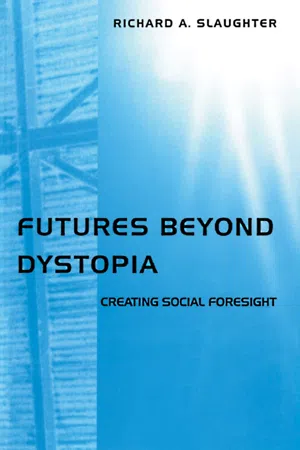
Futures Beyond Dystopia takes the view that the dominant trends in the world suggest a long-term decline into unliveable Dystopian futures. The human prospect is therefore very challenging, yet the perception of dangers and dysfunctions is the first step towards dealing with them. The motivation to avoid future dangers is matched by the human need to create plans and move forward. These twin motivations can be very powerful and help to stimulate the fields of Futures Studies and Applied Foresight.
This analysis of current Futures practice is split into six sections:
* The Case Against Hegemony
* Expanding and Deepening a Futures Frame
* Futures Studies and the Integral Agenda
* Social Learning through Applied Foresight
* Strategies and Outlooks
* The Dialectic of Foresight and Experience.
This fascinating book will stimulate anyone involved in Futures work around the world and will challenge practitioners and others to re-examine many of their assumptions, methodologies and practices.
- 336 pages
- English
- ePUB (mobile friendly)
- Available on iOS & Android
eBook - ePub
About this book
Information
PART 1
Aspects of futures enquiry
Introduction
Chapter 1 summarizes some of the evidence for the view that the human species is in greater danger than it yet clearly understands. This is by no means a ‘gloom and doom’ book, but it is essential to appreciate the scale and the nature of the predicament facing humankind. In an attempt to gain clarity about what is involved, the chapter sets out a number of propositions about ‘where we are’. These, obviously, can be critiqued and extended. The notion of ‘inner’ and ‘outer’ threats to humanity is raised. It is followed by a brief account of some widely shared ideas that offer various kinds of hope. Finally, obstacles and caveats are noted.
Chapter 2 looks in a little more detail at some of the ways we can begin to consider Futures beyond Dystopia. It begins by critiquing the ‘binary’ future (i.e. good/bad) and draws some conclusions from several Science Fiction sources. It then touches lightly upon some other resources available though non-standard views and perspectives. Essentially it grounds the notion of cultural recovery in processes that bring to greater awareness both defects and potentials in our current worldviews. It suggests that the speculative imagination is, at heart, a human capacity that can give access to a ‘grammar’ of future possibilities. The goal is to create social foresight and to help bring about societies that can respond to the futures they perceive.
These agendas place quite new demands upon the futures field and those actively involved in it. Thus, the question of professional standards is rapidly becoming central to its attempts to attain social legitimacy and a necessary ‘mainstream’ status. It is for these reasons that Chapter 3 takes up this issue. Without rapid progress in this key area, the futures profession will find it difficult to meet the challenges it now faces. There is a shift of pace and focus in this chapter. While it includes a hopefully useful sketch of the development of the futures field, those not professionally involved in futures work might want to skip it and proceed directly to Part 2.
Chapter 1
A twenty-first-century agenda
Everything is at stake
The twenty-first century may be a ‘make’ or ‘break’ time for humanity. Present trends do not encourage optimism. There are, however, many ways in which humans can act to develop foresight and to ‘steer’ toward more consciously chosen futures. This chapter sets out some suggestions for understanding more clearly, ‘where we are’ during this time.
A useful starting point is the transition from the twentieth century to the twenty-first. The year 2000 was widely celebrated but it was not quite what it may have seemed at the time. It was, in fact, an artefact of the Gregorian calendar. The latter was itself the result of 1,700-year long process during which our present sense of time was slowly brought into being by the collective efforts of people in many cultures. But early inaccuracies meant that the placing of the sequence of years was ‘out’ by several years. In other words, the ‘real’ year 2000 had already come and gone. It was mis-labelled as, maybe 1995, 1996 or 1997. We will never know.1 This reminds us that under the reassuring surface of everyday life, the normalcy of ‘the way things are’, there lie mysteries, unasked questions, and, perhaps, a deeper gulf of uncertainty than many realize. The overall pattern of knowing and not knowing is fundamental to understanding the condition of humanity at this time. It is also one of the themes of this book.
The year 2000 and the shift to a new century and millennium attracted many hopes for improvement in the human condition. But most of these hopes could not be sustained. The diet of ‘bad news’ that permeated the late twentieth century will continue for a long time to come because humanity is only part-way through a long and complex process of development that will take centuries or longer to complete. So the stakes will continue to rise. The bombs, the massacre of innocents, the turning of people against their own kind and their world, will continue. The environmental news will worsen. Coral reefs may disappear, forests shrink to remnants. We will lose many more species and currently fertile areas will become deserts, like others throughout history. Overall, the erosion of the ecological foundations of life will continue unabated. Equally, the fear of annihilation—whether by new forms of terrorism, resurgence of nuclear conflict or by some unstoppably mutating lethal virus—will loom large over rich and poor alike, particularly in over-crowded cities. It is a terrifying prospect—so terrifying, in fact, that those with the relevant money, resources, choices will, en masse, generally opt for the comfort of images, unreality industries, 3DTV, instead of the work of facing up to it. But face annihilation we must. One form of Dystopia or another is the most likely futures for humankind at this point.
Why such a bleak view? There are many reasons. Humanity cannot re-invent the inner worlds of those in power in a few years. It is the work of generations. Inequitable economic relationships with their ingrained ‘pyramids of sacrifice’ cannot be overturned overnight. There will be no sudden enlightenment among the world’s governments, no sudden upsurge of positive, visionary leadership among statespersons. They will continue to disappoint. The abstract goals of competing trans-national enterprises will continue to drive a technological dynamic that has already forsaken notions of limits and gone far, far beyond any conception of human need or positive social value. This dynamic is now poised to overwhelm the world’s cultures with yet another series of revolutions for which they are utterly unprepared.2
It is necessary to stress these facts at the outset because the whole purpose of this book is to show that, regardless of the above, there are ways forward that are most certainly worth attempting. But we should be clear at the outset that what is at stake in the forward view is, precisely, everything: the viability of our world and our own humanity.
Gaining clarity
It is obviously not a simple matter to understand the present condition of our world. Indeed, the revelation of the very processes of meaning-making, social construction and deep, unavoidable, interpretation has led some to lose their confidence and fall into the ‘problem of knowledge’, never to emerge. Others contemplate the same dilemma and yet maintain their dignity and poise, discern small consolations among the wreckage, the incapacity and the unknowing.3 Such responses are not inevitably unreasonable. They belong to people who care deeply and have sought to find ways forward, but failed. They are, perhaps, like some of the early explorers who perished because of inadequate maps in unfamiliar territory. Their efforts should be respected, but we should look further afield, find other maps, and explore other territories.
In order to gain clarity on the condition of our world it is useful to begin with a historical and cultural analysis. In other words we must understand why we live in this world and not in the innumerable others that were once possible. If there are alternate pasts and futures there are certainly alternate presents. Some works of imaginative fiction demonstrate this very clearly.4
Yet if there is one thing that modern scholarship has proved beyond doubt it is that we are all situated, grounded, if you will, in particular webs of language, ideology, assumptions and so on, many of which are partial, committed, provisional—in a word, fallible, ever open to challenge and to re-interpretation. That, after all, is what happens in every site of conflict: my version differs from yours. How, then, to give an objective account of reality? Well, best to admit right away that we cannot. But to acknowledge that does not plunge us into a sea of indecision and uncertainty where motivation and action die unborn. Quite the opposite. The fact that we cannot be objective, that we are all committed, enculturated, means that we should adopt a kind of modesty, an understated approach and style, as we try to engage some of the ‘big questions’ of our time. And engage them we must. Although there is no rulebook for reconstructing cultures that is one way of understanding the task before us.
Where can we obtain the clarity we need in order to act? Well, as suggested earlier, the first step is to attempt a diagnosis of the global predicament. What is working well, what badly? What do we need to maintain and protect, what do we need to change? We could start by valuing some of the things we have inherited from the efforts of people in the past: language, writing, electricity, notions of social justice and so on. From here we can deepen our cultural diagnosis by considering the body of work that has been created on this subject. For example, Lewis Mumford’s ‘long view’ on the past and present provides hints of a viable view forward. Mumford was concerned to critique the modern uses of science and technology. He also identified that period in time when notions of ‘limits’ were removed, thus permitting a historically new dynamic of exponential growth to be initiated.5 Understanding that that phenomenon was, and remains, a social construction also implies that it can be deconstructed and replaced by a view that more clearly reflects the needs of a planet suffering from too much material growth and associated impacts of many kinds.
But, as noted, there are many other views. That is precisely the point. Any cultural diagnosis will necessarily be created from a synthesis of the work of many people. For example, work of Castells, Saul and Scruton each contributes to an overall view.6 The former informs us about how deeply the ‘network economy’ is interpenetrating, and being shaped by, the many different cultural milieus in which it is now operating. Saul warns us about an over-arching corporatist ideology at work in the world which seeks opportunity and profit but which has become detached from the ecological foundations of the world and, indeed, has no real interest (or capacity to be interested) in the future. Scruton provides a masterly account of what he sees as deficiencies in modern, mediasaturated, marketing-oriented, atemporal cultural frameworks. Let it be noted, however, that these forays into cultural explanation are indeed only hints. To make real progress, futures enquiry needs a broader canvas.
Propositions about ‘where we are’
From these and many other sources, it is possible to draw together a preliminary set of propositions about aspects of the current context. Some will re-appear in different forms throughout the book.
- The Western worldview is, in certain respects, structurally ‘out of balance’. It supports a thin, instrumental, view of the world which, though successful in the short term, cannot be maintained in the long term.
- Dominant political and economic powers in the world are generally not interested in the real future. Their short-term agendas and habit of ‘bounded rationality’ serve to perpetuate destructive and unsustainable views, practices and systems everywhere.
- Significant arenas of human capability have been repressed or overlooked by Western institutions. These include: conscious participation in wider social and natural entities; celebration of being (as opposed to having); spiritual growth; the capacity to heal as a socially sanctioned vocation and, overall, the growth of awareness.
- Modern technologies do little or nothing to assist people in solving the perennial problems of human existence—meaning, purpose, soulful work, rites of passage, death. It has been said that they ‘provide everything to live with, but nothing to live for’. Yet in an expanding capital economy they are represented as being of central and vital importance.
- It is then but a short step to characterizing Western culture as ‘a culture of false solutions’ to such perennial human problems.
- The ideology of material growth was only viable for a short time and cannot be sustained. It could be replaced by an ethic of ‘enoughness’ or ‘voluntary simplicity’. But there are powerful forces ranged against such options, making them opaque and difficult to grasp.
- Overall, it may be possible to re-design some of the ‘ways of knowing’ that are contained within the Western worldview by retiring defective components and replacing them with consciously chosen equivalents. The tools for engaging in this work are widely available, but the places where they can be learned and practised are not yet very common.
Can such propositions be proved? There is certainly plenty of evidence. Sources can be cited; chains of reasoning explored, the formation and testing of hypotheses reviewed, modifications checked that flow from well-founded critiques. But no one individual can prove them because interpretations need to be verified by qualified communities of enquirers. They cannot be tested on the same kind of rig that tests the strength of concrete because they are not empirically verifiable. They rest on values, on judgements and on assumptions that support each. Within the domain of futures enquiry we find rich clusters of propositions that can, in the end, only be ‘tested’ through the collective judgements of many other minds, each of which are also embedded in their own worlds of reference that, in turn, are constitutive of the ‘real world’!
‘lnner’ and ‘outer’ threats to humanity
There is another significant dimension to this picture. Thus far, and despite a very bleak outlook, the view suggested here is that human beings can act to deepen their perceptions of their historical predicament (what Dror aptly calls ‘thinking in history’) and then act effectively in order to change it. The aim is not to effect a minor course adjustment, or even a series of them. Rather, the main goal is to help clarify viable pathways into a liveable future. One must necessarily admit that this is an unprecedented task, and this is partly why it will take longer to achieve than we might desire. The existential burdens will continue to grow, as will the many evidences of disaster and dysfunction around us.7
The ‘outer’ threats to humanity are at least visible, and therefore can be approached directly. But the ‘inner’ threats are quite different and require a different method and approach. Laszlo made reference to this domain some years ago in his book The Inner Limits of Mankind.8 E.F.Schumacher addressed similar territory in his final book A Guide for the Perplexed.9 But the most comprehensive treatment of this issue by a Western writer that takes up and integrates much that is known about the ‘inner path’ is that by Ken Wilber. His evolving work on an integral paradigm, integral psychology, the integration of science and religion, and many other themes, provides detailed insights into the grounding of cultural change that is a world away from popular ‘how to’ formats.10 We will draw deeply on these sources later in this book.
The Eastern equivalent, perhaps, is P.R.Sarkar, ably summarized by Sohail Inayatullah.11 What emerges from both accounts is a powerful sense that humanity is partway through a very long sequence of evolutionary development (both inner and outer). The drawback is that the time scales are immense. But it is just such macrohistorical perspectives that provide us with a language, concepts and insights into the underpinnings of possible future civilizations. Some important clues lie in the development of human consciousness to levels that have already been pioneered by advanced practitioners around the world. In this view, the future is not merely a result of material evolution and expected levels of technical capability. More profoundly, it emerges from the level, capability and integration of the consciousness that is creating and directing it.
Such a view rests on a deep appreciation of ‘inwardness’ that seems to make most sense in traditions that value and encourage it. For many it is some form of inner practice that leads to greater insight and clarity. One example is that of Diane Perry who, renamed Tenzin Palmo, became a Buddhist nun and subsequently spent twelve years in a cave in the high Himalayas. When asked to explain why she took such a drastic course of action she replied that:
it’s a poverty of our time that so many people can’t see beyond the material…. In this age of darkness with its greed, violence and ignorance it’s important there are some areas of light in the gloom, something to balance all the heaviness and darkness. To my mind the contemplatives and the solitary meditators are like lighthouses beaming out love and compassion on to the world. They become like generators—and they are extremely necessary12
What Palmo is expressing may be more familiar to Westerners through what Huxley termed ‘The Perennial Philosophy’.13 That is, the view that humanity shares a common heritage, both ‘inner’ and ‘outer’ and that there are appropriate ways of addressing and reconciling both. The suggestion here is not that large numbers of people should necessarily follow exactly this path. It remains a fact that too little is still understood about how to accelerate human transformation (though some promising work is underway at the Integral Institute). The point is that there are indeed real and vibrant alternatives to the kind of limited rationality that is currently driving the global system toward a diminished and Dystopian future. Such alternatives are obscured in Western societies where avoidance and denial thrive and other options are sidelined by materialism and instant gratification. But they can certainly be derived from other starting points, values and assumptions.
Now for the empirically minded, those in pursuit of share market dividends, for marketeers more generally, and for all those now being drawn into an uncritical involvement with the internet and the wonders of the ‘digital economy’—to all these people who are, perhaps, caught up in their own versions of ‘the way things are’, such considerations will seem esoteric or irrelevant at best. Who needs an inner life, who needs values or discriminating awareness, when you can have the latest web browsers and all the wonders they can deliver?
The answer is relatively simple, but the consequences are not. A combination of fairly primitive human motivations coupled with high-powered technology in any realm is likely to be what I have called elsewhere ‘a continuing disaster’. What were once called the ‘seven deadly sins’ (pride, envy, avarice, wrath, gluttony, sloth and lust) have finally been domesticated within the hyper culture of...
Table of contents
- Cover Page
- Title Page
- Copyright Page
- Figures
- Foreword
- Acknowledgements
- Abbreviations
- Introduction
- Part 1: Aspects of futures enquiry
- Part 2: The case against hegemony
- Part 3: Expanding and deepening a futures frame
- Part 4: Futures Studies and the integral agenda
- Part 5: Social learning through applied foresight
- Part 6: Strategies and outlooks
- Conclusion
- Notes
- Annotated futures bibliography
Trusted by 375,005 students
Access to over 1.5 million titles for a fair monthly price.
Study more efficiently using our study tools.
Frequently asked questions
Yes, you can cancel anytime from the Subscription tab in your account settings on the Perlego website. Your subscription will stay active until the end of your current billing period. Learn how to cancel your subscription
No, books cannot be downloaded as external files, such as PDFs, for use outside of Perlego. However, you can download books within the Perlego app for offline reading on mobile or tablet. Learn how to download books offline
Perlego offers two plans: Essential and Complete
- Essential is ideal for learners and professionals who enjoy exploring a wide range of subjects. Access the Essential Library with 800,000+ trusted titles and best-sellers across business, personal growth, and the humanities. Includes unlimited reading time and Standard Read Aloud voice.
- Complete: Perfect for advanced learners and researchers needing full, unrestricted access. Unlock 1.5M+ books across hundreds of subjects, including academic and specialized titles. The Complete Plan also includes advanced features like Premium Read Aloud and Research Assistant.
We are an online textbook subscription service, where you can get access to an entire online library for less than the price of a single book per month. With over 1.5 million books across 990+ topics, we’ve got you covered! Learn about our mission
Look out for the read-aloud symbol on your next book to see if you can listen to it. The read-aloud tool reads text aloud for you, highlighting the text as it is being read. You can pause it, speed it up and slow it down. Learn more about Read Aloud
Yes! You can use the Perlego app on both iOS and Android devices to read anytime, anywhere — even offline. Perfect for commutes or when you’re on the go.
Please note we cannot support devices running on iOS 13 and Android 7 or earlier. Learn more about using the app
Please note we cannot support devices running on iOS 13 and Android 7 or earlier. Learn more about using the app
Yes, you can access Futures Beyond Dystopia by Richard A. Slaughter in PDF and/or ePUB format, as well as other popular books in Education & Education General. We have over 1.5 million books available in our catalogue for you to explore.