Gender, Identity and the Culture of Organizations considers how organizations operate as spaces in which minds are gendered and men and women constructed. This edited collection brings together four powerful themes that have developed within the field of organizational analysis over the past two decades: organizational culture; the gendering of organizations; post-modernism and organizational analysis; and critical approaches to management. A range of essays by distinguished writers from countries including the UK, USA, Canada, Denmark, Sweden, Finland, the Netherlands and Sweden, explore innovative methods for the critical theorizing of organizational cultures.
In particular, the book reflects the growing interest in the impact of organizational identity formation and its implications for individuals and organizational outcomes in terms of gender. The book also introduces research designs, methods and methodologies by which can be used to explore the complex interrelationships between gender, identity and the culture of organizations.
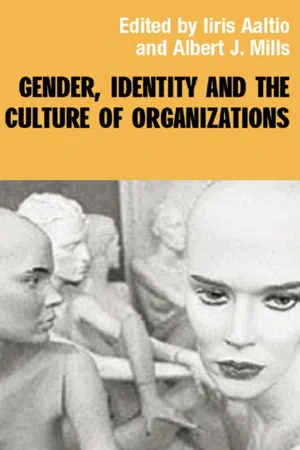
- 240 pages
- English
- ePUB (mobile friendly)
- Available on iOS & Android
eBook - ePub
Gender, Identity and the Culture of Organizations
About this book
Part I
Introduction
1 Organizational culture and gendered identities in context
Iiris Aaltio and Albert J. Mills
There is no escape – the term FEMINIST is written across our foreheads – probably for the rest of our academic careers. We must admit, though, that we did something to deserve it.(Katila and Meriläinen, Chapter 10, this volume)
Introduction
This edited collection brings together four powerful themes that have developed within the field of organizational analysis over the last two decades: organizational culture, the gendering of organizations, postmodernism and organizational analysis, and critical approaches to management. We view these themes as intertwined in research on the essence of organizational life with its multiple manifestations. In particular the book reflects the growing interest in the impact of organizational identity formation and its implications for ‘individuals’ and ‘organisational’ outcomes in terms of gender. These themes are integrated through a focus on new and varied research designs, methods and methodologies by which the complex interrelationships between gender, identity and the cultures of organizations are submitted to our understanding and can be explored. This book edition with its variety of methodological and conceptual approaches aims:
- to promote diverse theoretically based, empirical explorations on crossing issues between gender and organizational culture,
- to apply that understanding in the context of organizations and management, and
- to support critical reflections within organizational research in terms of equality between women and men at the workplace.
Organizational culture
The cultural approach to organizations became popular in the 1980s. As remarked by Stablein and Nord (1985: 22), ‘probably never before in organizational studies has an innovative area been given such attention so rapidly’. Reasons for the emergence of organizational culture studies are manifold. As suggested, there was a need to seek for new methods to study organizations and to find ‘subjective’ concepts to replace the old ‘objective’ concepts in order to understand organizational essence (Alvesson and Berg, 1988: 22–25). Culture became a theoretical tool to cross over the traditional micro- and macro-level organizational analysis (Morey and Luthans, 1985: 227–228). In general, internationalization gave impulses to study cultural aspects of business communication (Morgan, 1986). By now we can see the many branches stemming from the cultural perspective, its several theoretical and methodological contexts, and any idea of its simplicity, trend-like appearance or hegemony over other concepts, meets with a difficulty when facing this diversity. Among the approaches, the notion of organizations as ‘mini-cultures’ was raised by organizational educators and practitioners seeking more comprehensive ways of understanding organizational behaviour and management. This debate encouraged research that explored the complex factors influencing behaviour within organizations. The relationships between non-rational factors and multiple-level organizational outcomes were explored especially, and the focus was on the symbolism of organizational life in general. The first approaches of organizational culture emphasized its invisibility, whereas nowadays multiple methodologies and methods of analysis and interpretations are accepted. Exploring organizational cultures and their gendered nature means making them visible.
Culture debate as a heuristic for studying organizations is clearly acknowledged, but the impact of culture on gender and identity is largely ignored. By the late 1980s the culture debate subsided in the face of new theories of change (like re-engineering), on the one hand, and the growing popularity of postmodernist critique, on the other. However, there is evidence that the topic of organizational culture is finding renewed interest among scholars, as witnessed in the recently published Handbook on Organizational Culture and Climate (Ashkanasy et al., 2000).
This edited collection sets out to contribute to the revised interest in organizational culture as a heuristic for understanding the relationship between organizational arrangements and outcomes, in particular the way that combinations of symbolic, non-rational factors contribute to our understanding of ‘women’ and ‘men’.
Gender and organizational analysis
Sex is a biological classification of humans into women and men, whereas gender is a cultured knowledge that differentiates them. To understand what gender means is to understand its cultural dimensions. Thus, feminine and masculine genders consist of the values and ideals that originate from culture. The gender classification of men and women, male and female, as a biological or cultural definition is far from easy to handle in research and everyday life. Since the early 1970s a growing body of work has developed a focus on the gendering of organizations and its impact on individual and organizational outcomes. Why this growing interest in gender studies in management research today? There are several reasons for this. Besides the nowadays more explicitly expressed demand in Western societies for equality between the sexes, there is also a need for gender studies that connect the changing conditions for contemporary organizations. Gender is evidently an important aspect to take into account in business communication (see, for example, Hofstede (1980)). Applying ideas of gender for alternative ways to organizational change has also become a useful area of research. ‘Gender at work’ is the problematic issue in numerous accounts, among which the relationship between organizational culture and the social construction of gendered identities is of special interest. Sadly, despite the development of extensive scholarship on gender and organizations, the mainstream accounts, including the organizational culture debate, continue to ignore the relationship between organizational arrangements and gender. The new Handbook on Organizational Culture and Climate (Ashkanasy et al., 2000), for example, includes only one chapter that deals with gender. In addition, even when institutional contexts are accepted as having a great impact on gender in organizational realities, the channels by which they delve into the everyday life of people are still largely ignored. Multiple kinds of interpretations are needed. In contrast, this edited collection brings together a number of researchers noted for their work in exploring the relationship between gender, institutional realities and the cultures of organizations.
Postmodernism
Natural bodies, voices and texts become questioned in postmodernism. Postmodernist thought has strongly influenced the debate on gender, identity and the culture of organizations by highlighting the relationship between ‘subjectivity’ and ‘discursive organizational practices’, while, at the same time, questioning the viability of ‘gender’ and ‘culture’ as categories of understanding. In some cases this has led to ‘strategic’ uses of postmodernist analysis in the production of feminist accounts of gendering and organizational practices. In yet other cases this has generated post-feminist angst and even the rejection of ‘gender’ as a category of analysis. In all events, this has enriched the debate and sharpened the interest in identity and organizational analysis (Hassard, 1999). Men and women in organizations can be seen not only as carriers of bodies and voices, but also of femininity and masculinity, which are both organizational and institutional categories. Texts produced in organizational contexts are related to many questions of gender, not only as innocent and factual products by nature. The symbolism of organizational realities is seen in postmodernists’ understandings of organizations. While the early ideas of postmodernism emphasized the death of the subject in discourse, concern is nowadays given to the complex ways in which women and men seek to exert control over their lives (Elliott, 1999). As today’s organizations are almost like global, anonymous cities, individuals in their identity formation processes come up against organizational frames, and unavoidably meet gender aspects at the same time. They build their individual identities based on gender, and at the same time organizational identities become built. This edited collection reflects the growing interest in identity construction and the problematic of organizational discourse.
Critical approaches to management
Within the debate on gender and organizations, there is a feminist divide between mainstream ‘women in management’ accounts and critical management theories. The former approach focuses on ‘improvements’ in the status of women within existing organizational arrangements, accepting the notion of ‘women’ and ‘men’ as fixed, essential categories. In general, they emphasize equality and inequality issues in management, and focus on the means to achieve equality. The latter approach takes the problematic of social construction as its starting point, and seeks to identify the relationships between the social construction of organizational arrangements and the ‘organizational construction of gender’, seeing both men and women as important categories in the analysis. The approach also brings together an understanding of the multiplelevel social, organizational and institutional factors beyond the issues of inequality and organizational culture. The wider environment of this approach can be located in the dilemmas of overall workplace diversity and its management (Prasad, Mills, Elmes and Prasad, 1997). Gender aspects are part of this diversity, and meet and cross the other diversity aspects in the melting pots of organizations. This edited collection contributes to a critical approach to management by raising questions about the impact of organizational arrangements on people and their sense of gendered self, exploring the relationship between the cultures of organizations as ‘mini-societies’ and as institutional constructs, and the construction of gendered selves or subjectivities. ‘Showcases’ (Prasad and Mills, 1997: 3–27) about how to critically explore gender in this organizational social construction, and how to promote equality issues in the process, are also presented throughout the book.
The structure of the book
The book is divided into three sections: the first is the Introduction (Chapter 1); the second, ‘Theorizing Organizational Culture and Gendered Identities’, is composed of Chapters 2–6; and the third, ‘Methods: Beyond Explorations’, is covered by Chapters 7–11. In the first section we introduce the book and its overall themes and discuss some of the issues raised.
Theorizing gender and organizational culture
The second section brings together five different approaches to the theorization of organizational culture and gender. It begins with the work of Attila Bruni and Silvia Gherardi (Chapter 2) who take a ‘symbolic approach’. Here gender is viewed as ‘the most powerful symbol of differences, culturally enacted and “positioned” through material and semiotic practices. Gender is something we “do” and something we think.’ From this perspective organizational culture stands as ‘a signification domain’ within which gender is created as a discursive effect. Through a focus on organizational culture is revealed ‘the boundaries in which identity and gender are allowed, as well as the permeability and the meaning of these boundaries’.
Within this chapter gender is disconnected from the realm of the biological (except where, implicitly, biology itself can be seen as a form of signification). Individuals are not so much absent from but blurred within the text, replaced by subject positions (i.e. ‘a conceptual repertoire and a location for persons within the structure of rights pertaining to those who use the repertoire’). Here we are not so much concerned with what happens to women or men so much as the ‘en-gendering’ of persons. Through the concept of ‘dual presence’ – whereby persons experience conflicting aspects of en-gendering – Bruni and Gherardi suggest that organizational cultures provide boundaries across and within which conflicting experiences of en-gendering may occur. This viewpoint serves not only as ‘a strategy for dismantling the taken-for-granted of any cultural representation of gender’ but as an insight into the very real possibility of change.
Chapter 3, by Jeff Hearn, draws on pro-feminist, subtext and deconstructive approaches to problematize the notion of gender, identity and organizational culture. For Hearn the notion of organizational culture serves as a problematic construct for addressing gendered practices. Its potential for making gender more or less apparent lies in conceptualizing it as text and subtext. Yet it is limited as a heuristic by its rootedness in ‘gendered differentiations’ where organizational culture has been encoded as ‘feminine’ and ‘female’. In particular a focus on organizational culture is particularly problematic for Hearn’s concern with exposing maleness and masculinity in the processes of discrimination at work, arguing that it is far from clear what ‘the implications of the feminine/ female encoding of culture [are] for the analysis of men’s gendered power’. Hearn concludes that ‘notions of organizational culture may be deconstructed and recognized as a (misleading) shorthand for multiple, overlapping, paradoxical and contradictory processes of gendered othernesses, both women and men’.
In a similar vein to the previous chapter, Hearn moves us away from the notion of individual agency towards a social constructionist view of gendered categories (men/women; masculine/feminine). But the chapter moves us away from gender per se to a focus on ‘men’ and ‘masculinity’ and how these concepts have hitherto not been problematized within studies of discrimination at work. In so doing, the concept of ‘man’ has a more ontologically real feel to it than Bruni and Gherardi’s en-gendered subject positions. In his treatment of organizational culture Hearn appears to press the notion of signification further than Bruni and Gherardi in contending that it helps to signify and thus marginalize ‘femininity’.
In Chapter 4 Anshuman and Pushkala Prasad use a postcolonial ‘theoretical lens’ forged to an institutional approach to understand the contemporary dynamics of difference and identity in organizational cultural milieux. Here the concern is not simply with the social construction of womanhood within and by organizational settings but also the intersection of gender with ‘race, ethnicity, religion, national origin, etc.’ in the constitution of a spectrum of ‘other’ identity categories. To achieve this, the Prasads explore the impact of ‘neo-colonial and neo-imperial discourses of otherness’ on the cultures of organizations, viewed as ‘identity spaces’ and as sites for the transmission of and adjustments to globalization.
This approach focuses less on organizational cultures as ‘local’ sites but on the meta-discourses that influence institutional processes in the construction of cultural formations in organizational arrangements. In so doing the chapter raises issues about the viability of a study of gender divorced from the other ‘major axes of difference’ (e.g. race, class, ethnicity, sexuality, and religion), and a concept of organizational culture that is divorced from ‘geopolitical realities and global hegemonies that mediate the formation of identity spaces in organizational and institutional locations’. To that end, the chapter differs from the previous chapters in attempting to decontextualize subjectivity from purely localized influences.
Mats Alvesson and Yvonne Due Billing return us, in Chapter 5, to an organizational- level analysis in which the cultures of organizations serve as sites for the social construction of gender. In this perspective a crucial distinction is made between masculinity/femininity and male/female, with the first pair viewed as ‘more abstract and detached from biological sex’ and the second pair seen as ‘closer to what men and women actually do’. This, at one and the same time, sets up gender as an organizing process rather than a fixed system, while retaining some oblique notion of the biological. As with Hearn, Alvesson and Due Billing draw attention to the underlying gendered assumptions of the term ‘organizational or corporate culture’, but see the associations as problematic but potentially more enabling of feminist debate. For them the notion of organizational culture ‘send[s] signals about the importance of feelings, communities, social relations and teams, which are more in accord with femininity’.
In Chapter 6 Erica Foldy brings to the fore the problematic relationship between organizational culture and gendered identities through an exploration of the impact of diversity management on identities. Using a Foucauldian lens, Foldy’s interest in the relationship between power and identity is illustrated through analysis of the impact of diversity management programmes on identities. Here, more than in any of the previous chapters, we are focused on individual agency and the problem of multiple identities. In this framework, the gendered self is one of several identities that are contested within the context of work organizations and ‘their less visible and more embedded aspects, such values and underlying assumptions, which constitute their cultures’. Foldy’s analysis of diversity programmes helps to illustrate how, in recent years, the cultures of organizations – referencing the work of Schein (1985) – have become a ‘central arena’ for contests over identity, with diversity programmes having ‘their most immediate impact on observable manifestations of the culture, including representation of different demographic groups and organizational policies’. In contrast to Hearn’s rejection of ‘identity pol...
Table of contents
- Cover Page
- Title Page
- Copyright Page
- Illustrations
- Contributors
- Acknowledgements
- Part I Introduction
- Part II Theorizing organizational culture and gendered identities
- Part III Methods
Trusted by 375,005 students
Access to over 1.5 million titles for a fair monthly price.
Study more efficiently using our study tools.
Frequently asked questions
Yes, you can cancel anytime from the Subscription tab in your account settings on the Perlego website. Your subscription will stay active until the end of your current billing period. Learn how to cancel your subscription
No, books cannot be downloaded as external files, such as PDFs, for use outside of Perlego. However, you can download books within the Perlego app for offline reading on mobile or tablet. Learn how to download books offline
Perlego offers two plans: Essential and Complete
- Essential is ideal for learners and professionals who enjoy exploring a wide range of subjects. Access the Essential Library with 800,000+ trusted titles and best-sellers across business, personal growth, and the humanities. Includes unlimited reading time and Standard Read Aloud voice.
- Complete: Perfect for advanced learners and researchers needing full, unrestricted access. Unlock 1.5M+ books across hundreds of subjects, including academic and specialized titles. The Complete Plan also includes advanced features like Premium Read Aloud and Research Assistant.
We are an online textbook subscription service, where you can get access to an entire online library for less than the price of a single book per month. With over 1.5 million books across 990+ topics, we’ve got you covered! Learn about our mission
Look out for the read-aloud symbol on your next book to see if you can listen to it. The read-aloud tool reads text aloud for you, highlighting the text as it is being read. You can pause it, speed it up and slow it down. Learn more about Read Aloud
Yes! You can use the Perlego app on both iOS and Android devices to read anytime, anywhere — even offline. Perfect for commutes or when you’re on the go.
Please note we cannot support devices running on iOS 13 and Android 7 or earlier. Learn more about using the app
Please note we cannot support devices running on iOS 13 and Android 7 or earlier. Learn more about using the app
Yes, you can access Gender, Identity and the Culture of Organizations by Iiris Aaltio,Albert J. Mills in PDF and/or ePUB format, as well as other popular books in Business & Business General. We have over 1.5 million books available in our catalogue for you to explore.