- 240 pages
- English
- ePUB (mobile friendly)
- Available on iOS & Android
eBook - ePub
Writing Successfully in Science
About this book
"Writing Successfully in Science" pays particular attention to the needs of scientists whose first language is not English, explaining how to avoid the main pitfalls of English grammar and how to present work in a clear and logical fashion. It combines practical tips for the first-time writer with useful instructions for experienced contributors wishing to improve their technique
Information
CHAPTER ONE
Assessing your work and planning its publication
Dealing with preliminary questions—Writing and speaking while work is in progress—Assessing whether, when, and what to write—Deciding who and what to write for—Obtaining instructions to authors
Why must scientists write articles for publication? The reasons range from the pragmatic—such as winning fame, promotion, or a new job—to the idealistic—such as extending the boundaries of knowledge. The only good reason, though, is both practical and idealistic: communication is essential if science is to progress. You must document your work thoroughly before other scientists can repeat that piece of work, build on it, criticize it, or simply admire what you have achieved. In starting an investigation you are, in fact, taking the first step on the road to publication.
Research workers must write. They must also write simply and clearly enough for readers to understand and even enjoy what they are reading.
As a first step towards reaching the goal of comprehensible publication ask yourself the three sets of questions discussed below. The remaining steps in planning and preparing a research paper for submission to a journal are shown in Table 1.1 and described in Chapters 1 to 9. The steps in writing a thesis (Ch. 13) or technical report are similar to those in writing a journal article. You should of course adapt the sequence given here to your own way of working and to the kind of document you are writing.
THREE SETS OF PRELIMINARY QUESTIONS
First, are your studies designed to answer precisely the question you are examining? Have you drawn up a plan—a protocol—for what you intend to do? Do the studies cover all the criticisms likely to be made? Are the statistical methods valid?
Table 1.1 Main steps in preparing a research paper for publication
Secondly, do your experiments meet accepted ethical standards? You must answer this question if you are using human beings or animals, or if your work could affect the environment or the place where you are doing field work. You may also have to answer two related questions: is publication of your work likely to break any official secrecy regulations? and is publication likely to invalidate a later application for a patent? Take advice on these matters and, if necessary, modify your plans for what to include in the paper.
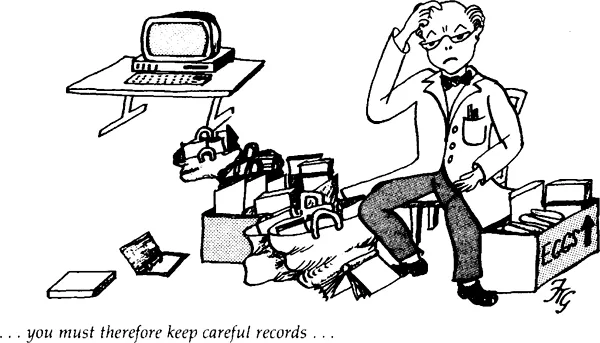
Thirdly, have you arranged how to record the details of your work as it proceeds? In some laboratories notes have to be kept in a prescribed manner, in bound notebooks with numbered and dated pages. Informal notes, including draft tables and figures, must also be kept in such a way that they can be found when wanted. From the beginning of an investigation you must therefore keep careful records, whether on paper or in a computer. Keep records of what you read (see Ch. 6), as well as of what you do.
WRITING AND SPEAKING WHILE WORK IS IN PROGRESS
When your investigation has been under way for some months, assess the direction the work is taking. One way to do this is to write down the question you are studying and describe what you have done so far. The act of writing about your work forces you to think about it more clearly than is possible while you are busy with the experiments or observations. Any lack of clarity shows up when you put your thoughts on paper:
‘writing necessarily uses words, and almost all thinking is done with words…the discipline of marshaling words into formal sentences, writing them down, and examining the written statement is bound to clarify thought’ (Woodford 1967).
Another way to assess progress is to present your methods and results orally or in poster form at a departmental seminar, or at a meeting whose proceedings will not be published in full (see Ch. 12). The comments and questions at the meeting will help you to decide whether your work is ready for submission to a journal.
DECIDING WHETHER AND WHEN TO WRITE
After these preliminary assessments you must also decide whether your work is suitable for publication. Is it really worth writing about? Some investigations turn out to be unsuitable for publication even though the topic originally looked worthwhile. Aim to publish a few first-rate articles rather than numerous minor contributions; quality of content will do you more good in the long run than the number of papers to your name.
A paper worth publishing records ‘significant experimental, theoretical or observational extensions of knowledge, or advances in the practical application of known principles’ (O’Connor & Woodford 1975, p. 3). Do your results and conclusions fulfil one of those requirements? One way of deciding whether they do is to write down the conclusions you have reached. Measure these tentative conclusions against what is known about the topic and then, if possible, show them to an experienced colleague working in a different area of science. Discussing your conclusions with an unbiased person, like making a preliminary presentation at a meeting, will give you a fresh view of your findings and how to interpret them. Putting your conclusions on paper and discussing them will also reveal whether you need to do more work to fill gaps in your arguments or observations before starting to write.
Another question to ask yourself is whether your tentative conclusions are still clearly related to the question you set out to study. If your findings have led you away from the original question, rethink and restate the question now, to prevent confusion in what you write later on.
After you have answered these questions satisfactorily, the point at which you start to draft the paper will probably be influenced by down-to-earth events. You or a colleague may be about to leave for a new job, grant money may be running out, or a deadline may have to be met. Whatever the circumstances, make an early start on sections such as the methods or results, but don’t begin the major job of drafting the whole paper until you are sure your findings are reasonably firm and complete, take knowledge of the subject a step further, and are ‘new, true and meaningful’ (DeBakey 1976).
DECIDING WHAT KIND OF PAPER TO SUBMIT FOR PUBLICATION
You also need to decide whether your material is suitable for a long paper with a detailed discussion or for a short report of results, with brief comments, if any. Would it be better to send a full report to a conventional journal, or submit a brief note or preliminary paper to a journal specializing in rapid communication, if that is customary in your discipline? If the paper is the first on which you are the first or sole author, aim to make it as complete and as good as possible. If you are working in a very competitive field, however, consider whether to write a shorter paper for a ‘letters’ journal.
Don’t slice a single piece of work into several short papers (‘minimum publishable units’) without a good reason for doing so. Editors call this kind of serial submission ‘salami science’ and they tend to reject the later slices. Publication of several papers on the same piece of work is acceptable only for large-scale investigations taking several years to complete, or for investigations that fall naturally into several self-contained parts or into parts that interest readers in different disciplines.
A paper you submit to a journal must be based on your own original work. Passing off another person’s work as your own—plagiarism—is fraudulent and unacceptable. The paper must also be new: that is—with the exceptions discussed below—it must not have been published in or concurrently submitted to another journal. Publishing similar papers in two or more journals—duplicate or multiple publication—is nearly always as unacceptable as plagiarism. Concurrent submission is unacceptable too, with the exceptions discussed below. Submitting the same paper to more than one journal at once may seem a good way of saving time but it wastes time for editors and referees, and money for journal publishers. Many journals therefore ask authors to state in a covering letter or on a copyright form that the paper has not been published elsewhere and has not been concurrently submitted to another journal.
The rule about multiple publication does not apply to preliminary communications. If you decide to write a brief note or preliminary communication you can still submit a full paper on the same topic later, provided that the preliminary version is not too detailed and that you refer to its existence in the later, fuller, version. Abstracts of presentations at scientific meetings don’t count as ‘previous publications’ either, provided that they are not too detailed and that not too many details have been released to the media, for example at a press conference, and disseminated widely before the full paper can be published.
Other exceptions to the rule about duplicate submission or publication may arise when the journals are aimed at totally different audiences, such as clinicians and geographers, or are in different languages, or—if both journals are local or regional rather than international—are intended for distribution in different geographical areas. If you think your paper will be suitable for duplicate publication under one of these three conditions, write to the editors of both your target journals at an early stage and obtain their consent to duplicate submission.
DECIDING WHO THE READERS WILL BE AND CHOOSING A JOURNAL
All writers, including scientists, must keep their readers in mind while they are writing, so consider next who your readers will be and why they will want to read your paper. Thinking about your audience will help you to choose the journal to which you will submit the paper. Choosing the journal will also enable you to look at examples on which you can model the paper and obtain instructions on how to prepare it.
Don’t necessarily choose the first journal that comes to mind—usually the one you read most often. Ask yourself whether the work you are reporting will interest a wide general audience, or everyone working in your branch of science, or just a few specialists. Then draw up a short list of possible journals, based on those considerations and on other points such as the following:
- Which journals do the people you hope to reach prefer to read?
Ask your more experienced colleagues about this point, or consult an information scientist in your institution’s library. If your first language is not English, consider the language of publication too: your paper may remain hidden for years if you publish in a minority language. (But balance this against point 4 below.) - Which journals print papers of the kind and length you propose to write?
The scope of a journal is usually defined at the beginning of the instructions to authors but is sometimes described in or near the masthead of the journal (the section where the publisher, editorial staff, frequency of publication, and subscription rates are listed). - Which are the well-established journals in your field?
Be careful about submitting papers to new journals or journals still in the gestation period. If such a journal fails, your paper may die with it. On the other hand, if the subject area covered by the journal is exactly right and the editor and publishers seem sound (ask colleagues for their advice), a new journal may be a good choice. Be careful, too, about submitting your early papers to ‘throwaway’ journals. Publishing in these is unlikely to help your career. - Which journals are of high scientific quality but have moderately low rejection rates (say 30% of submissions, or less)?
Rejection rates vary widely both between and within disciplines. journals of high prestige mayInternational journals of high prestige may have rejection rates as high as 80–90% of submissions. You might be better off choosing a national or local journal with a lower rejection rate, especially if your paper is of national or local interest. Some journals publish their rejection rates annually, or more experienced colleagues may be able to tell you what the rate is for a particular journal. - Which journals are covered by the main abstracting and title-listing services?
Journals may name these services in or near the masthead, or in publicity material. Or see the most recent edition of Ulrich’s international periodicals directory. - Which journals have editors who are highly regarded in their fields of science and provide prompt, fair, and helpful reviewing?
Not all first-rate research workers make first-rate editors, but most work hard to keep their reputations by producing the best journals they can. A star-spangled editorial board or advisory committee does not, however, guarantee that the editorial system is first-rate or that the referees are well chosen. Ask experienced colleagues for their views. - Which journals are published often enough to give your paper a chance of appearing within six weeks to nine months of acceptance (depending on whether the journal is a rapid results journal or one with a slower publication schedule)?
A monthly journal may be a better choice than a quarterly, all else being equal, but if the journal publishes acceptance dates it is worth calculating the publication lag—the time from acceptance date to publication date. You can minimize delays by following the journal’s instructions closely (see ‘Obtaining and reading the instructions to authors’ below). - Which journals require authors to be members of the society which owns or sponsors the journal?
The instructions to authors will answer this question. - Which journals have page charges or submission charges?
If you can’t find funding for page or submission charges this point could be important. Some journals waive these charges in certain circumstances, for instance for authors from countries with currency exchange problems. If your paper is well suited to such a journal, consult the editor about the charges if payment is a problem. - Which journals print high quality photographs (e.g. electron micrographs), and which accept colour photographs, if these are essential to your work?
Your own and your colleagues’ observations will tell you which journals are suitable. - Which journals provide offprints or reprints, which provide them free of charge, how many do they provide, and what do extra copies cost (if off prints/reprints are important to you)?
You may wish to publish in a less well-known journal with a generous reprint policy that enables you to reach exactly the readers you want by sending them offprints or reprints. (See p. 148 for the distinction between offprints and reprints.) - Which journals use a standard reference system that you can cope with easily?
This seemingly minor point will become a major annoyance if you haven’t got a bibliographic program for formating references on a computer and if a lot of trivial changes have to be made which don’t help readers at all—such as changing 1990a, b, etc. to 1990a, b, etc. throughout, or changing Jones B, Smith A, etc. to Jones B, A Smith, etc.
OBTAINING AND READING THE INSTRUCTIONS TO AUTHORS
When you have chosen a journal from your short list the next step is to read the current version of its instructions to authors. Many journals print these instructions (or guidelines, or information) in every issue, some print them once a year in the first issue of the year, and a few print them as a separate leaflet or booklet which you can obtain, usually free, by writing to the editorial office. If you work in a biomedical discipline you will find that many journals use, or say they use, the ‘Uniform requirements for manuscripts submitted to biomedical journals’ (Appendix 1) (ICMJE 1988), a set...
Table of contents
- Cover Page
- OTHER TITLES FROM E & FN SPON
- Title Page
- Copyright Page
- Introduction
- Acknowledgements
- CHAPTER ONE: Assessing your work and planning its publication
- CHAPTER TWO: Getting started: building the framework
- CHAPTER THREE: Preparing effective tables
- CHAPTER FOUR: Preparing effective figures
- CHAPTER FIVE: Writing the first draft
- CHAPTER SIX: Storing, choosing and styling references
- CHAPTER SEVEN: Revising the first draft: content and structure
- CHAPTER EIGHT: Revising the second draft: style
- CHAPTER NINE: Preparing the final version for submission
- CHAPTER TEN: Submitting the paper
- CHAPTER ELEVEN: Checking the proofs
- CHAPTER TWELVE: Preparing short talks and posters
- CHAPTER THIRTEEN: Writing a thesis
- CHAPTER FOURTEEN: Writing review articles and book reviews
- CHAPTER FIFTEEN: Preparing successful grant proposals and curricula vitae
- APPENDIX ONE: Uniform requirements for manuscripts submitted to biomedical journals*
- APPENDIX TWO: Terms to avoid*
- References
Trusted by 375,005 students
Access to over 1.5 million titles for a fair monthly price.
Study more efficiently using our study tools.
Frequently asked questions
Yes, you can cancel anytime from the Subscription tab in your account settings on the Perlego website. Your subscription will stay active until the end of your current billing period. Learn how to cancel your subscription
No, books cannot be downloaded as external files, such as PDFs, for use outside of Perlego. However, you can download books within the Perlego app for offline reading on mobile or tablet. Learn how to download books offline
Perlego offers two plans: Essential and Complete
- Essential is ideal for learners and professionals who enjoy exploring a wide range of subjects. Access the Essential Library with 800,000+ trusted titles and best-sellers across business, personal growth, and the humanities. Includes unlimited reading time and Standard Read Aloud voice.
- Complete: Perfect for advanced learners and researchers needing full, unrestricted access. Unlock 1.5M+ books across hundreds of subjects, including academic and specialized titles. The Complete Plan also includes advanced features like Premium Read Aloud and Research Assistant.
We are an online textbook subscription service, where you can get access to an entire online library for less than the price of a single book per month. With over 1.5 million books across 990+ topics, we’ve got you covered! Learn about our mission
Look out for the read-aloud symbol on your next book to see if you can listen to it. The read-aloud tool reads text aloud for you, highlighting the text as it is being read. You can pause it, speed it up and slow it down. Learn more about Read Aloud
Yes! You can use the Perlego app on both iOS and Android devices to read anytime, anywhere — even offline. Perfect for commutes or when you’re on the go.
Please note we cannot support devices running on iOS 13 and Android 7 or earlier. Learn more about using the app
Please note we cannot support devices running on iOS 13 and Android 7 or earlier. Learn more about using the app
Yes, you can access Writing Successfully in Science by Maeve O'Connor in PDF and/or ePUB format, as well as other popular books in Languages & Linguistics & Education General. We have over 1.5 million books available in our catalogue for you to explore.