- 176 pages
- English
- ePUB (mobile friendly)
- Available on iOS & Android
eBook - ePub
Key Issues for Secondary Schools
About this book
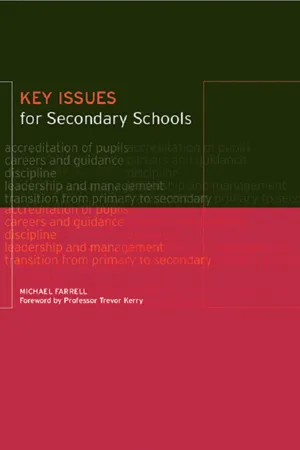
Michael Farrell presents an examination of the main issues affecting secondary schools and the implications for secondary education. The resource includes information on accreditation of pupils, careers education and guidance, discipline, leadership and management and transition from primary to secondary school.
By using the A-Z format, he tackles the issues in an easy to follow way. Each section ends with a series of points for action, selective suggestions for further reading and addresses of useful contacts.
Michael Farrell's book is intended for a wide range of people professionally concerned with education, from Headteachers and governors to BEd and PGCE students. It is a reference book that no secondary school should be without.
Information
Bibliography
Audit Commission (1998) Changing Partners, London, Stationery Office.
Audit Commission (1999) Missing Out, London, Audit Commission.
Ayre, D. (1995) School Governors and More Able Children, London, DfEE.
Barber, M. (1999) ‘Outcome depends on the middle years’, Times Educational Supplement, 1 October, p. 17.
Bardsley, K., Costa, P. and Walton, J. (1999) ‘The essential elements of an effective attendance policy’ in E. Blyth and J. Milner (1999) Improving School Attendance, London, Routledge.
Berkeley, R. (1999) Not Fitting In: Exclusions from school, a local study, Oxford, Department of Educational Studies, University of Oxford.
Blagg, N. (1991) Can We Teach Intelligence? A Comprehensive Evaluation of Feuerstein’s Instrumental Enrichment Programme, Hillsdale, N.J.: Erlbaum.
Bleach, K. (2000) The Induction and Mentoring of Newly Qualified Teachers, London, David Fulton.
Bloomer, M. (1997) Curriculum Making in Post-16 Education: The social conditions of studentship, London, Routledge.
Blythe, E. and Milner, J. (1999) Improving School Attendance, London, Routledge.
British Educational Suppliers Association (annually) The Complete Guide to British Educational Supply, London, BESA.
Brophy, J. E. (1979) ‘Teacher behaviour and its effects’ Journal of Educational Psychology 71, 6.
Brophy, J. E. (1983) ‘Classroom organisation and management’ The Elementary School Journal 83, 4.
Brown, S. (1990) in T. Horton (ed.) Assessment Debates, Milton Keynes, The Open University Press, pp. 5–11.
Bruner, J. (1986) Actual Minds, Possible Worlds, Cambridge, Mass., Harvard University Press.
Burden, R. (1998) in R. Burden and M. Williams (eds) Thinking Through the Curriculum, London, Routledge.
Clarke, A. and Millard, E. (1998) Gender in the Secondary Curriculum: Balancing the books, London, Routledge.
Davies, J. (1998) ‘Taking risks or playing safe’ in A. Clarke and E. Millard (1998) Gender in the Secondary Curriculum: Balancing the books, London, Routledge.
Department for Education (1993) Circular 9/93: Protection of Children: Disclosure of criminal background of those with access to children, London, DFE.
Department for Education (1994) Code of Practice on the Identification and Assessment of Special Educational Needs, London, DFE.
Department for Education (1994) Circular 1/94: Religious Education and Collective Worship, London, DFE.
Department for Education (1995) Circular 10/95: Protecting Children from Abuse: The role of the education service, London, DfEE.
Department for Education and Employment (1997) Circular 13/97: The Standards Fund 1998–99, London, DfEE.
Department for Education and Employment (1997) Circular 10/97 Teaching: High Status, High Standards: Requirements for courses of initial teacher training, London, DfEE.
Department for Education and Employment (1997) Excellence in Schools (White Paper) Cm. 3681, London, The Stationery Office.
Department for Education and Employment (1997) Excellence for All Children: Meeting special educational needs, London, DfEE.
Department for Education and Employment (1997) School Self Improvement: From targets to action-guidance to support effective target-setting in schools, London, DfEE.
Department for Education and Employment (1998) Circular 11/98: Target-Setting in Schools, London, DfEE.
Department for Education and Employment (1998) Meeting Special Educational Needs: A programme of action, London, DfEE.
Department for Education and Employment (1998) Circular 4/98: Teaching: High status, High standards: Requirements for courses of initial teacher training, London, DfEE.
Department for Education and Employment (1998) Excellence for All Schools, London, DfEE.
Department for Education and Employment (1998) Teachers Meeting the Challenge of Change, London, DfEE.
Department for Education and Employment (1998) Excellence in Research on Schools, Report No. 74 [The Hillage Report], London, DfEE.
Department for Education and Employment (1999) Circular 10/99: Social Exclusion: Pupil support, London, DfEE.
Department for Education and Employment (1999) Reviewing Performance and Pay of Heads and Deputy Heads: Guidance for governors, London, DfEE.
Department for Education and Employment (1999) Performance Management Framework for Teachers: Consultation Document, London, DfEE.
Department for Education and Employment (1999) Code of Practice on LEA–School Relations, London, DfEE.
Department for Education and Employment (1999) The Education (Individual Pupil Information) (Prescribed Persons) Regulations 1999 (Statutory Instrument 1999 No. 903), London, DfEE.
Department for Education and Employment (1999) Circular 06/99: Schools Causing Concern, London, DfEE.
Department for Education and Employment (1999) Excellence in Cities, London, DfEE.
Department for Education and Employment (1999) Social Inclusion: Pupil support, London, DfEE.
Department for Education and Employment (1999) Tackling Truancy, London, DfEE.
Department for Education and Employment (1999) Consultation Document on Governors’ Regulations, London, DfEE.
Department for Education and Employment (2000) Raising Aspirations in the 21st Century, London, DfEE.
Department for Education and Employment (annually) The Autumn Package, London, DfEE.
Department for Education, Home Office, Department for Health (1991) Working Together Under the Children Act 1989: A guide to arrangements for interagency co-operation for the protection of children from abuse, London, Department for Education, Home Office, Department for Health.
Department for Education and Employment and Office for Standards in Education (1997) From Targets to Action: Guidance to support effective target set...
Table of contents
- Cover
- Title
- Copyright
- Contents
- Foreword
- Acknowledgements
- Introduction
- Accreditation of pupil achievement: Balancing relevance and cohesiveness
- Assessment and its uses
- Attendance: How it can be improved
- Benchmarking: Comparing like with like?
- Careers education and guidance and work preparation
- Child protection: Systems and understanding
- Curriculum developments: Balancing cohesiveness and flexibility
- Discipline: Improving and maintaining it
- Failing schools: Lessons to be learned
- Information and communications technology: Keeping ahead
- Leadership and management: Its impact in the classroom
- Media relationships
- Moral values, school ethos and pupil attitudes
- National and local responsibilities: A new balance
- Partnerships: Governors, parents and the community
- Personal, social and health education: A communal approach
- Professional development: Towards a systematic approach
- Pupil differences: Gender and ethnicity
- Quality approaches and project management
- Resources and their best use
- School improvement plans: Optimising their effect
- Special educational needs: Some recent trends
- Standards and effectiveness
- Target setting: Behind the jargon
- Thinking skills and research skills
- Transition from primary to secondary school: Securing successful transfer
- Value added: Support or illumination?
- Very able pupils: Improving their attainment and contribution to the school
- Glossary (selective)
- Bibliography
Trusted by 375,005 students
Access to over 1.5 million titles for a fair monthly price.
Study more efficiently using our study tools.
Frequently asked questions
Yes, you can cancel anytime from the Subscription tab in your account settings on the Perlego website. Your subscription will stay active until the end of your current billing period. Learn how to cancel your subscription
No, books cannot be downloaded as external files, such as PDFs, for use outside of Perlego. However, you can download books within the Perlego app for offline reading on mobile or tablet. Learn how to download books offline
Perlego offers two plans: Essential and Complete
- Essential is ideal for learners and professionals who enjoy exploring a wide range of subjects. Access the Essential Library with 800,000+ trusted titles and best-sellers across business, personal growth, and the humanities. Includes unlimited reading time and Standard Read Aloud voice.
- Complete: Perfect for advanced learners and researchers needing full, unrestricted access. Unlock 1.5M+ books across hundreds of subjects, including academic and specialized titles. The Complete Plan also includes advanced features like Premium Read Aloud and Research Assistant.
We are an online textbook subscription service, where you can get access to an entire online library for less than the price of a single book per month. With over 1.5 million books across 990+ topics, we’ve got you covered! Learn about our mission
Look out for the read-aloud symbol on your next book to see if you can listen to it. The read-aloud tool reads text aloud for you, highlighting the text as it is being read. You can pause it, speed it up and slow it down. Learn more about Read Aloud
Yes! You can use the Perlego app on both iOS and Android devices to read anytime, anywhere — even offline. Perfect for commutes or when you’re on the go.
Please note we cannot support devices running on iOS 13 and Android 7 or earlier. Learn more about using the app
Please note we cannot support devices running on iOS 13 and Android 7 or earlier. Learn more about using the app
Yes, you can access Key Issues for Secondary Schools by Michael Farrell in PDF and/or ePUB format, as well as other popular books in Education & Education General. We have over 1.5 million books available in our catalogue for you to explore.