- 276 pages
- English
- ePUB (mobile friendly)
- Available on iOS & Android
eBook - ePub
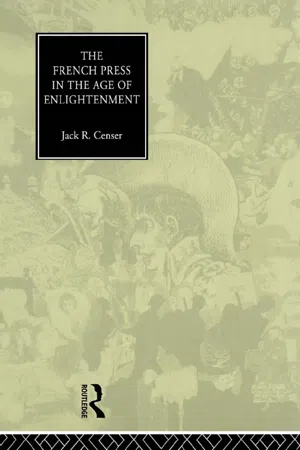
The French Press in the Age of Enlightenment
About this book
First Published in 2004. The ideas of the Enlightenment and belligerent royal officials critically influenced the French Revolution, but how did an entire generation learn about such ideas prior to the Revolution? Jack R. Censer's achievement in this volume is to marshal a vast literature in order to provide a coherent and original interpretation of the role of the French Press in the dissemination of social and political ideas in the years leading up to the Revolution. Censer also explores the relationship between journalists and government officials and unearths a range of sophisticated censorship techniques employed by the government to keep Bad News off the front pages. In a field dominated by specialized studies but few generalizations, The French Press in the Age of Enlightenment provides a bold synthesis regarding the periodical press from mid-century to the Revolution.
Part I
CONTENT
1
THE POLITICAL PRESS
The French political press originated in 1631 and was launched in earnest when Théophraste Renaudot, under the aegis of Cardinal Richelieu, founded the Gazette de France. Closely tied to the government, this newspaper from its inception depended on and reflected royal policy. While handbills, fliers, and manuscript materials abounded, the government squashed any effort to begin alternatives because it had guaranteed a monopoly to Renaudot.1 Nonetheless, within fifteen years new Francophone organs established themselves across the border to take advantage of the French market and address other French-language readers throughout Europe.
By the middle of the eighteenth century, this system had evolved into the continuing Gazette de France and several other extraterritorial papers, though only a few were allowed to enter France. An alteration of policy in the late 1750s opened the borders to a dozen or more periodicals.2 Most important among them were one in Germany (Courrier du Bas-Rhin), another in Avignon, and four based in Dutch cities—The Hague, Amsterdam, Leiden, and Utrecht.3 Along with the Gazette de France, this press generally shared a somber style and comprehensive coverage. A few other political magazines with relatively low periodicities existed, and they have been dropped in this analysis. Focus remains on these gazettes, all similar. Whatever their similarities in appearance, all extraterritorial papers enjoyed an independence from France totally unavailable to the Gazette, though they too differed widely among themselves. Interest in this sort of publication continued right up to the Revolution, as Pierre Le Brun founded his Journal général de l’Europe in Liège in 1785.4 Indeed, several of these publications managed to continue well after 1789.5
If one focuses upon the entire period of this study, 1745 to early 1787, the Gazette de France and its relatives provided the lion’s share of political information to contemporary readers. But throughout this period there were papers that varied from this approach, including a few adventurers who tried to publish the equivalent of the gossipy nouvelles à la main.6
After 1770, however, some really important innovations appeared. Beginning in 1772, the government accepted a proposal by the press tsar Charles-Joseph Panckoucke to publish under its general guidance a paper—the Journal de Genève—that would in theory have a foreign provenance but actually a French base. Two years later he added a literary section to this paper, also using it within another paper he founded, the Journal de Bruxelles. At first the latter had its own political reporting, but by 1778 the political sections of both papers had become identical. In the same year, the Mercure de France added the political portion of the Brussels sheet to its pages.7 These two French organs differed from other newspapers because they were clearly—at least to twentieth century observers—papers produced in France that nonetheless claimed a foreign origin. Even though their copy might approach the foreign papers, the government held more direct promises of conformity. One other feature separated them from their major competitors. They appeared more like a magazine, with fewer and longer articles than their predecessors.
Other papers with links to the government emerged to compete with the Gazette de France, foreign gazettes, and the “Brussels” and “Geneva” hybrids with their revised formats. In the middle 1770s, the foreign minister, Count de Vergennes, to further his policy of supporting the American revolutionaries against the British, helped set up and subsidized the Affaires de l’Angleterre et de l’Amérique. In addition, the Courrier de l’Europe, which began its life like other foreign gazettes, also became a much more controlled organ. Their mixture of independence and dependence may have been roughly equivalent to Panckoucke’s journals, though here, as we shall see, the government systematically played a dangerous game by allowing news that, though favorable at the level of foreign policy, promulgated democratic ideas. From its inception in 1776, the Affaires de l’Angleterre et de l’Amérique also distinguished itself by a far more analytic style than that of any other political paper.8 This overall strategy had been tried from the middle 1750s but without major effect.9
Another, and in this case, completely different, political periodical was the Annales littéraires et politiques, begun in 1777 by Simon-Nicolas-Henri Linguet. In a sense this paper resembles the foreign gazettes because it was a privately-run journal published abroad. But that vastly overstates the comparison. Like the Affaires de l’Angleterre et de l’Amérique, the Annales was a journal with a focus, in this case the opinions of Linguet. And his views were possibly the most extreme published prior to the Revolution.10
This panoply of print organs competed for the French public’s attention. As the introductory chapter argued, the main question about this press is assessing how problematic was it in its own time. The conclusion will address its role in the Revolution. Generally, in the case of politics during the Old Regime, royal self-justifications about the monarchy’s claim to rule according to divine right marked the conservative end of the spectrum. More difficult to determine is the polar opposite where many opinions contested. But at the least it may be said that contemporaries, while never envisioning a revolution, scorned, and some even vilified, both sitting kings of the last half of the eighteenth century.11 While some scholars have placed the press close to the conservative pole,12 the few who have offered alternatives have tended to discern an evolution toward radicalism.13
To address the political meaning of the press, one may begin by asking how clearly did it allow the audience to perceive the political world? Here the focus is, for obvious reasons, on French readers. Did they feel close to the action or far removed from vague images? Did they sense great distance or high magnification of the details and the overall situation? The point is to measure how distant they felt from political activity, not to measure the accuracy or competency of the press. While the latter topic is an important one that other scholars may wish to consider, the appearance of politics provides a reliable index to the “feel” or texture of the press as experienced by contemporaries. The emphasis in this book on the contemporary readers’ understanding further reinforces this concern. A second question, worthy of attention for similar reasons, is the political viewpoint available in the press. Narrowing, and thus sharpening, the focus leads to studying the audience’s understanding of the French government, surely the most significant question for French people. Concentrating on France does not mean assessing only French news because foreign news also held implications for France. And readers, knowing that the press was at least somewhat controlled, would have read the entire paper with an awareness of what they could learn about their own land through a variety of portals. Considering the perspective on France obviously contributes to assessing how troubling was the press. But the first question is important too because, as the conclusion to this chapter will further discuss, the clarity of the news holds implications about time that could contest monarchial prerogatives.
To understand the nature of the coverage, one might logically begin with the Gazette de France but, as will become evident, this newspaper so resembled its foreign doubles that first examining them turns out to be an acceptable strategy. For these extraterritorial gazettes, the basic unit of reporting was the event, understood here as an occurrence or series of occurrences happening over a short period and linked together in the minds of contemporaries. Thus, the news consisted mainly of events, for example, battles rather than military campaigns, or royal visits rather than complete accounts of perambulations.
In the foreign press, most events received only terse coverage. So short were these that contemporaries could only have seen them as cryptic. Even those then deemed significant, still were encapsulated in mere summaries. This lack of detail likewise made the subjects in any one of these news items fuzzy, indistinct, and indeed difficult to grasp.
Other problems further plagued these brief entries making the subjects described even fuzzier to readers. In part, so foggy a picture emerged because of the structure of the Old Regime newspaper, which was mainly organized into separate sections of news from major capitals. Each section housed a series of reports, usually written in the first person plural, about the concerns of that city. Thus, the reader of a pre-revolutionary paper would confront news items which usually seemed to describe occurrences from the point of view of the residents of different cities. As such, these articles generally emanated from a source distant from the readers, who were left to speculate on what the writer might have left out of any given article. This approach was clearly less appealing to the subscribers than one that somehow suggested a shared outlook with them.
Further increasing the reader’s tendency to sense that news items issued from hostile or at least unsympathetic sources were the frequent contradictory reports. Differences of fact or interpretation emerged from one issue of a paper to the next or even in different parts of a single issue. Views of the same subject varied a great deal. Because many differences stemmed from the coverage of the same event in the reports of several cities, these contradictions reinforced a perception of the newspaper as an accumulation of many biases alien to the reader.
Certain discrepancies among stories—especially when different national origins were not involved—might have estranged readers from events in an entirely different way. Such divergence portrayed the world as complex, if not confused. In this fashion the world receded from the reader. And the general skimpiness of coverage only reinforced this confusion.
Encouraging such separation between reader and event was a rather strange geographical divide between the subscriber and the event. Because these newspapers were produced beyond the frontier, the French reader often perused a newspaper from a distant place. Even stories from France were transmitted across the border and then back into France. All of this movement could not have encouraged readers to feel close to the source. News always seemed to come from far away.
Chronological gaps reinforced the geographical distance. Given the structure of the press and the slowness of the mails, readers often learned of an event two weeks after its occurrence, although the very efficient Gazette de Leyde could often shave off a few days. And sometimes the gap was far greater. This chronological distance could often be exacerbated if the news source transmitted the material in batches. Even if these mailings were separated by only a day or two, the vagaries of the postal service combined with the weekly publication of most papers could divide reports over several weeks, creating an impression of chronological dis jointedness.14
If readers felt distant from the news in the paper they perused, editors claimed no greater proximity. The latter constantly blamed delays on correspondents or on the post, both of whom editors felt powerless to control. One need only scan the papers to find editors claiming that they were at the mercy of their sources. And, to explain their often contradictory reports, the editors frequently averred that they too were mystified and had simply published what they had received. Not only did editors accept their distance from the events covered, they also associated their position with that of their readers. In demeanor and in appeals, editors linked themselves to their readers.15
But could perusing several periodicals overcome this distance? Certainly the geographic and chronological gap would remain the same. And the contradictions that led to doubts and feelings of alienation from the narrator would in almost all cases increase. Nothing would seem to alleviate the impression that editors were far removed from politics. Only in some small matters could readers increase mastery over events. Insofar as the papers relied on different sources, the audience might experience an overlapping coverage that would encourage them to believe their knowledge was greater. But most readers would find the overall effect to be much the same as reading their initial newspaper.
In some cases, foreign periodicals gave an event more than a paragraph or two. Some coverage ran on for several paragraphs while, for some events considered especially significant, reporting achieved even greater dimensions. This essay considers these last exceptions because, even though a minority, these far larger reports may have proved the most lucid. Although in these cases the extraterritorial papers could provide quite substantial material, they nevertheless did not overcome all of their customary limits. Indeed, some of these treatments seemed afflicted by virtually all the problems of the shorter reports though others offered much improved coverage.
Most of the variation regarding larger reports may be illustrated by comparing the effort of the Courrier d’Avignon with that of the Gazette de Leyde regarding the Gordon Riots, a great anti-Catholic explosion in London from June 2 to June 9, 1780. In the Avignon paper, news began to appear in the June 20 edition. A very skimpy, undated report formed one paragraph of the twice weekly paper’s eight pages. This initial story from London seemed to refer only to the opening day of the conflagration. But the next issue, June 23, included a complete account, more than one full page, dated June 20, that chronicled the tumultuous week. The following issue, published June 27, contained a report of June 11, illuminating further details. This one and one-half column piece (three-fourths of a page) focused on the fate of Lord George Gordon and the crowd and printed verbatim the British royal proclamation which provided the monarchical version of events. The June 30 Courrier mainly retracted much of the previous issue’s report. But in this edition of the paper, the editors also tried to explain their contradictory coverage. The Courrier of July 4 and July 7 added further detail in short reports. The riots then disappeared from the paper, although occasional reports trickled in about the fate of Lord George Gordon and about parliamentary debates on new measures designed to reduce popular activity.
Despite reporting that lasted over three weeks and often occupied significant space in the Courrier, readers likely saw this event as transpiring at considerable distance. First, the perspective on the riots was obviously not their own. The narrator of the stories appeared to readers, regardless of the reality, as an Englishman on the scene, engaged in the swirl of events. The other significant voice appearing in the Courtier’s reports was that of official royal pronouncements. But what most clearly marks these stories as emanating from another viewpoint is how the paper handled conflicting reports. The edition of the Courrier for June 27 reported that because of the dire situation, the king had suspended the laws and ordered military action. The result was 500 dead and 17 hanged. The next edition of the paper retracted this story and asserted that the laws had not been suspended. To explain the discrepancy, the editors claimed that during the heat of battle, commentators from different points of view provided varying accounts. Now, posited the editors, they had found a reliable source. This agonizing over credibility reveals that the paper was trying to assert itself over the competing versions. However, both the contradiction itself and the initial explanation about bias emerging in troubled situations were likely to reinforce the readers’ perception that the Courrier mainly spoke the political language of those about whom it reported.
Of course, such open grappling with these contradictions not only revealed the distance of subscribers but that of editors as well. And the newspapermen gave other direct testimony on their remove from events. From the very beginning of the Gordon Riots, the Courtier’s writers accepted their dependence on distant correspondents. Indeed, the first article emphasized: “The English papers have stated….” But it is in the precise language of the issue of June 30, which attempted to explain the contradictory reporting about the suspension of laws, that we can appreciate best the relationship of the editor to the ne...
Table of contents
- Cover Page
- Title Page
- Copyright Page
- Tables
- Acknowledgements
- Introduction: The Periodical Press
- Part I Content
- Part II Milieu
- Conclusion
- Appendix I Publication Estimates for Periodicals that Existed During the Years 1745–86
- Appendix II Sampling the Press 1745–86
- Notes
Trusted by 375,005 students
Access to over 1.5 million titles for a fair monthly price.
Study more efficiently using our study tools.
Frequently asked questions
Yes, you can cancel anytime from the Subscription tab in your account settings on the Perlego website. Your subscription will stay active until the end of your current billing period. Learn how to cancel your subscription
No, books cannot be downloaded as external files, such as PDFs, for use outside of Perlego. However, you can download books within the Perlego app for offline reading on mobile or tablet. Learn how to download books offline
Perlego offers two plans: Essential and Complete
- Essential is ideal for learners and professionals who enjoy exploring a wide range of subjects. Access the Essential Library with 800,000+ trusted titles and best-sellers across business, personal growth, and the humanities. Includes unlimited reading time and Standard Read Aloud voice.
- Complete: Perfect for advanced learners and researchers needing full, unrestricted access. Unlock 1.5M+ books across hundreds of subjects, including academic and specialized titles. The Complete Plan also includes advanced features like Premium Read Aloud and Research Assistant.
We are an online textbook subscription service, where you can get access to an entire online library for less than the price of a single book per month. With over 1.5 million books across 990+ topics, we’ve got you covered! Learn about our mission
Look out for the read-aloud symbol on your next book to see if you can listen to it. The read-aloud tool reads text aloud for you, highlighting the text as it is being read. You can pause it, speed it up and slow it down. Learn more about Read Aloud
Yes! You can use the Perlego app on both iOS and Android devices to read anytime, anywhere — even offline. Perfect for commutes or when you’re on the go.
Please note we cannot support devices running on iOS 13 and Android 7 or earlier. Learn more about using the app
Please note we cannot support devices running on iOS 13 and Android 7 or earlier. Learn more about using the app
Yes, you can access The French Press in the Age of Enlightenment by Jack Censer in PDF and/or ePUB format, as well as other popular books in History & French History. We have over 1.5 million books available in our catalogue for you to explore.