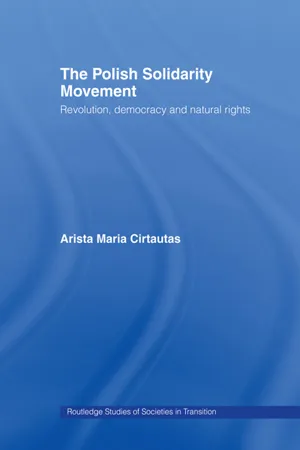
eBook - ePub
The Polish Solidarity Movement
Revolution, Democracy and Natural Rights
- 336 pages
- English
- ePUB (mobile friendly)
- Available on iOS & Android
eBook - ePub
About this book
This book provides a groundbreaking analysis of democratization in Poland by placing Solidarity in the context of the major democratic upheavals of modernity: the French and American Revolutions. This study undertakes the first full historical comparison of the Polish movement with the ideals and institutions of democracy achieved in the last three centuries.
Information
1 The charismatic presentation of natural rights
A Weberian theory of democracy
The belief that democracy represents a desirable goal or reality is so prevalent today that it is almost taken for granted. Throughout the world, a plethora of constitutions and battalions of politicians pay homage to the “will of the people” as the essential attribute of democracy. How this popular will is actually to be represented and articulated may be subject to various interpretations, but a commitment to the people’s will as the leitmotif of government is universally acknowledged by those nations considering themselves to be democratically constituted. This commitment is, however, of relatively recent vintage. As David Held remarks, “the widespread adherence to democracy as a suitable form for organizing political life is less than a hundred years old.”1 While democracy itself has a long history dating back to the Greek city states, for most of that history it was considered a radical and dangerous form of organizing political life. At some point, however, a change in perception took place. A form of government that was once considered radical is now considered eminently rational and morally suitable. Yet what precisely is the nature of this rationality, and on what basis can it be legitimated? These are the central questions that will concern us in this chapter.
THE SPIRIT OF MODERN DEMOCRACY
When Weber conceived of his ideal typical representation of the spirit of capitalism in his famous work The Protestant Ethic and the Spirit of Capitalism, he did so on the basis of his methodological concept of the “historical individual,” i.e. “a complex of elements associated in historical reality which we unite into a conceptual whole from the standpoint of their cultural significance.”2 Weber believed that one could only arrive at such a conceptual definition by understanding historical reality in terms of “concrete genetic sets of relations which are inevitably of a specifically unique and individual character,” not in terms of “abstract general formulae.”3 In other words, the phenomenon under consideration must be observed from an historical perspective in order to distill the “complex of elements” or the “sets of relations” that make an essential contribution to the cultural significance of the phenomenon. Before generating such a conceptual or ideal-typical definition of capitalism, Weber provided a “provisional description” of the spirit of capitalism based on the texts of Benjamin Franklin. In what follows, by drawing on Thomas Paine’s The Rights of Man, a similar description of the spirit of modern democracy will be presented. The intention here is not to present a fully elaborated review of major democratic thinkers. Rather, it is to provide some insight into the essential nature of democracy by drawing on the work of a representative author. Subsequently, a conceptual definition of democracy will be attempted. Both the description and the definition are intended to address two analytical levels. First, the nature of the ethos or the guiding beliefs that animate modern democracy will be illustrated. Second, the practical conduct and the form of political organization typical of modern democracy will be assessed. Taken together, these two analytical levels comprise the spirit or the “historical individuality” of modern democracy. At first glance, Paine might seem like an odd choice for the purpose of determining this “individuality” given the prevalent tendency in the literature on democracy to focus on the works of such undoubtedly important figures as Locke, Mill, Jefferson or Madison. In this company, Paine is not often seen as a particularly profound or original thinker. However, The Rights of Man warrants closer examination because of its powerful popular impact. In England, for example, Paine became an “instant hero” after its publication,
not only to the intellectual radicals among whom he moved, such as Blake, Holcroft, Horne Tooke, Godwin and Wollstonecraft, but to hundreds of thousands of artisans and journeymen who bought Rights of Man for sixpence or read it reprinted by their provincial radical association.4
Written in the heat of battle, like the Communist Manifesto, it is a focused and concentrated work condensing the fundamental principles of democracy into an abbreviated format in order to win adherents to the cause of democratic revolution. Accordingly, whatever Paine’s work might lack in intellectual depth is more than compensated for by its clarity and forcefulness. As Foot and Kramnick point out,
Paine developed and was the first master of democratic prose, which is as important in explaining his appeal to a mass readership as is the content of his arguments. Jefferson, himself a master of political prose, saw the unique strength of Paine’s prose, writing in 1821 that “No writer has exceeded Paine in ease and familiarity of style in perspicuity of expression, happiness of elucidation, and in simple and unassuming language.”5
Moreover, “the content of his arguments” as well have considerable merit—to the extent that the historian A. J. P. Taylor deemed The Rights of Man to be “the best statement of democratic belief in any language.”6 Taken together, then, a democratic style of writing combined with the elaboration of democratic ideas made Paine a highly influential, some would argue the most influential, writer of the revolutionary era.
For Paine, the ethos and organization of democratic life were, first and foremost, the products of reason. Yet he found himself having to defend the reasonableness and the rationality of democracy from the attack launched by Edmund Burke against the democratic principles of the French Revolution. In response to Burke, Paine constructed a series of arguments in favor of the rights of man and the government best able to guarantee these rights, namely representation grafted onto simple democracy. The logic of these arguments represents a pivotal chapter in the transformation of democracy from a radical manifestation of the will of the feckless mob, or of the “swinish multitude,” to a rational manifestation of the will of reasonable individuals endowed with natural rights. Paine attacked both the principles and the form of the traditional government of hereditary monarchy on the grounds that man, as a rational being with natural rights, could only be content with principles of government derived directly from these natural rights, and encased in a form of government consistent with these principles.
In the course of his debate with Burke, Paine elaborates on the two major themes that animate the spirit of modern democracy. First, the conviction that man has rights as an individual, not as the member of a family, a status group, a tribe or a race. Second, simply by virtue of being a man it is assumed that the capacity for reason and rational conduct follows. Provisionally, therefore, one can describe modern democracy as the rational political organization of free individuals.7 For Paine, the foundation of individual freedom lies in the natural rights that endow man with the right to act as an individual:
Natural rights are those which appertain to man in the right of his existence. Of this kind are all the intellectual rights, or rights of the mind, and also all those rights of acting as an individual for his own comfort and happiness, which are not injurious to the natural rights of others. Civil rights are those which appertain to man in right of his being a member of society. Every civil right has for its foundation some natural right pre-existing in the individual, but to the enjoyment of which his individual power is not, in all cases, sufficiently competent. Of this kind are all those which relate to security and protection.8
According to Paine, these natural rights derive their force and validity from the religiously defined origins of man.
The illuminating and divine principle of the equal rights of man (for it has its origin from the Maker of man), relates not only to the living individuals, but to generations of men succeeding each other. Every generation is equal in rights to the generations which preceded it, by the same rule that every individual is born equal in rights with his contemporary. Every history of the Creation, and every traditionary account, whether from the lettered or unlettered world, however they may vary in their opinion or belief of certain particulars, all agree in establishing one point, the unity of man; by which I mean that men are all of one degree, and consequently that all men are born equal, and with equal natural rights, in the same manner as if posterity had been continued by creation instead of generation, the latter being only the mode by which the former is carried forward; and consequently, every child born into the world must be considered as deriving its existence from God. The world is as new to him as it was to the first man that existed, and his natural right in it is of the same kind.9
Because Paine believed that “man did not enter into society to become worse than he was before, nor to have fewer rights than he had before,” the only reasonable form of government consistent with the natural rights of man was derived from the “social compact,” wherein man “deposits his right in the common stock of society, and takes the arm of society, of which he is a part, in preference and in addition to his own. Society grants him nothing. Every man is proprietor in society, and draws on the capital as a matter of right.”10 Based on this logic, Paine drew three crucial conclusions about the principles that should animate government derived from the “social compact”:
First, that every civil right grows out of a natural right; or, in other words, is a natural right exchanged. Secondly, that civil power, properly considered as such, is made up of the aggregate of that class of the natural rights of man, which becomes defective in the individual in point of power, and answers not his purpose, but when collected to a focus, becomes competent to the purpose of every one. Thirdly, that the power produced from the aggregate of natural rights, imperfect in power in the individual, cannot be applied to invade the natural rights which are retained in the individual, and in which the power to execute is as perfect as the right itself.11
Subsequently, Paine applied these principles to the formation of governments:
In casting our eyes over the world, it is extremely easy to distinguish the governments which have arisen out of society, or out of the social compact, from those which have not: but to place this in a clearer light than what a single glance may afford, it will be proper to take a review of the several sources from which the governments have arisen, and on which they may be founded. They may all be comprehended under three heads. Firstly, superstition. Secondly, power. Thirdly, the common interests of society, and the common rights of man. The first was a government of priestcraft, the second of conquerors, and the third of reason.12
Based on this definition of reason, Paine accorded the French Constitution and the American system of government the accolade of being rational in both form and principle:
In contemplating the French Constitution, we see in it a rational order of things. The principles harmonize with the forms, and both with their origin. It may perhaps be said as an excuse for bad forms, that they are nothing more than forms; but this is a mistake. Forms grow out of principles, and operate to continue the principles they grow from. It is impossible to practice a bad form on anything but a bad principle. It cannot be ingrafted on a good one; and wherever the forms in any government are bad, it is a certain indication that the principles are bad also.13
By “ingrafting representation upon democracy” the American government has “fixed the form by a scale paralleled in all cases to the extent of the principle.”14 As Paine concluded unequivocally, “the representative system takes society and civilization for its basis; nature, reason and experience for its guide.”15 Moreover, such a system is eminently desirable for the beneficial effects it produces:
As the republic of letters brings forward the best literary productions, by giving to genius a fair and universal chance; so the representative system of government is calculated to produce the wisest laws, by collecting wisdom where it can be found.16
To this system of wisdom and reason, Paine contrasted the fatuousness of hereditary monarchy:
How irrational then is the hereditary system which establishes channels of power, in company with which wisdom refuses to flow! By continuing this absurdity, man is perpetually in contradiction with himself; he accepts, for a king, or a chief magistrate, or a legislator, a person whom he would not elect for a constable.17
Again and again, Paine argued against the world of custom and privilege and hereditary status on the basis that it is unnatural and therefore unreasonable. For example:
We must shut our eyes against reason, we must basely degrade our understanding, not to see the folly of what is called monarchy. Nature is orderly in all her works; but this is a mode of government that counteracts nature. It turns the progress of the human faculties upside down. It subjects age to be governed by children, and wisdom by folly. On the contrary, the representative system is always parallel with the order and immutable laws of nature, and meets the reason of man in every part.18
In Paine’s opinion, the “rational system of representative government” was the logical outcome of the capacity for rational conduct that he believed was inherent to man. Every individual is capable of defining and pursuing his interests:
Every man is a proprietor in government and considers it a necessary part of his business to understand. It concerns his interest, because it affects his property. He examines the cost, and compares it with the advantages; and above all, he does not adopt the slavish custom of following what in other governments are called leaders.19
In contrast to such slavish customs which were buttressed by the traditional perception that “government is some wonderful mysterious thing,”20 Paine maintained that “the government of a free country, properly speaking, is not in the persons, but in the laws. The enacting of those requires no great expense; and when they are administered, the whole of civil government is performed.”21 For Paine, the purpose of government could not be ascribed to tradition or superstition, rather government had to be the means to a particular set of ends:
Government is nothing more than a national association; and the objective of this association is the good of all, as well individually as collectively. Every man wishes to pursue his occupation, and enjoy the fruits of his labors, and the produce of his property, in peace and safety, and with the least possible expense. When these things are accomplished, all the objects for which government ought to be established are answered.22
Similarly, the forming of a constitution also had to follow this logic:
In forming a constitution, it is first necessary to consider what are the ends for which government is necessary: secondly, what are the best means, and the least expensive, for accomplishing those ends.23
Paine evidently considered the creation of the American Constitution to be exemplary in this regard:
Here we see a regular process—a government issuing out of a constitution, formed by the people in their original character; and that constitution serving, not only as an authority, but as a law of control to the government. It was the political bible of the State.24
Yet even that constitution may be subject to revision in the future if the progress of reason were to determine a more appropriate and even more rational form. As Paine concluded:
The best constitution that could now be devised, consistent with the condition of the present moment, may be far short of that excellence which a few years may afford. There is a morning of reason rising upon man, on the subject of government, that has not appeared before.25
Under the influence of this “morning of reason,” Paine sought to discredit decisively the traditional forms and principles of government that stood in the way of what he believed was a more rational, reasonable and efficient organization of political life. The rational nature of modern democratic political organizations, so vividly exemplified by Paine’s work, can be captured by Weber’s concept of instrumental rationality. Paine’s belief that democratic government, and the constitution it is founded upon, should be the product of a calculation of the best and least expensive means for accomplishing certain ends corresponds to Weber’s statement that:
Action is instrumentally rational when the end, the means, and the secondary results are all rationally taken into account and weighed. This involves rational consideration of alternative means to the end, of the relations of the end to the secondary consequences, and finally of the relative importance of different possible ends.26
Yet, as Paine’s treatise also demonstrates, this rational form of organization was bound to the ethical norms provided by the natural rights doctrine. Such a form of political rule or government was thus both sanctioned and constrained by the “ethically colored maxims”27 that comprise the ethos of modern democracy. This paradoxical relationship wherein reason is validated by the divinely informed principles of the ethos of natural rights is an essential attribute of the phenomenon of modern democracy. The conviction that man, as an individual, has both natural rights and a natural capacity for reason is derived from a religiously based interpretation of man and, therefore, constitutes the “irrational” element of the rationality characteristic of democratically organized political life. Indeed, the very belief that rational conduct is possible among all individuals, that discipline and self-control are universal attributes of reasoning individuals, arose from this ethical base. Paine could...
Table of contents
- Cover
- Halftitle
- Title
- Copyright
- Dedication
- Contents
- Preface
- Introduction: revolution, democracy and Solidarity
- 1 The charismatic presentation of natural rights: a Weberian theory of democracy
- 2 Formal natural rights and the American Revolution
- 3 Substantive natural rights and the French Revolution
- 4 Natural rights and liberal capitalist development: an overview
- 5 The Marxist–Leninist response to natural rights and liberal capitalism
- 6 Solidarity’s articulation of natural rights
- 7 Solidarity and liberal capitalism
- Epilogue: the Polish Revolution in comparative context
- Notes
- Bibliography
- Index
Trusted by 375,005 students
Access to over 1.5 million titles for a fair monthly price.
Study more efficiently using our study tools.
Frequently asked questions
Yes, you can cancel anytime from the Subscription tab in your account settings on the Perlego website. Your subscription will stay active until the end of your current billing period. Learn how to cancel your subscription
No, books cannot be downloaded as external files, such as PDFs, for use outside of Perlego. However, you can download books within the Perlego app for offline reading on mobile or tablet. Learn how to download books offline
Perlego offers two plans: Essential and Complete
- Essential is ideal for learners and professionals who enjoy exploring a wide range of subjects. Access the Essential Library with 800,000+ trusted titles and best-sellers across business, personal growth, and the humanities. Includes unlimited reading time and Standard Read Aloud voice.
- Complete: Perfect for advanced learners and researchers needing full, unrestricted access. Unlock 1.5M+ books across hundreds of subjects, including academic and specialized titles. The Complete Plan also includes advanced features like Premium Read Aloud and Research Assistant.
We are an online textbook subscription service, where you can get access to an entire online library for less than the price of a single book per month. With over 1.5 million books across 990+ topics, we’ve got you covered! Learn about our mission
Look out for the read-aloud symbol on your next book to see if you can listen to it. The read-aloud tool reads text aloud for you, highlighting the text as it is being read. You can pause it, speed it up and slow it down. Learn more about Read Aloud
Yes! You can use the Perlego app on both iOS and Android devices to read anytime, anywhere — even offline. Perfect for commutes or when you’re on the go.
Please note we cannot support devices running on iOS 13 and Android 7 or earlier. Learn more about using the app
Please note we cannot support devices running on iOS 13 and Android 7 or earlier. Learn more about using the app
Yes, you can access The Polish Solidarity Movement by Arista M. Cirtautas in PDF and/or ePUB format, as well as other popular books in Politics & International Relations & Communism, Post-Communism & Socialism. We have over 1.5 million books available in our catalogue for you to explore.