This classic text presents problems of learning and teaching mathematics from both a psychological and mathematical perspective. The Psychology of Learning Mathematics, already translated into six languages (including Chinese and Japanese), has been revised for this American Edition to include the author's most recent findings on the formation of mathematical concepts, different kinds of imagery, interpersonal and emotional factors, and a new model of intelligence. The author contends that progress in the areas of learning and teaching mathematics can only be made when such factors as the abstract and hierarchical nature of mathematics, the relation to mathematical symbolism and the distinction between intelligent learning and rote memorization are taken into account and instituted in the classroom.
- 232 pages
- English
- ePUB (mobile friendly)
- Available on iOS & Android
eBook - ePub
About this book
Information
8
A New Model of Intelligence
Teachers And Learners
A human child is at the most learning age of the most learning species that has yet evolved on this planet.
We learn in a variety of ways. Some of these, such as operant conditioning and habit learning, we share with other animals. But one of these ways is unique to man—to homo sapiens: not just the naked ape, as a zoologist (Morris, 1967) has called us, but the understanding ape—the ape with the potential for knowledge, even wisdom. The extent to which this potential is realised will depend, for each individual, on how he develops the intelligence with which he is born, just by virtue of being human.
This, in turn, will largely depend on his teachers. These begin with his informal teachers, such as his parents, grandparents, older brothers, and sisters. Soon, and importantly, these come to include professional teachers.
Some of the best teaching is indirect (e.g., by providing interesting activities for children to explore together). So by teaching, I mean any kind of action that is intended to influence the learning process. This process is inaccessible to direct observation by an outside person in the same way as our internal bodily processes are to a medical practitioner. In both these cases, a person who intervenes without an adequate mental image of what is going on inside is as likely to do harm as good.
In this chapter, I offer an outline for a mental model of intelligence. A full presentation occupies a 300 page book (Skemp, 1979a), so a single chapter in the present book can be no more than an outline. However, ‘a journey of a thousand miles begins with a single step’, and in this chapter I offer some suggestions for the first few steps.
Habit Learning and Intelligent Learning
I begin by developing further the distinction between habit learning and intelligent learning.
Habit learning has been extensively studied by the behaviourist school of psychologists, mainly with animals. A well-known example is provided by the Skinner box. A hungry rat is put in a cage, in which there is a bar sticking out horizontally from one side. In the course of its movements around the cage, the rat happens to press the bar, and a morsel of food is released into the cage. Eating the food reduces hunger, and each time this happens, the association between the stimulus situation (being in the cage, hungry) and bar-pressing is reinforced. Gradually this builds up into a habit.
This kind of learning is also found in humans. Here is an example. A little boy’s parents noticed that he had acquired a new and puzzling behaviour when given a biscuit. This was, while eating it, to hold the biscuit above his head between bites. When asked why, he didn’t know. On reflection, his father remembered that while on holiday they had been friendly with a family who had a little dog called Penny. Penny also liked biscuits! So we now had a probable explanation of this habit, which had persisted even when it was no longer required.
In habit learning, certain actions are reinforced as a result of their outcomes, so learning follows action. And what is learned is action; the cognitive element is small. Rote learning, such as we do when we memorize a telephone number, is verbal habit learning.
Once learned, habits are very persistent. They have low adaptability: the little boy went on with his habit long after it was no longer useful, and if our telephone number is changed, we cannot erase the old number from our minds as we do from our desk pad. The old number persists, and gets in the way of the new one.
In contrast, the main feature of intelligent learning is adaptability. Our actions are goal-directed, not stimulus-determined. We use flexible plans of action, adaptable to each new situation. These can be constructed in advance of action, and modified in the light of action. They enable us to achieve a wide variety of goals, in a wide variety of situations. What is more, we can devise several plans, and choose the best, before putting this plan into action. Intelligent learning often precedes action. And action is used not only for achieving goals, but for testing hypotheses.
At the level of habit learning, one can find some justification for the behaviourist view that our behaviour is shaped by the environment. In sharp contrast, my model for intelligent learning asserts that we can also shape our own behaviour, to achieve the same goals in different environments. If I am thirsty and want a drink of water, at home I go to the kitchen and turn on the tap. As a child, I went to the yard and worked a pump handle. In a cafe, we ask a waitress. In camp, we find a clear stream. On a winter day when our pipes froze, our breakfast coffee was made with melted snow. Different environments, different plans of action, all directed toward the same goal: relief of thirst. Each plan is based on knowledge of the environment; and building up this knowledge is a major function of intelligence. Action is not a response to an external stimulus, but directed toward whatever goal an individual has in mind. The cognitive element is great, and as a result, so is the variety of available plans. Knowledge gives adaptability. Science and technology are more sophisticated examples of this combination, of well-devised plans of action derived from knowledge. Science is concerned with building up knowledge, technology with applying it. Math is important for both.
Both kinds of learning are available to us as humans, and both have their uses. In learning to spell, rote learning is necessary for words spelled and pronounced irregularly, such as bough (on a tree), bow (respectfully), bow (and arrow), trough, enough; although we can use intelligent learning for words whose spelling is regular, such as can, ban, fan, man. The mix is different for different subjects. The right mix for mathematics is about 5% rote learning, 95% intelligent learning: but all too often it is taught in a way which makes the latter impossible.
When Is a Stimulus Not a Stimulus?
At the end of my road there is a red mail box. When I have a letter to post, in behaviourist terms this box is a stimulus to which I respond by putting the letter through the slit. From the main road my side road is inconspicuous, so when I am returning home in my car from shopping downtown, this red box acts as a landmark. Now it is a ‘stimulus’ for a different response: to signal a right turn, slow down my car, look carefully both ahead and in my mirror, and either turn or stop until it is safe to turn right.1 When returning from the opposite direction it is now a stimulus to turn left, which in this case requires less caution. And when I am going from Coventry to Kenilworth, this same stimulus evokes no response—in effect it ceases to be a stimulus.
The burden of the foregoing will be apparent. I do not find the notion that our behaviour is stimulus-determined a useful one in the context of intelligence. It belongs, if anywhere at all, to the levels of automaticity in our behavior.
Goal-Directed Action
It is a matter of simple everyday observations such as the foregoing that much human activity is goal-directed.
This implies that if we want adequately to understand what people are doing, we need to go beyond the outward and easily observable aspect of their actions, and ask ourselves what is their goal. To say that Richard Skemp is riding his bicycle may be perfectly true, but it is only part of what matters. I may be riding to my office; or I may be enjoying physical recreation with my son; or I may be testing the adjustment of my three-speed gear.
Moreover, taking the first goal state, this may underlie actions that look quite different. For example, instead of bicycling I might be standing quite still by the side of the road, waiting for a bus; or I might be walking (which in this case would also be along a different path); or I might be driving my car (in which case I would start off in a totally different direction). To limit a description of what was happening to the observable behaviours, superficially very different, would be to miss what they had in common, namely the goal state. I am not claiming that all our behaviour is goal-directed; only that some, perhaps much of it, is; and that where this is the case, to ignore it is to ignore one of its most important features.
Survival, Adaptability, and Evolution
If this assumption is true, one question leads to another. If we can identify the goal underlying certain observable activity, we want next to know what is the significance of that goal rather than some other. And the more examples we look at, the more it becomes apparent that many of our goal states have one thing in common: that they favour survival.
In the bicycling example, three possible goal states were mentioned: being in my office, physical recreation with my son, and checking my three-speed gear. Among the properties of the first goal state are being physically in a good position for doing my job—having near me colleagues, students, a telephone, books, reprographic facilities—and thereby (amongst other things) earning a living. My salary enables me to pay for food, clothing, shelter; and without these, I would not long survive. Physical recreation with my son has health-giving properties for both of us, whereby we are both likely to live longer; and it is through our children that our families, our nations and our species continue to survive when we do not. An efficient three-speed gear enables me to reach my destinations more easily, and so makes makes available more time and energy for other purposes—again, indirectly, with benefit to survival. Medium-term, long-term, and short-term, all three choices of goal state, and success in reaching them, have properties that contribute to survival.
And for a large proportion of the goal states we choose, we can find, once we get in the way of looking for them, properties that relate favourably to survival: be this state physical location, some other physical state such as temperature, or a mental state. Often these are interconnected. A person who is lost on the moors in winter (not in the mental state of knowing where he is) cannot reach a physical location where he will find shelter and warmth: and he may die as a result.
This frequent relation between our choice of goal state and survival should come as no surprise. Every species now in existence is here because, and only because, it has evolved characteristics that enable it to survive. These characteristics are both physical and behavioural. Most of the former, and some of the latter, are genetically programmed: they form part of the survival equipment of the species. But the evolutionary process of adaptation of these innate characteristics, although often very effective, is slow. If the environment changes faster than a species can adapt, that species will become extinct. Under these conditions, one of the most valuable characteristics that a species can evolve is not a visible one, either physical or behavioural: but the invisible asset of adaptability. We, as members of the species homo sapiens, are the most adaptable species of any; and what gives us this adaptability is an ability to learn in a particular way, which I call intelligent learning. The ability itself I call intelligence. To the relations between intelligence, adaptability, and the achievement of our goals, we now turn our attention.
Director Systems
The starting point of this model was the assumption that many, perhaps most, of our actions are systematically directed toward bringing about goal states. Now, the situations in which we find ourselves doing this are not always the same. Nevertheless, we are able to achieve our goals by varying our actions appropriately, and this ability is in itself very pro-survival. A system for doing this I call a director system, and because the idea is borrowed from cybernetics, the ways in which a director system works will be familiar to many readers. But I need to recapitulate them briefly for the sake of what comes after.
Its essence is a comparison between the present state of some operand in the environment and its goal state, combined with a plan of action directed always so as to reduce this difference until the present state coincides with the goal state. This means that both the present state and the goal state have to be represented within the director system in some way: otherwise, how can they be compared? So, in slightly greater detail:
We need a sensor, which takes in information about the present state of the operand, and represents it internally. In Fig 8.1 it is represented by an eye.
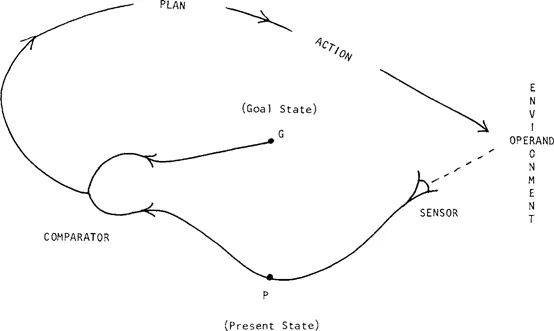
Figure 8.1
We need an internal representation of the goal state. We need a comparator, to compare these. And we need a plan of action: what we actually do to change the state of the operand from its present state to the goal state.
The distinction between the possible sources of these plans of action, and their different resulting natures, is a key feature of the present model of intelligence.
Goal-Directed Learning
In the lower animals, many of their director systems are innate, complete with instinctual plans of action. These form part of the survival equip...
Table of contents
- Cover Page
- Half Title page
- Title Page
- Copyright Page
- Contents
- NOTES AND ACKNOWLEDGMENTS
- PART A
- PART B
- REFERENCES
- AUTHOR INDEX
- SUBJECT INDEX
Trusted by 375,005 students
Access to over 1.5 million titles for a fair monthly price.
Study more efficiently using our study tools.
Frequently asked questions
Yes, you can cancel anytime from the Subscription tab in your account settings on the Perlego website. Your subscription will stay active until the end of your current billing period. Learn how to cancel your subscription
No, books cannot be downloaded as external files, such as PDFs, for use outside of Perlego. However, you can download books within the Perlego app for offline reading on mobile or tablet. Learn how to download books offline
Perlego offers two plans: Essential and Complete
- Essential is ideal for learners and professionals who enjoy exploring a wide range of subjects. Access the Essential Library with 800,000+ trusted titles and best-sellers across business, personal growth, and the humanities. Includes unlimited reading time and Standard Read Aloud voice.
- Complete: Perfect for advanced learners and researchers needing full, unrestricted access. Unlock 1.5M+ books across hundreds of subjects, including academic and specialized titles. The Complete Plan also includes advanced features like Premium Read Aloud and Research Assistant.
We are an online textbook subscription service, where you can get access to an entire online library for less than the price of a single book per month. With over 1.5 million books across 990+ topics, we’ve got you covered! Learn about our mission
Look out for the read-aloud symbol on your next book to see if you can listen to it. The read-aloud tool reads text aloud for you, highlighting the text as it is being read. You can pause it, speed it up and slow it down. Learn more about Read Aloud
Yes! You can use the Perlego app on both iOS and Android devices to read anytime, anywhere — even offline. Perfect for commutes or when you’re on the go.
Please note we cannot support devices running on iOS 13 and Android 7 or earlier. Learn more about using the app
Please note we cannot support devices running on iOS 13 and Android 7 or earlier. Learn more about using the app
Yes, you can access The Psychology of Learning Mathematics by Richard R. Skemp in PDF and/or ePUB format, as well as other popular books in Education & Education General. We have over 1.5 million books available in our catalogue for you to explore.