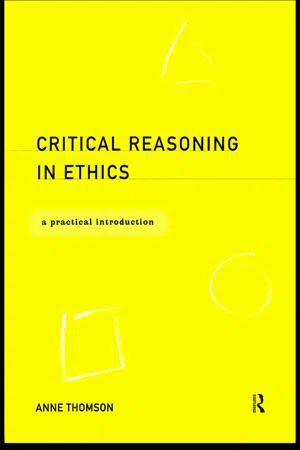
Critical Reasoning in Ethics is an accessible introduction that will enable students, through practical exercises, to develop their own skills in reasoning about ethical issues such as:
* analysing and evaluating arguments used in discussions of ethical issues
* analysing and evaluating ethical concepts, such as utilitarianism
* making decisions on ethical issues
* learning how to approach ethical issues in a fair minded way
Ethical issues discussed include the arguments about abortion, euthanasia, capital punishment, animal rights, the environment and war.
The book will be essential reading for philosophy, health, social work and nursing courses.
- 224 pages
- English
- ePUB (mobile friendly)
- Available on iOS & Android
eBook - ePub
About this book
Information
Chapter 1
Analysing moral reasoning
Reasoning about moral or ethical issues such as abortion or euthanasia is often to be found in newspaper articles and letters to the editor. Those writing the articles may hold a particular point of view – for example that abortion is morally wrong – and wish to convince others that this point of view is right. One way to attempt to do this is to offer reasons or evidence which they believe supports their position: that is to say, they present an argument. What we mean by ‘argument’ in this context is a reason or a series of reasons which aim to support a particular claim, which is called the conclusion.
This is not the only context in which reasoning about ethics occurs. Sometimes we attempt to reason for ourselves about a particular ethical issue. For example, you may see a fellow worker stealing something from your employer, and experience a genuine dilemma as to what to do in these circumstances, since you feel some loyalty to your friend but also have a sense of responsibility to your employer. If the question you ask yourself is not ‘What shall I do?’, but ‘What ought I to do’, then you may engage in moral reasoning by considering the consequences of various courses of action, or by weighing the conflicting responsibilities, and attempting to come to a conclusion on the issue.
We have mentioned two instances of moral reasoning – written arguments (often in newspapers, but also to be found in textbooks, magazines, political pamphlets and so on), and the mental exercise of figuring something out for oneself. In this chapter we shall concentrate on written moral arguments, in order to help you to develop skills both in recognising when other people are presenting moral arguments, and in understanding the way in which someone’s argument aims to support its conclusion. Chapters 2 and 3 will deal with assessment of moral arguments, and in Chapter 4 we shall offer practice in doing the reasoning for yourself on a number of ethical issues, when we introduce decision making.
Recognising moral arguments
In order to be able to recognise moral arguments, we need to be clear about two things:
- What is the difference between an argument and a written passage which does not contain an argument?
- What is the difference between a moral argument and a non-moral argument?
Let us consider the first of these.
Recognising arguments
All arguments, whether on ethical issues or not, will contain a main conclusion and a reason or reasons which are offered in support of the conclusion. Certain characteristic words – which we can call conclusion indicators – may be used to introduce a conclusion – for example, ‘so’, ‘therefore’, ‘thus’, ‘hence’ – as illustrated in the following passage:
Most manufactured baby milks have been found to contain chemicals which can cause infertility. So mothers of new-born babies should be advised to breast-feed their babies.
Here the conclusion is the second sentence, and is introduced by ‘So’. Where such words are used they can give us a clue that an argument is being presented, but we need to remember that these conclusion indicators also have other uses in language, so we cannot take it for granted that any passage which contains such a word must be presenting an argument.
There are a number of words which can function as reason indicators, which can also suggest to us that reasoning is taking place. Examples are ‘because’, ‘for’, and ‘since’. The above argument could have read as follows:
Mothers of new-born babies should be advised to breast-feed their babies, because most manufactured baby milks have been found to contain chemicals which can cause infertility.
In this example, the word ‘because’ signals that ‘most manufactured baby milks have been found to contain chemicals which can cause infertility’ is being offered as a reason for the conclusion that ‘mothers of new-born babies should be advised to breast-feed their babies’.
Conclusions and reasons are sometimes introduced explicitly by a phrase which makes the author’s intention very clear, for example ‘it follows that’, ‘I draw the conclusion that’, ‘the reason for this is’. Other words which can indicate the presence of a conclusion are ‘must’ and ‘cannot’, as shown in the following two examples:
He must have committed the murder. No-one else had the opportunity to do it, and his fingerprints were found on the murder weapon.
People who accept that it is sometimes right to go to war cannot really believe that killing is always wrong. War inevitably involves killing.
In the first example the evidence presented in the second sentence is being used to support the conclusion that ‘He must have committed the murder’. The second passage relies on the claim that war inevitably involves killing, in order to support the conclusion that those who are not in principle opposed to war cannot believe that killing is always wrong.
Although we can often find ‘argument indicator’ words to help us to identify arguments, it is possible for a passage to be an argument even if it contains no such words. Here is an example:
Being aware of the dangers of driving too fast is not sufficient to stop people from speeding. Many drivers are still exceeding speed limits. A recent television campaign has emphasised the dangers of driving too fast, by showing home videos of children who were subsequently killed by speeding motorists.
In order to recognise this passage as an argument, we need to consider the relationships between the statements in the passage. Can any of the statements be taken to support any other statement? We could answer this question by considering each statement in turn, and asking ‘Is any support or evidence given for this?’ When we consider the first statement in this passage, we find that the rest of the passage can be taken to support the claim that awareness of the dangers of driving too fast does not stop drivers from speeding. The two further claims made in the passage – that many drivers are still speeding, and that there has been publicity about the dangers – are presented as reasons for accepting the conclusion expressed in the first sentence.
We have discussed two ways in which we might recognise an argument:
- by finding ‘argument indicator’ words (conclusion indicators, or reason indicators),
- by finding a claim for which reasons appear to be offered.
If we have found ‘argument indicator’ words, then it is reasonable to assume that the writer was intending to present an argument. However, when we try to assess whether a written passage contains an argument, we are not simply trying to guess what the author’s intentions were. A passage can function as an argument even if the author did not consciously set out to present an argument. It will function as an argument if it contains some claim (the conclusion) which is given support by other statements in the passage (the reasons).
There are many different purposes of written communication, and often, when, for example, we read newspaper articles, it will be obvious to us that an argument is not being presented. Some pieces of writing aim to tell a story, some to evoke our sympathy with a person’s misfortune, some to amuse us, some to describe a scene, and some to present information to us without drawing any conclusions. However, the wording of a passage may sometimes mislead us into thinking that an argument is being offered, particularly when information is presented. For example, only one of the following two passages is an argument. Read them, and decide which one is an argument.
- Most mothers want the best for their babies. Some people think that it is better to feed babies on breast milk rather than on manufactured baby milks.Not all mothers find it convenient to breast feed.
- Mothers who go back to work soon after the birth of their babies find it inconvenient to breast feed. Trying to persuade such mothers to breast feed will only make them feel guilty. Instead, we should require employers to extend the period of paid maternity leave, so that mothers have more freedom of choice as to how to feed their babies.
In order to decide whether the passage is an argument, it is useful to ask first if there is a single main point which the passage is making. We can consider this question in relation to each of the statements in the passage. First passage (a) – does it try to convince us that most mothers want the best for their babies? It simply presents this as a piece of information, without giving us any evidence to support it. Does the passage try to convince us that some people think that it is better to feed babies on breast milk rather than on manufactured baby milks? Again, no support is given in the passage for this claim. Does it offer evidence for the claim that not all mothers find it convenient to breast feed? No, it simply presents this as a fact. There is a sense in which the passage aims to convince us of the truth of each of these statements, by presenting them as pieces of information, but not by presenting extra information or evidence which supports any of them. The statements are not interrelated in such a way that any one of them, or a combination of two of them, supports another. Hence this passage is not an argument, but simply presents information from which readers might draw their own conclusions.
Now let’s consider passage (b). Does it support the claim that mothers who go back to work soon after the birth of their babies find it inconvenient to breast feed? No, it just tells us that this is so. Does it offer any evidence that trying to persuade such mothers to breast feed will only make them feel guilty? No, again, this is simply presented as a fact. Does it offer support for the claim that instead of trying to persuade these mothers to breast feed, we should require employers to extend the period of paid maternity leave, so that mothers have more freedom of choice as to how to feed their babies? The other two statements do appear to offer some reason for accepting this recommendation, in that the recommendation gives one possible solution to the problem identified by the other two statements – namely that there may be some mothers who want to breast feed their babies, and feel guilty about not doing so, but find it inconvenient to do so, because (perhaps for financial reasons) they go back to work. Thus it is reasonable to regard this passage as presenting an argument, though we may wish to question whether it is a very good argument. Perhaps the recommendation to require employers to extend maternity leave is unrealistic. Perhaps the argument relies on a questionable assumption – that it is better for babies to be breast fed than to be bottle fed. Perhaps there are other ways of solving the perceived problem – for example, convincing mothers that their babies can still be healthy if bottle fed, or providing crèches in places of employment,so that mothers can both work and take time off to breast feed their babies.
Examination of these two examples emphasises the fact that argument is not just a matter of presenting information. It is, rather, a matter of presenting a conclusion based on information or reasons.
Distinguishing moral from non-moral arguments
We now turn to the question as to what is distinctive about moral arguments. Does it really matter whether we can distinguish between a moral and a non-moral argument? In some respects, the two are alike, in that they present a reason or reasons for accepting a conclusion, and if we develop our skills in recognising arguments in general, then we are likely to be able to recognise moral arguments as arguments. Moreover, the basic steps we must take when we evaluate arguments (which will be set out in Chapter 2), are the same for both kinds of argument. However, the primary aim of this book is to improve reasoning skills applied to ethical issues, so it is important to learn to recognise those issues and features of language which suggest that a moral argument is being presented.
A moral argument, simply because it is an argument, will contain a conclusion, i.e. a claim in support of which some reasoning is offered. Think for a moment about what the idea of a moral or ethical claim involves. Before reading on, try to write down what you think are the important characteristics of a moral or ethical claim. You may find this very difficult, so perhaps as an easier first step, you could list a few examples of moral claims.
You may have come up with examples which claim that a certain action or activity or way of life is wrong – e.g. ‘It is wrong to fiddle your tax return’. Or your examples may have been claims that someone, or everyone, ought or ought not to act in a particular way – e.g. ‘Jamie should not hit other children’; ‘Everyone ought to look after their elderly parents’; or ‘Teachers should not use corporal punishment on pupils’.
A moral argument must have a conclusion which makes some kind of moral claim, as do the examples quoted in the last paragraph. These moral claims are often expressed as recommendations, using the words ‘should’ or ‘ought’. Even where they do not directly make a recommendation (e.g. ‘It’s wrong to fiddle your tax return’), it is clear that a recommendation is intend...
Table of contents
- Cover Page
- Title Page
- Copyright Page
- Acknowledgements
- Introduction
- Chapter 1: Analysing Moral Reasoning
- Chapter 2: Assessing Moral Reasoning
- Chapter 3: Exercising The Skills Of Reasoning
- Chapter 4: Decision Making
- Chapter 5: Concepts In Practical Ethics
- Chapter 6: Moral Principles And Moral Theories
- Chapter 7: Fair-mindedness And The Role Of Emotion
- Appendix 1: - Comments On Selected Exercises
- Appendix 2: - Summaries On Specific Ethical Issues
- Bibliography
Trusted by 375,005 students
Access to over 1.5 million titles for a fair monthly price.
Study more efficiently using our study tools.
Frequently asked questions
Yes, you can cancel anytime from the Subscription tab in your account settings on the Perlego website. Your subscription will stay active until the end of your current billing period. Learn how to cancel your subscription
No, books cannot be downloaded as external files, such as PDFs, for use outside of Perlego. However, you can download books within the Perlego app for offline reading on mobile or tablet. Learn how to download books offline
Perlego offers two plans: Essential and Complete
- Essential is ideal for learners and professionals who enjoy exploring a wide range of subjects. Access the Essential Library with 800,000+ trusted titles and best-sellers across business, personal growth, and the humanities. Includes unlimited reading time and Standard Read Aloud voice.
- Complete: Perfect for advanced learners and researchers needing full, unrestricted access. Unlock 1.5M+ books across hundreds of subjects, including academic and specialized titles. The Complete Plan also includes advanced features like Premium Read Aloud and Research Assistant.
We are an online textbook subscription service, where you can get access to an entire online library for less than the price of a single book per month. With over 1.5 million books across 990+ topics, we’ve got you covered! Learn about our mission
Look out for the read-aloud symbol on your next book to see if you can listen to it. The read-aloud tool reads text aloud for you, highlighting the text as it is being read. You can pause it, speed it up and slow it down. Learn more about Read Aloud
Yes! You can use the Perlego app on both iOS and Android devices to read anytime, anywhere — even offline. Perfect for commutes or when you’re on the go.
Please note we cannot support devices running on iOS 13 and Android 7 or earlier. Learn more about using the app
Please note we cannot support devices running on iOS 13 and Android 7 or earlier. Learn more about using the app
Yes, you can access Critical Reasoning in Ethics by Anne Thomson in PDF and/or ePUB format, as well as other popular books in Philosophy & Ethics & Moral Philosophy. We have over 1.5 million books available in our catalogue for you to explore.