- 240 pages
- English
- ePUB (mobile friendly)
- Available on iOS & Android
eBook - ePub
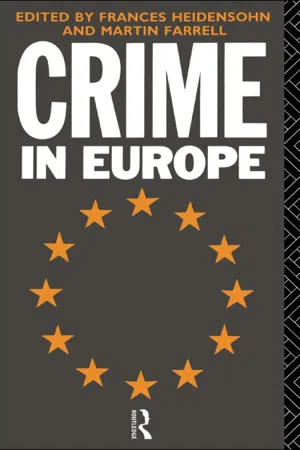
Crime in Europe
About this book
While some European nations share similar crime rates and trends, many differ widely in their approach to criminal justice. And as Europe's internal frontiers prepare to give way to a `single market', issues such as the movement of terrorists, international fraud, and drug trafficking, take on new, significant dimensions. This is the first book to address these issues and attempt a comparative criminology for Europe. The contributors cover a range of subjects including *crime prevention* women and crime*the relationship of ethnic minorities to crime and the police*corporate crime* accountability in the prison system.
Information
Part one
Crime and Europe
Chapter one
Introduction
Convergence, diversity and change
Frances Heidensohn
‘Europe’ and all things European have become matters of increasing importance in the late twentieth century. The Single European Act and the removal of barriers to trade and to labour mobility after 1992 were the first points of focus. Other changes have also, however, had significant impact. The building of the Channel Tunnel between Britain and France was one of these. On a much wider level, the major developments in Eastern Europe, with their profound political, economic and social consequences, affected the whole of Europe, not least in making the definition of Europe itself problematic.
In predicting the prospects of the new Europe, however defined, many topics have been addressed, but crime has been included amongst them only quite recently. Clearly barriers are not being removed nor the Channel Tunnel built in order to improve the effectiveness of supranational policing. It is as realisation of the likely effects of these policies has grown that concerns are expressed by the police and other agencies about them.
It can, indeed, be argued that, until the 1980s, crime in Europe was not a conceptual framework which would have had meaning, save for the select participants in the regular Council of Europe Colloquia. By the time of the conference for which these papers were originally written, it had become a recognisable theme for several reasons. First, and most obviously, the political developments in the European Community nations have made it so, and not least because while other social consequences of 1992 and after had been well explored, and were the clear responsibility of designated bodies, those for crime, for policing and criminal justice had not been and were not so clearly defined as Fijnaut and Levi show devastatingly in this volume (Chapters 8 and 12).
In addition to the policy issues thus raised, developments in the study of crime have helped produce a climate more favourable to comparative criminological study. As Shapland shows (Chapter 2), while criminology has developed in distinctive ways in European nations there have been powerful trends towards homogeneity. The growth of victim studies is only one example of what she notes as common needs of consumers and policy-makers in criminal justice. Another influence undoubtedly comes from the growth of comparative studies in welfare and via social policy where theoretical developments are more fully realised. As the links between crime and welfare and social control have become more apparent, so has the need for concepts and frameworks to explain them as is apparent in the sections on France and Austria in this volume (Chapters 9 and 11).
Crime in Europe is thus on policy and intellectual agendas for the 1990s. The purpose of this volume is fourfold. First, the papers here provide background and foreground material on a wide range of items appearing on both agendas: policing, drugs, terrorism and fraud will all be true ‘European’ issues. Second, a number of major questions are raised and explored here, such as the effects of barrier removal on policing and the possibilities of a Europe-wide force. Such questions cannot be fully answered as yet. Other sections fulfil a third aim and show the scope of systematic comparative study of crime. Finally, throughout the book Europe’s diverse criminological heritage summarised by Shapland (Chapter 2) informs the chapters and suggests the scope of future work in this field.
Most of the continental authors are lawyers while the British are social scientists. Shapland notes not only this difference but also that the dominant influences on British criminology in the twentieth century–Grünhut, Mannheim and Radzinowicz–were all European lawyers. (Roger Hood has observed that the historical impact of these influences has tended to be neglected and remain unexplored.) Differences in method and approach follow from the varied discipline perspectives as do matters of concern. The contributions to this book have sufficient linking themes and topics to illustrate a convincing argument not merely for a volume devoted to crime in Europe, but also for the possibilities of a European criminology.
My aims in this introductory chapter are therefore threefold. The first is to set the whole collection in its context as a contribution to developments and discussions in and about late-twentieth- century Europe. Second, I shall highlight the main current themes in the area of crime both generally and as they are illustrated here. Finally I shall outline some of the problems and the policy issues which now feature on the ‘Crime in Europe’ agenda and are likely to continue to do so.
BACKGROUND: EUROPE, THE MODERN CAREER OF A CONCEPT
The Second World War was very much a European war. At, or within a few years of, its conclusion the nation-states of continental Europe had formed two geo-political groupings round which were a fringe of neutral states. In 1957, six of the countries of the ‘West’ signed the Treaty of Rome, pledging themselves to remove tariff barriers and form an economic community. Britain joined the European Economic Community in 1973, together with Ireland and Denmark. By 1988 there were twelve member states and others, including possibly former Eastern Bloc countries, are likely to join in the 1990s. For four decades most of Eastern Europe developed on very different social, political and economic lines from the west with planned, command economies, not plural, capitalist ones.
However, rapid and dramatic changes in the USSR and Poland, as well as in other Warsaw Pact countries, reshaped the social and political map of Europe in the late 1980s. ‘Europe’ not only meant a geographical landmass and its offshore islands, but also suggested the possibility of something much more. The ‘core’ of the new Europe is formed by the Community States, which should have no internal trade barriers after 1992. As well as economic integration, wider unification especially of certain key social policies is also being proposed and debated.
Beyond the European Community (EC) nations lie the non-aligned states, mostly with highly sophisticated political and economic systems and notably comprehensive welfare. While these two groupings are certainly likely to be affected by the planned EC changes in the 1990s, it is in and from Eastern Europe that the most notable changes of the decade are likely to come as political icebergs melt like snowballs in the sun. Much has been spoken and written about both the planned and the unplanned changes, which will alter the concept of ‘Europe’ itself, yet one important issue has received relatively little attention: crime in Europe.
Social Europe for example (the EC’s social affairs directorate journal), in its special report on The social dimension of the internal market’ (Commission of the European Communities 1988), presents detailed material on education, unemployment, migration, wages, etc., but does not mention crime. This is a notable omission for a number of reasons. It is a sociological truism that crime is a social phenomenon and varies with social conditions and economic climates. Indeed, it is clear from several chapters in this volume that there has for some time been concern in several European countries about rising crime rates (Chapters 3, 4, 9 and 11). Some of this concern has been translated into international action where specific wider threats have been identified in terrorism (Chapter 8), drug abuse (Chapter 6) and fraud (Chapter 12). These have been, for the most part, reactive responses to crises.
Yet there has been so far a relatively modest response to the crime possibilities offered by ‘Europe’ itself. To take only EC nations, for example: can terrorists move as freely as trucks once customs and passport controls are removed? Will there be ‘infiltration’ as illicit drugs are carried from a relatively open market to a tightly controlled one? How will gun control laws be unified from their present enormous diversity? Many other Europe-wide trends are likely to influence crime patterns in the 1990s, some of them influenced by European policies. Labour mobility shifts not only workers but also patterns of social control and family life. Some of the migrant workers will be skilled, affluent, ‘legal’ and accepted. Others will be part of a semi-legal underclass, vulnerable to exploitation, even violence (Chapter 7). Some of both groups may be from ethnic minorities whose apparent participation and victimisation rates in relation to crime raise central issues of public policy.
Crime should therefore already be a key issue for all European countries in the 1990s, through the unintended consequences of planned policies in EC countries, major political developments, especially in Eastern Europe which may generate social changes such as migration, new patterns of urbanisation and industrialisation, which are very much linked with trends in crime.
KEY ISSUES
Crime has not yet achieved the same high profile as a European topic as have, for example, wine lakes and butter mountains or the European Monetary System. There have, however, been growing signs of concern from the public and politicians over a number of events. In the late 1980s, for example, the behaviour of English football hooligans at matches abroad, especially after the Heysel disaster, in which thirtynine people died, caused mounting anger and led to English clubs being banned and to calls for identity cards, passport confiscation and preventive detention (Williams et al. 1989). Detention of British subjects in Spanish and Swedish gaols for alleged drug offences focused interest on the different criminal justice systems of other European nations (Alderson 1989). A ‘hot pursuit’ chase across the German frontier, as well as a series of terrorist incidents made questions about police cooperation and co-ordination highly topical (Police Review 1989d).
Alongside popular and media preoccupation with these matters there have been a growing number of conferences and debates which have highlighted issues in several areas (Hood 1989). From the papers delivered at the York conference we have made the following selection which should contribute to understanding, analysis and debate about crime in Europe. Three major themes emerged at the conference and are illustrated in the chapters in this book: convergence, diversity and change. It was also constantly stressed that failure to recognise and confront the effects of these issues could have serious consequences.
Convergence
As van Dijk points out in Chapter 3, crime in Europe appears in some senses to know no frontiers even before these are formally abolished. As he shows, there is remarkable congruence between recorded crime rates in the major west European nations. Bienkowska (Chapter 4) suggests that in the three East European countries she analyses, crime rates are considerably lower than in the west, but that they are highest in the most affluent, the German Democratic Republic. Heidensohn (Chapter 5) shows that female crime rates are relatively low and fairly similar throughout Europe; Albrecht (Chapter 7) finds common patterns in victimisation rates among ethnic minorities in several countries, as well as common misunderstandings about their participation rates and their perceptions. Dorn and South (Chapter 6) note that while illicit drug use was once confined to relatively few parts of Europe, it is now found everywhere. While some of these observations are based on official figures which should be treated carefully, there are clearly enough consistencies to raise interesting questions.
Are there, for example, social influences which spread consistently across the continent and are associated with crime? Is crime indeed a product of affluence, anomie and anti-authoritarianism as van Dijk suggests? What would the consequences be of the growing aspirations of so many Europeans? Or of the ‘harmonised’ economic future? On the other hand, crime rates in Europe are not consistently correlated with Gross National Product.
Another form of convergence can be found in the Europeanising or internationalising of some forms of criminal activity. While the majority of offences and offenders are still petty and local, some lend themselves to multinational organisation. Levi (Chapter 12) shows how fraudsters move easily from one state to another and increasingly exploit the potential of an open market. Dorn and South outline drug-trafficking trails while Heidensohn points out that prostitution is one of the most established international rackets.
Perhaps one of the most surprising conclusions one can draw from the papers here, as indeed from other symposia (see especially Hood 1989), is that there is considerable congruence in definitions of what constitutes crime problems and issues between different nation-states in Europe. This is not, of course, to say that ‘crime’ always means the same thing everywhere, or that it can be a meaningful and useful category. Clearly this is a much more complex question. It is, however, worth stressing the impact of three discernible but distinctive trends which appear to have aided this development. First, there is the ‘internationalising’ of certain crimes which are not confined to any one nation or even continent: terrorism, drug offences, fraud exemplify this. Second, common social influences have rendered much of the capitalist world a ‘global village’ in another sense, where everyone objects to petty crime, minor incivilities and vandalism and to expensive, and repressive, criminal justice agencies. Finally, there is what we can call the diffusion of new discovery, especially of a new crime agenda and of concern for victims of crime. Because of the impact of ail these features of the modern world, common definitions of crime as a problem are far more readily understood than either recent criminological orthodoxy or common sense would expect.
While trends and patterns in crime rates across Europe show either consistency or a tendency to converge, rather less harmony appears in the responses to crime among European nations. Some parallels are manifest. Crime control has become a major issue for most governments as have victim support and policies to deal with fears of crime (van Dijk, de Liège and Pelikan–Chapters 3, 9 and 11). Co-operation between police forces has been increased in response to terrorism, organised crime and drug-trafficking (Fijnaut, Chapter 8). An important external influence has produced some convergence in some areas. US Government policies require its allies to adopt the same approaches to drug use (Dorn and South), control of fraud (Levi), and terrorism (Fijnaut).
Diversity
While some European nations already have common crime patterns or are subject to similar international crime trends, their criminal justice systems and their crime and penal policies differ markedly. Van Dijk shows that it is impossible to predict either overall expenditure on crime control from crime rates, or, more specifically, imprisonment rates. Vagg (Chapter 10) notes diversity in prison regimes, with Britain being more out of step than other nations. Levi finds enormous variation in control of fraud, as do Dorn and South in drugs policies. Fijnaut stresses the enormous variation in policing systems, the hostility between them and the failure of attempts to co-ordinate their efforts. Pelikan’s description of a mediation experiment in a country with a written constitution, de Liège’s of crime control in a centralised system and Bienkowska’s view of Eastern Europe, where crime figures can be state secrets, all illustrate the varied complexity and the range of European crime policies. They also emphasise that there are critical lines which divide Britain, which has no written constitution or Ministry of Justice from other European nations. Again, policing still is a very different concept to many Europeans who have lived under fascist police states (Chapter 3) than it may still be to those who know the Anglo-American idea of police. What is notable about European diversities in responses to crime is that they are largely imposed upon crime patterns which appear consistent or converging.
Change
Throughout the papers in this volume runs a common thread of increasing social changes. From the position of women (Heidensohn) to the greying of the population (van Dijk) and the widespread movement of peoples in search of work or political freedom (Albrecht) present and future Europe is in flux. Crime is always linked to change. Crime rates generally rise in periods of upheaval, though the issue is complex. Certain specific changes in political frontiers and policies post-1992 may well have marked effects on crime rates and several chapters address these questions (Dorn and South, Fijnaut, Levi). What is striking is that relatively little attention has been given to these topics until recently.
It seems unlikely that the colourful diversity of criminal justice systems in Europe will survive harmonisation elsewhere without damage. European court judgments as well as EC directives already affect citizens’ lives directly in Britain. Incorporation of the European Convention on Human Rights into English law is a not inconceivable possibility which would have profound consequences. However, while the future may hold promise of growing civil rights, a major paradox of the new, freer, more mobile Europe may be that its growth may be paralleled by pressures for more control: for identity cards, more computers and other hardware, more sophisticated (and secret) police organisation, curbs on football fans and AIDS/HIV carriers, more defensible space and higher levels of private security, more and longer prison sentences. In short while Europe should be more conscious of crime it should not allow its citizens’ civil rights to be crushed by that consciousness (Levi, van Dijk).
TOWARDS COMPARATIVE CRIMINOLOGY
It is one purpose of this book to illustrate the scope for the comparative study of crime across Europe. In order to study crime comparatively three conditions need to be met. There must be sources of material and data with which to make comparisons: crime statistics, victim surveys, research studies. Second, translatable concepts have to be available to make possible the collecting, ordering and analysis of such data. Finally, some kind of framework, part universe of discourse, part set of common concerns, must exist.
It is hard as yet to meet all these conditions readily: the USSR began to publish reliable crime statistics only in 1988. There are, however, already existing examples which illustrate some of the fecund potential of such approaches.
The fascinating and complex arguments about the ‘dispersal of discipline’ thesis in which Foucault’s attempt at a vast project on the development of social control in western societies has been used and challenged by a variety of writers is just one example of the possibilities (Foucault 1977; Cohen 1985; Scull 1984; Bottoms 1983; Ashworth 1988; Ignatieff 1978). Another lies in the work of feminist writers who have analysed the nature of formal and informal social control in relation to gender (Heidensohn 1985; Eaton 1986; Smart 1977). This work is well illustrated in Cain’s (1989) collection of European studies which show the extent of, and in which she attempts to theorise, the policing and the experiences of young women in modern Europe. Notably, both these projects have produced work at a variety of conceptual levels: in both the role of the state and of penal and criminal justice agencies is theorised and at the same time, detailed empirical case studies published. As yet, other enterprises are still at the stage of beginning to ask interesting questions. How can we, for example, explain differences in penal policies in nations with apparently similar social conditions and crime problems? Downes suggests (1988) that the notable differences between British and Dutch penal policies have several causes, notably the common education and approach of members of the Dutch judicial system as compared with the British and also the ‘culture of tolerance’ permeating Dutch society which enables people to accept deviance more readily and to be less punitive towards deviants than in Britain.
The contributions in this volume raise many such questions and provide some guidance in reaching the answers.
AN AGENDA FOR CRIME IN EUROPE
Symposia such as the one on which this book is based are important generating sources for new agenda. This one was no exception. From the many topics raised two key areas of criminology and crime policy emerged as most important.
Criminological questions
Research
The chapters in this volume all contribute to the comparative study of crime in Europe. They variously present case studies (Vagg, Pelikan, de Liège), comparative analyses (Vagg, van Dijk, Bienkowska, Heidensohn) or make cross-national comparisons on particular topics (Dorn and South, Levi, Fijnaut). Most comparative work in this field has tended to compare the USA with other countries and has ignored the proximity of European nations. Yet as these chapters illustrate, there is immense scope for comparative work. There are of course problems. A major issue is data (van Dijk, Bienkowska, Heidensohn). Publication and dissemination of research findings are others. Suitable comparative models and theories will also be necessary. It is notable that whereas European theorists once exercised considerable influence (Shapland), now criminologists write in English and their theories are American (Heidensohn).
Crime policy
Crime policy at a European level is no one’s business, although the Council of Europe does take an overall interest, it has no actual powers in thes...
Table of contents
- Cover Page
- Title Page
- Copyright Page
- Illustrations
- Contributors
- Preface and acknowledgements
- Preface to the paperback edition
- Part one Crime and Europe
- Part two Patterns and Trends
- Part three Policies and Problems
- Notes
- Bibliography
Trusted by 375,005 students
Access to over 1.5 million titles for a fair monthly price.
Study more efficiently using our study tools.
Frequently asked questions
Yes, you can cancel anytime from the Subscription tab in your account settings on the Perlego website. Your subscription will stay active until the end of your current billing period. Learn how to cancel your subscription
No, books cannot be downloaded as external files, such as PDFs, for use outside of Perlego. However, you can download books within the Perlego app for offline reading on mobile or tablet. Learn how to download books offline
Perlego offers two plans: Essential and Complete
- Essential is ideal for learners and professionals who enjoy exploring a wide range of subjects. Access the Essential Library with 800,000+ trusted titles and best-sellers across business, personal growth, and the humanities. Includes unlimited reading time and Standard Read Aloud voice.
- Complete: Perfect for advanced learners and researchers needing full, unrestricted access. Unlock 1.5M+ books across hundreds of subjects, including academic and specialized titles. The Complete Plan also includes advanced features like Premium Read Aloud and Research Assistant.
We are an online textbook subscription service, where you can get access to an entire online library for less than the price of a single book per month. With over 1.5 million books across 990+ topics, we’ve got you covered! Learn about our mission
Look out for the read-aloud symbol on your next book to see if you can listen to it. The read-aloud tool reads text aloud for you, highlighting the text as it is being read. You can pause it, speed it up and slow it down. Learn more about Read Aloud
Yes! You can use the Perlego app on both iOS and Android devices to read anytime, anywhere — even offline. Perfect for commutes or when you’re on the go.
Please note we cannot support devices running on iOS 13 and Android 7 or earlier. Learn more about using the app
Please note we cannot support devices running on iOS 13 and Android 7 or earlier. Learn more about using the app
Yes, you can access Crime in Europe by Martin Farrell,Frances Heidensohn in PDF and/or ePUB format, as well as other popular books in Social Sciences & Health Care Delivery. We have over 1.5 million books available in our catalogue for you to explore.