- 264 pages
- English
- ePUB (mobile friendly)
- Available on iOS & Android
eBook - ePub
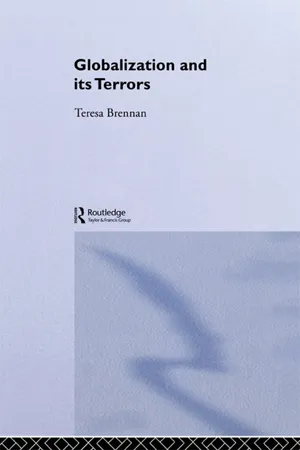
Globalization and its Terrors
About this book
It has long been realised that the poorer countries of the south have paid for the unstoppable onward rush of globalisation in the exploitation of their natural and human resources. Recent events have made it clear that there may be a price to be paid in the west as well.
In this elegant, lucidly argued account, Teresa Brennan argues that the evidence already exists that globalisation has for years been harming not just the poor of the third world but also its alleged beneficiaries in the affluent west. She shows how the speeding-up of contemporary capitalism, in which space is substituted for time, means that neither then environment nor the people who live in it are given the opportunity to regenerate and how this leads directly to pollution-induced, immune-deficient and stress-related disease. In a final chapter she suggests some alternative ways forward through a return to regionally based production and an emphasis on local economies.
1 Introduction
“An unseen hand that strikes from nowhere without accountability, destroying innocent lives.” That is the incumbent US president's definition of terrorism.1 From the perspective of the South, it is also a definition of globalization, insofar as the invisible hand of the market destroys the conditions of life for human beings, among other species. Other species are destroyed at a rate now reckoned in hours.2 The destruction of the life conditions of human beings proceeds more slowly, although the invisible hand leads to loss of human life as abrupt as that caused by the unseen hands of terrorism. It does so directly, through industrial and nuclear accidents. It also precipitates more rapid death in other ways. In India since1998, over one thousand farmers have committed suicide since losing their livelihood to corporate agribusiness.3 For others, including those who die of globalization's effects on ill health in the North, the market's unseen hand takes its time.
For the main part this book concentrates on the detrimental effects of economic globalization (which I will define shortly) on human life in those countries which purport to benefit from it. The new anxieties over terrorist attacks are only the latest in a series of fears generated by globalization in the West. They overlay increasing chronic ill health, longer working hours, greater debt, running hard to stay in the same place. They go hand in hand with cutbacks in welfare and education and health benefits.4 Globalization not only generates these day-to-day anxieties, but abets terrorism, which is a self-conscious response to global economic policy.5 The terrorist attacks on the World Trade Center were explicitly attacks on the symbol of the global economy. They were an attempt to do to the North, or the West, what the North has done to the South: destroy life without accountability.
The global economy, as a cause of terrorism, was given prominence in the Middle Eastern press response to the collapse of the twin towers.6 But while the link between terrorism and economic globalization was forefronted in the Middle East, it has been given scant concern in the West, where the emphasis is on the Palestinian–Israeli conflict. Terrorism is portrayed solely as the work of Islam-identified extremists and fanatics hostile to Israel, a representation which leaves out the fact that recruitment by the relevant organizations depends partly on the unemployment generated by free trade. Cocooned by candy-floss news, the large majority of people in the United States are unaware of this, just as they are unaware of the damage done in the name of US economic interests. Americans are told by their president that they are hated for their freedom, not that they are hated because they use over a third of the world's nonsustainable resources for 7 percent of its population, or because the pitiful wages paid in the Third World subsidize the inexpensive cuisine and low-priced goods to which US citizens are accustomed.7 Nor are Americans told that the same cuisine depends on cash-crop agribusiness displacing the subsistence farming at base not only of a varied diet, but often any diet in the Third World. If chat rooms and radio talk shows are an in indicator, Americans generally are convinced that they feed the South through aid programs, not that they are responsible for starvation.
In the heterogeny that is its real strength, the US does not only live in ignorance. Before September 11th, it had produced the most active and effective of the resistance movements to globalization. That same movement, at and after the demonstrations against free trade at Seattle in December 1999, generated increasing awareness of the harm done in the name of the US. It highlighted how the global economy damaged the interests and lives of the majority of those in the United States, where more people sink below the poverty line or struggle harder to stay in the middle classes each year.8 The movement was beginning to draw out the ill effects on Western health. But attending to the ill effects of globalization in the West as well as the South has been diverted by the war on terrorism. The sanity of the opposition to globalization has been undermined by the violence of the terrorist response to it. One of the many tragedies engendered by the attacks on the World Trade Center is that they have made it harder to oppose globalization, although globalization was such a prominent factor in motivating the attacks in the first place.
Terrorism does not need to bring the consequences of globalization back home. They are already here. I will show in this book that physical illness in the West increases as global profit grows, and that there is a strong case for believing that mental illness grows as well. I will also show that there is a relationship between globalization (which in this book means economic globalization) and the destruction of the climate by pollution. Indeed, there is an observable relation between globalization and the rise of environmental, immune-deficient, stress-induced and depressive disease. We are dealing with a causal chain, in which globalization increases profit because it speeds up production and distribution. As production and distribution speed up, so do fossil fuel emissions, whose quantitative increase far outweighs the positive changes in emissions control. Hence more pollution and climate damage. Hence environmental illness. Of course profits were made by speeding up production and distribution before globalization, just as environmental sickness preceded the growth in trade that has marked the past thirty years. But globalisation makes it worse.
As defined in this book, globalization is the continuation and logical outcome of a process of extension, a process which begins with the division between household and workplace, grows through specialization in production, then through colonialism, concentrations in land use, through urbanization and suburbanization, and though other forms of spatial reach. Against the use of globalization, it has been argued that “the concept of imperialism, with its focus on the value creation of labor and the value appropriation by capital, is more to the point: it sheds logic on the different loci of exploitation (labor, dominated countries) and accumulation (capital, imperial firms and states).”9 The reason I use the term globalization in preference to the term imperialism is that globalization encapsulates the spatio-temporal logic which imperialism, as a theory of capital accumulation and/or underconsumption, either ignores or substitutes for an understanding of value extracted at the point of production.10 While the economic theory that follows is anchored in a theory of value, it is also a theory of how expansion is the unavoidable accompaniment of speeding up the extraction of profit in production. Speeding up production necessarily means going further afield for markets and raw materials. By globalization, then, I mean an economic dynamic whereby the increasing speed of production entails expansion as a matter of course, while expansion necessitates more rapid production and distribution to sustain itself. There will be more on this in the next section.
Traversing greater distances at increasing speeds means consuming more oil and generating more fossil fuels. Even if some businesses produce without pollution, they cannot avoid the demands of the more rapid distribution instigated by their global competition. The more global distribution becomes, the more fossil fuels are used for transportation, even if a particular production process is free of them. The fact that more fossil fuels are needed to maintain and extend the global economy is flagged by fears of oil shortages. Before this war, the US President had already declared his intention of drilling for oil in the Alaskan wilderness and off the Florida coast. In addition, the control of oil pipelines is at issue in the war against terrorism. In this, present struggles for hegemony in Central Asia repeat a pattern that has been ongoing for a century. The “Great Game” of the latter part of the free trade belle époque of the later nineteenth century was about moving the chess pieces (as sometime Viceroy to India Curzon put it) around the Central Asian board.11 The “New Great Game,” as Ahmed Rashid termed it, is over transportation and access to oil from the Caspian and nations surrounding it.12 The Taliban was allied with and supported extremist organizations, but it also broke its promise, given to the US in return for aid, to support an oil pipeline proposal originally mooted by a multinational consortium evaluating construction of a Central Asia Gas (CentGas) pipeline between Turkmenistan and Pakistan. (This is known as the Unocal project, although Unocal has since withdrawn.) Part of this pipeline would have crossed western Afghanistan.13 Bombing Afghanistan accomplished the aim of installing a government which has already signified full backing for the pipeline proposal. Whatever its other outcomes, the war on terrorism is fostering oil acquisition, which in turn feeds speedier production and more rapid transportation, and greater fossil-fuel emissions. Iraq only produces 3.9 percent of the world's oil, but control of Iraq is critical to control of the region that produces most of it.
Fossil-fuel emissions are not the only consequence of speed. Speeding up production, and global production in particular, contributes to other forms of chemical pollution, leading in turn to rapidly increasing levels of cancer, allergies and immune disorders. The “green-washing”14 directed by corporations and governments toward the growing majority concerned with increasing ill health denies any connection between health and economic globalization. Indeed there are arguments that “natural capitalism” and “green” investment portfolios can solve the present environmental crisis … with a little goodwill thrown in. They can certainly help, and the following argument should not be taken as an argument against the implementation of less polluting technologies in any context. If the first priority of meeting the Kyoto Protocol is assisted – and it is – by technologies which reduce emissions without changing the basic system of production, only the perverse would argue against their introduction. Nonetheless the idea that these technologies will stop environmental degradation of themselves neglects the real barrier to their implementation. In any system of extension, from centralization to globalization, profit is made by speeding up the rate of extraction of natural, especially biological, resources (such as trees, plants, fish, animals, and so forth), as well as the “productivity” of human labor, and thus taking more from nature than one returns.
The idea that there is any necessary connection between globalization, the destruction of the climate, and mental and physical ill health is not only denied by monetarist-influenced policy. The same is true for the new center-left embodied in the US Democratic Party, the British Labour Party and a growing number of erstwhile social democratic organizations. The center-left makes more concerned environmental noises but, like the new right, it believes in globalization. This combination of the right noise and the wrong direction is what Blair made known as the “third way”.15 The “third way”, as a putative solution, has also been mooted by US democrats. It supports globalization while nominally supporting the environment. But one cannot have it both ways. To support globalization and free trade is to foster climate destruction (and hence eventually the destruction of most species). As I will show in the first part of this book, there is no avoiding their link, except in the most fanciful technophile imagination. Not only this, but, as the links are followed through, it is plain that that global capitalism attacks all the conditions of life: from climate through to air, food and water. Any war, from Iraq through to Afghanistan, increases those attacks through increasing fossil fuel and other toxic emissions, and diverts attention away from the damage done to long-term survival by the global economy war protects and extends, while securing more fossil fuels for the future.
The fact is that globalization is about securing more oil to keep profits going at the expense of the young and unborn. Additionally, globalization is about cheap labor markets and forcing down wages and salaries. It is about reductions in corporate tax, increases in taxes for the employed, and cuts in social services. Most of all it is about using up the earth's resources at an increasing speed and at a massive environmental price.
The myth is that globalization is about cell-phones and little teeny microchips, rather than the heavy-duty transport of natural and biological resources.16 This is not true. Computers have drastically increased the use of coal,17 and in this they are typical telecommunications products, relying on electricity which in turn relies on fossil fuels. Aside from that, by 1990, over a quarter of goods traded were natural “‘primary products’ such as timber, fish and copper.”18 Nearly three-quarters of goods traded are manufactured products. Of these, machinery and transport constitute 35 percent of all goods traded, while chemicals, iron and steel and other semi-manufactures constitute 17 percent, and clothing and textiles 6 percent.19 Manufactured goods are made from biological and natural resources, which means they also draw on natural reserves.20 “With the important exceptions of minerals and petrochemical products, virtually all the raw materials used in industry are of biological origin, coming from the agricultural and forestry sectors.”21 The goods that now move more rapidly around the globe include everything from croissants to refrigerators: electrical goods made in Japan and the US go to Egypt and Nigeria; Nigeria in turn exports its trees. Or it did. Exports have now fallen drastically in response to overlogging.22 Even the most cursory survey of the increased global traffic in commodities shows that globalization is about far more than clean, new information technologies. Any move to expand the territories covered by trade agreements, or conquer the ones that are non-compliant, results in more rapid exhaustion of natural resources, and more transportation of heavy goods and services, as well as the less noxious ones.23
Contemporary celebrants of globalization have claimed additionally that free trade ensures adequate commerce between the “brain” countries and “body” countries, as one book styles them.24 The “brain” countries, of course, are the rich ones, and their riches are due to their brains. But these rich “brains” have their own bodies, bodies which are made daily weaker by their polluted environments. Meantime, the underfed and underused brains of the “body” countries are denied the time and income with which they might pursue an education. They sell – cheap – the natural resources and physical labor which might pay for that education, were it not supporting the First World “brains.” They are not in a position to seek an education. Not only this, but the labor market for unskilled and semiskilled labor is far more extensive than the demand for skilled and educated labor. Unskilled and semiskilled labor is used in the production of the goods and services which meet basic human needs. These goods, in turn, constitute the bulk of the world's domestic and global trade, trade which helps human “brains” to be embodied, fed, clothed, housed and serviced.
Free trade not only increases the traffic in natural resources, thereby depleting the global environment. It not only accelerates the fossil-fuel consumption needed to transport those resources. It also accelerates the traffic of human beings, who also use up fuel making their way to centralized workplaces. As we noted, historically, centralization is the first stage of the same dynamic that brings globalization into being. The more centralized production is, the bigger the company has to be in order to compete, and the more mergers and acquisitions take place. Jobs become fewer, and you have to go further to get them. Both the new right and the third way promote centralization and globalization at the same time as they cut back on spending for human needs, from basic education to welfare and healthcare. They cut back just as everyone gets sicker, and more depressed, and now more paranoid, for fear of more attacks.
The same global process which accelerates pollution also results in increasing inequality in income and access to healthcare. It results in cuts in social provision, otherwise known as the welfare state, throughout the OECD countries as well as increasing poverty in the South. The reason most of this book pertains to the Western world, to those who have ostensibly benefited from global capitalism to date, is twofold. First, many in the North are unaware of how negative the impact of globalization on their lives and health is and has been. They are even more oblivious now the focus is on terrorism. Second, the South or Third World, like the Second World or former Eastern bloc, is daily made an empty promise: the promise is that they, too, if they follow the global path, will be rich and prosperous. The promise is false not only because the North's prosperity, in large part, is made at the expense of the South. It is also false because life, for more and more of the North's inhabitants, is increasingly insecure, unhealthy, ill-educated, and impoverished. As there are already excellent accounts of the effects of globalization on the South, especially in the work of Martin Khor,25 it seemed of more use to the South to expose a false promise for what it is. In addition, with the threat of terrorist attacks reiterated daily in the US, and general fears concerning them gathering in Britain and France, the West at home forgets what it was suffering before it was distracted. It was distracted of course by a threat which now justifies a war on third world countries, a war whose interests cannot be separated from US and Northern oil interests – interests which are advantaged by this war even if they did not of themselves cause it.
In health terms, all those in the West (Europe, the US), like those of the South or Third World, are negatively affected by centralization and globalization, no matter how much money they make. Yet this fact is downplayed or disowned, as popular and political thought proclaim that the globalizing path is the only path. Capitalism is not only right, we are told, but natural. Naturally, capitalism will go global wherever it can, exercising its right to produce as much wealth as possible. It is true that capitalism as a system strives to go global. But capitalism is not the ...
Table of contents
- Front Cover
- Half Title
- Title Page
- Copyright
- Dedication
- Contents
- Acknowledgments
- Preface: the critique of judgment
- 1 Introduction
- 2 Daily life in the West
- 3 The war on the atmosphere
- 4 The war on the land, sea and other conditions of life
- 5 Health cuts and corporate wealth
- 6 Education and the cost of children
- 7 The third way and the feminization of poverty
- 8 The source of profit
- 9 Price, inflation and energy
- 10 The prime directive
- Notes
- Index
Trusted by 375,005 students
Access to over 1.5 million titles for a fair monthly price.
Study more efficiently using our study tools.
Frequently asked questions
Yes, you can cancel anytime from the Subscription tab in your account settings on the Perlego website. Your subscription will stay active until the end of your current billing period. Learn how to cancel your subscription
No, books cannot be downloaded as external files, such as PDFs, for use outside of Perlego. However, you can download books within the Perlego app for offline reading on mobile or tablet. Learn how to download books offline
Perlego offers two plans: Essential and Complete
- Essential is ideal for learners and professionals who enjoy exploring a wide range of subjects. Access the Essential Library with 800,000+ trusted titles and best-sellers across business, personal growth, and the humanities. Includes unlimited reading time and Standard Read Aloud voice.
- Complete: Perfect for advanced learners and researchers needing full, unrestricted access. Unlock 1.5M+ books across hundreds of subjects, including academic and specialized titles. The Complete Plan also includes advanced features like Premium Read Aloud and Research Assistant.
We are an online textbook subscription service, where you can get access to an entire online library for less than the price of a single book per month. With over 1.5 million books across 990+ topics, we’ve got you covered! Learn about our mission
Look out for the read-aloud symbol on your next book to see if you can listen to it. The read-aloud tool reads text aloud for you, highlighting the text as it is being read. You can pause it, speed it up and slow it down. Learn more about Read Aloud
Yes! You can use the Perlego app on both iOS and Android devices to read anytime, anywhere — even offline. Perfect for commutes or when you’re on the go.
Please note we cannot support devices running on iOS 13 and Android 7 or earlier. Learn more about using the app
Please note we cannot support devices running on iOS 13 and Android 7 or earlier. Learn more about using the app
Yes, you can access Globalization and its Terrors by Teresa Brennan in PDF and/or ePUB format, as well as other popular books in Business & Business General. We have over 1.5 million books available in our catalogue for you to explore.