- 184 pages
- English
- ePUB (mobile friendly)
- Available on iOS & Android
eBook - ePub
About this book
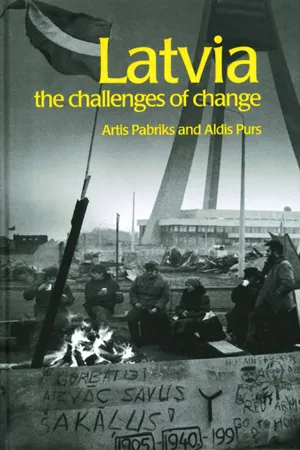
The past one hundred years have been a very trying time for Latvia, complete with success, tragedy, and still unrealized promise. Within the course of a generation, the country experienced revolutions, wars and independent statehood, and then the slide into authoritarianism. World War II brought new occupations. The tragedies were staggering: holocaust, executions, and an exodus of refugees. Soviet consolidation bred deportations, forced collectivization and partisan warfare. Almost fifty years later, Latvia regained its independence and emerged from decades of disastrous Soviet rule.
This book comprehensively surveys Latvia's recent past and prospects for the new millennium, placing contemporary events in historical perspective. The authors address the evolution of the country from the movement against Soviet rule to the dilemmas of contemporary politics: party formation, the problem of corruption, the quest for the future and a regional and international role, the struggle to develop a civil society, the issue of ethnic relations and the recurring tendency towards statist solutions. Proper attention is also given to economic developments.
Chapter 1
A HISTORICAL INTRODUCTION TO MODERN LATVIA
Modern Latvia encompasses 64,589 square kilometres on the eastern shore of the Baltic Sea. The land itself is not immediately imposing, but has a gentle, pastoral beauty and a surprising variety of landscapes. A coastal zone of long beaches, a few natural harbours and navigable rivers yields to a patchwork of fields, forests, lakes, marshes and low hills. The landscape also reveals the history of Latvia before the nineteenth century. The ancestors of the Latvians built fortifications on the hilltops for centuries prior to the arrival of German Teutonic Knights and missionaries. Archaeological digs continue to uncover the contours of ancient Baltic society. In 1201, under the Germans, Riga was built. Latvia's landscape is dotted with relics of the following seven hundred years of different ruling powers’ hold on the eastern Baltic littoral. Most castles, churches and palaces tell of the local control of Baltic Germans, but others attest to the periods of Polish and Swedish rule. Many ruined castles bear witness to Russia's expansion into the Baltic area in the eighteenth century. By the end of that century, all of modern Latvia was within the realm of the Russian Empire. Baltic Germans continued to hold power locally, but the nineteenth century witnessed the rise of a new force. The peasant nation that constituted the bulk of the population began to see its ethnic differentness as a unique identity. This identity consisted of social and economic demands as well as the political mantra of modern nationalism: that the political unit should be synonymous with the ethnic. Latvia's history stretches for millennia, but the modern history of the Latvians begins essentially in the nineteenth century.
THE NINETEENTH CENTURY, 1800–1917
Latvians had always been ethnically unique with a distinct culture and language, but only in the nineteenth century did this ethnic uniqueness become the basis for social and state organisation. The emergence of these identities coincided with pan-Germanic philosophical currents of the late eighteenth century, influenced by the French Revolution. Johann Gottfried von Herder, who taught and preached in Riga from 1764 to 1769, inspired modern nationalism in Latvia. Herder's stay in Riga was largely responsible for his interest in peasants. He participated in peasant traditions such as Midsummer's Eve and collected and published Latvian folk songs in his Stimmern der Volker in Liedern.1 Herder was effectively “the first intellectual who acknowledged the Latvian people as a nation worthy of an individual identity”.2 Garlieb Merkel, a Baltic German, echoed Herder's belief. Unlike Herder, however, Merkel was blatant in his condemnation of Baltic German lords. He warned that Latvian serfs could be a revolutionary force. The growing frequency and severity of serf rebellions, the words of humanists like Merkel and Herder, and the fear of events in France led Tsar Alexander I to contemplate a change in peasant–lord relations.
A general emancipation of Baltic serfs was in its early stages when Alexander I was sidetracked by the Napoleonic Wars. Although Alexander 1's reign became more conservative following the wars, the plans for serf emancipation in the Baltic Provinces proceeded in the 1810s. In 1817 and 1819 Baltic serfs were emancipated.3 This newly granted freedom had few privileges; ex-serfs were not given land, nor could they purchase it. They were denied freedom of movement and were still obligated to the social control of their former lords. The emancipation, however, came more than forty years before the emancipation of Russian serfs, guaranteeing that the Baltic Provinces followed a radically different course of development during the nineteenth century. The south-eastern corner of modern Latvia, however, was not administratively a part of the Baltic Provinces. This corner, Latgale, would develop differently from most of contemporary Latvia.
The restrictions accompanying emancipation guaranteed continued Baltic German control and impoverished Latvian peasants. Prompted by poverty and despair, some Latvian peasants converted to Orthodoxy en masse, hoping to have better treatment under the religion of the Tsar. Legal changes in the 1840s and 1850s allowed Latvians the right to buy land and move more freely. Gradual Latvian purchases of land and the ability to move to towns, coupled with a demographic explosion, fuelled the growth of Latvian nationalism in the second half of the nineteenth century. Latvian smallholders and townsmen looked for a movement that would protect their interests against the enormously privileged Baltic German nobility.4
As Latvians purchased land, they moved into junior positions in local administration and the judiciary. Many became schoolteachers. Previously, the most gifted children rose above their station in life through education that involved cultural assimilation. Latvian peasant identity was shed, and people became Baltic Germans. Baltic Germanness was associated more with education and position in society than blood. In the mid-nineteenth century, the need to assimilate waned. Sons of Latvian peasants (at the time almost solely sons) entered a Baltic German world of education which included humanist streams of thought that praised the spirit of Latvians and accorded them equal value to other nations. By mid-century, about thirty Latvians were enrolled at the University of Dorpat (Tartu), the only institution of higher learning in the Baltic Provinces and a bastion of the Baltic German world in the Tsarist Empire. This group consciously identified themselves as Latvians, chose not to assimilate and began the Latvian national awakening. Inspired by the Young Italy and Young Germany movements, they called themselves the Young Latvians (Jaunlatviesi).
The Young Latvians did not completely divorce themselves from the traditional Baltic German cultural milieu. Most married Baltic German women, wrote in German and were equally comfortable in Russian. Their ability to manoeuvre for limited Latvian rights and to gain more popular acceptance for the idea of a Latvian nation depended upon what Benedict Anderson called “their bilingual literacy, or rather literacy and bilingualism.”5 They worked as intermediaries between the Baltic Germans, the Russian Court and the Latvian peasants in a society that increasingly needed an active and literate citizenry. Anderson's observations on why the beginnings of nationalism are invariably referred to as “awakenings” also fit the Latvian example. Awakening from sleep connected the new polity with a distant past. Anderson's words echo the Young Latvians:
the vanguard of most European popular nationalist movements were literate people often unaccustomed to using these vernaculars, this anomaly needed explanation. None seemed better than 'sleep,’ for it permitted those intelligentsias and bourgeoisies who were becoming conscious of themselves as Czechs, Hungarians, or Finns to figure their study of Czech, Magyar, or Finnish languages, folklore, and musics as ‘rediscovering’ something deep-down always known.6
This first generation “rediscovered” Latvian language, tradition and folklore. It created for the Latvian nation all of the accoutrements of a modern, civilised nation, from a national epic to Latvian translations of the Classics to scientific language. Their published output found an eager market in the new Latvian smallholders and those moving to the city.
The Latvian peasantry was an eager market because literacy rates in the Baltic Provinces were abnormally high for the Russian Empire.7 From the mid-nineteenth century, literacy rates increased markedly every decade and there was a boom in school construction. At least 80 per cent of the Latvian population could read—a rate that dwarfed Russian rates. Increasing literacy, sophistication and wealth led to the formation of Latvian self-help organisations. The Latvian Association of Riga, founded in 1868, was the first and most important. Provincial branches co-ordinated a campaign promoting education and culture across the Baltic Provinces. In 1873, the Latvian Association organised the first Latvian Song Festival in Riga, a visual and audible demonstration of Latvian cultural merit. The Latvian Association of Riga and the Young Latvian Krisjanis Valdemars epitomised the Latvian nation from 1850 to 1885. They struggled for a cultural awakening, but had a gradual programme for social and political change. They did not advocate social rebellion, but defended the values of the middle class from private property to their leading role within the national awakening. Krisjanis Valdemars, whose formula for the national revival was education + technology + capital, found no contradiction in working within Tsarist ministries while becoming the material godfather of the movement. The Young Latvians were loyal to the Tsar; the extent of their political programme was indigenisation or the replacement of the Baltic Germans’ privileged position in Baltic society with Young Latvians.
Economic and demographic changes surpassed the modest plans of the Young Latvians in the 1880s and 1890s. In the second half of the nineteenth century, the Empire began a vigorous drive for industrialisation. Riga was a natural starting point. The city's port was a natural conduit for trade and the Baltic German elite was eager to convert earlier land-holding wealth to wealth based on merchant ties and industrial strength. The liberalisation of restrictions on peasant movement also gave Riga and the towns of the Baltic Provinces the work force for the new industrial and mercantile concerns. If, in 1861, Riga was not much different from its Hanseatic former self (that is, controlled by guilds and predominantly export oriented), by the turn of the century Riga was a city transformed. Its economy became increasingly diversified; its engineering, lumber, chemicals and manufacturing industries all vied with the more traditional textile industry for the floods of workers arriving every decade. Riga's population more than doubled from 1867 to 1897; its workforce quadrupled. The Baltic Germans were able to maintain their control over the city despite the revolutionary changes of early industrialisation. Their percentage of the population decreased markedly, but their wealth and power remained unchallenged. Even in 1900, Baltic Germans owned more than 80 per cent of Riga's largest businesses.8 Riga was not alone; the towns of Mitau, Vendau and Libau all became industrial centres (if small ones) in the last decades of the nineteenth century.
As already mentioned, the Young Latvians did not see Imperial power as a threat to Latvian identity. They identified Baltic German hegemony as the obstacle to their national aspirations. After their years at the University of Dorpat, many of the Young Latvians assembled in 1863 as the editorial staff of the Petersburg Newspaper (Peterburgas avize). Although the paper was clearly critical of Baltic German hegemony, it also contained articles on self-improvement, the latest farming techniques, and debates about economics. Baltic German pressure closed the paper in 1866. The experience pushed many of the Young Latvians closer to the Slavophiles and the idea that Russification could curb the power of the Baltic Germans.
From 1880 to 1900, the Tsarist authorities began a vigorous campaign of Russification in the Baltic Provinces and Finland. Ideological Russifiers were not content with the simple removal of German influence. They had as little respect for the Latvian peasantry as the Baltic German aristocracy did, and hoped to transform Latvian peasants into good Russians. Younger Latvians resented the “Young Latvians” compromise with Tsarism as a compromise with autocracy and looked beyond the ideas of nationalism. Finally, because the Russifiers targeted t...
Table of contents
- Front Cover
- Half Title
- Postcommunist States and Nations
- Title Page
- Copyright
- TABLE OF CONTENTS
- Figures and Tables
- Chronology
- Preface
- Map of Latvia
- 1 A Historical Introduction to Modern Latvia
- 2 Latvia's Politics 1987–1991: The Thorny Road Towards Independence
- 3 Latvia's Democracy Examined: 1991–1999
- 4 Latvia's Economy since 1991
- 5 The Foreign Policy of Latvia
- 6 Conclusions
- Bibliography
- Index
Trusted by 375,005 students
Access to over 1.5 million titles for a fair monthly price.
Study more efficiently using our study tools.
Frequently asked questions
Yes, you can cancel anytime from the Subscription tab in your account settings on the Perlego website. Your subscription will stay active until the end of your current billing period. Learn how to cancel your subscription
No, books cannot be downloaded as external files, such as PDFs, for use outside of Perlego. However, you can download books within the Perlego app for offline reading on mobile or tablet. Learn how to download books offline
We are an online textbook subscription service, where you can get access to an entire online library for less than the price of a single book per month. With over 1.5 million books across 990+ topics, we’ve got you covered! Learn about our mission
Look out for the read-aloud symbol on your next book to see if you can listen to it. The read-aloud tool reads text aloud for you, highlighting the text as it is being read. You can pause it, speed it up and slow it down. Learn more about Read Aloud
Yes! You can use the Perlego app on both iOS and Android devices to read anytime, anywhere — even offline. Perfect for commutes or when you’re on the go.
Please note we cannot support devices running on iOS 13 and Android 7 or earlier. Learn more about using the app
Please note we cannot support devices running on iOS 13 and Android 7 or earlier. Learn more about using the app
Yes, you can access Latvia by Artis Pabriks,Aldis Purs in PDF and/or ePUB format, as well as other popular books in History & Baltic History. We have over 1.5 million books available in our catalogue for you to explore.