- 296 pages
- English
- ePUB (mobile friendly)
- Available on iOS & Android
eBook - ePub
Symbol and Image in Celtic Religious Art
About this book
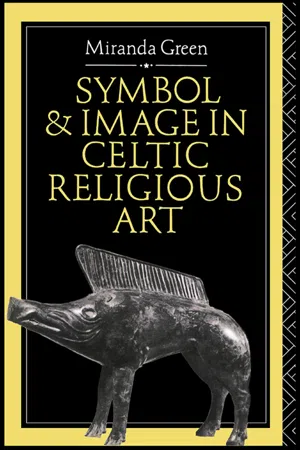
In Symbol and Image in Celtic Religious Art , Miranda Green argues that only by deciphering their complex systems of images and symbols can we uncover the realities of Celtic life and belief in Europe before and during the Roman period. She explores a number of iconographic themes in depth and examines the tribal and regional differences in artistic cult expression to reveal the very varied concepts embraced by anthropomorphic imagery. Discussion ranges from the artistic expression of animal cults and that of natural forces to the effect of religious belief on artistic style, and Miranda Green argues that stylistic features such as emphasis and exaggeration express the religious viewpoint of Celtic patrons and artists
Information
1
Prologue
Most of our knowledge of Celtic religion derives from iconography and epigraphy dating to the Roman period. This is augmented by both classical and vernacular Celtic (Irish and Welsh) literary material, though much of the latter is chronologically too late in its extant form to be useful. In addition to the inevitable interpretative bias of the Graeco-Roman authors, their writings dwell largely on ritual rather than the nature of belief-systems. Thus, although the Druids and sacrificial ceremonial are discussed at length by such commentators as Strabo and Caesar, there is little mention of the gods themselves. In the pre-Roman period, the elaborate character of many Iron Age graves attests only the strong belief in an afterlife, endorsed by contemporary Mediterranean observers. Once again we are brought no closer to the deities of the Celtic world.
In general, Iron Age Celts did not possess the tradition of consistent physical representation of their divinities. There are some images dating to this early phase: two main clusters, in southern Gaul near the Greek colony of Massilia (Marseille) and the Rhineland, may be particularly identified, and there is other early iconography too. But the presence of divine images vastly increases under the influence of Rome when the stimulus of mimetic representation applied to previously tacit, aniconic divine concepts brings the Celtic gods into sharp focus for the first time. Certain scholars, indeed, believe that these gods may have come into existence only after Celtic submission to Rome and the formation of the Romano-Celtic provinces. But the fully developed nature of these divinities early in the Roman period, combined with archaeological evidence, demonstrates that many of these beings must have been present as concepts in the earlier ‘free’ Celtic phase. Unsupported by written sources from the Celts themselves, who were virtually illiterate, iconography is both ambiguous and potentially misleading. None the less, certain features of Celtic symbolism are sufficiently distinctive to suggest recurrent patterns of religious thought-processes. It is these which are my prime concern in succeeding chapters.

Map 1 Spread of Celtic territory in Europe and Asia Minor: after J.de Vries, La Religion des Celtes, 1963.
The Celts and the gods
During both the pre-Roman ‘free’ Celtic and the Roman phases, the pagan peoples of Gaul and Britain consisted essentially of rural societies whose economies, unsheltered by the protective screen of urban life, were preoccupied with such observable natural phenomena as the behaviour of the seasons, the weather, and the cosmo-celestial activities of the sun, thunder, lightning and rain. All these forces were apparently supernatural and at times capricious; naturally they were objects of fear, wonder, veneration, and worship, not least because the Celtic livelihood was so immediately dependent upon the fertility of crops and domestic beasts, themselves in turn reliant upon sun and rain.
This focus upon the natural environment is reflected in Celtic religious symbolism. While the Celts had a multiplicity of deities, as evidenced by inscriptions of the Roman period and by the very varied iconographic types, the dominant powers were those of the sky, weather, and fertility and the land. The imagery and symbolism of cult-expression reflects these religious foci. Many divinities were closely associated with topography—with mountains, lakes and springs—and others wielded the elemental forces of the cosmos. The close ties with the natural world are seen also in the prominent tradition of animal symbolism: in a Celtic milieu, beasts assumed a dominant role, frequently representing an aspect of belief unaccompanied by any humano-divine image.

Map 2 The tribes of Gaul and the Rhineland: after Anon, Die Kelten in Mitteleuropa, 1980.
Regional differences in belief (Maps 2–8)
In a tribal, rural society where communications could be slow and difficult, it was inevitable that local conservatism should manifest itself in religious belief and express itself in iconography. Many Celtic deities appear to have been tribal protectors who, according to Irish legend, married the local goddess of the land and together watched over particular areas. In fact it is possible to recognize several strata in the divine hierarchy or pantheon. Certain divine concepts, namely, sky-gods, sun-gods, and the mother-goddesses, transcended regional boundaries and appear to have been worshipped all over the Celtic world. But even here regional preferences in symbolism and representation may be distinguished. For instance, the sky-god appears as a warrior-horseman in north-east Gaul and the Rhineland; in the lower Rhône Valley of Provence, the symbolism is explicitly solar and the sky-god image is projected by his sun-wheel; but in the Pyrenees the celestial deity is represented by a different solar symbol—the swastika. Similar diversity is reflected in the iconography associated with the mother-goddess cults. In many areas the mothers are presented as a triple image, but in Burgundy the maternal role of the triad is emphasized by the depiction of nursing babies, swaddling clothes, and bathing apparatus. By contrast, the triple goddesses in the Rhineland are portrayed as two solemn middle-aged matrons flanking a young girl and all carrying not emblems of human fertility but fruits symbolic of the productive earth. The horse-goddess Epona is supraregional but specific to Burgundy is her depiction on a mare with a suckling foal. Other divine images have discrete distributions: the Gaulish hammer-god appears particularly in Lorraine and in the Rhône Valley between Burgundy and Nîmes. The antlered god belonged principally to north-east and central Gaul. The triple-headed form of image was especially beloved of the Remi. In Britain, the hooded triplets (the genii cucullati) are associated above all with the Dobunni of the Cotswolds and the area of Hadrian’s Wall. In the lowest stratum of the divine hierarchy, we have the very localized spirits, perhaps occurring only once and associated with a particular village, spring, or tree.

Map 3 Tribal territories in Celtic Britain: after J.Wacher, Roman Britain, 1978.
Symbolism and divine images
This book is primarily concerned with the physical, visual expression of the divine, with the images people envisaged and projected of supernatural entities and with the animate and inanimate symbols with which pagan Celts endowed their depictions of the gods. It is the accompanying symbols which frequently give clues to a deity’s function or identity. Sometimes an emblem or attribute may be of a general character, like a cornucopiae, shared by several different gods, imbuing them with a fertility and prosperity function. Other emblems may be divinity-specific, like the wheel of the sun-god or the hammer-god’s attribute. Epona always has an equine companion; Nehalennia is nearly always portrayed with a dog. All these symbols enhance the image of a divine representation. Sometimes the symbolism is contained within the divine depiction itself—the triple-headed image or the antlered Cernunnos are examples of this. Again such symbolism is there to identify, to enhance, extend or project a message to the beholder.
We have to enquire as to what is the function of a created image. Religious representation may serve several purposes, not necessarily all mutually exclusive or distinct. A stone carving of a deity placed in a shrine may possess a function that is different from its placement in a domestic or sepulchral context. A depiction of a god in a temple may be the cult-image, which means that originally at least the divinity was considered as residing within that image. Perhaps a carving was not always seen as housing the god specifically, but was sometimes set up to demonstrate reverence and honour to the deity by symbolic physical representation, in exactly the same manner as the erection of a statue may commemorate a revered human individual at the present day. An image could be created and established within a shrine as a focus of worship, its presence serving to channel the attention of the devotee and to stimulate thoughts about the divine. All of these functions may be true, especially of the more monumental portrayals. Liturgical items such as sceptres or vessels may well have been invested with sanctity or holy power; they were directly employed in the service of the gods. The role and status of personal items is more complex: figurines may be regarded as straightforward divine images, with the same function as monumental depictions, writ small. But items like jewellery will have combined sacred and secular functions.
If cult-images were visual expressions of belief, we need to clarify the responsibilities involved in their production. At least two individuals were generally associated with their creation—the initiator and the executor. We have on the one hand the patron-purchaser-dedicant and on the other the artist-craftsman. Both would be key figures in determining the type of image; both would need to be in sympathy with the form of image required. The symbolic content would be a matter of conscious choice by people who were fully cognizant with the means best employed in endowing a cult-object with the greatest potency. Related to this point is the matter of methods of physical cult-expression. Some parts of this book are concerned with the way images were portrayed rather than the symbols themselves. Certain stylistic traditions may be identified which veer away from realistic depictions of human and animal images. This may be achieved by means of plurality, exaggeration, or schematism. But each tradition was meaningful and possessed a definite purpose. In general, it is fair to say that this divergence from naturalism in art-style is the result of Celtic influences.
Celt and Roman
With the exception of material which demonstrably dates to well before the Roman period, the iconographic form in which the evidence for Celtic religious art is preserved owes a great deal to Mediterranean artistic tradition. But the concepts which are expressed in this art and which underlie it are often no more Roman than Iron Age. Celtic art (which owes so much of its inspiration to external influences) is anything but Celtic. In the Romano-Celtic phase, there is a shifting balance in the iconographic and religious contributions of the Celtic and the Graeco-Roman world. The Romans brought to Celtic lands the recurrent tradition of representing deities by images which were more or less mimetic, where artists used naturalistic human and animal models as the basis for image-projection. Alongside this tradition was that of epigraphy—giving the gods names which were inscribed in the Latin alphabet, names which were sometimes associated with these images and sometimes alone. Lastly, the Romans introduced divine concepts which were on occasions absorbed and adapted by indigenous belief-systems. Succeeding chapters present the full gamut of hybridization: at one end of the spectrum are such divine entities as Apollo and Mercury who often apparently retain their Mediterranean identity as far as iconography is concerned, but who adopt alien native epithets and Celtic consorts who owe nothing to the Roman world. At the other are the semi-monstrous images—like the antlered god and the triple-headed Remic deity. In between are representations of gods whose symbolic content may owe little to the classical world—the hammer-god and Epona fall into this category; Sucellus’ hammer is probably not of Graeco-Roman origin and neither is Epona’s mare. The mother-goddesses owe rather more to Mediterranean iconography: but for their frequent triplism, they often strongly resemble Roman maternal concepts and indeed the cornucopiae, ubiquitous symbol of prosperity/fertility among Romano-Celtic deities, is entirely classical in origin. Nevertheless, the image of the triple mother-goddess owes its presence essentially to Celtic religious traditions.

Figure 1 Gilt silver cauldron: Raevemose Bog, Gundestrup, Jutland, Denmark. Fourth/second century BC. Nationalmuseet, Copenhagen. Diameter 69cm. Photo graph: Nationalmuseet, Copenhagen.
Some images of Celtic divinities occur for the first time under Roman influence. The mother-goddesses, Nehalennia, divine couples and many more image-types cannot be traced prior to the Roman period. But others may be found in the—albeit comparatively rare—stonework of southern Gaul and the Rhineland, in the rich iconographic area of Celtic coinage and the unique cauldron from Gundestrup in Jutland (Figure 1). This controversial cult-vessel, made of over 90 per cent pure silver, originally gilded and with a capacity of 130 litres, may have been manufactured in Thrace in the fourth or third century BC. But despite its provenance and its possible origins, the cauldron may well have been a Celtic liturgical object. Some of the images fashioned in repoussé on its inner and outer plates—the antlered deity, the wheel-god and the ram-horned serpent for instance—are too idiosyncratic to belong other than to the Celtic world. All of these image-types have close parallels in later, Romano-Celtic, cult-iconography. Finally, there is the evidence of the wooden images from Celtic healing springs, dating to around the time of the Roman conquest, precursors of the stone votive carvings which were offered to the resident curative divinity during the Romano-Celtic phase. These, and other scattered and often insecurely dated but stylistically similar wooden images which are lucky survivals in water-logged contexts, are suggestive of a wealth of iconography which has not survived, perhaps examples of similar Celtic images to those placed in a sacred grove near Massilia which have been immortalized by the Roman poet Lucan:
…simulacraque maesta deorum Arte carent caesisque extant informia truncis. Ipse situs putrique facit iam robore pallor Attonitos; non vulgatis sacrata figuris Numina sic metuunt: tantum terroribus addit, Quos timeant, non nosse deos
‘The images were stark, gloomy blocks of unworked timber, rotten with age, whose ghastly pallor terrified their devotees—quite another matter from our own rustic statues which are too familiar to cause alarm’
(Lucan, Pharsalia, III, 412–17)
2
The female image
This chapter concerns the feminine principle in Celtic cult-expression. I exclude here the multiple deities such as the three mothers, since they are discussed as a distinct group elsewhere (Chapter 6). The goddesses considered here are multifarious and performed a number of varying but interrelated functions. The evidence upon which I concentrate is the symbolism implicit in the art-form. However, other factors are taken into account where relevant: thus the names of goddesses, when given epigraphically, may be helpful, especially where such a name recurs frequently—like that of Epona or Nehalennia, or where the name itself conveys syihbolism—like that of Rosmerta (‘the Great Provider’). In this way, the name may give a clue to identity which may reinforce the deity’s interpretation as inferred from the iconography, or the name may add a new dimension in understanding role and function. ...
Table of contents
- Cover Page
- Title Page
- Copyright Page
- List of illustrations
- Preface
- Acknowledgements
- 1: Prologue
- 2: The female image
- 3: The divine marriage
- 4: The male image
- 5: The symbolism of the natural world
- 6: Triplism and multiple images
- 7: Style and belief
- 8: Epilogue
- Abbreviations
- Notes
- Bibliography
Trusted by 375,005 students
Access to over 1.5 million titles for a fair monthly price.
Study more efficiently using our study tools.
Frequently asked questions
Yes, you can cancel anytime from the Subscription tab in your account settings on the Perlego website. Your subscription will stay active until the end of your current billing period. Learn how to cancel your subscription
No, books cannot be downloaded as external files, such as PDFs, for use outside of Perlego. However, you can download books within the Perlego app for offline reading on mobile or tablet. Learn how to download books offline
Perlego offers two plans: Essential and Complete
- Essential is ideal for learners and professionals who enjoy exploring a wide range of subjects. Access the Essential Library with 800,000+ trusted titles and best-sellers across business, personal growth, and the humanities. Includes unlimited reading time and Standard Read Aloud voice.
- Complete: Perfect for advanced learners and researchers needing full, unrestricted access. Unlock 1.5M+ books across hundreds of subjects, including academic and specialized titles. The Complete Plan also includes advanced features like Premium Read Aloud and Research Assistant.
We are an online textbook subscription service, where you can get access to an entire online library for less than the price of a single book per month. With over 1.5 million books across 990+ topics, we’ve got you covered! Learn about our mission
Look out for the read-aloud symbol on your next book to see if you can listen to it. The read-aloud tool reads text aloud for you, highlighting the text as it is being read. You can pause it, speed it up and slow it down. Learn more about Read Aloud
Yes! You can use the Perlego app on both iOS and Android devices to read anytime, anywhere — even offline. Perfect for commutes or when you’re on the go.
Please note we cannot support devices running on iOS 13 and Android 7 or earlier. Learn more about using the app
Please note we cannot support devices running on iOS 13 and Android 7 or earlier. Learn more about using the app
Yes, you can access Symbol and Image in Celtic Religious Art by Miranda Green in PDF and/or ePUB format, as well as other popular books in Social Sciences & History of Religion. We have over 1.5 million books available in our catalogue for you to explore.