- 136 pages
- English
- ePUB (mobile friendly)
- Available on iOS & Android
eBook - ePub
About this book
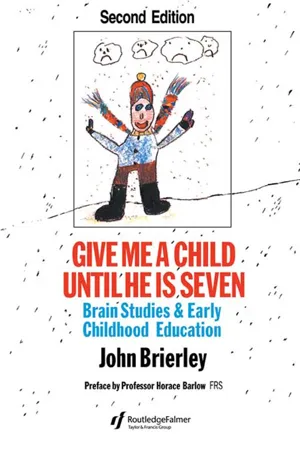
John Brierley's book was first published in 1987 and was very well received. It has now been re-issued in its second edition owing to a demand from students and teachers. The book represents the essence of many talks given to parents and teachers of nursery and infant children and teacher trainers. Evidence is used to demonstrate the young brain's potential, flexibility and resilience and to highlight the crucial importance of the pre-school and early school years to later development. The study supports the move for more and better opportunities for children in the crucial years from birth to seven.
Information
Topic
EducationSubtopic
Education General1 Introduction
Many parents, and indeed most experienced teachers, marvel at the miracle of progress a child makes in his two or three years in the infant school. By comparison with a child of 5 a normal child at the end of the infant stage is capable of assuming responsibility and exercising leadership. He will have acquired a measure of social discipline and he can be expected to be friendly, lively and responsive. Unless he is very slow he will have advanced a long way and in many directions in his work. He will have made a satisfactory start in learning to read, write and calculate. His memory and imagination are good. He can express himself often very well in talk and through writing. Indeed, linguistic ability seems to accelerate in many children towards the end of the seventh year when the quality and quantity of what they say and write about never fails to surprise and delight. Children at this stage have learnt to use many different kinds of material for work in art and craft. Hand and eye coordination are quite good and their paintings in particular often have a freshness and directness which is never regained. They can use their physical powers with confidence and their bodies with increasing dexterity and enjoyment. But even before the start of formal schooling at five any parent or nursery teacher will recognize how developed are his curiosity, critical sense and imagination.
In 1972 a Government White Paper, A Framework for Expansion1, devoted a section to the under-5s and stated:
We now know that, given sympathetic and skilled supervision, children may be able to make educational progress before the age of 5. They are capable of developing further in the use of language, in thought and in practical skills than was previously supposed.
Unfortunately the impetus for the expansion of preschool provision witnessed in the 1970s has been lost and education has failed to capitalize on a period in human development when the brain and sense organs are highly developed and the capacity to learn is at flood-readiness.
My two chief aims in this short book are to use evidence from brain studies to demonstrate the young brain's potential, flexibility and resilience and especially to highlight the crucial importance of the pre-school and early school years. What is known lends support for more and better opportunities for children in these vital years of life from birth to about 8.
Throughout the book I have ventured to underscore some principles for the education of young children at school and in playgroups arising from brain studies. Some of these will apply to older children as well. For ease of reference I have collected these principles together in Chapter 12.
Important discoveries from brain science arise from many directions but the pieces of research lie scattered like a jigsaw puzzle half finished and no overall picture of how the brain works is yet in sight. Indeed knowledge of the overall action of the brain has been less touched by science than by anything else that influences our daily lives to the same degree.2 This is not surprising. The brain is delicate, complex and hidden and its fine structure is fantastically intricate. Anatomical work on brain structure is immensely laborious and needs courage, persistence and good technical support to carry it through. For our purposes in attempting to relate the physical brain to higher mental functions a degree of modesty is required in the use of the evidence.
Much of what is known about the brain supports the common sense and instincts of the vast majority of parents and teachers and the more insights that are gained from what is known the more our motives are strengthened towards providing a good environment for learning at home and school. As I hope to show, a good environment is not a luxury but a necessity during the early years of life. It is important to know that it is good to talk to a child, that young children need to play and explore, that experience of touch, sound and sight are vital, that memory and imagination are important for development, that a broad curriculum which teaches a child to notice and to think is crucial and that a secure family life with the affectionate care of adults whom a child can trust and who can set him standards are essential. The reason why all this should be so provides essential depth to this knowledge and strengthens the motives for planning good opportunities. Only a part of this background can be added by brain studies but it is important to possess it, not only to enhance development, but to prevent injustices arising.
Notes
1 HMSO (1972)
2 Phillips, CG. et al (1984) ‘Localisation of function in the cerebral cortex’, Brain, 107
2 The Brain
The brain of a normal adult weighs about three pounds. Passingham 1 has made an interesting deduction: that the human brain is three times as large as would be expected in a hypothetical primate of our build. Though large it is not simply a bigger version of an ape's brain; rather those parts concerned with learning, the cerebellum and cortex (see diagram), are developed to about three times the size of those in, say, a chimpanzee. The cerebellum ensures steady, skilful and properly timed movements under the overall control of the cortex which itself is largely concerned with thinking, planning, hearing, speaking and seeing. As befits its vital role as the human thinking cap, the cortex is about half the weight of the entire nervous system.
Another instructive fact is that the size of the brain and head show an astonishing range of individual variation. Although on average the brain weighs about three pounds, about 1350 grammes, the variation in weight of the large majority of men's brains lies between 1180 and 1704 gram-mes and all but 5 per cent of women have a range in brain weight which lies between 1033 and 1533 grammes (women are smaller anyway). Despite this vast variation it has not been possible to relate differences in weight to differences in intellectual ability except in instances where brain weight is well below the normal range. The cut off point for normality in adults seems to lie below 1000 grammes.
Karl Pearson2 eighty years ago made measurements of head size and academic performance in over 1000 students and 12-year-old boys and girls and obtained correlations between head measurements and academic performance ‘so small that they are in every case of no service for the purposes of prediction’. Subsequent work has confirmed Pearson's view. It seems then that the main asset of a brilliant child is not more grey matter but that he/she somehow or other has a knack of using the ordinary brain machinery differently. This does not rule out the distinct possibility that the brain of a particular child possesses unique features that cannot readily be detected by the microscope.
Brain surgeons, when looking at a living brain, say that its strangest quality is its stillness, giving no hint of character or ability. The fact that nerves run to it from all over the body and away from it indicates that it has overall control. Though it is one organ it consists of four closely interlinked parts: the cortex (grey matter); the brain stem whose upper part forms the central core of the brain (sometimes called the ‘old’ brain, old in the evolutionary sense); the lower brain stem or ‘bulb’ and the cerebellum (see diagram).
Cortex
It is with the cortex that I shall be primarily concerned because it plays a major role in learning, thinking and planning and further details about it will be picked up and elaborated in later chapters.
The cortex lies on the outer surface of the brain and is a mantle of about 2000 cms 2 in area, immensely folded to pack its enormous area into the skull. The sheet of cortex is about 3 mm thick and is formed from nerve cells (neurones) of many varieties and sizes, in all about 10,000 million. This


rough estimate has been made by counting the neurones and multiplying up.
When sections of cortex from a variety of mammals are examined under a microscope the number of cells in comparable sections of the same size is, remarkably, similar in all mammals. This rather startling fact is because the lower density in large brained animals such as ourselves is compensated for by an increase in depth of cortex. The spacing of neurones may be of special importance because the less densely they are packed the greater the number of nerve pathways that can be made between them; and, though it is a speculation, the richness and variety of branching and connectivity may be important in the development of intelligence. The spacing of neurones in the human cortex would facilitate this.
Beneath the top rind of the grey matter of the cortex (grey because it contains the cell bodies of the neurones) the bulk of the tissue is a pulpy white matter formed from million upon million of criss-crossing fibres (axons) of the neurones conducting nerve impulses. A record from the surface of the brain would show electrical oscillations taking place all the time due to groups of neurones continually discharging electrical signals. Though the number of neurones is vast in the cortex, they are found in other parts of the brain as well. The cerebellum contains millions itself. Despite the staggering number of neurones, they are, surprisingly, in a small minority among brain cells as a whole and about 80 per cent of brain weight is due to glial cells.3 The purpose of these numerous cells is a mystery. They may serve as packing material to the delicate neurones but nature is less wasteful than this. Their close relationship to the surfaces of the neurones could suggest that they may play a part in nourishing the latter and perhaps also in the specific function of nerve conduction. Some recent suggestions are that they may be concerned with memory.
All the cells in the brain might add up to 100,000 million packed into the smallish space of our head. The vastness of this number of cells, what they do and how they connect so that we achieve a unity of thought, is as paralyzing to our understanding as the vastness of space.
Embedded in the pulpy white matter under the cortex are some solid masses of grey matter of various kinds and I shall return to these in a moment.
Perhaps rather surprisingly, the cortex is divided into two distinct halves, the left and right hemispheres, each with different functional roles. The left is more concerned with speech and the programming of skilled movements and the right with some visuospatial skills, such as recognizing faces and reading maps. While the hemispheres do have different domains of specialization, pushing the contrast between them too far would be misleading.4 The right hemisphere has some limited verbal comprehension. It is better at concrete rather than abstract words, and in those rare cases of children whose left hemisphere has had to be removed because of disease or injury before age 2, clear simple speech develops in the right. Similarly the left hemisphere also contributes to face recognition both in the healthy adult and in the infant whose right hemisphere has had to be removed.
The two hemispheres are connected by a tough strap of nerves, the corpus callosum, which enables them to work together as a balanced system. At any one time it is as though one pan of the scales, so to speak, is raised, while the other is lowered to give harmony to thinking and behaviour. It is unknown how this mental unity is achieved or in what form information is transmitted from one hemisphere to another.
The Four Lobes
Each hemisphere has four lobes on it: temporal, occipital, parietal and frontal (see diagram). The temporal lobe is like the thumb of a boxing glove when th...
Table of contents
- Cover
- Half Title
- Full Title
- Copyright
- Contents
- Dedication
- Acknowledgements
- Note to the Second Edition
- Preface
- Professor Horace Barlow
- 1 Introduction
- 2 The brain
- 3 Habits and skills
- 4 Myelin and early learning
- 5 Growth pattern and learning
- 6 Crucial times for learning
- 7 The gift of speech
- 8 Double brain
- 9 Learning by playing and exploration
- 10 Remembering, learning and thinking
- 11 What we are born with
- 12 The twenty-one principles
- 13 Conclusions
- Index
Trusted by 375,005 students
Access to over 1.5 million titles for a fair monthly price.
Study more efficiently using our study tools.
Frequently asked questions
Yes, you can cancel anytime from the Subscription tab in your account settings on the Perlego website. Your subscription will stay active until the end of your current billing period. Learn how to cancel your subscription
No, books cannot be downloaded as external files, such as PDFs, for use outside of Perlego. However, you can download books within the Perlego app for offline reading on mobile or tablet. Learn how to download books offline
Perlego offers two plans: Essential and Complete
- Essential is ideal for learners and professionals who enjoy exploring a wide range of subjects. Access the Essential Library with 800,000+ trusted titles and best-sellers across business, personal growth, and the humanities. Includes unlimited reading time and Standard Read Aloud voice.
- Complete: Perfect for advanced learners and researchers needing full, unrestricted access. Unlock 1.5M+ books across hundreds of subjects, including academic and specialized titles. The Complete Plan also includes advanced features like Premium Read Aloud and Research Assistant.
We are an online textbook subscription service, where you can get access to an entire online library for less than the price of a single book per month. With over 1.5 million books across 990+ topics, we’ve got you covered! Learn about our mission
Look out for the read-aloud symbol on your next book to see if you can listen to it. The read-aloud tool reads text aloud for you, highlighting the text as it is being read. You can pause it, speed it up and slow it down. Learn more about Read Aloud
Yes! You can use the Perlego app on both iOS and Android devices to read anytime, anywhere — even offline. Perfect for commutes or when you’re on the go.
Please note we cannot support devices running on iOS 13 and Android 7 or earlier. Learn more about using the app
Please note we cannot support devices running on iOS 13 and Android 7 or earlier. Learn more about using the app
Yes, you can access Give Me A Child Until He Is 7 by John Brierley in PDF and/or ePUB format, as well as other popular books in Education & Education General. We have over 1.5 million books available in our catalogue for you to explore.