- 240 pages
- English
- ePUB (mobile friendly)
- Available on iOS & Android
eBook - ePub
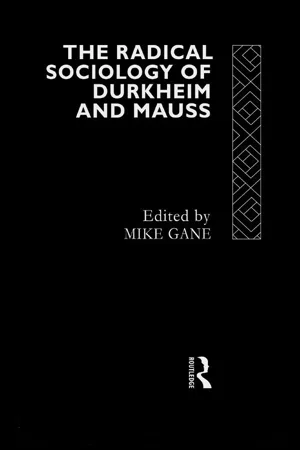
Radical Sociology of Durkheim and Mauss
About this book
In this outstanding collection, Mike Gane brings together a selection of key articles on Durkheim and Mauss showing their points of convergence and divergence. Included here are Mauss's 'A sociological assessment of Bolshevism 1924-5' and his 'Letters on Communism, Fascism and Nazism'. This is an engrossing book not only for scholars and students of Durkheim and Mauss but for anyone interested in radical social theory.
Information
Part 1
Chapter 1
Durkheim’s ‘two laws of
penal evolution’
An introduction
T.Anthony Jones and Andrew T.Scull
I
Durkheim’s essay, ‘Two laws of penal evolution’,1 was first published in 1900, when he was forty-two. Written at a crucial phase in his intellectual development, it remains of importance to sociologists for several reasons. In the first place, it sheds new light on Durkheim’s thought in a number of areas. As an indication of his increased theoretical sophistication, it is instructive to compare the account he here gives of the evolution of punishment with the rather crude and vulnerable one he gives of the same subject in The Division of Labor. It provides us with one of Durkheim’s few extended discussions of the impact of the political sphere on the rest of society, most notable for his insistence on its importance as an independent variable having a potentially powerful influence on centrally important aspects of society. Additionally, it provides us with an illuminating account of what he saw as the differing nature and role of the conscience collective in primitive and advanced societies. And as a pioneering attempt to study crime in a comparative perspective and to relate changes in the treatment of deviants to long run changes in the social structure, the essay remains an important and instructive contribution to social theory.
Central to Durkheim’s sociology is the question of the social basis of morality. His fascination with this topic naturally led to a recurrent concern with deviance as the violation of moral rules. His major work in this area was, of course, Suicide; but even in books ostensibly devoted to quite different subjects, such as the division of labor and the sources of social solidarity, the methodological foundations of the new science of society, and so forth, considerable space is devoted to deviance.
One is, therefore, not surprised to learn that among Durkheim’s earliest lecture series at Bordeaux was a two year course in criminal sociology.2 In 1896, these lectures were absorbed into the much more extensive course on Physique Generale du Droit et des Moeurs. This latter course aimed at providing ‘a complete picture of all moral phenomena,’ and contained a section on the infringement of social norms and the nature of crime ‘which included some statistical work, subsequently abandoned, that was, according to Mauss, comparable to that in Suicide’.3 None of this empirical work survives. However, Durkheim also devoted many of these lectures to the reconsideration of a problem he had first raised in The Division of Labor, namely, a theory of the genesis and evolution of punishment; and these were later published in the form of the essay with which we are here concerned. Despite the essay’s considerable theoretical and historical significance, it has been the subject of a surprising academic neglect. Indeed, it remains virtually unquoted in contemporary sociological writings.4 Symptomatic of the lack of scholarly acquaintance with it is the way Barnes recently devoted extensive space to criticism of Durkheim’s arguments in The Division of Labor on the evolution of punishment, while ignoring the far more sophisticated treatment of the same subject in this essay.5 In part, this neglect seems to arise from the fact that the essay can only be found in an old and rather inaccessible periodical; and in part, unfortunately, from the fact that it has not hitherto been translated into English.6
II
Durkheim’s ‘Two laws of penal evolution’ exhibits a large degree of continuity with his work in The Division of Labor, although in several respects it is an advance on the analysis found in that earlier work. He still holds to the view that the severity of punishment declines with increasing differentiation, but modifies it by claiming that it varies not only with the degree of development but also to the extent that central power is absolute. Apparent negative instances, where the trend towards milder punishment is moderated or even reversed, Durkheim now attempts to explain by referring to the secondary factor of political power, which acts ‘to neutralise the effects of social organisation’.7
Such a resort to ‘secondary’ or ‘atypical’ factors to explain away negative instances, where the facts appear to contradict his central thesis, is a typical Durkheimian manoeuvre.8 Usually, however, Durkheim makes little effort to show what these factors might be, and why they should operate to produce the observed effects. Moreover, they usually retain a curiously ad hoc air, being obviously added merely to dispose of inconvenient objections. In all these respects he departs from his normal practice here. First, he devotes considerable space to a discussion of what exactly he means by ‘absolutism’.9 He proposes two alternative ways of recognising absolutism. It exists (a) whenever there are no legal or customary limits on the exercise of governmental power, where those limits are purely prudential ones; and/or (b) whenever the relationships between the ruler and the ruled approximate those between a man and his property. In a similarly careful fashion, he provides a mass of examples to show that, empirically, deviations from the trend towards milder punishments are always associated with hyper-centralisation of political power. And by arguing that offences in authoritarian societies assume the same sort of sacrilegious character as those in primitive societies, he tries to show that this empirical generalisation is consistent with the fundamental thrust of his explanation, rather than just a mere ad hoc convenience.
The second law Durkheim claims to have established is that ‘deprivation of liberty, and of liberty alone, for periods varying according to the gravity of the crime, tends increasingly to become the normal type of repression’.10 Having once more surveyed the treatment of the criminal in an extensive series of societies ranging from ancient Egypt to France of the 1890’s in order to show that his generalisation holds empirically, Durkheim finally tries to indicate why the regularities he has identified exist.
In itself, Durkheim’s reconstruction of the factors lying behind the growth of imprisonment to its position as the primary response to criminal behaviour is remarkable, both for the sophistication of the argument and the clarity with which it is expounded. The first part of the explanation is couched in functional terms. Having demonstrated that imprisonment is unnecessary in a society where responsibility is a group rather than an individual matter, which corresponds to the situation in primitive societies, Durkheim shows how the breakdown of this elementary type of social organisation, and the concomitant development of the notion of individual responsibility, meant that society needed some measure to insure that the culpable could not flee to escape punishment. The prison as a place of pre-trial detention fulfilled this requirement.
Significantly, however, Durkheim is not satisfied with this teleological form of explanation, and asserts that it remains subordinate to the search for efficient causes. As he put it in The Rules of Sociological Method, ‘The fact that we allow a place for human needs in sociological explanations does not mean that we even partially revert to teleology. These needs can influence social evolution only on condition that they themselves, and the changes they undergo, can be explained by causes that are deterministic and not at all purposive.’11 He then shows that precisely the same social conditions which produce a breakdown in the notion of collective responsibility also produce the essential preconditions for the invention of the prison.
The subsequent growth in the importance of the prison until it becomes virtually synonymous with the very notion of punishment is largely the result of the growing mildness of punishment. The increasing unwillingness to resort to death, torture, and mutilation leaves a vacuum which can only be filled by the further development of imprisonment. Thus, the two laws Durkheim has identified can now be seen as interdependent; and there remains only the task of explaining why punishment becomes progressively less severe.
He begins by rejecting the common sense view of this development, which would attribute it to the increasing sympathy and sensitivity towards the suffering of others produced by the growth of civilisation. His argument is of the following form: (a) our increasing horror of violence directed towards other people might well make us recoil from inflicting harsh punishments; but (b) it would also simultaneously make crimes against persons seem more abominable. We would consequently face an insoluble dilemma, whose likely outcome would be an increased severity towards crimes against persons, for our sympathy for the offender must necessarily be less than for his victim. As we shall show below, this is an unnecessarily weak point in Durkheim’s thesis, probably deriving from his natural desire to make the distinction between his position and the conventional wisdom sharper than it might otherwise appear to be.
Instead of seeking an explanation in terms of growing sympathy, Durkheim suggests that since punishment is simply a response, the expression of the outrage a crime produces, ‘it is in the evolution of crime that one must seek the cause determining the evolution of punishment’.12 In his earlier efforts in The Division of Labor to establish the tendency to move from repressive to restitutive sanctions, Durkheim had been content to treat crime as a single undifferentiated entity. The abundant anthropological evidence now available, which shows that many deviations treated as crimes in contemporary society (e.g. murder, theft, rape) merely provoke efforts to gain restitution for the harm done in primitive societies, has led to the discrediting of the notion of such a transformation.13 Yet other evidence, which Durkheim cites here, indicates that many of the punishments in less-developed societies were indeed a harsh and cruel form of retribution. Durkheim resolves this paradox and at the same time makes an important step towards explaining why punishment should exhibit much harsher features in some societies than in others, by means of a highly ingenious and theoretically interesting distinction between two types of crime. On the one hand we have crimes directed against collective things and on the other those directed against individuals. Amongst primitive peoples, the penal law is almost entirely restricted to offences of the first type, while as evolution advances, they decline in importance and offences against individuals assume greater and greater significance.
The sentiments offended by the two types of crime are considerably different, and it is from this difference that the variation in the intensity of punishment arises. Crimes of the ‘religious’ or collective type have the character of sacrilege, being perceived as offences against some transcendent and superhuman force. The strength of conviction as to the sanctity of the rule tends to be matched by the strength of the reaction which its violation calls forth. In his earlier writings, the theory of punishment advanced by Durkheim saw punishment as a ‘symbolic expression of the community attitude towards crime, [for] a severe penalty is a mode of reaffirming the sanctity of the norm the criminal has broken’.14 Thus, even though violations of sacred prohibitions are the least likely of criminal offences, such offences are met with strong sanctions. They are seen as ‘exceptionally odious’, since the offences are regarded as sacrilegious, and pity for the offender cannot arise to moderate the punishment; for what is ‘an individual’s suffering when it is a question of appeasing a God’?15
Where the offence was rather against the collective sentiments which had the individual for their object, the case was rather different. Here the pity for the criminal and his victim were of the same sort, both deriving from a reluctance to see a fellow human being suffering. ‘Thus, here, the very cause which sets in motion the repressive apparatus tends to halt it. The same mental state drives us to punish and to moderate the punishment. Hence an alternating influence cannot fail to make itself felt…there is a real and irremediable contradiction in avenging the human dignity offended in the person of the victim by violating it in the person of the criminal. The only way, not of removing the difficulty, (for it is strictly speaking insoluble), but of alleviating it, is to lessen the punishment as much as possible.’16
Now this argument is essentially similar to the one Durkheim used to reject the conventional argument in terms of increasing sympathy. There he argued that such a development would produce a dilemma in which people would be torn between sympathy for the suffering of the criminal and sympathy for the suffering of his victim. His own argument is that changes in the conscience collective occur, involving a move from a repressive collective morality, unconcerned with the individual, towards a flexible morality which deifies the individual. This produces an exactly parallel dilemma, in as much as attempts to protect the sanctity of the victim via harsh punishment necessarily violate the sacred individuality of the criminal. In this case, however, Durkheim argues that the dilemma will be circumvented by moderating the severity of the punishment inflicted.
The difficulty is not a serious one. Durkheim could have avoided it by simply accepting the explanation in terms of increasing sympathy as one, rather crude, account of why punishment declines in severity; while at the same time asserting that his own thesis that it was the result of underlying changes in the conscience collective provided a more adequate and carefully stated account of what was involved.
When crimes against individuals first entered the realm of the criminal law, the tendency was to punish them extremely harshly; only with time have the punishments moderated. While at first sight this might seem to provide evidence against Durkheim’s argument, he attempts to overcome the problem by suggesting that what happens when crimes against individuals first attain that status, is that people’s moral outlook is so pervaded by religiosity that initially they fail to make the cognitive distinction between the two types of crime. Only with time, and the further differentiation of society, does morality lose ‘its primitively confessional character’, 17 t...
Table of contents
- COVER PAGE
- TITLE PAGE
- COPYRIGHT PAGE
- ACKNOWLEDGEMENTS
- NOTE ON TRANSLATORS
- INTRODUCTION: EMILE DURKHEIM, MARCEL MAUSS AND THE SOCIOLOGICAL PROJECT
- PART 1
- PART 2
- PART 3
Trusted by 375,005 students
Access to over 1.5 million titles for a fair monthly price.
Study more efficiently using our study tools.
Frequently asked questions
Yes, you can cancel anytime from the Subscription tab in your account settings on the Perlego website. Your subscription will stay active until the end of your current billing period. Learn how to cancel your subscription
No, books cannot be downloaded as external files, such as PDFs, for use outside of Perlego. However, you can download books within the Perlego app for offline reading on mobile or tablet. Learn how to download books offline
Perlego offers two plans: Essential and Complete
- Essential is ideal for learners and professionals who enjoy exploring a wide range of subjects. Access the Essential Library with 800,000+ trusted titles and best-sellers across business, personal growth, and the humanities. Includes unlimited reading time and Standard Read Aloud voice.
- Complete: Perfect for advanced learners and researchers needing full, unrestricted access. Unlock 1.5M+ books across hundreds of subjects, including academic and specialized titles. The Complete Plan also includes advanced features like Premium Read Aloud and Research Assistant.
We are an online textbook subscription service, where you can get access to an entire online library for less than the price of a single book per month. With over 1.5 million books across 990+ topics, we’ve got you covered! Learn about our mission
Look out for the read-aloud symbol on your next book to see if you can listen to it. The read-aloud tool reads text aloud for you, highlighting the text as it is being read. You can pause it, speed it up and slow it down. Learn more about Read Aloud
Yes! You can use the Perlego app on both iOS and Android devices to read anytime, anywhere — even offline. Perfect for commutes or when you’re on the go.
Please note we cannot support devices running on iOS 13 and Android 7 or earlier. Learn more about using the app
Please note we cannot support devices running on iOS 13 and Android 7 or earlier. Learn more about using the app
Yes, you can access Radical Sociology of Durkheim and Mauss by Mike J. Gane in PDF and/or ePUB format, as well as other popular books in Social Sciences & Communism, Post-Communism & Socialism. We have over 1.5 million books available in our catalogue for you to explore.