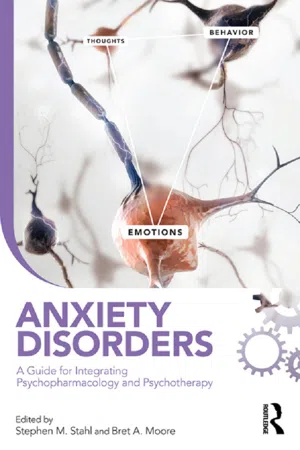
Drs. Stephen M. Stahl and Bret A. Moore have created an instant classic in Anxiety Disorders: A Guide for Integrating Psychopharmacology and Psychotherapy. Anxiety Disorders is a comprehensive reference for the psychiatry and psychology student, intern, or resident, early career psychiatrist or psychologist, and the busy clinician. It distills the most important information regarding combined treatments for anxiety and presents the material in an easily accessible, understandable, and readable format. Each chapter addresses a specific type of disorder: PTSD, panic, generalized anxiety, obsessive-compulsive and other disorders, and is authored by prominent clinicians with years of experience in providing integrated, individualized treatments. With its thorough exploration of psychopharmacological treatments, psychosocial treatments, and, crucially, the integration of the two, Anxiety Disorders is a text no 21st-century clinician or student can afford to be without.
eBook - ePub
Anxiety Disorders
A Guide for Integrating Psychopharmacology and Psychotherapy
- 294 pages
- English
- ePUB (mobile friendly)
- Available on iOS & Android
eBook - ePub
Anxiety Disorders
A Guide for Integrating Psychopharmacology and Psychotherapy
About this book
Information
Part I
The Nature of Anxiety
CHAPTER 1
Benefits and Challenges of Integrated Treatment
The interest in integrating biological interventions with psychosocial therapies in the area of mental health is a rather recent phenomenon. In contrast, the effort to integrate different psychotherapeutic approaches has a longer history which began in the late 1970s, when a proliferation of discrete psychotherapy schools became divisive to a professional consensus on best practices, creating the impression that therapists had to pick sides and choose to become a specialist in a particular school of psychotherapy. There was a tendency for practitioners to adhere clarkto a particular school’s theory of psychopathology, and to study little or nothing of other, “competing” schools. Yet, as the multitude of psychotherapies became increasingly unwieldy, and the factionism of practitioners along party lines engendered intransigence, a subset of clinicians, usually referred to as “eclecticists,” studied the gamut of psychotherapies and found that the different therapies had many common tenets and approaches, although their jargons were often different (Marks, 2010; Marks et al., undated).
To try to make sense of the smorgasbord of techniques and approaches, the International Academy of Eclectic Psychotherapists (IAEP) was formed in 1981 “to bring more practitioners towards rapprochement in an effort to break the ‘only truth’ barrier” (IAEP, 1991). Subsequently, the Society for the Exploration of Psychotherapy Integration (SEPI) was formed in 1983 (Stricker, 2010) “to promote the development and evaluation of approaches to psychotherapy that are not limited by a single orientation.” These two organizations promoted communication across schools, and recognized that many therapies were, in fact, observing the same phenomena and responding to them with similar approaches, though such similarities were hard to appreciate among “adherents” to a particular approach.
Apart from these schools’ theoretical differences, data started to become available in the 1970s (Luborsky, Singer, & Luborsky 1975; Smith & Glass, 1977), and were substantiated throughout the 1980s and 1990s (Asay & Lambert, 1999), on the comparative effectiveness of the different schools of psychotherapy (Wampold et al., 1997). Unsettling data emerged from meta-analyses of controlled studies comparing seemingly different treatments with similar results (Humble, Duncan, & Miller, 1999). This lack of major difference in therapeutic outcome among various psychotherapies lent support to the idea that the various schools of psychotherapy might be more similar than previously suspected, and this in turn gave rise to a search for commonalities among the therapies. A common factors theory (Messer & Wampold, 2002) was postulated which proposed that different approaches to psychotherapy have common components that account for outcome better than components that are unique or specific to each approach (Imel & Wampold, 2008). While several common factors have been identified, including empathy and relationship components, as well as the effect of placebo (Stefano, Fricchione, Slingsby, & Benson, 2001), patient variables are believed to exert the single greatest effect on therapy outcome (Tallman & Bohart, 1999).
The discovery of similar equivalent effectiveness among various medications within the same class of psychotropics has highlighted a parallel lack of specificity among pharmacotherapies, and led to the speculation that there may also be a “central” or common factor operating in the pharmacologic treatment of psychiatric conditions (Moncrieff & Cohen, 2009). Such a factor, or factors, has yet to be adequately identified in the case of pharmacotherapy, but some of the same factors affecting psychotherapeutic outcome, such as empathy (Riess, 2010) and placebo, have been speculated to have an effect on medical procedure outcomes. Moreover, in many cases different psychosocial treatments appear to be as effective as pharmacotherapy for the same condition, and this lack of difference begs the question of whether pharmacotherapy and psychotherapy are not both obtaining results by and large through shared common factors, rather than through specific mechanisms unique to the interventions. The Wampold hypothesis (Wampold, 2001) that the true difference among treatments is zero provides an alternative to the medical model, which assumes that there is a specific underlying neurological mechanism for each psychiatric condition and that drugs are effective because their respective mechanism of actions differentially address specific imbalances inherent to the disorder under treatment (Muse & Moore, 2012). In contrast to the strict biological model, the alternative view suggests that whether norepinephrine or serotonin is targeted, or whether cognitive-behavioral or psychodynamic therapies are implemented in the treatment of depression (Swartz, Frank, & Cheng, 2012), or whether placebo is employed as an active treatment (Baskin, Tierney, Minami, & Wampold, 2003), the interpersonal relationship with a provider and the ensuing patient’s expectation for positive change are what largely drive condition improvement. This is aided somewhat by a nonspecific psychobiosocial change inherent in all treatment approaches, as well as by spontaneous recuperation in which the organism’s innate ability to heal itself, divorced from any therapeutic intervention, tends to return the person to pre-morbid functioning (Posternak et al., 2006).
In general, it might be assumed that no matter which treatment is selected and applied, outcome will generally be positive for a certain number of patients receiving attention for a given condition. While there is ample evidence to suggest that this may be true to an extent, we are far from recommending picking an intervention strategy at random. In fact, the push to discover specificity of treatment outcome is very much alive, and although results have not been singularly encouraging, certain discoveries are worth reviewing for those clinicians who value making evidence-based decisions regarding the selection of treatments.
Muse (2010) reviewed efforts at integrating pharmacotherapy with psychotherapy and offered an impression of evidence-based indications for when one modality might be chosen over the other, or combined for synergic effect. Table 1.1 summarizes these tentative findings.
INTEGRATING PSYCHOBIOSOCIAL TREATMENTS OF ANXIETY DISORDERS
With reference to anxiety, the indications and cautions derived from Table 1.1 can be summarized as follows: (1) Psychosocial approaches are to be favored over pharmacotherapy for the majority of anxiety disorders. (2) When used, pharmacological interventions are mainly adjunctive and supportive of psychotherapy, the exception being with severe obsessive-compulsive disorder (OCD) or posttraumatic stress disorder (PTSD). (3) There are several specific instances where pharmacotherapy of anxiety may be contraindicated, owing to its tendency to cause interference with the therapeutic goal of patient-generated management of response to anxiety symptoms. (4) While cognitive-behavioral approaches to psychosocial treatments are overrepresented in controlled clinical studies, they are, nonetheless, a well-validated treatment modality, especially in the treatment of anxiety disorders. (5) Monotherapy is generally to be preferred to combination therapy because of multiple factors including cost, exposure to side effects, and limited data supporting the superiority of a combined approach over judiciously assigned monotherapy. Table 1.2 summarizes several points in the selection of monotherapy versus combined therapy in integrated psychobiosocial intervention with anxiety disorders.
A basic assumption in the management of anxiety is the need for the patient to tolerate and accept the experience of anxiety, without catastrophizing about improbable dire outcomes, and without using avoidance as an escape strategy. With social anxiety, the patient is encouraged to challenge fantasies of irreparable damage to reputation or career because of anxiety in public speaking engagements, just as the patient experiencing panic is encouraged to challenge assumptions about disastrous physical/medical outcomes from exposure to anxiety. Cognitive-behavioral treatment of anxiety emphasizes controlled exposure to anxiety-producing situations and/or cognitions in such a way that eventually leads to a weakened conditioned response. This can only be achieved through exposure to real situations and to real anxiety, and through the prevention of avoidance responses such as ritualistic compulsions and phobic fugue. The use of drugs which attenuate, mitigate, or eliminate anxiety should occur in a way that furthers the therapeutic goals, rather than derailing psycho-social treatment by encouraging artificial avoidance of anxiety and dependency on an outside agent.
TABLE 1.1
Monotherapy vs. Combined Therapy in Integrated Psychobiosocial Intervention
Monotherapy vs. Combined Therapy in Integrated Psychobiosocial Intervention
Research:
A) Medication’s efficiency is hard to calculate since the greater part of its effect is placebo, which also accounts for the greater part of psychotherapy’s effect, and which appears to be culturally bound and, as such, fluctuates over time as a function of cultural beliefs.
B) Research designs have been inadequate in identifying and separating the effects of medication and psychotherapy on various disorders.
C) Side effects of medication, which are demonstrably greater than with psychotherapy, are not adequately weighed as (negative) outcomes in research that compares this modality to psychotherapy.
Treatment:
A) Medication is important in:
1) Treating positive signs of schizophrenia
2) Treating mania in bipolar disorder
3) Treating depression with psychotic features
4) Treatment of ADHD, especially hyperactive type
B) edication is of comparable importance to psychotherapy in:
1) Treatment of major depression
2) Treating depressive end of bipolar disorder
3) Panic disorder
4) Tourette’s
C) Medication is of secondary importance to psychotherapy in:
1) Treating negative signs of schizophrenia
2) Treating depressions other than major depression (adjustment disorder, depression NOS)
3) Treating obsessive-compulsive disorder
4) Treating eating disorders
D) Medication is generally not indicated in:
1) Treating simple phobias
2) Treating dysthymia
3) Treating chronic insomnia
E) Combining both medication and psychosocial therapy might be indicated for:
1) Schizophrenia, in which neuroleptics are augmented with systemic, family, or milieu therapy for overcoming the poor social integration involved in negative symptoms, and for reducing discontinuation of therapy
2) Bipolar disorder I, in which mood stabilizers are augmented by cognitive-educational approaches, intended to help the patient gain insight into the advantage of medication compliance
3) Major depression, in an effort to increase engagement and activity level
4) ADHD, in which analeptic medication is paired with cognitive-behavioral approaches aimed at time management, impulse control, and executive functions
5) Panic disorder, in which cognitive-behavioral approaches emphasize tolerance of anxiety while SSRI medications raise the threshold for manifest panic
6) Obsessive-compulsive disorder with a strong obsessive component, in which obsessive symptoms may be adjunctively treated with serotonin-specific reuptake inhobitors (SSRIs) or tricyclic medication while compulsive components are simultaneously treated with behavioral approaches
Limitations:
A) Current research is dominated by attempts to match diagnosis with treatment modality, paying little attention to subject variables and life event interplay.
B) Little research has been done to optimize the behavioral administration of medications in an effort to integrate medication into behavioral approaches.
C) Cognitive-behavioral therapy is over-represented in controlled studies, leading to the question of how effective are psychosocial interventions in general when only a limited sampling of such interventions is compared to placebo and medication.
D) The medical model has emphasized symptom reduction, reducing the value of emotional distress as a motivator for therapeutic change.
Conclusions:
A) Medication is overused in the primary care setting, given its limited efficacy, its deleterious effects, and the availability of alternative psychosocial treatments of proven value with significantly less-marked side-effect profiles.
B) Much more research is needed on the differential effects of medication and psychotherapy on various diagnoses, patient populations, and presenting/underlying life issues before specific, empirically based, authoritative statements can be made with any degree of confidence as to which treatment or combination of treatments might be preferentially recommended.
Source: Adapted from Muse (2010); Muse and Moore (2012).
Research on integrated psychobiosocial treatment of anxiety disorders is not as extensive as one might wish. Conclusions, therefore, are quite tentative, and aim at identifying which interventions are effective enough to be considered first-line, and which of these might best be employed alone or in combination with other therapies.
Posttraumatic Stress Disorder (PTSD)
Perhaps with no other of the anxiety disorders has the controversy over common factors versus specificity in treatments been waged more than with PTSD. Meta-analyses of different trauma-focused treatments for PTSD have consistently found no difference among the efficacy of these treatments (Bisson & Andrew, 2009), yet the American Psychiatric Association (2004) and the Institute of Medicine of the National Academies (2008) currently recommend trauma-focused psychological therapies as first-line treatment. Nonetheless, Benish, Imel, & Wampold (2008) have presented a meta-analysis which concluded that “psychotherapies produce equivalent benefits for patients with PTSD” regardless of whether they are trauma-focused. The Benish et al. study has been challenged by some (Ehlers et al., 2010) and defended by others (Wampold et al., 2010).
Williams, Richardson, & Galovski (this book, Chapter 8) provide a good review of anxiety intervention approaches for treating PTSD. They point out that, while pharmacotherapy can be beneficial, it rarely provides complete remission of PTSD. Indeed, a variety of medications have shown adjunctive benefit in reducing PTSD symptoms, but the consensus is that at this time there is no clear drug treatment for PTSD (Maxmen & Ward, 2002). On the other hand, there is an array of psychosocial approaches, most notably cognitive-behavioral approaches, which have proved to be effective in treating PTSD in individual an...
Table of contents
- Front Cover
- Half Title
- Title Page
- Copyright
- Dedication
- Contents
- List of Contributors
- Series Editor’s Foreword
- Foreword by Mark H. Pollack
- Preface
- Acknowledgments
- Part I The Nature Of Anxiety
- Part II Treatment
- Index
Trusted by 375,005 students
Access to over 1.5 million titles for a fair monthly price.
Study more efficiently using our study tools.
Frequently asked questions
Yes, you can cancel anytime from the Subscription tab in your account settings on the Perlego website. Your subscription will stay active until the end of your current billing period. Learn how to cancel your subscription
No, books cannot be downloaded as external files, such as PDFs, for use outside of Perlego. However, you can download books within the Perlego app for offline reading on mobile or tablet. Learn how to download books offline
Perlego offers two plans: Essential and Complete
- Essential is ideal for learners and professionals who enjoy exploring a wide range of subjects. Access the Essential Library with 800,000+ trusted titles and best-sellers across business, personal growth, and the humanities. Includes unlimited reading time and Standard Read Aloud voice.
- Complete: Perfect for advanced learners and researchers needing full, unrestricted access. Unlock 1.5M+ books across hundreds of subjects, including academic and specialized titles. The Complete Plan also includes advanced features like Premium Read Aloud and Research Assistant.
We are an online textbook subscription service, where you can get access to an entire online library for less than the price of a single book per month. With over 1.5 million books across 990+ topics, we’ve got you covered! Learn about our mission
Look out for the read-aloud symbol on your next book to see if you can listen to it. The read-aloud tool reads text aloud for you, highlighting the text as it is being read. You can pause it, speed it up and slow it down. Learn more about Read Aloud
Yes! You can use the Perlego app on both iOS and Android devices to read anytime, anywhere — even offline. Perfect for commutes or when you’re on the go.
Please note we cannot support devices running on iOS 13 and Android 7 or earlier. Learn more about using the app
Please note we cannot support devices running on iOS 13 and Android 7 or earlier. Learn more about using the app
Yes, you can access Anxiety Disorders by Stephen M. Stahl, Bret A. Moore, Stephen M. Stahl,Bret A. Moore in PDF and/or ePUB format, as well as other popular books in Psychology & Nursing. We have over 1.5 million books available in our catalogue for you to explore.