Writing matters: it plays a key role in the circulation of ideas in society and has a direct impact on the development of democracy. But only a few get to do the kind of writing that most influence this development.
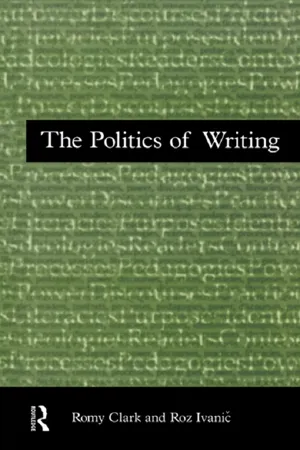
The Politics of Writing examines writing as a social practice. The authors draw on critical linguistics, cultural studies and literacy studies, as they explore and analyse:
* the social context in which writing is embedded
* the processes and practices of writing
* the purposes of writing
* the reader-writer relationship
* issues of writer identity.
They challenge current notions of 'correctness' and argue for a more democratic pedagogy as part of the answer to the inequitable distribution of the right to write.
- 272 pages
- English
- ePUB (mobile friendly)
- Available on iOS & Android
eBook - ePub
The Politics of Writing
About this book
Information
1
INTRODUCTION
A TASTE OF THE CONTENT OF THE BOOK
Some types of writing have more status than others:
That’s me, and this is me playing the ‘I have an elaborated code’ syndrome. Some of it I’m playing a game – playing a game with words really now… sometimes it’s like the working class person trying to speak posh.
It’s one minute with the dinner jacket on and the next minute with the cleaning outfit. I know that that’s what’s happening, but I just think ‘Oh get on with it, Rachel, get on with it‘.
(Rachel, 1991)
Writing is a struggle, even for the most experienced writers:
In spite of what I’ve said about being extraordinarily familiar with my own way of writing plays, I still feel whenever I sit down to write … like I know nothing. I feel like an amnesiac on a diving-board, staring down at the pool, knowing I have to dive but not remembering that I can swim.
(Trevor Griffiths, 1993)
Writing constructs identities for writers:
Now if I’ve got access to new clothes, different clothes, I will make distinctions in which ones I’m going to buy … and it’s the choice between the words that you use, between the clothes that you buy, says something about you, which is ever-changing as well, I think. It won’t be static, it will be ever-changing …
(Rachel, 1989)
Writing is a tool for thinking:
You’ve got that many ideas rushing. You know what you want to say and then changing it into the words to put onto paper … cos speaking is completely different from writing so you … but I found it great.
(Jay, 1983)
Writers can be constrained by the demands and expectations of their readers:
Sometimes I feel they want you to do so much: you’ve got to present it in an academic way, write it with your ideas; you’ve got to argue both sides and see things on two sides, AND they want ethics. Now to try and bring those things together in one is not easy. Especially when a lot of the things which naturally arise are ethical like questions of resources and if you’re talking about an Aids patient should get more or less money there’s a tendency to think, well, it’s an ethical issue, so ethics are in there, but I think what they want is to be clouted over the head.
(John Simpson, 1991)
and writers can resist the pressures on them to write in a certain way:
I think it’s appalling, I really do. I will never submit to that. I think she can ask me to put quotations in, if these are the rules of the academic game … I don’t like them … but my quotations are there for a reason…. the length of the quotation I feel will back up a point and I wouldn’t have carried on writing if I didn’t feel that it was all appropriate and I will never ever give in to someone telling me to shorten them.
(John Simpson, 1991)
The conventions of written language are not all logical:
It’s carrying on: it’s telling about the green. I’ve not changed dramatically. It was carrying on from ‘the green’ … I could’ve swore blind it should’ve been a comma… it’s come as quite a shock!
(Michael, 1983)
Written language is a web of intertextuality:
I don’t even know where my own words are coming from, Roz, any more.
(Rachel, 1989)
WHY READ A BOOK ABOUT THE POLITICS OF WRITING?
Our aim in this book is to provide a synthesis of a range of perspectives on writing. As teachers of writing we have, over the years, come to realise how important it is to have a sophisticated, wide-ranging understanding of the nature of writing as a political, social, mental, physical and linguistic act. Our attempts to understand what is involved in writing took us on an unexpected journey way beyond the confines of any one discipline. In this book we present a genealogy of our understanding of writing, sharing with you the paths we have trod in developing a view of writing that can help us make principled decisions when we teach it.
We imagine you, the readers, to be interested in the politics of writing because you recognise that writing is more than just a mechanical skill. We imagine most of you to be interested in writing as part of a wider interest in how society works. We imagine many of you, like us, to be interested in writing because you teach it in school, in adult education, or in higher education. We hope you will also find that reading this book helps you to reflect on your own experience as a writer, and that this will enable you to bring fresh insights to the next piece of writing you undertake.
Our search for an understanding of what is involved in writing has taken us on a journey through a wide variety of fields of study, the main ones being social theory, cultural studies, media studies, semiotics, discourse analysis, linguistics, applied linguistics, literacy studies and composition studies. In our bibliography you are likely to find references with which you are familiar alongside others that may be new. We are not aiming to make a major contribution in any single one of these fields; rather, we aim to bring them together and make connections among them that will provide a more broadly based understanding of writing than can be offered from within any single discipline. Within the space constraints of the book we have not been able to deal with every field in great depth, but we have tried to provide at least one reference which will allow you to pursue an interest further.
We originally intended to focus mainly on academic writing, and many of our examples in Chapters 3–7 are of students writing for university courses. However, we believe that the way of thinking about writing we are presenting can be extended to all types of writing, and in many places we draw out the connections, similarities and contrasts among types of writing. We intend our comparisons to work in both directions: what we say about academic writing is intended to provide the grounds for thinking about writing of all types, and what we say about other types of writing is intended to shed new light on academic writing. The political issue of which members of a society become transmitters of meanings (which we discuss in Chapter 2) is an important starting point for thinking about any type of writing, and the aspects of writing that we use as headings for Chapters 3–8 apply to writing in general, not only to academic writing.
We devote most of the book to developing an understanding of writing as a social and political act, because this is, in our view, a prerequisite for making any pedagogic recommendations. Recognising the political nature of writing is what motivates us, and many other teachers of writing, to work with people who want to improve and extend their writing capabilities. Recognising the political nature of writing is what has led us to the pedagogic principles that guide our practice as teachers of writing, as we present them in Chapter 9. This is why we have chosen the title The Politics of Writing, and we have organised the book to reflect that priority.
WHO ARE WE TO WRITE ABOUT WRITING?
We have both been teaching writing for over twenty years in a variety of settings. This experience has stimulated a fascination with what is involved in learning to write, and given us experience, between us, of a wide variety of learner writers. Since 1982 we have both been engaged in research on writing and learning to write. In 1986 we founded the Teaching of Writing Research and Development Group at Lancaster University, and have been collaborating on various teaching and research projects to do with writing and learning to write since then. We have ourselves both struggled with writing throughout our lives, and still do. Each new writing task is a new threat and a new challenge, particularly (but not only) when it involves a new genre. Collaboratively writing a book is at this moment a new undertaking for us, facing us with the very difficulties and complexities we are writing about in it. All writing is still for us always also learning to write, as we gradually acquire new genres and new discourses. Our teaching, our research and our critical reflection on our own experiences as writers are central to this book, so here, first, is a sketch of each of our lives as teachers of writing, and an outline of the research projects in which we have been involved.
Teaching writing
Romy: I taught writing as part of my EFL work, mainly with adult learners, in Italy, Singapore, Venezuela and England. My real interest in writing developed in 1986 when I became responsible for the in-sessional provision of academic support for overseas students at Lancaster University. A large part of that work is focused on helping bilingual undergraduates and postgraduates from many different countries with academic writing. Since 1987 I have been providing the same support service for students whose first language is English who need help with writing. Trying to provide support for a wide range of students with differing backgrounds, discipline areas and learning needs has forced me to question the view of writing as a ‘skill’, as some sort of neutral technology that can be neatly packaged up and passed on to learners. I have learned that it is important to see writing as a social practice, embedded in social relations within a specific community, each with its own complex ideological and conventional practices within which individual students have to find identities as writers that they feel confident and comfortable with. So, central to my work has been trying to gain more understanding of the processes and practices of writing that people engage in and why, and to share that understanding with my students: this book is part of that attempt.
Roz: I taught English to children aged 10-17 in rural English secondary schools for five years. I had not intended to become an English teacher: the job I originally applied for was to teach Drama and Latin. However, day-to-day life in a secondary school gradually led me to what was to become my main professional interest: working with learners who found writing difficult. At first I saw this simplistically as a difficulty with spelling. This led me to find out more about ‘dyslexia’ and to start taking holiday jobs on summer schools for children aged 7-14 with specific language difficulties – work I continued to do intermittently for ten years. I learned a lot from the opportunity to talk individually with the children, learning to see ‘writing’ from their point of view. I ran the Language Support Service at what was then called Kingsway-Princeton College in London for eleven years, making special provision for students who needed extra help with literacy, aged 14-68. The variety in this job is an important source of my questioning about writing. It included a writing club for teenagers who had given up on school, evening classes for adults wanting help with writing, initial literacy for students who had left school and wanted a second chance, support for students on courses ranging from general vocational preparation, through ‘O’ Level as it was called in those days, now ‘GCSE’, to Access to Higher Education courses. I worked for a year in the writing lab at San Joaquin Delta College, California, where I met inspiring teachers and learner writers from very different backgrounds and educational cultures from Britain. One of the main questions that emerged from all that work was: Why write? Education itself provided the answer for some, but not for all. Since starting work at Lancaster University in 1986 my work as a writing teacher has been more sporadic: I have worked as a volunteer for the Lancaster College Adult Basic Education service, I have worked with Romy teaching academic writing to MA students in Linguistics, and I have responded to many knocks on my door.
Researching writing
The research we have undertaken individually and collaboratively has illuminated writing from various perspectives. Contrasting different writers and different types of writing has stimulated our thinking about the nature of writing. Both of us have been motivated mainly by a desire to understand writing better in order to teach it better, but some strands in our research have been less pedagogically oriented.
Research on adults’ perceptions of punctuation
Roz worked with ten adults on a Basic Education programme, asking them their reasons for punctuating their writing as they did. The main finding of this project was that these learner writers always had good reasons for putting full stops and commas where they did, even though 23 per cent of these were wrong according to the standard conventions of written English. They were appealing mainly to the commonsense criteria of sound and meaning ‘putting punctuation where you pause’ and ‘putting a full stop at the end of a complete idea’ but these were not adequate guidelines all the time. (For more details see Ivanič 1996.)
Research on reader response to newspaper articles
Romy researched the effect of ideological presuppositions on readers of accounts of the miners’ strike in that year. She found that most readers conform to the writer’s representation of the world, but some resist it. Although this research was focused mainly on reading, it is the springboard of her understanding of the political nature of writing, as presented particularly in Chapters 2 and 7 of this book. (For further details see Clark 1984.)
Research on characteristics of writing across the curriculum
Roz researched the characteristics of words like ‘purpose’, ‘factor’ and ‘effect’, and the way in which such words pervade the discourse of secondary and higher education. On the basis of a small-scale study she found that those who use them successfully in their writing seem to do well in GCSE. (For further details see Ivanič 1983, 1991.)
Research on the nature of the writing process
Together with the Teaching of Writing Group at Lancaster University, we have evolved a list of the components of the writing process which includes affective and socio-political aspects of writing as well as cognitive. We have done this by running an exploratory activity with a variety of groups of participants: groups of learners from various countries, ages and backgrounds, groups of teachers and groups of researchers. We describe this work in Chapter 4, and give further details in Clark and Ivanič 1991.
Research on writer identity
Our work on the writing process led us to be particularly interested in challenging the convention that academic writing is ‘impersonal’, and revealing the ways in which the self is bound up in all types of writing. Romy worked with students of several nationalities on a Diploma in Politics and International Relations, exploring the issues of identity that arose for them in their writing, particularly the construction of authority. Roz worked with mature students on a range of courses in the social sciences and humanities, exploring how they were positioned by particular pieces of writing, and their reasons for identifying with or distancing themselves from these positionings. We draw on this work particularly in Chapter 6. (For further details see also Clark and others 1990b; Ivanič and Roach 1990; Ivanič and Simpson 1992; Ivanič 1993, 1994a, forthcoming, Ivanič and others 1996.)
Research on Critical Language Awareness in relation to writing development
Critical Language Awareness (CLA) means explicit discussion of issues of power and ideology underlying language use. It is a term coined by a group of us at Lancaster University (Clark and others 1990a and 1991; Fairclough 1992b) at the time when there was considerable interest in increasing the amount of explicit ‘Knowledge About Language’ in the curriculum in British schools. We were particularly interested in ways in which CLA-raising could help students with their academic writing. This issue p...
Table of contents
- Cover
- Title
- Copyright
- Contents
- List of Figures
- Acknowledgements
- 1. Introduction
- 2. Writing, Politics and Power
- 3. Writing and Social Context
- 4. Writing Processes and Practices
- 5. Why Write?: Purposes for Writing
- 6. Writer Identity
- 7. The Role of the Reader in Writing
- 8. Issues of Correctness and Standardisation in Writing
- 9. Social and Educational Implications of Our View of Writing
- Notes
- Bibliography
- Index
Trusted by 375,005 students
Access to over 1.5 million titles for a fair monthly price.
Study more efficiently using our study tools.
Frequently asked questions
Yes, you can cancel anytime from the Subscription tab in your account settings on the Perlego website. Your subscription will stay active until the end of your current billing period. Learn how to cancel your subscription
No, books cannot be downloaded as external files, such as PDFs, for use outside of Perlego. However, you can download books within the Perlego app for offline reading on mobile or tablet. Learn how to download books offline
Perlego offers two plans: Essential and Complete
- Essential is ideal for learners and professionals who enjoy exploring a wide range of subjects. Access the Essential Library with 800,000+ trusted titles and best-sellers across business, personal growth, and the humanities. Includes unlimited reading time and Standard Read Aloud voice.
- Complete: Perfect for advanced learners and researchers needing full, unrestricted access. Unlock 1.5M+ books across hundreds of subjects, including academic and specialized titles. The Complete Plan also includes advanced features like Premium Read Aloud and Research Assistant.
We are an online textbook subscription service, where you can get access to an entire online library for less than the price of a single book per month. With over 1.5 million books across 990+ topics, we’ve got you covered! Learn about our mission
Look out for the read-aloud symbol on your next book to see if you can listen to it. The read-aloud tool reads text aloud for you, highlighting the text as it is being read. You can pause it, speed it up and slow it down. Learn more about Read Aloud
Yes! You can use the Perlego app on both iOS and Android devices to read anytime, anywhere — even offline. Perfect for commutes or when you’re on the go.
Please note we cannot support devices running on iOS 13 and Android 7 or earlier. Learn more about using the app
Please note we cannot support devices running on iOS 13 and Android 7 or earlier. Learn more about using the app
Yes, you can access The Politics of Writing by Romy Clark,Roz Ivanic in PDF and/or ePUB format, as well as other popular books in Filología & Lingüística. We have over 1.5 million books available in our catalogue for you to explore.