![]()
Chapter 1
A Loft, in the Early Days
The exact date is not there, but in June 1952, I typed a note on a sheet of graph paper, now in a loose-leaf journal, about T. S. Eliot's “objective correlative,” which with “its own correlatives in all branches of art” I referred back to Longinus in classical times, to Coleridge's discretionary union of Reason and Imagination, and then to Hemingway's “sequence of motion and fact,” and Stanislavski's “emotional memory.” At the time, I probably knew less about that memory, and the emotion defined by a character's “superobjective,” than about Eliot's view of Hamlet as an “artistic failure,” because of irresolution, excessive feelings, and a mockery of disgust, which in its tortuous self-indulgence can't be objectified. But why was that note on graph paper? I'm not sure, but it was probably left over from the days, not long before, when I was finishing a degree at NYU in chemical engineering, though I was writing a dissertation then, on Eliot and William Butler Yeats, doing that for Stanford, while teaching in the Language Arts Department at San Francisco State (College then, University now). Below what I had typed, I scribbled the following in pencil, this dated June 20, still legible now, but fading:
Arranged today for a lease on the studio for The Actor's Workshop. Queer to have associated myself with an acting enterprise, but despite myself I'm beginning to be aware of the potentiality for the success of our group. We have developed so far with intelligence and caution. At no times have our ambitions, at least in practice, exceeded our possibilities.
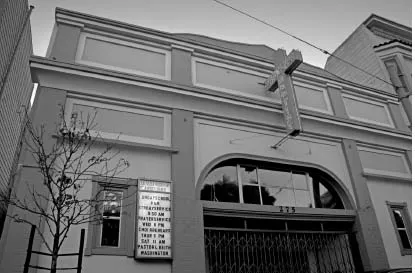
The possibilities were not much, or vague indeed, when some months before, on a cold wintry night, Wednesday, January 16, about ten of us gathered around a stove in a grimy loft above a judo academy, to discuss the formation of a “study group” for actors. At 275A Divisidero Street, now the Ebenezer Baptist Church, we were not far from Haight when the Haight was still straight, and at the border of the Fillmore District, a black ghetto then, where, with the Grateful Dead and Jefferson Airplane, light shows, strobes, and psychedelics, the countercultural Sixties later took off.
Figure 1.1 Ebenezer Baptist Church: where the loft was, now the vestry, and no A after 275
As for that gathering up there in the loft (with rat shit below the stairs, which I'd clean whenever we met), there were no Beats or proto-hippies, and several were academics, but it was nevertheless a tentative preface to what became, through its bogus reputation as the “Paris of the West,” the San Francisco Renaissance, or the place where the action is. Even then—with The Actor's Workshop nationally recognized, but always struggling to survive—there wasn't much action of consequence on the established professional stages, the Geary and the Curran, which were in the continental tilt still part of the circuit of “Tributary Theater.” That was the term used in the old yellow-covered Theater Arts magazine, but not as I saw the territory, in its pathetic double sense: the musicals, mindless comedies, and with a star to attract the playgoers, an edifying serious drama, flowing in commercial rivulets or tributaries to the provinces, which were as ever paying tribute to Broadway. There was already in the Fifties talk of “decentralization,” but if not illusion, a lingering stalemate, except for the network of “little theaters,” which around the Bay Area went from the Hillbarn in San Mateo to the Interplayers near Fisherman's Wharf to the Company of the Golden Hind in Berkeley. These were among the best, with unexpected plays and sometimes inventive stagings, but undeniably amateur standards because of amateur actors. Of those in our nascent studio, some had professional experience, a couple had been on Broadway, others in theaters elsewhere, perhaps in summer stock, or as walkons or understudies, in the road shows saving money by using local actors. A few had also performed in the little theaters, and might have lived with that, but most, restive or disenchanted, wanted something more.
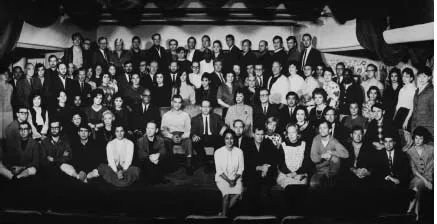
So it was with Jules Irving, who had convened that session with me. With his own experience on Broadway, beginning as a child actor, and what looked like a takeoff career, he found it was going nowhere, put false promise behind and, while also completing a degree at Stanford, was teaching acting and directing at San Francisco State. Actually, at that first meeting, I was the only one with no acting experience, or for that matter, much experience in theater at all, having come to it belatedly, in the transition from engineering, still catching up. While trying to learn quickly everything I could, reading plays, seeing plays, studying theater history, yet teaching and writing with other inclinations, there was also recurrent doubt about my being in the theater—all the more because of its backwardness, compared to the other arts. Which is not something, however, I would have talked about that night. As the discussion proceeded, the notion of a study group elided into the lower-case, singular “actor's workshop,” where scenes to be rehearsed would be chosen for the particular actor, and after presentations there'd be collective critiques. If anything was said of method it was trickle-down Stanislavski, and with the vagaries of “interior life,” mainly psychological. There was no talk at the outset of a producing theater—always there, surely, as a more than subliminal subtext—but when The Actor's Workshop emerged as capitalized (incorporated later, still scrounging for funds), the singular remained, and did through all the years in San Francisco, despite various pressures to change the name entirely, as the company expanded from that group in the loft to nearly 150 (including designers and technicians), playing in two, sometimes three theaters simultaneously.
Figure 1.2 Down at the Encore Theater (1960), less than two-thirds of the company; the directors sitting center (Jules Irving to the left)
If there was anything expansive in our humble beginning, it was that the focus on rehearsing scenes, disciplined without spectators, shifted to doing a “showcase play,” with critique afterward, but an audience response before. Over time I came to distrust “the audience,” and wrote a book about it, and its susceptibility to the most exhausted illusions; but still psyching out the quality of my own, I was in accord with Jules on the showcase. We set, however, rather strict limits to that. There would be only a single performance, with a carefully invited audience, and no reviewers allowed (though one showed up, who agreed not to review it). Meanwhile, we enunciated a policy—or what became a refrain—of “slow growth,” though by what measure of merit we were not entirely sure. The major criterion for selecting the play had no principle or aesthetic behind it, except that there'd be substantial roles for each of the actors. About one thing there was no afterthought or discussion: since the workshop idea was proposed by Jules and myself, it was assumed we were the directors, though my own function would be more like a dramaturg. That wasn't a familiar practice then (or even now), in the American theater, with its strictures or suspicion about anything too intellectual, from which reflexive wariness our studious group was not exempt. In any case, there it was, a literary/critical consciousness and a questioning disposition, which showed up from the start in my writing of program notes.
Feeling their way at first, the notes became a frequent source of controversy, even hostility, which was the evolutionary fate of The Actor's Workshop, with newspaper critics, among the audience, and in the company itself—especially those, the presumably knowing ones, far more experienced in theater than I was, one or another resisting every experiment or innovation that eventually brought us distinction. Of course, once our work was widely recognized, but especially in New York, authenticating it locally, they always knew it would happen. As for my own state of becoming, I came to believe that the less I knew about theater as it was, the more generative the task of finding out what it might be. And that often came, as suggested in previous writings, from what was happening in the other arts.
Still legendary in San Francisco, The Workshop did over a hundred productions, as well as children's theater, studio performances, incipient Happenings and Action Events, which developed from collaborations with diverse artists and musicians around the Bay Area. What we did had a lasting influence on a generation of actors and directors who were with the company, and two now-venerable experimental groups, the Mabou Mines and San Francisco Mime Troupe, also originated there. As it persisted through multiple tribulations, conceptual, internal, financial, The Actor's Workshop was acknowledged as one of the major “regional” theaters, along with the Alley in Houston, the Arena in Washington, and the Guthrie in Minneapolis. Now called “resident professional,” there are hundreds of such theaters now, but to this day none that even approaches the one in San Francisco, not only because of the unexpected coherence of its ever-expanding company, but because of the audacious strangeness, no less the surrounding controversy, of certain plays it produced. This included some of the earliest stagings—before most were heard of in this country—of Brecht, Beckett, Pinter, Genet, Arden, Whiting, Frisch, Dürrenmatt, as well as neglected American playwrights, such as George Hitchcock and James Schevill, and (her first play ever produced) Maria Irene Fornes. Overall, for that spectrum of productions—the avant-garde augmented by unusual stagings of the classical—I wrote about eighty-five program notes; only about half of them will be included here, but that should be sufficient to suggest historically and aesthetically the unsettling substance and complexity of it all.
As one looks back upon them now, the notes are a virtual archive of what, at first by dubious increments, made our theater exceptional, with an increasingly conscious sense of where we were going, and why, and with reflections on the plays, their conceptual bearing upon the stubborn endurance of a theater during the period of the Cold War and its “Balance of Terror.” In that regard, the notes are a cultural history—on the immediate scene, an embattled culture, as the plays moved toward an extremity. If canonical now, they were elusive and baffling then, and could be a scandal for some in the audience, insulting, or simply outrageous. And so it was, too, for the untutored reviewers, who if puzzled or distressed, covered up embarrassment with condescending scorn. As time went on, they were confronted, too, with stagings they hadn't imagined, in radically detailed abstractions, as visual artists designed for us, which also gradually changed the look of our program covers. And because they are orchestrated here with the notes, I should say something about that, and how the programs were made to begin with.
Most readers will remember, before photocopying, the mimeograph machine, but few will recall before that the gelatin pads on which typewritten manuscripts were reproduced. You placed the texted page down on the gelatin, pressed down slidingly with your fingers, lifted the page away and, as if on Freud's mystic writing pad, left an imprint there. Then you put a clean sheet down upon it, carefully over the imprint, sliding your fingers again, and there it was, when the page was lifted, a purplish reproduction. Which is how our first programs were done. Later, however, with the artists designing covers, and other processing, they acquired color, imagery and, sometimes in abstracted lettering, emblematic character.
As for the character acquired by The Workshop through the thirteen years in San Francisco, before Jules and I, and some of the company, went off to Lincoln Center (another story, elsewhere told), that will be more than implicit in the program notes that constitute the major part of the text here, with prefatory notes upon the notes, and some reflections after. I'll explain, so far as I can, why they were written as they were, and indeed there's an accretion of history in how, for certain productions, stylistically, by indirection, they went about preparing the audience, no less the skeptical critics, for a suspension of disbelief—about which, often, they were not likely to be willing.
That was not the case with the first play actually presented at the Divisidero Street loft, though Philip Barry's Hotel Universe, produced on Broadway, was even there—an upscale comedy, with a Freudian mystique—not the usual fare. With Jules directing, we had auditioned another play, Somerset Maugham's The Constant Wife, but after several readings and rehearsals, we decided it wasn't quite right for the temperament of the group, though what had the highest priority was that we could cast much better the Philip Barry play. About the temperament of the program note, which follows, for better or worse that was pretty much mine. In the later gatherings of program covers, we'll skip this one (as for the other earliest plays), which is simply a blank white page, around this announcement, in the purplish gelatin type:
The Actor's Workshop
presents
HOTEL UNIVERSE
by
Philip Barry
And then when you turn the page, the note, without a title:
Wit and gentility are the attributes of Philip Barry's drama which have impressed the theater public. These same attributes, which account for his reputation as one of the finest modern practitioners of the comedy of manners, were, at his recent death, his original sin. For Barry did not intend to flourish in history as a comedist; he had more serious aspirations. And Hotel Universe, his most profound but worst-received play, is hardly a comedy of manners. It is the summary expression of his morality.
For Barry's bewildered and badgered characters are representatives of the Lost Generation made famous by F. Scott Fitzgerald and Ernest Hemingway. It was Barry's own generation. Its delineation, however, has been confined mainly to the novel, whose powers of description and analysis were more adequate to the dissection of the psychotic soul of the Twenties.
The innocence of essential understanding of this period was a product of disillusionment, reeling standards, and the incertitude of life in an atomized universe. The drama, with its peculiar objectivity and concision, found it hard to grapple with this problem. The expressionism of the European theater invaded the soul but became stranded there. In America, only Eugene O'Neill, in his morbid adventure into psychology, Strange Interlude, dared explore these same regions.
Hotel Universe, produced in 1930, did not, as did Strange Interlude, resort to the soliloquy to develop its theme, but instead experimented with the classical unities of place, time, and action. As orginally staged, the play was continuous, set in a splendid villa out on the very edge of the world, where space and time commingle and are lost in each other. So, too, the play's characters are lost. If they do not speak in soli...