Jurgen Herbst traces the debates, discussions, pronouncements and reports through which Americans have sought to clarify their conceptions of the goals and purposes of education beyond the common school.
The Once and Future School argues that to make sense of the current trials of secondary educational system and to maintain any sense of direction and vision for its future, we need a clear understanding of its path in the past and of its setting in a multi-national world. From their beginnings in colonial America to the present day, Jurgen Herbst traces the debates, discussions, pronouncements and reports through which Americans have sought to hammer out and clarify their conceptions of the goals and purposes of education beyond the common school.
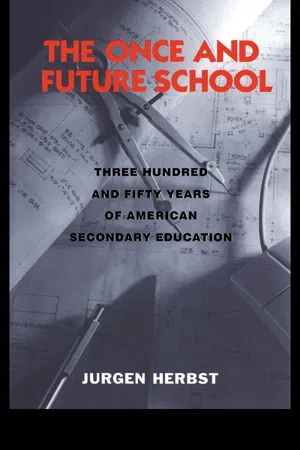
eBook - ePub
The Once and Future School
Three Hundred and Fifty Years of American Secondary Education
- 280 pages
- English
- ePUB (mobile friendly)
- Available on iOS & Android
eBook - ePub
The Once and Future School
Three Hundred and Fifty Years of American Secondary Education
About this book
Information
1
The Origins of Secondary Education
Medieval Cathedral Schools and Arts Faculties
Our traditions of secondary education have their origin in the artes liberales of the Middle Ages. These were the seven liberal arts of the trivium (grammar, logic or dialectic, and rhetoric) and of the quadrivium (arithmetic, geometry, astronomy, and music). Their study involved practice in the arts of communication: Latin, the common language of educated people in Europe, and mathematics, the universal language of numbers. The young students began their schooling with grammar, the lowliest of the seven arts, added the other two “trivial” branches, and finished their arts course with the quadrivium. Wherever schoolmasters and scholars were ambitious, they added a smattering of mental, natural, and moral philosophy.1
In Europe students pursued their Latin education in continental grammar schools, gymnasia, lycées, collèges, and university arts faculties and in English grammar schools and university colleges. In North America they did so in grammar schools, academies, and liberal arts colleges. Only toward the middle of the nineteenth century did we begin to recognize a curricular distinction between secondary and tertiary education. That is why in the early parts of this book I discuss Latin schools and colleges together. In Europe these institutions prepared their students for professional studies in the higher faculties of civil and canon law, medicine, or theology. In North America they sent students to professional school, apprenticeship, or practice.
Though Europe’s universities opened first as professional schools—in Bologna, for example, lawyers were the first instructors; in Salerno, med ical doctors congregated to learn from one another; and Paris gained fame as a theological faculty—the confusion of vernacular languages and the scarcity of cathedral and other Latin schools forced the universities to begin their own teaching of the liberal arts.2 In this way the arts faculties came to supplement cathedral and Latin schools, and all of them taught the liberal arts.
The instruction youngsters and young men received served political and social purposes. The Church and governments sponsored and encouraged advanced education for reasons of state. They needed loyal and wellqualified diplomats and counselors, cardinals, administrators, priests, lawyers, physicians, and teachers to keep the ship of state safely afloat. To ensure a constant supply of such professionals, the Church and governments supported the institutions that produced them. Families sought education for their children beyond the elementary level to raise the esteem in which they were held by their neighbors and to improve their children’s economic well-being. When a family heir achieved position and influence in the church, civil service or one of the professions, status and prestige were sure to accrue, even if his income remained meager by the standards of mercantile or industrial success.
Medieval Europe’s Latin schools and universities thus served as indispensable pillars of empire and church. Because of the vital role the university studia played in ensuring the preservation of civil and ecclesiastical institutions, emperors and popes recognized them as privileged corporations. They authorized them to govern and organize themselves in their faculties.3 As a result the medieval studia emerged as public powers equal to those of imperium and ecclesia. 4 In subsequent centuries their fortunes and influence would rise and decline, but they would never relinquish their claim to privilege and power. They would serve the modern princes of throne and altar as they had served the sovereigns of medieval empire and universal church.
The traditions of Western academic learning have always been considered a labor of the mind, not of the hand. The example that suggests itself is the medieval surgeon. Because he worked with his hands, contemporaries classified him with the tooth-pulling barber and the wound-dressing orderly. The book-learned physicians who dispensed their wisdom in oral and written instructions saw to it that the surgeon was not to be ranked as their equal.5 From their beginnings in the medieval universities, the learned professions—the law, divinity, and medicine—all relied on the word as their one essential tool. Their novices received it first as students of the artes liberales and subsequently in the lectures and books of the learned doctores in the higher faculties. Education was book learning and mental labor.
Mental labor was held to be appropriate for men of leisure. It was not, in the main, considered suitable for women, serfs, or slaves. Though leisure and privilege were not required attributes of students who entered the medieval universities, they gradually became so until by the eighteenth century the sons of aristocrats dominated the student bodies of Europe’s universities. On the Continent, advanced education included the Latin school as a preparatory step, the arts faculty as an apprenticeship, and one of the professional faculties as the final period. Because each of these stages involved a process of selection and elimination, it could truly be said that in advanced education few were called, and fewer yet were chosen to stay the entire course.
Schooling thus was an ordeal, if not by fire or water, then by words and their proper use. It brought the young man from his parochial home into the orbit of universal empire and nation state. Whether in the days of empire it was Latin as the universal language of educated men or, by the nineteenth century, a national language, it was always a language different from the vernacular he had spoken during his youth. This language became the scholar’s mark of distinction. Language was his sign of achievement and it demanded respect. Ermine coat and golden tassel might indeed identify the scholar to the beholder’s eye. But clothed in whatever garment and greeted with whatever honors, the scholar found it was his language that truly marked him as one of the elite.
After the Reformation
The Reformation shifted the fountain of academic power and influence away from universal church and empire to the secular sovereigns of territorial states and confessional churches. These continued to provide preparatory and professional education for the future civil and ecclesiastical servants of their respective realms. As before, academic training bestowed privilege and status, and brought the graduates wealth and influence. This naturally bound the latter to their benefactors who were also the founders and protectors of the universities. It also gave university graduates powerful incentives to preserve their own privileged status and to bequeath it to their sons and successors. Considerations of political influence and social status continued to weigh heavily when university affairs were discussed.6
As the influence of the Roman Catholic Church declined and the territorial-confessional churches gained power and became the instruments of their secular sovereigns, the emphasis on political concerns in university affairs became more pronounced. With growing secularization, the social and economic background of the students also grew more varied. 7 To be sure, defenders of the medieval universities could and did proudly observe that their institutions had been open to new talent and that ecclesiastical princes had used them deliberately to bring fresh blood into the church.8 Celibacy, after all, barred priests, bishops, and cardinals from supplying sons of their own. Yet by the sixteenth century a more worldly tone in the universities and a curriculum stressing civility as much as piety were undeniable. The gentrification of the universities had begun.
Because gentry and nobility valued the universities as proper training grounds for their sons and other young relatives, they came to regard the universities as means of insuring the survival of their families and houses. They welcomed the new emphasis on civility and gentlemanly virtue. They appreciated the worldly learning of the humanists, which, as literae humaniores, focused on grammar and rhetoric rather than on the logic of the scholastics before them. Mark Curtis put it well when he wrote of Oxford and Cambridge in the late sixteenth century: “The apostles of humanism were convincing the English gentry and nobility that the learning they preached not only instilled virtue and wisdom, but nourished the capacities and talents needed to manage affairs of state…. Learning fostered civility.”9 Sir Thomas Elyot’s book, The Governor, became the model for the well-educated gentleman serving his king. Even future clergymen, educated in the colleges of Oxford and Cambridge, shared the new directions. “The parson in 1600,” wrote Hugh Kearney, “was a gentleman among gentlemen.”10
At the same time, the infusion of new vitality from below into the leading ranks of church and state slowed. The English colleges in particular were less concerned with training uneducated country youths from poor families in basic skills or with preparing them for professional careers. They concentrated on conveying good breeding, social graces, and the worldly skills of gentlemen and courtiers. Their students were the sons of the landed gentry, of merchants and professionals, and less so of artisans and yeomen. Everywhere in northern and western Europe the share of poor students began to decline.11
Secularization and gentrification accompanied other changes in the universities’ curricula. The cumulative impact of the age of discoveries, of European expansion overseas, of the scientific revolution of the seventeenth century, and, eventually, of the industrial revolution, nationalism, and the spread of capitalism threatened the conventions of bookish learning and the reliance on the classical tradition of the word. For the settlement of disputed questions scholars relied less and less on the analysis of written texts and on disputations among learned men. Instead they col lected artifacts and observed natural phenomena. They turned to the penetration of geographical and astronomical space, the experimentation with physical and biological objects, and the use of the products of these activities in commerce and manufacture. These activities together with the large-scale competitive struggle among the peoples of Europe for dominance, abetted and propelled by the energies of entrepreneurial capitalism, came to redraw the world of scholarship as they had reshaped the map and landscapes of the world. Johann Wolfgang Goethe put it succinctly when he had Faust change the biblical “in the beginning was the word” to the “in the beginning was the deed.”
The institutional changes in education were unmistakable. Where once libraries had been the center and the only essential component of cathedral schools, monasteries, colleges, and universities, now botanical gardens; arboretums; physical, chemical, and geological cabinets and museums; and engineering laboratories and agricultural experiment stations appeared and altered the academic landscape. New types of schools were created to respond to the needs of sovereigns and industrialists. Colleges of mining and of engineering: higher schools of science and technology; and schools of medicine, dentistry, veterinary science, architecture and landscape gardening, economics and finance, and others were founded. They commenced their task of training specialists for the new world of industrial and commercial enterprise.
The Coming of Schooling
These changes ushered in an era in which the teaching of the liberal arts, particularly of grammar, its lowest branch, came to be more and more removed from the pursuit of investigations, research, discovery, invention, and professional training. As Philippe Ariés has pointed out for France, collegiate education turned into a program of schooling that aimed at instilling discipline and forming character. By the sixteenth century Parisian collèges no longer served as homes for students and masters but as day schools in which young grammarians learned their first lessons in Latin, logic, and rhetoric. These collèges, wrote Ariés, had by now taken on “the character of a modern educational establishment.” Gone were the freewheeling days of instruction in the halls of the rue du fouarre, where students listened to lectures in the arts and philosophy under the guidance of masters who were themselves students in one of the higher faculties. Now, “the master giving instruction in the arts stopped being a scholar or thinker, a dialectician or logician famed for the originality of his thought, and became a pedagogue, a pedant, a mere laborer treated with scant respect.” Schoolboys under discipline were his students. The modern secondary school had arrived.12
In the French collèges instructors taught grammar as well as the arts and philosophy and left only professional studies to the university faculties, but in the German-speaking countries only grammar moved into urban Latin schools while the arts, philosophy, and the sacred languages either remained in the arts faculties of the universities or were taught in the Continental gymnasia illustria. These municipal institutions functioned as nonuniversity arts faculties. Though they were not authorized to award academic degrees, they could educate future civil and church officials relatively inexpensively, and they provided prestigious employment for local doctors, ministers, lawyers, and teachers.13 Everywhere, however, grammar was the prime subject in the rapidly developing urban Latin schools, the gymnasia and the pedagogica. Teachers used grammatical drill to instill discipline and to form habits of thought and attitudes in young pupils. In like manner, they relied on catechetical instruction to safeguard a proper moral education in the creed of the established confession.14
In many Calvinist cities and states the gymnasia illustria separated preparatory from university studies. Johann Sturm’s gymnasium in Strassburg consisted of a lower school for Latin instruction and an upper division for the arts, philosophy, and theology. Calvin’s Academy in Geneva was similarly divided into a schola privata for grammatical instruction and a schola publica, which offered Greek, Hebrew, philosophy, and theology. Many Dutch, German, and Scottish universities followed similar combinations.15
In England, just as in France, older fellows in the university colleges had originally taught students their Latin grammar. But after the separate establishment in 1382 of Winchester College as a Latin school, grammatical instruction moved from the university colleges into collegiate and noncollegiate Latin grammar schools. At St. Paul’s and Merchant Taylor’s in London, the government of such schools had been placed in the hands of trade guilds. Elsewhere, as in Harrow-on-the-Hill or at Charterhouse, private groups especially incorporated for the purpose directed these schools.16 The curriculum corresponded to that of the schola privata in Geneva and to the gymnasia and pedagogica in Lutheran countries. As on the Continent, the collegiate and noncollegiate Latin grammar schools came to serve as preparatory institutions for the universities, which, in their arts faculties, continued to teach the arts and philosophy.
By the eighteenth century the separation of “schooling” from university studies was well advanced. Professional studies and the scholarly and scientific pursuits associated with them were carried out in the higher faculties and schools of the universities or they became the province of soci eties and academies specially created for this purpose.17 By contrast, the Latin-based education in the English grammar schools, German gymnasia, and French collèges, in some of the Continental arts faculties, and in the English university colleges took on a more pronounced schoolmasterly, disciplinary tone. As Ariés put it, pedagogy had triumphed.18
The Modern School
The arrival of secondary schooling as distinguished from tertiary y collegiate or university studies marked the beginning of modernity in education. Before the coming of the common school in the eighteenth century, schooling meant Latin instruction. By the mere fact of having embarked upon his studies, the Latin student had lifted himself above his fellow human beings into a realm of cultural elevation that did not require our modern distinction between secondary and tertiary education. This had been true in the European Middle Ages and also in the backwoods country of the American frontier. The differences between the curricula of European university arts facultie...
Table of contents
- Cover Page
- Title Page
- Copyright Page
- List of Tables
- Acknowledgments
- Preface
- 1. The Origins of Secondary Education
- 2. Grammar Schools, Colleges, and Academies In Early America
- 3. The Nineteenth-Century Liberal Arts College
- 4. The People’s College
- 5. State Systems of Secondary Education
- 6. Midwestern Democracy
- 7. Between Town and Gown: The High School In Wisconsin
- 8. Growing Pains
- 9. The Committee of Ten
- 10. From Manual to Vocational Education
- 11. The Legacy of Vocational Education
- 12. Toward the Comprehensive High School
- 13. The High School Under Siege
- 14. The High School In Search of Itself
- 15. End of an Era
- 16. From the Twentieth to the Twenty-First Century
- Notes
Trusted by 375,005 students
Access to over 1.5 million titles for a fair monthly price.
Study more efficiently using our study tools.
Frequently asked questions
Yes, you can cancel anytime from the Subscription tab in your account settings on the Perlego website. Your subscription will stay active until the end of your current billing period. Learn how to cancel your subscription
No, books cannot be downloaded as external files, such as PDFs, for use outside of Perlego. However, you can download books within the Perlego app for offline reading on mobile or tablet. Learn how to download books offline
Perlego offers two plans: Essential and Complete
- Essential is ideal for learners and professionals who enjoy exploring a wide range of subjects. Access the Essential Library with 800,000+ trusted titles and best-sellers across business, personal growth, and the humanities. Includes unlimited reading time and Standard Read Aloud voice.
- Complete: Perfect for advanced learners and researchers needing full, unrestricted access. Unlock 1.5M+ books across hundreds of subjects, including academic and specialized titles. The Complete Plan also includes advanced features like Premium Read Aloud and Research Assistant.
We are an online textbook subscription service, where you can get access to an entire online library for less than the price of a single book per month. With over 1.5 million books across 990+ topics, we’ve got you covered! Learn about our mission
Look out for the read-aloud symbol on your next book to see if you can listen to it. The read-aloud tool reads text aloud for you, highlighting the text as it is being read. You can pause it, speed it up and slow it down. Learn more about Read Aloud
Yes! You can use the Perlego app on both iOS and Android devices to read anytime, anywhere — even offline. Perfect for commutes or when you’re on the go.
Please note we cannot support devices running on iOS 13 and Android 7 or earlier. Learn more about using the app
Please note we cannot support devices running on iOS 13 and Android 7 or earlier. Learn more about using the app
Yes, you can access The Once and Future School by Jurgen Herbst in PDF and/or ePUB format, as well as other popular books in Education & Education General. We have over 1.5 million books available in our catalogue for you to explore.